
RoSals

It is the last of the family owned restaurants on Taylor, the street that runs through the center of the neighborhood where immigrants congregated in such numbers in the early decades of the 20th Century that it earned its designation as Little Italy. Salvatore would go to the Fulton Street markets most every morning to select his meat and produce for the day. Roseanne would stay behind in the kitchen, making fresh pasta and starting sauces from the recipes that her mother and grandmother perfected. The laughter and toasts of the diners feasting at the nine tables on the first floor bounce off the marred wood floor, pounded tin ceiling, and white-washed walls cluttered with dozens of family photos. Its name is their names: Roseanne and Salvatore… RoSal’s.

Our first time there was a test. I had a client coming in from the East Coast and when I asked about dinner, she was delighted. “How ‘bout Italian – authentic Italian,” she emphasized, with a New Jersey delivery that elongates vowels and drops “r’s.” She grew up in a household where Mom made pasta and Dad made sauce so she was picky, she said. No pressure.

My husband Larry and I had our favorites but I spent a couple days asking others about theirs. Rosebud, Tuscany, Carmine’s, Gene and Georgetti’s – all came up, but they have “touristy” stamped all over them, not authentic. An acquaintance described RoSal’s using adjectives that reeked of authentic: nothing fancy or forced, old-country friendly, grandma’s recipes, last of its kind, treat you like family. It sounded worthy of a test.

Linda, the short, round, smiling hostess/manager/server for the night, greeted us warmly and I explained about my client coming in without saying my husband and I were there to rate the food and experience. Eight of the nine tables in the main floor dining room were full and we took the last one, right next to the open kitchen, noting the two by the window overlooking Taylor Street would be a better spot. We ordered house specialties and were struck by Linda’s invitation to change ingredients at will. “If you want spinach in that rather than broccoli, no problem. Change the pasta if you’d like, or the sauce. You can throw shrimp in that vegetarian dish. Whatever you’d like, the kitchen is glad to substitute.”

Dinner was superb, delicious, reminiscent of dinners we had in small towns in central Italy. Not only were we treated like family but we seemed to be their absolutely favorite relatives.

Three days later I returned with my client in tow. She looked around approvingly at the family-owned-restaurant décor and at Linda, who smiled her way to the front of the room. “You must be Melissa,” Linda beamed at my client after giving me a long-lost-friend hug. “Welcome to RoSal’s. Dorothy’s told me so much about you! I’m so glad to meet you.” and she turned to put us at her best table, in the corner by the window.

We could have been served hot dogs and I’m convinced Melissa would have loved the place. But instead the $6 a glass house chianti, fried ravioli, antipasto salad, chicken RoSal’s and Italian ice served in a frozen lemon exceeded her expectations. Pleasantly full. Feeling warm and cozy. The evening ended with a hug from a client who is apt to be business as usual.

RoSal’s never disappoints, even when Linda isn’t there for Joe, who now runs the place since Roseanne and Sal unofficially retired, takes over and gets to know his regulars in the same, embracing way. He’ll pull a chair up to your table and talk about anything – his kids, yours, vacations, what’s new, how’s business, how the White Sox are doing for they play not far from RoSals and fans congregate there before or after games. He forgives Larry for being a Cubs fan and they both envision the day when their teams are on opposite sides of the World Series and cream the other side of town. A born-and-bred Sox fan with the glory of having a World Series win a few years back, and a husband who I love desperate to see his guys “win one before I croak,” as he’s fond of saying, I dread the specter of a north side vs. south side series and find myself silently relieved when my Sox go into a slump.

I used to order shells with broccoli every time we were there, adding shrimp usually, or chicken when I was up for a change. But chicken Florentine beckoned when it was served at the table next to us and it threatened to become my regular except that the specials on the last page of the menu continually tempt explorations and never disappoint. Larry always orders meat lasagna even when he vows he is going to try something new. He doesn’t even ask for a bite of mine, and Linda reassures him that ordering the one thing you love  most is smart, because it’s not like you come every night or even once a week or month.

Larry had a yen for that lasagna while recovering from surgery at nearby Rush Medical Center so I called and asked if they did carry-outs. Nuts, I said when the person on the other end of the line said sorry, no. He so loves your lasagna.

“Dorothy, is that you?” It was Linda who put Larry and lasagna together.

“Yeah. Larry’s over here at Rush and I thought I’d get him a big treat.”

“Be here in a half hour and we’ll have it ready for you,” she said without missing a beat.

The package I took back to the hospital had lasagna to last four meals, a loaf of their crisp-crust bread, the antipasto salad and half a pan of tiramisu – all for the price of a lasagna entrée. What can I say?

RoSal’s is our hands-down favorite restaurant here or anywhere. We long for a return trip when we haven’t been there for a while. And Linda, who gives us both long-lost-friend hugs when we walk through the door, still asks about Melissa as though she saw her last week. I smile at her Linda-ness. It was eight years ago.

The Ubiquitous Iron

The Ubiquitous Iron


Regan Burke, May 2016

When Joe was born, my mother arrived with an iron and ironing board so I could iron the baby’s clothes. My mother, Agnes, went to church at the ironing board. It relieved her hangovers, and calmed her nerves. In every house we moved into she found a sanctuary for ironing – a laundry room, spare bedroom, basement.

No, Agnes did not iron for a household of four children, did not present us with ironed sheets and pillowcases or freshly pressed school uniforms. Her ironing was reserved for her alone. She laid out her oxford cloth shirts or linen dresses on the ironing board, placed a dampened dish towel over the garment and pressed down with a hot iron until steam th-3rose up, then moved to another spot, re-dampening the towel when it dried out. Her eyes winced at the uprising of clean hot steam. The acrid smell of damp cotton or wool down below flared her nostrils. As she conquered the wrinkles at hand her furrowed malcontented brow smoothed out. Agnes’ younger sister, Joanne, after a few bourbons always eulogized her with, “Your mother loved to iron.”

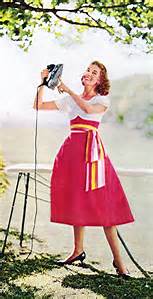
Forty-nine years later I still have the iron Agnes gave me. It has a hole in the top for water which is converted to steam in the hot iron and whooshes out of the 39 holes on the sole. The sole is stained from undistilled water and from those years when I fell for the convenience of spray starch. Numerous falls off the ironing board onto a hard floor have blunted the tip. The faded red, white and blue settings sit atop a dulled black heavy plastic handle which is wrapped with a discolored turquoise electric cord. I can still see myself in the mirror-like shine of the chrome sides. And it still works.

I should have discarded it long ago. I’ve packed it up and moved it from every place I’ve lived since 1967 always keeping it in the corner of the closet shelf over my clothes. I’ve tried to replace it with new irons, but they last only a few years and I go right back to the trustworthy General Electric 39-holer.

Wrinkle-free fabrics have made Ironing unnecessary now. Lower-end baby boomers and their offspring don’t even know how to iron. When it became fashionable or rather acceptable to wear wrinkled linen in the 1990’s I chucked the old ironing board. Something stopped me from discarding my vintage iron, however. I still use it to press scarves on a folded towel laid out on the dining room table.

At craft fairs I see old irons decorated with decoupage and sequins transforming them into doorstops and  bookends. Maybe I’ll spray paint my iron anniversary gold and give it to my son on his birthday next year. I’ll paint words on the bottom: Happy 50th Birthday To Us. Will he wonder why I kept the iron my mother gave me all these years? I certainly do.

The Big Lie: Catholic Hell

The Big Lie: Catholic Hell

In every one of the thirteen grade schools I attended in the 1950’s, Catholic nuns taught me about Heaven and Hell, including the nugget that Heaven was only for Catholics, but there was no guarantee I’d go there. From the age of six I knew if I, as a Catholic, died with a “mortal” sin on my soul, I’d go to Hell, or perhaps Purgatory, the halfway house to Heaven.

This teaching dwelled in the official Catholic textbook for American children used from 1885 to the late 1960s, the Baltimore Catechism. Theth-2 Catholic Church denied that physical Heaven, Hell and Purgatory are part of Church doctrine, long before the Pope declared in 1999 that heaven and hell were “primarily eternal states of consciousness more than geographical places of later reward and punishment”. But that turnaround came after these medieval lies were grafted onto sapling children like me.

The only non-Catholics I knew as a child were our babysitters. I always felt sorry for them because they were headed straight to Hell when they died. In 1957 when I saw a TV ad for Old Orchard Shopping Center, I asked my mother, “where’s Skokie?” “That’s where all the Jews live,” she answered. At 11 years old, I didn’t know there were Jews alive in the world. I thought they were all burning in Hell.

I’ve come to believe that my own personal heaven and hell do exist. I visit hell whenever I relive the last time I got sober forty years ago, or when I regret insensitive words I spoke five minutes ago. And heaven appears when my 10-year-old grandson texts me photos of his lizard.

At the suggestion of my fellow seeker Terry, I crammed into the O’Hare Hilton with 1,000 other souls one weekend in 2012 for a retreat, “Transforming the World through Meditation” with Franciscan Richard Rohr and Benedictine Laurence Freeman, two men I’d never heard of. I had started meditating a few months prior in a Buddhist group and asked Terry if she knew any Christian meditation groups.

In addressing heaven and hell, Rohr said the ego prefers winners and losers. He offhandedly mused that if Jesus descended into hell, as it says in Church doctrine, than there is no more hell because, ”Hell cannot exist in the light of God.” I lost my breath, sprung out of my seat and staggered to the door for air.  A volunteer brought me a chair and water. “Raised Catholic?” I nodded yes. “Yeah, this happens a lot.”

If my subterranean soul had known all my life that I wouldn’t go to Hell for attempting suicide or stealing pens from the office, if I had known all non-Catholics were not doomed to go to Hell; I would have been a better friend to Jesus. I didn’t know my nature was adolescent, fertilized with dead ideas about Hell, sprouting false judgements on myself and everyone I knew.

Uncovering the lie is heaven indeed.

Apologies

As I heal from recent hip replacement surgery, it strikes me that I’ve inconvenienced many. I think you’re all happy I’m doing well, and I really was a docile patient. Yet, some apologies are in order.

First, to my family. Kath, Megan and Kevin, I’m sorry I put you through the challenges of my recent hip surgery. I thought that if I could take it in stride, it was probably no big deal. It seems the three of you were more keyed up about the surgery than I was. I suppose it’s emotionally taxing to go through how we pay our bills, where the life insurance policies are, and which mattress has all of the money hidden in it, just in case I didn’t wake up from the anesthetic.

And by the way, hip, you should be sorry for shedding all of that nice cartilage. Most of the rest of my body is doing just fine with cartilage keeping bones apart. And while I’ve met many persons with new titanium hips and knees, most of humanity seems to do fine with their original equipment.

I’m sorry to the hospital admissions office that got the surly Dave when I arrived for check-in at 6am. I’m guessing I was a brilliant conversationalist in the pre-op staging area as well, but truthfully I don’t remember what we talked about.

Nurse’s aide and housekeeper, I’m sorry the doctor didn’t put enough stitches in my hip and therefore I bled like a stuck pig all over the floor and bedding. I remember wondering whether I should be scared since I don’t usually bleed all over things. I guess the good news is that I still had enough blood left in me to stay alive. The medical resident sure put enough bandages on my hip to keep me from decorating any more floors and linens.

Dr Lyon, I’m sorry I couldn’t stay awake till 10:45 pm when you made rounds. I remember your saying that I wouldn’t have to wax that part of my leg for a while after you pulled 8 bandages and a half roll of surgical tape from my bleeder.

Kitchen staff- you were very nice letting me call down for my meal like I was in a restaurant, then I had the gall to fall asleep mid hamburger bite and didn’t finish my lunch and dinner. What I remember of it was delicious.

And home-health nurse, Renata, I’m sorry I gave you a little jolt when trying to get a smile on your face. There are three no-no’s with hip replacements: don’t bend over more than 90 degrees, don’t cross your legs, and don’t stand pigeon-toed. After being asked to repeat these precautions at least a dozen times, I couldn’t resist having a little fun. I’m sorry I created a look of shock on your face by telling you I practiced touching the floor 20 times per day and crossing my right leg 10 times.

And finally, I’m sorry, fellow CTA bus rider, for whacking you in the leg with my cane. I’m afraid I’m not used to carrying around such dangerous contraptions. I used to walk up and down Michigan Av and the halls of work and school without incident. Thanks to my hip, I now am given wide berth in many venues. But unlike Donald Trump, I’m not afraid to say ‘I’m sorry.’

“Get Off the Bus” by Annette Bacon

“Get Off the Bus”  by Annette Bacon

Get Off the Bus

th-1I made the 146 bus after a quick run and put my Ventra card on the reader. It did not beep so I tried it several times. The driver said that I had an 85 cents negative balance. I apologized and said that I only had a ten and a twenty. She said I needed to get off the bus. I started to leave and this guy shouted, “Don’t, you do not have to get off the bus. I am calling the CTA.” “She can’t throw an elderly person off the bus due to lack of funds.” People were staring at us and I decided to get off. I ran across the street to my garage and took some quarters out of my car. I ran back to the bus stop as the other 146 bus had arrived. I put the quarters in the money holder. I looked up and saw the people from the first bus getting on. The bus driver said, “What’s happening?” “Thth-3e bus behind me is empty.”

The same guy that was yelling on the other bus said, “I’ll tell you what happened, the other bus driver threw this elderly woman off the bus and that is against the law, so I called the CTA. And there she is!” He was pointing right at me. I cringed again and tried to pretend I was reading. The same guy called a friend and said the whole story again so loud I could hardly stand it. He ended the phone call with,“And I told the CTA I want this bus driver relieved of her duties. She did not have her badge on either!” I panicked. Someone was getting fired due to me? The woman was probably a single mom with four kids. When we arrived at my stop on Michigan Avenue, I jumped off and ran into the Fourth Presbyterian Church sanctuary. I said a prayer for this woman and asked God not to let her get fired.

As I went up the stairs of the church, I could feel my blood pressure was up and I felt like I was flying. On the second floor I walked into Buchanan Chapel and tried to calm myself. I couldn’t decide if I should call the CTA and identify myself as the “elderly woman”. Then I could ask them not to fire her. The system was so huge I knew this would not make sense. They would think I was deranged. Meditation was the answer. Afterwards I took my “elderly woman” body up the elevator to my memoir writing class at the church’s Center for Life and Learning.

In the Attics of My Life, Jerry Garcia Lives

In the Attics of My Life, Jerry Garcia Lives

I worked in politics my whole life, always hoping for the perfect politician. The world view I dreamed up included good people who ultimately acted in the best interest of the whole.  Bill Clinton could have been my hero. I loved his rallying cry in the 1992 campaign, “personal responsibility.”

But I had doubts. Could I work for a candidate who was pro capital punishment and unsure of his view on abortion? Those were two issues I thought every Democrat knew to be against and for.

The “personal responsibility” message won me over. In th-11991 I abruptly left Chicago for Arkansas to work as Clinton’s campaign scheduler, a grueling job that required 24/7 attention. One cold January night Clinton and his entourage, George Stephanopoulos and Bruce Lindsey, returned to Little Rock in a small private jet from all-important New Hampshire. I met the plane on the dark, deserted tarmac to give Clinton his next day’s schedule. He descended the jet’s stairs with a big smile, came directly at me, grabbed my coat and ran his hands up and down my long furry lapels. “Nice coat, Regan,” he whispered.

This encounter may be the reason I love Bill Clinton.

When he won, I relocated to Washington to work in his administration. I moved into the first floor condo of an 1880 townhouse on Church Street in DuPont Circle. In 1994 he passed a crime bill I thought went too far. Next he signed NAFTA, an agreement opposed by every Democrat I respected. Both policy shifts were spearheaded by White House insider, Rahm Emmanuel, who decidedly did not have the public good at the forefront of his self-serving mind. But Clinton loved him. Dissatisfaction settled in the space between my bones and muscled me awake at 3 o’clock in the morning for the next seven years.

In the still of an August morning in 1995 NPR told me Jerry Garcia died. I collapsed on the bathroom floor weeping over the death of something I couldn’t put words to. At 49-years-old my idealism had come to an end: my false world of everlasting good died with Jerry Garcia. Reality glared back at me in the mirror as I brushed my hair, seeing for the first time a wrinkled face and rubbery neck. I dressed in a soft yellow, flowery cotton frock and pinned a silk flower in my hair, ready for the grieving day.

My dog Voter squirmed away from my extra long hug and I went out the door to my old friend, Keith Lesnick waiting to drive us to work. As soon as I got in the car tears spilled out. He asked about the sadness, and I slobbered out a few words, “Jerry Garcia signed into rehab last night,” I said. “He died in his sleep.” Keith waited a few respectful minutes, and then, with one simple sentence, he opened a new, naked reality that included the unspoken caveat of don’t take yourself too seriously.

He said, “well, it’s not as if it’s Aretha Franklin.”

Immortality, Interrupted: Lake Forest Eviction

220px-Barat-PereMy lawyering father would make a barrel of flimflam cash, move our family to a gilt-edged neighborhood and drink it all up within a year. He would sneak away on a business trip and a few weeks later my mother would wake my two sisters and I in the middle of the night, pack us into the car and drive to another state, another town, another gilt-edged neighborhood.

In seventh grade I entered my 11th school since I started first grade in 1952, the Academy of  Sacred Heart in Lake Forest, Illinois. I intended to shine in all subjects, especially my nemesis arithmetic, no matter what was happening at home. Experience warned me I didn’t have much time until the next midnight move so I crammed my head with Latin conjugations, algorithms, periodic tables, Romeo and Juliet, diagrammed sentences, the French revolution and the Gospel of Mark. At the end of the year the Mater Admirabilis Award (Mother Most Admired, another name for Mary), an Oscar-like trophy would be bestowed on an eighth-grader for her excellence in academics, sports, religious and civic activities. Her name would be engraved on a bronze plate and permanently fixed next to the previous winners. I prayed everyday for God to keep me in that school through the eighth grade so I could win that prize.

Sacred Heart nuns had been in Chicago since the 1860’s. Bishop Anthony O’Regan brought them from France to open a school at Rush and Illinois Streets, a mile from where I live now. They taught women leadership in society rather than social graces and homemaking. O’Regan moved the school to pastoral Lake Forest when hotels, saloons and brothels flooded the Rush Street neighborhood.

A hundred years later, French still permeated our activities. “Congé” (holiday) was a surprise day when schoolwork was suddenly replaced by a day of fun such as playing Cache Cache, a version of hide-and-seek. Congé ended with “Goûter” (to taste), a roomful of refreshments celebrating the winners of the day’s games. This joie de vivre coupled with the nuns’ love of God appealed to my awakening soul.

My teachers gradually increased my extra credit assignments to include tutoring, public speaking and sports. By the end of the 8th grade everyone knew my name would be forever on display in the trophy cabinet.

In the school bus on the way home from an ordinary day in early May, I thanked God for Sacred Heart and my soon-to-be immortality. The bus driver pulled into our driveway and slammed on the brakes. Furniture, clothes, pots and pans, bicycles – everything we owned clogged the pavement.

I told my sisters to stay on the bus, as if something dangerous was happening, until I saw my mother sitting on the couch with my 3-year-old sister Stacy. I needed to save her from a reality I didn’t understand. A sheriff blocked the front door. We were not allowed to enter. A family friend arrived to drive us to a downtown Rush Street hotel. A week later I was in another school, another town, another state.


Film School with Vivienne

Film School with Vivienne


The elevator opened to a lit-up scene of human statues in the closed-for-business City Hall lobby.

“Cut! Close that elevator door!”

I slinked back into the elevator, up to the 4th floor Elections Department and flew to the telephone in my office where, in the Saturday morning quiet, I had just finished the 1993 voter registration plan.

I called my high-rise neighbor, Vivienne de Courcy. “You have to come down here right now!”

“Ach. Can’t possibly. Bogged down. Writing,” said Vivienne, a frustrated 9-5 insurance lawyer who spent Saturdays grinding out movie scripts.

“You must — they’re shooting a movie in the lobby. We can get access with my I.D.”  Vivienne and I loved sifting through the credits at the end of movies trying to figure out what everyone did, but we’d never been on a movie set.

Chicago’s City Hall squats on one city block with doors at Randolph, LaSalle, Washington, and Clark Streets. I hurried to the Washington Street side of the building down the stairs to the lobby. Flyers were posted in the stairwell: Lobby Closed Saturday Noon for Filming of The Fugitive. When did they put those up?

I ran down the hallway, shoved open the polished brass doors and caught my uninhibited, garrulous sidekick swinging her long legs out of a taxi on Washington Street.

Vivienne’s knockout looks never suffered from uncombed hair and no make-up. Flinging her camel-hair cape over her shoulder she shivered in the March wind, grabbed my arm and skipped inside. I muttered quick instructions: don’t embarrass me, don’t say a word, don’t make me laugh, do not get me in trouble.

Crew Only signs sat on food tables along the corridor. Perched at the table near the rotunda we hawk-eyed bowls of popcorn. Vivienne whispered her intuitive movie-credits knowledge. That’s the Director. Production Assistant. There’s the Script Supervisor. Which one is the Grip? Dunno.

A crew member gestured to the popcorn, assuming we were extras. Vivienne helped herself. What? Don’t do that!

And then, Action! Harrison Ford came running down the circa-1911 polished marble staircase across the wide rotunda zig-zagging through the crowd of extras I had witnessed by the elevators. Cut! He walked back upstairs. Action! He came running down again chased by Tommy Lee Jones.

Oh my god, he’s coming this way. “Vivienne! Say something!” Harrison Ford sauntered over to munch popcorn. I shoved Vivienne toward him. He said hello and she asked him how he liked Chicago.

“Is that an Irish accent?”

“’Tis.”

“How do YOU like Chicago?”

“I love it.”

“Well, I love popcorn.”  He smiled and strolled away.

My starstruck legs wobbled. Back at my side with a handful of popcorn, Vivienne shimmered. Turning toward the exit we faced crew and extras gathered for the catered lunch behind us.

“Are you two extras? What’s that I.D. around your neck?”

We skedaddled down the hallway, fluttered out the doors and whooped it up all the way home.


Vivienne de Courcy’s first feature length movie. “Dare to be Wild” is premiering at the Palm Beach Film Festival in April, 2016. She currently resides in Ireland and London.

You read that out loud in class?

bethfinke's avatarSafe & Sound blog

Regan-Burke That’s Regan, today’s guest blogger, peaking out of her hood at a Chicago bus stop.

It was a lucky day for me when Regan Burke turned up for one of my memoir-writing classes. A civil rights activist, Regan was a White House staffer during the Clinton presidency and has colorful – and moving – stories to tell. She files away unusual words she hears and cleverly shoehorns one or two of them into each essay – you’ll find one here in her guest post about the value of honesty in memoir-writing.

There’s a Lacuna in My Story

by Regan Burke

Sometimes I email the essays I write for my memoir classes to a good friend.

She tends to find my work imprudent and irresponsible.

”You read that aloud in class?” she’ll ask. “Yep,” I answer. “I did.”

I have a strong motivation for writing the truth. A book by Dr…

View original post 449 more words

Hippies At Thanksgiving

Ode to Thanksgiving

th-2

Vermont with Tricia Thack and our children in her ’62 Ford
To escape husbands and dull lives at the Jersey Shore
Route 100 Pittsfield apartments at the Village Green
A four-bedroom apartment on the ground floor
With sheltered hippies, ski bums, drop-outs, in-betweens
Divorcees, dharma bums, dogs, cats and a runaway queen
Working snow season ten miles up the road
Bars, restaurants, ski lifts, tourists by the busload

California hippies made yogurt
We ate it plain no mediocre
East Coast hippies found health food stores
Raw cashews, unsulphured raisins, no carnivores
Steam the vegetables
Sunflower seed salad incredible
Eat brown rice
Don’t eat meat, except bacon

October 1969
Friendships accelerated deeply on pot and wine
Music-fueled astral planes
Snowshoes with children in tricky terrains
Thanksgiving dinner hearkened merrymakers from the mountain
Mishmash beans soaked in apple-cider-vinegar foamy fountain
Simmered four hours with smashed garlic cloves
Vegetables landed willy-nilly into crackling oil skillet on the stove
Chopped tomatoes, peppers, onions, zucchini, squash, mushrooms, celery
Washed brown rice seethed unstirred roguishly
Cool beans hot rice folded into vegetables simmering glimmering
A bland bowl for the children fingering
Honey dollop, crushed marijuana, basil, jalapeños, paprika, ginger, pepper, ever so
Settled on low heat emitting brewed fragrance of Old Mexico
Aroma announced time to eat Mishmash and pour sauternes
Apple wine and marijuana released the kitchen from worldly concerns

Cool cats appeared extra marijuana added to Mishmash haplessly
California hippies topped off stew with yogurt joyfully
We relished the sweet and savory peace of our groovy family