La Dolce Vita in Cinque Terre

It took six months in 1998 to organize our jitter-filled lives around a two-week vacation in Vernazza, a thousand-year-old fishing village in Cinque Terre on the Italian Riviera.

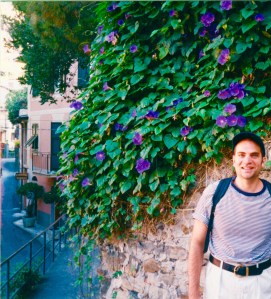
Vernazza RoccoRooco, Kristina, Mark and I left the 19th century train station and rolled our overstuffed suitcases 20 minutes up a cobblestone switchback twined in purple morning glories. Our home abroad sat 1300 feet above the Mediterranean Sea and overlooked a village of 1000 happy Italians. We arrived at LaTorre midday, when the sea is dark turquoise and the sun swells the nose-tickling lemon and olive trees.
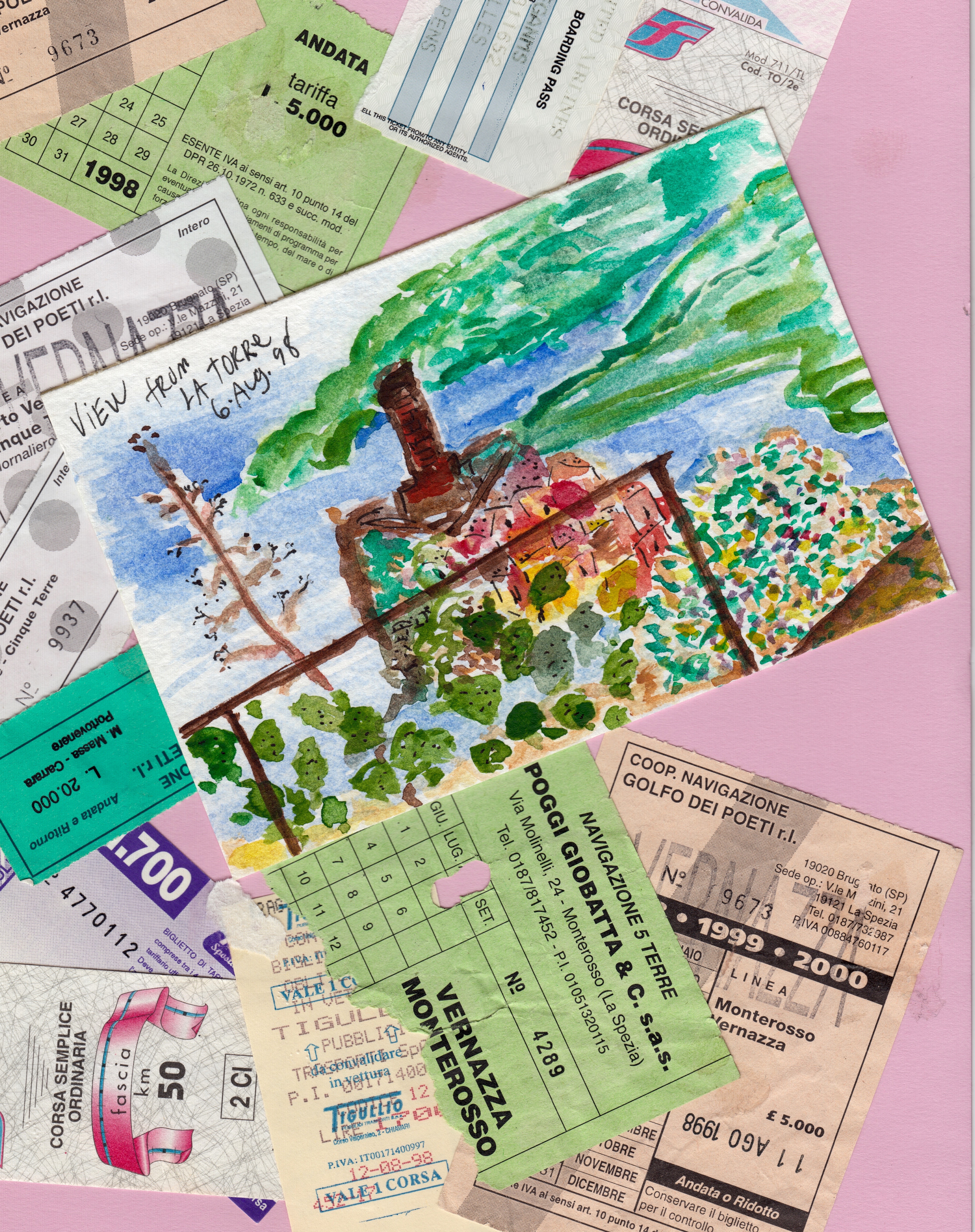

LaTorre is a 13th century pirate lookout with a galley kitchen, a modern bathroom, a luminous living-dining area and an alcove captain’s bedroom. Three other beds were lofted into stacked platforms in a stone tower, and the only way to get to them was by rope ladders. We staked out our sleeping arrangements and headed back down the path to the village.

Like bloodhounds we followed the scent of ground basil and garlic around the village into a ristorante on the piazza at the harbor. Our first meal was homemade bread dipped in fresh pesto,Vernazza’s culinary legacy to the world.

Some days we hiked the village-to-village trail along the sea, returning to Vernazza by water taxi. Other days the train took us to Le Spezia, Portofino, Pisa Vernazzaand Lucca. At night we lounged on LaTorre’s heirloom terrace in front of the twinkling lights of passing boats on the navy blue horizon.

And then the phone rang.

John Funderburk  was on the line frantic to let me know that a journalist was about to call me wanting information about Monica Lewinsky. John was a fellow political appointee in the Clinton Administration and he recommended I consult with a lawyer before taking the call. Perfect vacation bliss was now teetering at the cliff of a darkened sea.

My D.C. job occasionally had me organizing publicity and logistics at events for the President’s appearance. In the Spring of 1997 I’d been advancing a small fundraiser in a Washington hotel when an old friend from Indianapolis came into the room through the metal detectors right after Monica Lewinsky. Lewinsky was known among advance people as a Clinton stalker, so I asked my Hoosier friend to shield the President from her potential clutch as he passed by.

A half a year later news broke about a Grand Jury investigation into Clinton’s relationship with former White House intern Lewinsky. Back in Indianapolis my friend panicked that he would be hauled before the Grand Jury. So he held a press conference about his brief encounter with Lewinsky – and mentioned my name.

The sudden jolt of reality stirred our Dolce Vita quartet in Italy to hatch hilarious mad scenarios to confound the intruding journalist. When the call came, Rocco answered. “Prrrronto! Si? Si? Sorry. No Inglese! Ciao!”

Che finito, we returned to our intermezzo between the acts of the crazy world.

The World’s Worst Vacation by Carol Zoha Hawk

After the Thanksgiving of 1999, my husband, Jerry came home from work with the news that his friend had offered to let our family use his new townhouse in Miami for the Christmas holiday. He and his wife had only been there once. We happily packed our bags and were off.

091027a

The pristine townhouse had all new furniture and was located in a new development in a Hispanic community. We enjoyed seeing the area’s highlights.

After breakfast on December 31st, I put the dishwasher on. We heard rain but how could that be – the sun was shining. Water was pouring from the garage ceiling. There was no handyman about. We got pots, pans and mops and eventually the deluge stopped. What would we tell Jerry’s friend?

As we started our New Year’s Eve celebration, we noticed an odor coming from the bathroom. Poo! Yes it was poo backing up into the tub. We heard the family next door celebrating New Year’s Eve as Jerry had the disgusting task of plunging the bathtub.

That same night, Emily awoke in intense pain and we decided we had to take her to the E.R. Twelve year old Robert was deep in sleep. We left him a note just in case he got up before we returned. Jerry stopped plunging and he knocked on our neighbor’s door to get directions to the nearest E.R.

The E.R. was dirty. No one spoke English. It took forever for them to get an interpreter. Lines of drunks were sleeping it off. An old woman on a gurney kept asking passers-by to shake her hand. The doctor was an unfriendly, ugly man with dirty hair and a triangular nose. Emily had refused an injection to relieve her pain, and they had no triage. He said there were three drunks to look after before he would see Emily. “We have a first-come, first-served policy”, he said as Emily was writhing in pain on a gurney. Smoke was coming out of my ears.

I asked the nursing staff to help, but they seemed reluctant. There was no administrator available. A security guard approached Jerry and said I had to leave the E.R. I wasn’t going to leave my daughter in the E.R. With his hand on his gun holster, he escorted me to the outer corridor.

Jerry stayed with Emily.

Eventually, an English-speaking nurse came out, and said that she was subbing at the E.R. just for the night. She agreed that this was an awful hospital. If any medical procedure was necessary for Emily, this Florence Nightengale said she’d take us to the hospital where she worked. Emily had taken her medication. There was a reduction in her pain. A while later, the same nurse said that Emily had passed a kidney stone and she was getting ready for discharge.

A tired Emily and her shaken parents drove to the townhouse, picked up Robert and drove to the airport. When we left, the garage ceiling was still leaking and beginning to fall and there was lots of poo backed up in the tub.

Take My Breath Away: Love of Art

Take My Breath Away: Love of Art

Neatly arranged parchment sleeves hid small prints that slipped out and overwhelmed me like guests at a surprise party. The New York Metropolitan Museum of Art responded to my 7th grade request by sending a thick envelope with sacred works by Titian, Bosch, Jacometto, Raphael, Durer and Fra Angelico. As I gingerly sifted through this unexpected bounty, I gasped with awe and gratitude-grateful that God had given me such a gift and awe for beauty I had never before known.

IMG_1076 (1)Mother Ann Cleary at the Academy of the Sacred Heart in suburban Chicago set the class to writing a description of a classic painting including information about the artist and personal impressions of the artwork. In my 1959 mailing to the Met I simply re-stated the assignment and asked for help. I suppose the name of my school prompted the curator at the other end of my letter to choose representations of New Testament stories. That was the year I won the all-school prize for best writing.

After this intoxicating initiation into the eye-popping wonders of art I thirsted for more. I read the back section of Time Magazine every week for news on the art world and scoured the library for books on lives of the artists. I was prohibited from hanging anything on the rented walls of my bedroom so I made square cardboard boxes and pasted works of art on each side. I strung-up the art boxes from the overhead light, curtain rods, door hinges – any place where I could gaze at my magazine-clipped reproductions.

My first art purchase was a print of Picasso’s Boy with Pipe. It shared wall space with art posters from places I visited – a Roger Brown from the 1985 Navy Pier Art Expo, a Toulouse Lautrec from an Art Institute exhibition. In the 1990’s my job required frequent travel around the US and overseas. To protect myself from on-the-road temptations I stole free time and scurried through backstreet art galleries and street markets. I brought home img_0678suitcase-compatible originals such as a small clay maquette of an Easter Island head by Oslo artist Marian Heyerdahl, Thor’s daughter. In 1997 I signed on to EBay. Within hours I was hooked on outsider folk art, bidding on heart-stopping works like a multi-colored turtle made from a hubcap.

Love of art freed me from the inclination to decorate my home for the approval of
others. In my petite apartment the walls are crammed with oils, pastels, watercolors, shadow boxes, metal sculptures, retablos and ceramic tiles. There is so little unadorned wall space that I string up paintings from the curtain rods in my wall-to-wall windows. An oil of Johnny Depp as the Madhatter by Chicago artist Anne Brandt blocks the curiosity of neighboring eyes.

George Carlin once said “life is not measured by the number of breaths we take, but by those moments that take our breath away.” By that standard I surpassed my quota long ago.

Diehard fans

A blessedly short article in today’s Chicago Tribune reported on the crosstown hatred Sox fans have for Cub fans and their disdain for the playoff series. All I could do was groan.

I’m a diehard Sox fan and I come from original diehards. My father’s first game was with his father at the 1917 Sox-Giants World Series and the seven-year old thrilled to see the South Siders beat the hated New York team four games to two. I was raised in a household where I thought the other New York team was named the G.D. Yankees (Dad didn’t swear in front of his little girls) and when I later dated and married this Cubs fan, he was grudgingly happy for me.

For more than 20 years, the firm I worked with represented various professional Chicago sports teams, which gave me a view of fans from the inside. The true over-the-top diehards were scary. The stereotype would be a 20-something male who doesn’t have much of a life and thus identifies so closely with his team that he hates anything that might take away some of its prestige or limelight. Truth is, all but the “20-something male” is pretty on target. These diehards come in all genders, ages and backgrounds and were well known to team staff, often nicknamed (e.g. The Addams Family) and concern about what they might say or do was everpresent.

Now I can’t say that those quoted in the Tribune story fall into this category but I can tell you with certainty that all of the Sox fans I know – and there are many, many, many – are rooting for the Cubs. Maybe not as enthusiastically as they would if the Sox were in the post-season but we got our series in 2005, and if we can’t be in play this year having another Chicago team win a World Series will be something to cheer.

Check in again if there is ever a Sox-Cubs World Series. But then we survive cross-town games every year and there are more camera shots of cross-town couples holding hands than anything else.

For today’s game, my Cubs fan husband and our Cubs fan son won the lottery and scored tickets from the Cubs eight rows behind the Cardinal’s dugout – and at a price comparable to a regular season game. And this Sox fan will be looking for them on TV and root, root, rooting for the Cubbie.

Book review: Anthony Doerr’s “All the Light We Cannot See”

bethfinke's avatarSafe & Sound blog

AllTheLight

I usually avoid reading novels and short stories with characters who are blind. Too many fiction writers portray blind characters one-dimensionally — we’re either heroic or tragic, bumbling or, particularly lately, blessed with super-powers.

But Anthony Doerr isn’t like other authors.

One of the main characters in Doerr’s current best-selling novel All the Light We Cannot See is blind, but there’s much more to Marie-Laure LeBlanc than that. She grew up in Paris, her father is raising her on his own. The two of them evacuate to a village in Brittany called St. Malo after Paris is invaded by the Nazis, her father goes missing, and she’s a teenager by the time the Americans arrive on D-Day.

Doerr writes in third-person, and his chapters are very short — they swing back and forth between the changes young Marie-Laure is enduring in France and those that Werner Pfennig, an orphaned teenager in Germany, faces when…

View original post 631 more words

Biking Around the Bomb

 Bicycle Grace by Regan Burke

The photo shows 2 athletic young men, 2 children and me, a plump old lady, pedaling east across Stockton Drive, a tree-lined street that sidewinds Chicago’s Lincoln Park Zoo.

The photo appeared in the City Beat section of the Chicago Tribune August 10, 2015 with the headline, “Biking Against the Bomb.” The caption reads “Demonstrators begin a 7-mile bike ride Sunday to mark the blast zone of the atomic bomb dropped on Nagasaki, Japan.”  My bike has a big yellow front tire, a black whitewall rear tire and red basket. I’m sporting neon pink ankle-length trousers, lime-green sneakers, and a “Bike Around the Bomb” extra-large short-sleeve turquoise t-shirt snugly over my long-sleeve lemon shirt. The t-shirt just happens to be the same color as my helmet and eyeglasses. My bike posture befits a 69-year old short grandmother with bulging thighs and donut midriff.

I stand out in the photo.

You see my hands gripping the handlebars of my beloved town bike. What you don’t see is God caressing those hands with high-fives. The day this photo was taken, that bicycle grace relieved me of the physical pain of moral certitude.

When I was in my 50’s, I worked in downtown Chicago overlooking the Daley Center. Every month a group of bicyclists, Critical Mass, gather in the plaza before their raucous ride through city streets. How I longed to join them! But I’d been derailed from lifelong bike-riding by fibromyalgia. After I retired I downshifted into wheelchair-bound despondency.

Suicidal thoughts took me to the velodrome of alternative therapies. Round and round I went to anyone, anything that might relieve my suffering mind-body. Eventually meditation led to feldenkrais, writing therapy, pain relief, and a bicycle.

I’ve marched in peace demonstrations since the 1960’s so “Biking Against the Bomb” was the perfect foray into group cycling since I regained mobility. Educated by nuns, I learned about peace huddled under my 1st-grade desk hiding from a possible atomic bomb. Pray for peace. God required peace by every means possible.

President Truman had written his own moral code a year before I was born. In August, 1945 he murdered 180,000 Japanese civilians with atomic bombs. An unnamed fear took root in my fetal shroud and sprouted in the dappled shade of A-bomb-talk throughout my youth. This genetic consequence chained me to the spokes of peace activism.

At my meditation group I tried to describe my day of bicycle grace but spiritual gobbledegook fell out of my mouth and I self-consciously coasted to the end of my sharing with, ”I think I could ride with Critical Mass now.”

Group-think chattered: “Oh no. Not them. Scofflaws. Sail through stop signs. Wheel around pedestrians. Weave in and out of traffic. Lawless.”

I said, “But they have a police escort.”

“Yeah. Unruly fringe group. Take over the street and piss off drivers.”

I went home, opened my computer, defaulted to moral certitude and clicked “going” on the next Critical Mass event listed on FaceBook.Biking