What Is My Work, You Ask?

What Is My Work, You Ask?


1962. My work is to stop laughing like a nervous little girl and start smiling like an unflappable young lady in the coffee shop on the Asbury Park boardwalk. To turn away from the seagulls fighting over dead fish on the beach and write “pancakes” and “bacon” on my notepad. To pay attention to the old telling the story of the 1934 wreck of the cruise ship SS Morro Castle on the beach. To save money for tickets to Joan Baez and Bob Dylan at the Asbury Park Convention Hall.

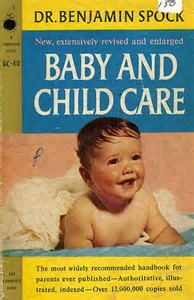
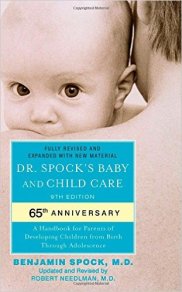
1967. My work is to read Dr. Benjamin Spock’s Baby and Child Care and apply its 51hjigsfuol-_sx309_bo1204203200_commandments to week-old smiles, cries in the night, a nine-month old sprinter and a child who eats only chicken. My work is to stand my ground in the whirlwind advice from mothers, aunts and grandmothers. To learn to ride a baby on the back of my bicycle. To animate words as I point to clouds, trees and cars as if I’ve never seen these things before in my life.
1976. My work is to bypass the door to the secluded basement with its graveyard of empty vodka bottles. To surrender to my new single-motherness. To trust my untrustworthy father and move from a sandy Jersey Shore cottage to a downtown Chicago highrise. My work is to know this is the best plan for a nine-year-old boy’s future happiness.

1982. My work is to dress up in business clothes, act smarter than I am, eavesdrop on everyone’s conversations in a boiler room full of political operatives, ask stupid questions and digest enough information to schedule Nancy Stevenson in places that help win votes for her husband’s campaign for governor.

1990. My work is to be a motherless child. To lament the loss of my uterus and ovaries, and, my boyfriend. To escape to Paris and London with my twelve-year old niece. To atone for all my past sins.To feign self-confidence while running the Illinois Democratic Party.

1993. My work is to take Prozac on the way to Washington to join the management class of the Clinton Administration. To imagine I have power and to hide humiliation when I’m exposed. My work is to honor the ruling class. To recognize they are human. To protect myself from evil-doers and self-promoters. My work is to mourn the loss of naiveté.

2006. My work is to shield myself and others from Cook County Government officials who believe if you are happy at your job you’re not working hard enough. To cherish those I lead for what they are today and not for what they will be tomorrow. To protect them from those who refuse to know their names.

2017. My work is to record how far my shadow falls behind me. To tell the truth about myself and trust God with where the words go and what they do when they get there. My work is to proclaim the US Constitution guarantees me the freedom to assemble publicly and express myself openly without retribution. My work is to say I love America and when the saints go marching in, oh! how I want to be in that number.

Inspired by “An Address to My Fellow Faculty,” by A. Papatya Bucak, from brevitymag.com

Irish DNA: Inheriting A Stigma

Irish DNA seems to have a gene actively predisposed to alcoholism though there’s no scientific evidence that it’s hereditary.

The first ugly secret in my family is that my twenty-three year old mother, Agnes Donnelly Ryan Burke, was drunk in the Georgetown Inn in Washington with my father at the time her mother died. She wasn’t located until the next day. Later that year my parents were married in Key West where my father, Bill, flew reconnaissance planes across the Florida Straits to Cuba. Their married life began with Bill spending two weeks in the brig after a drunken brawl over Agnes.

Alcohol addiction begins with an immature reaction to the emotional and physical pain of adverse childhood and young adult experiences. When and why did Agnes and Bill cross over from heavy drinking to alcohol disease? Bill’s mother died when he was three so he had early trauma. Agnes was prescribed Guinness Stout when she was twelve for anemia so she had early permission. Their chaotic, calamitous alcoholic marriage intruded on the childhoods of my three sisters and me but as far as I know we are not all alcoholics. We all manifest common characteristics of growing up in an alcoholic home: fear of emotions, conflict avoidance, perfectionism, compulsive behavior, depression, melodrama, overreaction to change, and the denial of all these traits and their connection to alcoholism.

In the forty-one years I’ve been in Alcoholics Anonymous, there have been ongoing, persistent discussions, “Is it hereditary? Is it a disease?” Since the1900’s the language describing alcoholism has screamed out to the non-addicted populace, WE CAN’T HELP IT. The world has been given plenty of messages to enable it to accept us alcoholics as normal people with medical problems. Currently, the community that studies these questions is
untitledpromulgating the idea that addiction is a biological disorder from a dysfunctional brain – not inherited and certainly not a moral failing.
This past year I had coffee after church with a new acquaintance. In swapping little tales about ourselves she told me she had a match.com date who told her he was in AA. “Isn’t that disgusting?” she said. I abruptly excused myself saying I had forgotten to walk my dog and had to run right home.

Alcoholism was shameful before I was born, shameful in my family growing up, shameful in myself, and shameful now. All the work that has gone into trying to change negative thinking against alcoholics has not shifted the stigma one iota. Two million recovering alcoholics still sneak off to life-changing, life-saving AA meetings, keeping their recovery a shameful secret.

Agnes died of alcoholic brain syndrome (wet brain) when she was seventy. Bill joined AA when he was forty-five and stayed sober for 35 years until he died. He was proud to be part of a recovery community and thrived by helping others. But he never felt as though he quite measured up to the world outside of the AA fellowship. He wasn’t secretive about his alcoholism, nonetheless, the stigma hounded him until the end.

The Exorcist: RIP

The Exorcist: RIP

Truth is Stranger than Fiction
…but it is because Fiction is obliged to stick to possibilities; Truth isn’t.” ― Mark Twain
I was 24 years old and six months out of Marlboro Psychiatric Hospital in Monmouth County NJ, when I read the The Exorcist in 1971. Marlboro was a notorious looney bin where patients attacked one another, food-borne germs killed people, and the criminally insane were constantly getting loose. I landed there after a year-long binge on LSD and Boone’s Farm Apple Wine. My psychiatrist terrified me with photos of headless babies born to LSD-consuming mothers.

After my release, I went to AA meetings, lived with a friend, got a job making terrariums at Julius Roehrs Garden Center in Farmingdale and saved for a home for me and my four-year-old son Joe. He was living with my ex-husband and his parents.

I’d picked up the paperback at Main Street Pharmacy after dropping Joe at his interim home in Belmar. We’d played at our beloved seaside for our weekly visit and parted cheerfully. I drove to the Belmar Diner, ordered a grilled cheese and coke, and opened the book. An hour later I was in my VW van in the diner parking lot, bewitched by the reading.

The book’s demon-possessed 12-year-old girl is called Regan. I’d seen my name printed on report cards, paychecks, my social security card and driver’s license, but I’d never seen the name Regan in any context outside of myself. The author, William Peter Blatty madereference to Regan’s name coming from Shakespeare’s King Lear. My p
arents had told me my name came from King Lear. Exorcist Regan’s mother was an 51evfuyqtdl-_ac_us160_actress whose director, Burke Williams, visited frequently and drank too many martinis. My father’s name was William Burke. He loved martinis. Exorcist Regan lived with her mother in Georgetown. My family had lived in Georgetown after my sisters and I were born.

I finished the book in the parking lot as the sun set on the Shark River Inlet, then serpentined down the road to my mother’s house in my slow-moving van. I was having periodic LSD flashbacks in those days, and the dizzying words of Regan’s possession plundered my healing nervous system.

My mother, Agnes, sat up from her beer-soaked abyss as I blasted through the front door and slammed The Exorcist down on the coffee table. Who is this guy? How do you know him? Why didn’t you warn me about this? How could you let me read this?

Agnes, an avid reader but detached from pop culture or bestsellers hadn’t read the summer blockbuster. I told her about Regan, Burke, martinis, Shakespeare. She joked the author must have been one of those undergraduates who attended parties at our house in Georgetown when I was a baby. I consulted my father in New York, and he had no idea who William Peter Blatty was, though after The Exorcist movie came out he pretended he did.

Years later a friend ran into Blatty and asked him if he had named Regan after me. “Absolutely,” the author replied, “They had the best parties. That name always haunted me. Who would name their little baby after one of Shakespeare’s most craven females?”

RIP William Peter Blatty January 12, 2017. Vaya Con Dios.

Farewell Obama

Farewell Obama

Hope Against Hope

It was three degrees in Chicago. Amy and I were driving around at 7 a.m. on a Saturday looking for a parking space an hour before the ticket booth opened. We spotted the long line as WGN radio announced tickets were sold out. Why were they queued up outside McCormick Place a mile from the entrance knowing there were no more tickets? Hope against hope?

We despaired. Back home I contacted Ethan in Atlanta, a devoted friend who honed his political PR skills working for me during the Clinton administration. Ethan was on call for eight years as one of Vice President Joe Biden’s advance people. He had connections. By Monday night, he’d emailed me two tickets for President Barack Obama’s farewell speech the next day.

The confounding street closures on our drive back to McCormick Place frightened us into imagining we were shut out of the mysterious world of a presidential event. Blockades finally led us into Parking Lot A. We left our coats in the car and grabbed our coveted tickets. Out of the parking garage, across the fourth-floor bridge over Martin Luther King Drive, down the escalator—we hurried up to a suited young man with a big badge that read, VOLUNTEER. He said, “Oh, you have red tickets. You’re in the expedited line. You don’t have to get in line now—go enjoy yourselves and come back at 5 o’clock.”

We exchanged lucky-us glances and twirled around toward the McCormick Hyatt hotel. Amy asked for guardian angel Ethan’s address so she could send him a thank-you gift, maybe a Chicago pizza.

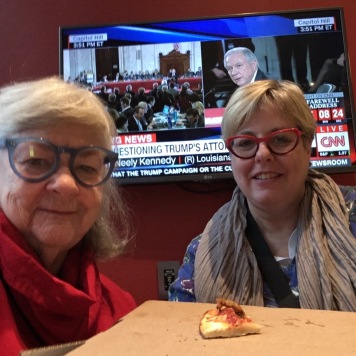
In the hotel food court we luxuriated in a booth that had outlets for our phones and img_1180-1televisions tuned to CNN. We lunched on pizza and salad, then turned our attention to the televised Senate confirmation hearing of Senator Jeff Sessions for U.S. Attorney General. We hardly spoke as the senators’ questioning revealed that civil rights, voting rights and protecting women from violence were bills that Jeff Sessions had voted against.
The McCormick Hyatt is attached to the mammoth halls of the McCormick Convention and Exposition Center. Obama celebrants poured into the hotel lobby past us in the food court toward the farthest hall to wait for one of the most bittersweet hours of our lives.

We joined the stream of believers to the red-ticketed line-up thirty minutes before walking through metal detectors and down a long gated chute to our seats—and a perfect view of the President’s podium.

The chatty crowd had tissues ready. My cell phone buzzed. “What? What?”

I shrieked at Amy next to me to read CNN news on her phone. Jake Tapper was reporting the Russians had damaging personal and financial information on Donald Trump and the Trump campaign colluded with Russians to fix the election. People around us were buzzing about the story. Some shrugged their shoulders as if they expected it. Some said, “More nuttiness.”  And some, like us, had the look of weary scavenger hunters receiving one more piece of the multi-level puzzle explaining Hillary Clinton’s loss.

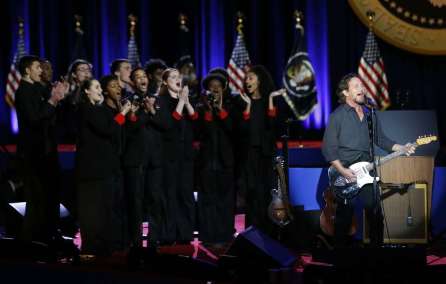
0011060ae1214f529ad359da0c73d5a6-1dba7ec2c01f4ded8486de6775f69b6f-3Just then, Pearl Jam’s Eddie Vedder and the Voice of Chicago children’s choir came on stage and sang Patti Smith’s “People Have the Power.”
The Many-Taled Capital: Memories of Washington DC

The Many-Taled Capital: Memories of Washington DC

On Thanksgiving day 1963, my father and I were in People’s Drug Store at DuPont Circle, in Washington, D.C. The store hushed as the radio blurted out President Lyndon Johnson’s proclamation that Florida’s Cape Canaveral would now be known as Cape Kennedy. (Ten years later the Floridians changed it back.) I was visiting my father on break from my third high school, Walsingham Academy, in Williamsburg, Virginia.

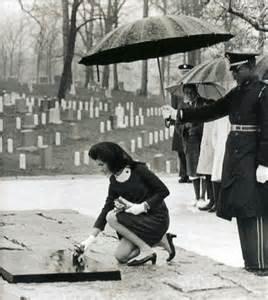
Washington sputtered in the aftermath of the assassination – its only crowds advanced to JFK’s gravesite at Arlington National Cemetery. At seventeen and without a driver’s license I capitalized on my father’s somber distraction to hone my driving skills using his th-1Cadillac to visit friends who were also home for the holiday. I learned to navigate Rock Creek Parkway, the notoriously confusing Pierre L’Enfant circles, Key Bridge and Pennsylvania Avenue. I knew to stay in the northwest part of the city, that there was something sinister in southwest, southeast, and northeast Washington. I cruised by the white-brick colonial home on Foxhall Road that I’d occupied with my parents and two sisters in the early ’50s, before my parents’ drinking turned us all into gypsies and eventually landed us in the Chicago suburbs.
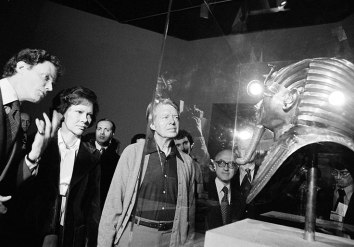
The next time I visited Washington, I was with my second husband and my son, 9-year-old Joe, for Jimmy Carter’s 1977 inauguration. Carter tut-washington-dc-jimmy-cartertook the oath of office in 28-degree weather with the Bible opened to the defining passage, Micah 6:8: “And what does the Lord require of you? To act justly and to love mercy and to walk humbly with your God.” I remembered enough geography to land a handy parking spot, and after the ceremony we wound our way around the Capitol to the National Gallery of Art, for the nation’s first blockbuster museum exhibit, King Tut.
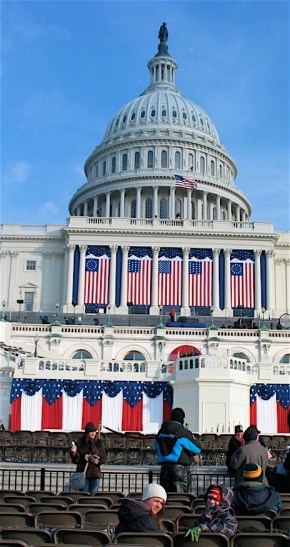
Sixteen years later I moved from Chicago to Washington to work in the Clinton administration. My cousin Therese with her children, Peter and Melissa, visited often from their home three hours away in New Jersey, sometimes at the drop of a hat: “Therese, if you can get down here tomorrow afternoon, we can go for a tour of Air Force One!”

One summer Peter was one of the lucky few 12-year-olds to be accepted as an intern in the Smithsonian Institution’s summer camp. It was across the street from where I worked at the Department of Education. He freewheeled around the museum in the afternoons before we drove home together. In the evenings he briefed me on where to find Charles Lindbergh’s Spirit of St.Louis and Abraham Lincoln’s stovepipe hat.

capitol-img_0595
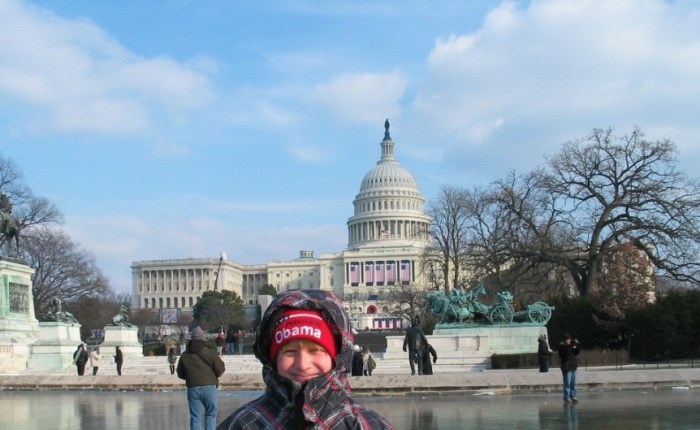
My trips to the capital city are infrequent these days. When my grandchildren, C.J. and Kirby, were 10 and 12, we flew from Chicago and braved the 20-degrees with 1.8 million others for Barack Obama’s 2009 inauguration.

Two years ago Peter retrieved me from the Washington Hilton in his new car, a spiffy bronze Fiat. He’d been working in Washington after a stint in the Peace Corps. He drove through Rock Creek and around the neighborhoods–Adams-Morgan and DuPont Circle–pointing out all his favorite spots, just as he had 20 years earlier, as if he were my guide to places I’d never been.

The Incorrigible Scottish Terrier

The Incorrigible Scottish Terrier

Ozzy compulsively reads the d-mail of those who have preceded him along the sidewalk by sniffing low-lying boxwood, wrought iron fences and hardy city trees. Some would think this slow walk an aggravating willfulness and train the beast to move on. Not me. I appreciate the instincts and habits of this tamed wild animal who yanks me from one spot to the other, forward and backward, reminding me of his constant presence.

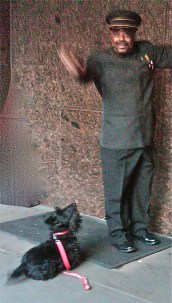
img00188-20110523-1919-2High-rise apartment buildings bookend each corner in Ozzy’s block of early 20th Century townhouses. At one corner, Gary the doorman entertains his Thompson Hotel guests by pop-flying Milk Bone dog treats for Ozzy to snatch in midair. Their RBI reaches 80% most days. Rounding the corner on Oak Street, Ozzy sniffs out bowls of treats laid down by strangers at the shops I think of as clothing museums – Dolce and Gabbana, Tom Ford, and Carolina Herrara.
The Scottish Terrier is notoriously independent. My twice-a-day walk with 20-pound Ozzy has wrenched my left shoulder to the point where I have had my entire shoulder joint replaced. One remedy for outwitting the domineering dog is to attach the leash to a loose chain collar and when he pulls, snap the leash so he’s startled by the scritching sound of the sliding chain. I tried this for a while.

One snowy evening last winter, I gathered my dog-walking storm gear – neon green il_340x270-672296456_4r2jcaterpillar coat (easily seen in the dark), slip-proof gloves (for hanging onto the leash), cleated boots, Ozzy’s sweater, and dog boots to protect from the stinging salt. We trudged across Michigan Avenue to East Lake Shore Drive by the Drake Hotel. They continually shovel and salt a long stretch of pavement there. The wind blocked any possible noise from street traffic, and the snow muffled foot traffic. We marched down the street then back, across Michigan Avenue, into the dog entrance of our building, up the elevator and into the hallway of our apartment. I loosened and lowered my hood and looked down to find Ozzy’s iced-up chain collar melting on the carpet – but no Ozzy.
Pounding on the elevator door I screamed, “Is my dog in there?” I flew down three flights of stairs, out the dog entrance, and into the middle of the intersection where Michigan Avenue meets Lake Shore Drive. Ozzy’s black body would easily show in the white snow.

“Oh God! I know you’re punishing me for not picking up after him tonight but it’s too much to bear! Please.”

I screamed out to passersby as I crossed to the Drake where the doorman yelled, “Yes! Hurry! I saw him running toward the lake!”

Another, a dog-walker, “He went over there!”

And another, “I saw someone take him to 209!”

At 209 the unfamiliar doorman said, “I was hoping you’d come by, since I didn’t know how to find you.” He retrieved unrepentant Ozzy from the package room and I carried him the one block home. The following morning’s walk took us to Walgreen’s to purchase a proper dog collar.

On Winning: The Cubs and Cleveland

On Winning: The Cubs and Cleveland

Susan Keegan and I hopped in her shiny new red Cadillac Crossover in Chicago and booked out of town to Ohio.

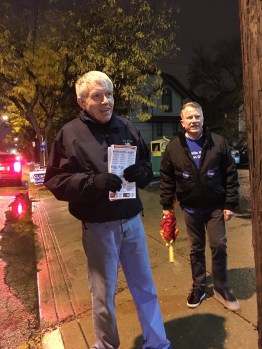
Our mission:  canvass voters for the Hillary Clinton campaign. Ohio was a battleground state where we had friends to accommodate us for the five days leading up img_1041
to election day. Our canvassing territory was Ohio City, a quaint restored section of Cleveland. Thirty-eight hours before we left town the Chicago Cubs won the World Series against the Cleveland Indians. The final game had taken place in Cleveland, and conscious of the seriousness of our mission to win over Cleveland voters, we vowed to keep our Cubs hats at home. I even told someone I was from Toledo to curb anticipated antagonism.

We met old and new friends  – Keith from Sonoma, Carol from Washington DC, Jamie from Oakland, Dennis from Virginia and even Vivienne who flew in from Ireland for the effort to nail the Trump coffin shut in a small patch of the American body politic.

News from my iPhone said Chicago’s parade for the Cubs win would be held the next day beginning at Wrigley Field, rolling down Lake Shore Drive and Michigan Avenue to Grant Park, right past my condo building. “Oh Noooo,” I groaned in the car, “I’m going to miss it.” “Do you want to go back?” Sox fan Susan asked half-jokingly. No, we were off to do God’s work. No turning back.

I texted my 19-year old grandson, C.J, and told him to go to my place to watch the parade. He’d already been planning to bring his brother, 10-year-old John into town from their suburban home to spend the night and get a good position on the parade route. “Thanks for letting us stay,” C.J. texted, “John borrowed your Cubs hat – I hope you don’t mind.”

By the time Susan and I arrived at Cathy and Marc Dann’s vintage Tudor outside Cleveland we were exhausted from talking the entire seven-hour drive about Hillary’s winning campaign. All the polls said she was going to win. The betting community said she was going to win. Astrologers said she was going to win. The last time the Cubs won the World Series, the incumbent party won. Since Hillary was the incumbent party’s candidate, we took that as one more sign  we were about to have our first woman president. Women were prohibited from voting for twelve more years after the Cubs last won the World Series in 1908. Women had won the pennant in 2016. This election was our World Series.

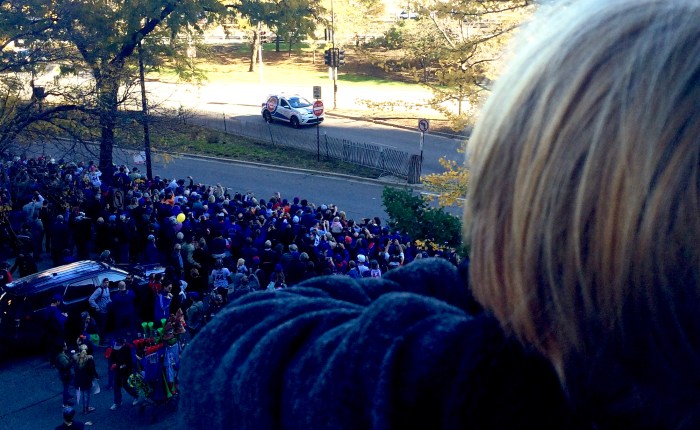
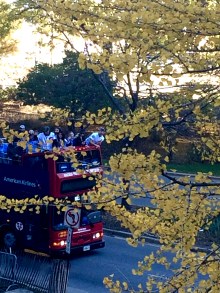
From my third floor balcony, C.J. and John each took iPhotos and videos of the Chicago Cubs open air buses with the players, their img_4826families, friends, team managers, coaches and owners as they crept down Lake Shore Drive onto Michigan Avenue. Cubs first baseman and cancer-survivor Anthony Rizzo lifted the trophy above his head as fans shouted, “We Never Quit.”
Fourteen hours after the polls closed in Ohio, Susan and I drove home. We had no trophy, no win. But we vowed, like the Cubs, to never quit.

2016: Rachel Jackson and Hillary Clinton – Slander Will Wound but Will Not Dishonor

2016: Rachel Jackson and Hillary Clinton – Slander Will Wound but Will Not Dishonor

th-2
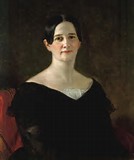
Oh, my dear Rachel Jackson — 188 years after the brutal campaign between your husband Andrew and John Quincy Adams, the citizens fear the republic will not survive the brutal campaign of 2016 for the 45th President of the United States.

The two candidates are Republican Donald Trump, a known philanderer, tax cheat and a liar; and Hillary Clinton, the first woman nominated by the Democratic Party, the same party formed by your husband in 1824.

th-4
2016 voters mistrust Hillary Clinton. Statisticians show she distorts the truth 28% of the time, compared to Trump’s lying 70% of the time. However, the public fixates on Republican propaganda that pounces on her daily for mishandling classified material when she was Secretary of State. Yes, Rachel, we have had three women Secretaries of State since women won the right to vote in 1919.

This lack of voter confidence is not the hallmark of the 2016 campaign, however.

Throughout his campaign, Trump has proclaimed Hillary and other women incompetent, liars, corrupt, pigs, fat and flawed. Trump runs beauty pageants and builds hotels. He’s been plagued by women publicly accusing him of unlawful touching. He calls them liars and shifts the conversation to stories of our 42nd President’s sex scandals. Our 42nd President, Bill Clinton, is Hillary’s husband. Trump excoriates Hillary for enabling her husband’s extramarital affairs, then he turns around and calls for Hillary’s aide de camp to be dismissed because the aide’s husband exposed himself to a series of women. Trump says the aide’s marriage to a “major sleaze” makes her a security risk.

America in 2016 is collectively depressed by the deluge of vulgarity. Voters clamor for more issues yet soak up the scurrilous, all the while exclaiming the United States will never regain her honor.

You know how this feels, my dear Rachel. The Hermitage, your beloved Nashville plantation, restored for visitors, serves up details of your death. When you married Andrew Jackson, your violently jealous first husband published a news article that you were never divorced, knowing that he lied to you about filing your divorce papers. He accused you of adultery and bigamy. Your new husband Andrew, a lawyer, rectified the situation and you remarried him legally. All this humiliation was heaped upon you before you were twenty-three years old.

Andrew Jackson fought wars and politicked around the country for the next forty years leaving you at home to manage the 1000-acre family farm. Your work kept you from the day-long carriage ride to town until the day you had to shop for your Inaugural Ball gown. It was only then, in your Nashville hotel lobby, after Andrew Jackson won the election, that you came across a campaign pamphlet accusing Andrew of adultery and running off with you, another man’s wife.  And you accused of bigamy.

Weakened by stress, depression and shame, you returned to the Hermitage and died, buried in your Inaugural ball gown. Our 7th President began his term in profound grief without you at his side.

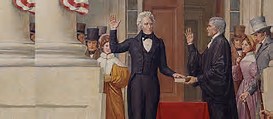
thWell, Rachel, I want you to know the government peacefully transferred power from John Quincy Adams to Andrew Jackson and Old Hickory scripted your tombstone, “A being so gentle and so virtuous – slander might wound but could not dishonor.”

On the eve of the election, our country’s history is small comfort to the downtrodden, but they will soon hope again because slander might wound the United States but it will not dishonor her.

Casper the Holy Ghost

Casper the Holy Ghost

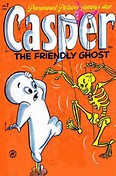
The Holy Ghost appeared to me in the first grade on the day our Catholic school nun taught our class about the three persons of the Trinity.  My shimmying skin signified Casper the Friendly Ghost had floated into our classroom with his new, deeper nature as the Holy Ghost’s doppelgänger. A 1950’s cartoon character, the bubbly, happy, peaceable Casper tried desperately to befriend humans because his fellow ghosts were too sinister.But the poor guy terrified most people even though his spirit was warm-hearted and affable. Now he was one of the persons of God. And I needed Him.

My original first grade at Stone Ridge Academy of the Sacred Heart in Washington DC was interrupted by illness. I didn’t learn about the Holy Ghost until I got to my next first grade in a parochial school in Terre Haute Indiana. I was happy to repeat the first grade so I could be with my younger sister and best friend, Erin.

Third-gader Mara, my older sister, teased me relentlessly about flunking first grade in front of her friends – and what would have been my friends if she hadn’t poisoned them against me. I prayed that my one new friend, Casper the Holy Ghost,would scare Mara away from tormenting me.

I never had any trouble with the Trinity. Catholics bless themselves by making the sign of the cross, tapping the head, heart and each shoulder, while reciting “In the Name of the Father, the Son and the Holy Ghost.” The concept of the Trinity was and is still simple – three persons in one, just like a cross. For the life of me I don’t know why theologians are always trying to explain it. Perhaps they didn’t have Casper to guide them in the first grade.
I dressed as Casper at Halloween –  many kids still do. My mother wasn’t the least bit interested in dabbling in children’s holidays, much less making costumes. But my Casper costume was a cinch. As long as I didn’t cut holes for my eyes, she let me drape a white sheet over my head and Erin, in her hobo costume, led me around trick-or-treating. Mara, in her I Love Lucy outfit, ridiculed us surrounded by her pack of friends.

th-5

I started collecting Casper the Friendly Ghost comic books in 1952 when I was six. By the time I was ten I had them stacked up alongside Superman comics in my closet. One day I came home from playing baseball and Mara had thrown away my comic book collection. She said it was time for me to grow up. The slick odor of those mistreated keepsakes haunted me for a time but the quivering feeling of Casper’s friendship and protection eventually evaporated.

th-6
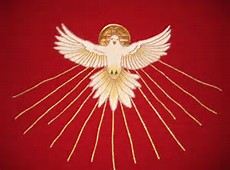
About that time Catholics started using Holy Spirit instead of Holy Ghost. The only image I had of the Holy Spirit was an inanimate white dove hanging open-winged over statues of Jesus. He certainly didn’t look like he needed friends. I slinked away from the Holy Ghost until years later when He fell into my own spirit and turned my old fear of Mara into forgiveness. She’s still scary. But not to me.

Another Mother for Peace

Another Mother for Peace
anothermothersunflowerlogo
Another Mother for Peace poster

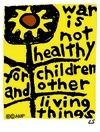
In 1968, Jim Kelly and I moved to Lansing, Michigan with our toddler son. While Kelly studied for his Masters of Social Work at Michigan State, one-year-old Joe and I marched with the national anti-war organization “Another Mother for Peace” to protest cereal companies that advertised during violent cartoons on Saturday morning TV.

We returned to Belmar, New Jersey, at the end of the school year and moved into an old Victorian beach house where Kelly painted the exterior in lieu of rent. At the end of the summer, we moved in with Kelly’s parents while he sought employment. Built-in babysitters allowed us to frequent our favorite saloon, McCann’s Tavern. In autumn, 1969, I got word that the Vietnam Moratorium Committee was planning what would be the largest antiwar protest in United States history. il_570xn-259808473

I set about convincing our drinking group at McCann’s to drive the four hours to the March on Washington. Ramparts Magazine had taught me everything I needed to know about the War. This publication gave birth to my congenital anti-war condition with stories such as an expose about a Michigan State University group that worked in Vietnam as a front for the CIA.

In McCann’s we debated off and on about driving to the nation’s capital in the dead of night. Even though everyone just wanted to drink and have a few laughs, I kept it up. “Forty-five thousand American troops have died in the past two years. If we don’t end the war your military deferments will be rescinded and you’ll all get drafted into the Army.”

That did it.

Two carloads of us drove off at McCann’s last call. Since I had lived in Washington as a teenager for a few months with my father, I drove the lead car, pretending I knew the directions.

When we arrived, yellow school buses were parking bumper to bumper around the White House so President Nixon wouldn’t see the protesters. We headed to a Jersey Shore friend’s place near DuPont Circle to sober up and eat. Reeking of coffee and cigarettes, our speed-freak friend had been up all night working in a restaurant but he hitched on to our party and created an all-out breakfast banquet. They all fell asleep. I dropped a diet pill and took off for the Lincoln Memorial.th-7

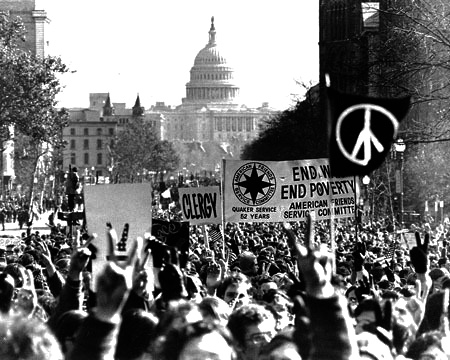
Peter, Paul and Mary and Arlo Guthrie belted out tunes between speeches from anti-war Senators Eugene McCarthy and George McGovern. Peace hero Dr. Benjamin Spock, whose book on baby care taught me how to be an engaged mother, told us half million idealists that we were all noble. Pete Seeger led the crowd in the singing of John Lennon’s “Give Peace a Chance.” I have loved sing-alongs ever since.

Back at the crash pad I hustled my friends outside to join the protesters marching toward DuPont Circle. We all got tear-gassed, screamed for mercy, helped each other to our cars and tore out of town.

The war ended six years later.

No one got drafted.