Acting Against Type

Acting Against Type

Sitting in my church pew for the last 45 years I’ve heard from time to time that characters in the Old Testament are types of Christ. For instance, the Jonah story — spending three days and nights in the belly of a whale before the big fish spat him out on the beach is a type of Christ because the tale is a foretelling of Jesus spending three days in hell after he died, then emerging from his tomb onto the shores of Christianity. I don’t know why all this typology is necessary to connect the Old Testament to the New or, for that matter, what it has to do with me.
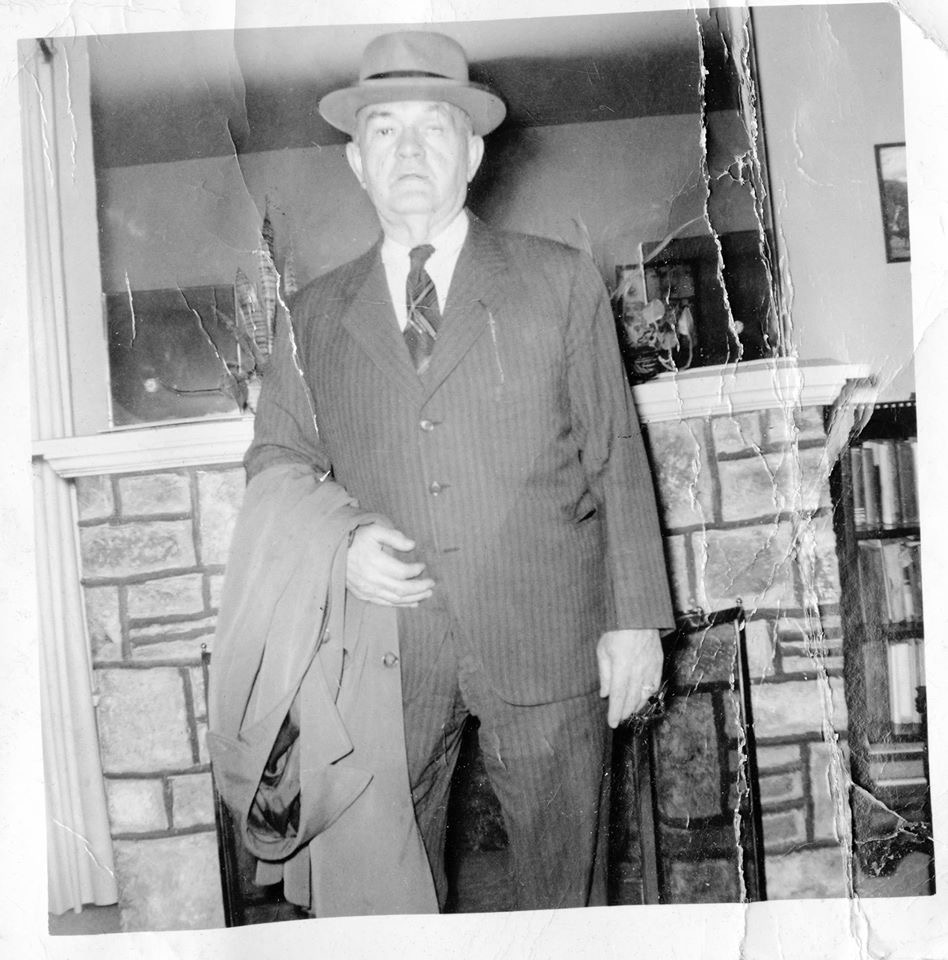
Grandpa Bill Burke

I suspect looking to the past to explain the present is a natural phenomenon, one we’ve used to nail each generation’s stake in the Oregon Trail of human history. Christian typology fortifies this grand obsession. Just as actors fruitlessly try to escape typecasting by choosing roles that are opposite their types, we cannot escape the age-old pull of seeing signs of our type in those who’ve gone before us.

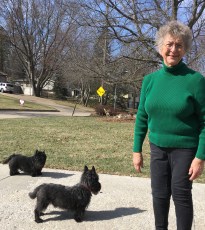
A cousin named Barb Violi found me a few years ago through FaceBook. My father had spoken of his sister once or twice, but  he never mentioned she had children, or that he visited them in Memphis from time to time. When I visited Barb for the first time in her home in Omaha last month, she shouted, “Oh my God, you look just like Grandpa.”
IMG_1534
Barb Violi with Zoe & Louie

Looking for signs of my type in them, I was hungry for Barb’s memories about Grandpa and our other relatives. There were a few similarities in the dead forebears but nothing like that of Barb herself who is a rabid Democrat, cultivates indoor geraniums, loves her Scottish Terriers, swims and rides her bicycle and has art-covered walls. Her yard is full of birdhouses and flamingo planters. We are the same type

Barb told me our grandmother’s name was Katherine. My father was the type who kept secrets. He’d never mentioned her. She was killed in a car accident when he was a toddler in Terre Haute. My son unwittingly named his daughter Katherine with no knowledge of his great-grandmother’s name. My father’s father, whose looks I favor, had a girlfriend, Stacy, whom my father secretly visited in Indianapolis. My father named his youngest daughter, my sister, Stacy. My mother, who was an east-coast snob, couldn’t have known the connection because she would never have stood for naming Stacy after anyone connected to my father. Barb disclosed that most of my father’s relatives were not the drinking type. My mother found non-drinkers the ultimate in lower life forms. The only thing lower: Midwesterners.
Unknown
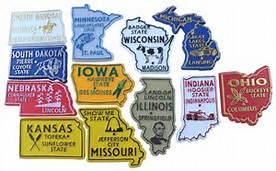
The Midwest

I keep looking for some ancestral typecasting to blame for my body shape, my alcoholism, my arthritis, my murderous thoughts. Jesus and Buddha both taught that we are who we are in the moment, unyoked from the past or the future.

Adhering to this spiritual axiom requires me to act against type.
Something Fishy at the Spring Migration on the Platte River

Something Fishy at the Spring Migration on the Platte River

Something’s fishy. Is it fate? Chance? God?

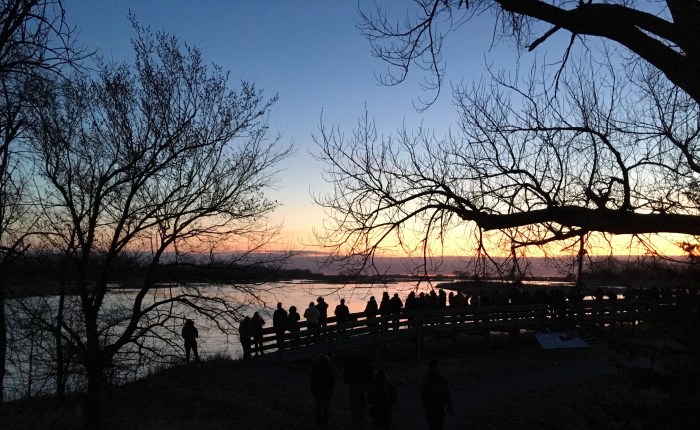
On the Platte River in central Nebraska I gather with friends from Chicago for the spring migration of the Sandhill Cranes. We arrive at our rented cabin just in time for the dusk fly-in ¼ mile down the road at the Audubon Rowe Viewing Stand on Elm Island Road. On the boardwalk-like stands we parrot the 100-plus birdwatchers as they steer their binoculars toward the goose-like honking in the sky. The bugling cries grow louder as the cranes start to

appear. Thousands of birds swirl in the overhead vortex down into the shallow river with their spindly feet splayed like landing gear on an airplane. It takes about two hours for the birds to land in their overnight roosts on the sandy Platte. We press our binoculars into our eye sockets until the very last bird nudges itself into place, snuggling alongside its friends in the water for the night.

sandhill_crane_usfws
Sandhill Crane

The long-beaked crimson-headed North American Sandhill Crane coexisted with dinosaurs, making it one of the world’s oldest bird species. For six weeks every spring, 600,000 of these five-foot tall grey beauties stop in Central Nebraska.

At dawn, Peter, Amy, Anne, Laurie and I make our way back to the riverbank for the lift-off. The cranes yak each other awake in one of nature’s most melodic cacophonies. They fly off in waves after socializing for a long stretch extending their time on the river to mid-morning. During the day they forage in the corn fields adjacent to our cabin, packing in calories for their long trip north.

Murmuring overtakes the viewing stand. The nature-loving brood from Illinois, California, New Jersey and  Florida grow collectively quiet to hear the cranes’ every cackle, trill and honk. Conversations spring up, “I was in New Jersey once. Drove out route 80 to 70 to 35 to the Atlantic Ocean.” Why do men always talk in numbered roads?

I overhear an Audubon tour guide whisper on down the line to her group, “right there, below that white roof at the river’s bend, there’s a whooping crane.” I focus my binoculars. There it is.

th-2
Whooping Crane

There are 500 whooping cranes in the wild in North America. And I just saw one.

I run to my pals at water’s edge repressing a squeal, “There’s a whooping crane!” We are silenced by the stark white ladle-shaped body of the whooper shuffling among the blue-grey hoards of Sandhills over a mile upriver. We report the news to strangers around us, lending our binoculars to latecomers, cooing when the big white bird stretches its wings in view of our naked eyes. I whisper to Peter and Amy, “if I see a river otter before we head for home you can throw me from the plane because my life will be complete.”

th
River Otters

An hour later Peter nudges me. “there’s an otter.” And so it is. Fishing around in the water, diving down and popping up, nature’s graceful pet latches onto a tangle of twigs and leaves, twirling around and around as it floats downstream under the bridge away from sight.

Yes, something happened on the Platte. Was it you, God? You, who are both fishy and honorable? You, the everlasting instant.


Inspired by the hymn “You, Lord, Are Both Lamb and Shepherd” (“Christus Paradox”) by Sylvia Dunstan (1955-1993) who drafted these words on a commuter bus “after a particularly bad day at the jail” where she was serving as chaplain:
“You, Lord, are both Lamb and Shepherd.
You, Lord, are both prince and slave.
You, peace-maker and sword-bringer
of the way you took and gave.
You, the everlasting instant;
you, whom we both scorn and crave.*

Screaming at Hillary Clinton in Soldier Field

Screaming at Hillary Clinton in Soldier Field

Llani O’Connor and I were rabid Hillary Clinton fans during the 2008 Presidential Primary election. We exchanged did-you-hear-what-she-said exclamations all through the summer and fall of 2007 after she announced her candidacy.

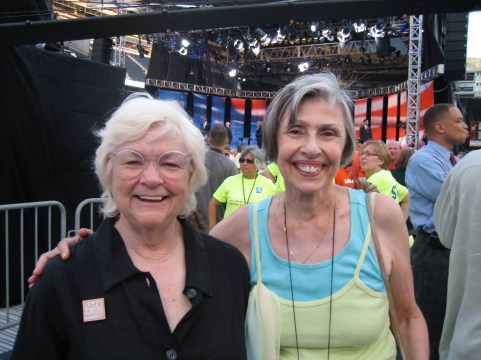
IMG_1029.JPGThis photo from August 7, 2007 shows us with sunny smiles, blouses opened to our bra-lines, red-faced, droopy-haired and sweaty at an outdoor Presidential Forum in Chicago’s Soldier Field. All seven Democratic candidates are on stage in the background: Chris Dodd, John Edwards, Bill Richardson, Joe Biden, Dennis Kucinich, Barack Obama and Hillary Clinton. It was a full 15 months before the election, and Hillary was way ahead in the polls.

I had worked as Hillary’s advance person on a few trips when I was working in the Bill Clinton Administration in the 1990s and was completely starstruck by her brilliance, kindness and sense of humor. Llani and I were ecstatic to be voting in the Primary Election that would result in the first woman presidential candidate. We knew she was going to win.

I obtained three tickets to the Soldier Field event after shamelessly begging an old friend who was an aide to Senator Joe Biden. Our third companion, Ann, drove us there, dodging and weaving down South State Street to 31st, ignoring stop signs and red lights, crossing under South Lake Shore Drive then barreling back north 17 blocks to the south parking lot of Soldier Field. We recovered quickly from the tilt-a-whirl ride and rushed into the stadium onto the field to get to the closest seats possible.

The stage was set at the fifty-yard line. Long red,white and blue panels draped behind it, and dark blue curtains hung behind the panels, blocking the back and sides of the stage. Folding chairs filled up the rest of the field.

It was 95 degrees that day – so hot that the moderator, Keith Olbermann cracked that if the candidates didn’t behave he’d cut off their air conditioning. The stadium walls offered no shade and we thumbed our noses at the heat along with the other 15,000 people, all of us 1043829789_89f65ee11b_bdancing around and singing songs for three hours waiting for the 90-minute event to start.
We were disappointed that little-known populist Dennis Kucinich received the most applause, but Hillary’s star power exploded next to the six men. We waited for the candidates to leave the stage before heading to the car for the treacherous ride home with Ann.

“Llani! Look! Hillary’s out in the audience shaking hands. Let’s go!” We plowed through hot bodies and upturned chairs to get as close to our hero as possible. Suddenly, Llani, in her baggy pink shorts, flimsy sandals and turquoise tank top climbed onto a folding chair and took off, hopping from one chair seat to another, camera in hand, shoulder bag swinging wildly and screaming at Hillary to look her way.

Traveling home the wrong way down one-way streets with Ann behind the wheel evoked little excitement after that.

Does Anyone Really Like to Read This Stuff?

Does Anyone Really Like                                 to Read This Stuff?

From the backseat of my earliest memories I hear, “Why did God make me? God made me to know Him and to serve Him in this world and the next.” It’s the first lesson I memorized in Catholic grade school, before I could even read. Sometime in my early life I heard about the Bible but our religious lessons were taught from the Baltimore Catechism with no mention of the Bible. Nuns told me Jesus was my friend, but never cited Scripture to back up the claim. Some have said the Church of Rome never wanted the Flock to read the Bible lest they start thinking for themselves, rather than having their theology managed by priests.

UnknownAt Sacred Heart Academy the high schoolers were graded on their verbatim delivery of the 1700-word Passion of Christ from the Gospel of John. Seventh graders were required to sit through a recitation of the Passion as part of Religion class. I never listened at Sunday Mass, so my first hearing of Bible passages was the torture and execution of my friend Jesus. These bloodcurdling passages sparked a morbid curiosity about the rest of the Bible, but I didn’t have a Bible to read on my own. My parents, indwelled with a long lineage of Irish-Catholic hatred for non-Catholics, refused to have a Bible in the house “like those Protestants.”

I borrowed a Bible when I enrolled in a Bible course, part of the initiation rites of the born-again cult I belonged to in the 1970’s. The elders used Scriptural passages to confront me and my live-in, abusive boyfriend with an ultimatum to either marry or separate. We chose marriage because neither of us could face life without sex. For a wedding gift, we received a gilt-edged Harper’s Study Bible, inscribed in gold, with my name misspelled (Reagen). Owning the Bible exalted me into the fellowship I craved, and I feverishly used that Bible for the next three years, marking the margins with exclamatory words, folding over pages and bookmarking meaningful passages.

I didn’t reject the Bible when I left the cult, rather I never liked the Bible and was even repulsed by it. Aside from my own bad experiences with it, the Bible’s first book, Genesis, talks of God creating Paradise and throwing out the first humans because they wanted toth be gods themselves (who wouldn’t?). Then, that couple had two boys and one of them killed the other. Most of the rest of the Old Testament describes violent gangs warring over territory, an angry God, and thousands of flawed people wandering in the desert.

In February 2013, I heard Catholic contemplative Richard Rohr say to 1,500 retreat-goers that Bible stories are myths to provide insight into human nature. The simple transformative act of spiritual hearing jolted me into a surprising love for reading the Bible—the same Bible that has been there all along.

Are We Getting Dragged Into Their Holy War?

Hal Lindsey’s end-times prophecies in The Late, Great Planet Earth, permeated the born-again, religious cult I joined in the early 1970’s in Toms River, New Jersey. There were about fifty of us—disparate spiritual seekers who accepted Jesus Christ as our personal the_late_great_planet_earth_coversavior, a requirement for inclusion in the exclusive Fellowship. One of the elders had broken away from a local Plymouth Brethren Church and opened the basement of his family’s large, wooded, colonial home for Bible study and Sunday services for us blue-jeaned recovering addicts and alcoholics. As a newly sobered-up ex-hippie, full of self-loathing, all I wanted was to be accepted in that Fellowship.
Based on his interpretations of the Book of Revelations, Lindsey’s book sensationalized end-of-the-world Biblical prophecies connecting them to current events as proof of the coming Rapture where Christians would be taken up to heaven and avoid Armageddon. Satan’s plans to form a one-world government and religion, as prophesied, were triggered by the establishment of the state of Israel and the World Council of Churches—both in 1948. Everywhere I looked in those days I saw Lindsey’s signs of the end times: increase in the divorce rate, recreational drugs, new technology, the gasoline shortage, religious ecumenism, and the birth of the European Union.

Church elders directed every aspect of our lives. Men were the head of the household, women submitted to them and didn’t work. We lived in separate homes but were discouraged from socializing outside the Fellowship, lest we be influenced by secular humanist ideas, like having credit cards, one of Satan’s tools to create a global economy. We didn’t put our money in The Bank of America because the bank was seeking to legalize interstate branch banking, thereby centralizing all the country’s money into a single entity, another Satanic plan.

When my son joined Little League in the first grade, I sat away from the other parents in the bleachers fearing the wrath of God if I talked to anyone outside of the Fellowship. Church members scorned me for volunteering for Jimmy Carter for President in 1976, even though he was born-again.

After four years, I extricated myself from the Fellowship, left my abusive husband in New Jersey and drove my nine-year-old son 800 miles west to Chicago for a new life. A group of Christians at LaSalle Street Church who had experienced similar religious cults nursed me back to spiritual and emotional health. The ideas of Hal Lindsey dissipated into the ether of bad dreams and gradually I no longer looked for signs of the end times.

Until now.

President Trump in his first speech to the Joint Congress announced he was not the President of the world, rather the President of us Americans.

These words, and words of White House strategist Steve Bannon announcing a nationalistic government free from links to other countries remind me of Hal Lindsey’s warning to resist Satan’s plans for a global economy and one-world government.

Are they fighting a holy war?

signs28_title
http://1timothy4-13.com/files/prophecy/signs28.html

Continue reading “Are We Getting Dragged Into Their Holy War?”

This is What Happens When You Opt-In

Looking out my third floor window as I tap words into my MacBook Air, I see three crows bounce from bare tree limbs to the ground and back — caw, caw, cawing at each other about their breakfast. The internet once told me if you look a crow in the eye, it will 12196091_952754094793732_8173525927943455115_n-1remember you for three years. Momentarily anthropomorphizing these superior animals, I connect to them telepathically. Thank you Mr. and Mrs. Crow for visiting me this morning. This connection more than compensates for those mornings when their caw, caw, cawing wakes me earlier than I’d wish.

All of a sudden, something pops up in the corner of my screen: “White House forced to reverse course on Trump’s golfing.” I instantly break off my birdwatching and open the link to this urgent story. I don’t dislike golf, but I’m not interested either. However, since the tragedy of 11/8, I involuntarily relinquish my time to so-called breaking news. I click and read. The next thing I know a little box appears with a photo of a pair of shoes I covet. Hmmm, I wonder if those are on sale. I click.

Pope Francis calls these commercial intrusions “opprobrium of savage capitalism.” Yikes. I’m ashamed. But still I click.

When I retired in 2011, I left behind a well-serviced computer and an outstanding modern invention, the Blackberry cell phone. On my own, I wasted time and money trying to replace these gadgets of convenience. Mourning the loss of IT department expertise, I succumbed to the sales pitches of Sprint, AT&T and T-Mobile, gobbling up three different mobile phones within six months. The first one, an android, made sparkling photos. It accidentally slipped through my fingers into Lincoln Park’s South Pond as I leaned over to click a photo of a turtle sunning on a rock. For my second cell phone I decided to forego the camera and try a much less costly flip phone. Alas, my thick Irish fingers couldn’t navigate the buttons. The well-trained manager at T-Mobile suggested an iPhone and showed me how easy it was to use, how cheap it would be on a monthly payment plan and how all the information stored in the cloud downloaded (or is it uploaded?) into the phone.

Acquiring a computer was simpler. I knew without an ever-ready IT department, I had to thbuy an Apple since it was the only brand with a store on Michigan Avenue, which I equate, rightly or wrongly, with quality. And it has a walk-in IT department.

After a prolonged learning curve, I have enough knowledge to use my gadgets for news, restaurant suggestions, bus schedules, appointment reminders and a depository for my writing, rants and raves. I maintain an online community of friends, enemies, strangers, relatives, and acquaintances, larger than I could ever handle offline.

Well, Reader, it’s time to brake for breakfast. But first I must read two articles that just extralargepopped up:  “Is a ‘deep state’ subverting the presidency?” and “Bald Eagle Population Booming In Chicago.”


How to Survive Grade School: Leave Thy Low-Vaulted Past

How to Survive Grade School: Leave Thy Low-Vaulted Past


First Grade  You have chicken pox and can’t go to school. You have mumps and can’t go to school. You have measles and can’t go to school. We’re all going to live in a hotel for a while so you can’t go to school.

Second Grade We’re moving to a new town and you’ll be going to a new school. The nun says you can’t read so you have to repeat First Grade.

First Grade We’ll buy you a bicycle to take your mind off your shame. What color do you want? Green? Ok. Oh, your sisters want bicycles too, blue and red.

Second Grade The nun says you read well enough to advance to Third Grade.

Third Grade Why don’t you know how to multipy? Come to the convent after school. We’ll have snacks and I’ll teach you arithmetic. You’ll be late going home. Can you cross the street by yourself?

Fourth Grade We’re moving to a new town and a new school. We’re moving again and you’re going to another new school. We’ll be living in a hotel until we find a home. You’ll be riding the public bus to school.

Fifth Grade We’re moving to another town and a new school. We’ll be living in a hotel until we find a home. March to class. March to lunch. March to recess. No talking in the hallway. No talking in the classroom. No talking at lunch. We’re moving into a house in another town and another school. They don’t wear uniforms, so let’s go shopping. Whew! No uniforms. No marching. And lots of talking.

Sixth Grade Hey new girl! Let’s sneak into the church at recess and read the booklet about sex. Let’s go ice skating after school and play Steal the Bacon with the boys. Want to join Girl Scouts? We’ll go camping and collect badges. We’ll sneak off in the middle of the night to meet the boys. I hear the nuns sent you home for wearing a sweatshirt to school. It’s ok. You just have to know the rules.

Seventh Grade We’re moving to another town and a new school. You have to iron your own white shirts, polish your brogues. Learn French. Work harder on arithmetic. You and your sister are playing palace guards, dressed in frog costumes, in Gilbert and Sullivan’s The Mikado. Ride your bike to play summer softball. Ride your bike to Cathy Riley’s, then ride her horses into wild raspberry fields.

Eighth Grade You’re on your way to win the all-school trophy for all-around best student. Keep up your grades, sports, tutoring and extra credit projects. We’re moving to a new town without your father. You’ll be living with relatives for the last six weeks of the school year. The school requires all eighth graders to memorize nine poems in order to graduate, including Oliver Wendall Holmes’ The Chambered Nautilus:

Build thee more stately mansions, O my soul,
As the swift seasons roll

Leave thy low-vaulted past!

Let each new temple, nobler than the last,
Shut thee from heaven with a dome more vast,
Till thou at length art free,
Leaving thine outgrown shell by life’s unresting sea!

Change Your Life with Lima Beans

Change Your Life with Lima Beans

     When I put the light green kidney shape in my mouth, my tongue moved it to my baby molars, gingerly munching up and down, side to side, until I felt a mushy bean pop out of the slimy skin onto my tongue. I gasped, and my reflexive inhale involuntarily pulled the glob to the back of my throat. I gagged on the paper-like skin, exhaling the sodden lump back through the front of my teeth and out onto my plate. My little five-year old body sat at that table until “you eat those lima beans.” After everyone went to bed, I dumped the loathsome things in the garbage. That night I vowed to forever hate lima beans and thus seeded a recipe for an unyielding, uncompromising, black and white life.

     Whatever possessed my mother to force me to sit at the table of uneaten lima beans for hours? Was it a doctor who told her that her children needed to eat vegetables? Or perhaps she was trying to introduce exotic foods into our menu so she could show off her three little girls and their sophisticated palates.

     My sisters and I all hated vegetables. The older, Mara, would feign putting a forkful of beans in her mouth with an air of superiority, a competitive streak born in her and never pruned. Erin, the youngest, figured out how to put her vegetables in a neat pocket formed by her napkin and dump it in the trash while no one was looking. Hiding unpleasant situations is perennially rooted in her life.

     When the self-actualization movement bloomed in the 1960s and ’70s with books such as The Prophet, I’m Ok You’re Ok and Be Here Now, I cultivated my deeper self by rooting out my hatred for lima beans. I tilled the soil for a backyard garden in Toms River, New Jersey, and planted the formerly-detested vegetables. When they sprouted, I thought the light green shape hanging from the stem was a single bean. After a few weeks, bumps appeared under the thick skin of the seed pod. I diligently hosed away aphids, leafhoppers, and mites, but I was sure my crop was deformed. Consulting Rodale’s Basic Organic Gardening book, I learned the bumps were actually beans – four lima beans per pod. After a few months, I pulled the bean pods from the vines, broke them open and started eating the sun-drenched crop right there on my knees in the garden. My neighbor flew out of her back door and yelled Stop! You can’t eat raw lima beans! They’re poison!

     Uh-oh.

     This was a new reason not to eat them, cooked or uncooked, but I was determined to use lima beans to crack open the hardened space between “what is” and “what could be.” I brought an apronful of beans inside, cooked, salted and buttered them and ate the day’s harvest for breakfast. They were good.

     Abiding in the distasteful takes practice. The once indigestible lima bean aerated my closed mind and paved the way toward a paradise of tasty, fresh vegetables.


What Is My Work, You Ask?

What Is My Work, You Ask?


1962. My work is to stop laughing like a nervous little girl and start smiling like an unflappable young lady in the coffee shop on the Asbury Park boardwalk. To turn away from the seagulls fighting over dead fish on the beach and write “pancakes” and “bacon” on my notepad. To pay attention to the old telling the story of the 1934 wreck of the cruise ship SS Morro Castle on the beach. To save money for tickets to Joan Baez and Bob Dylan at the Asbury Park Convention Hall.

1967. My work is to read Dr. Benjamin Spock’s Baby and Child Care and apply its 51hjigsfuol-_sx309_bo1204203200_commandments to week-old smiles, cries in the night, a nine-month old sprinter and a child who eats only chicken. My work is to stand my ground in the whirlwind advice from mothers, aunts and grandmothers. To learn to ride a baby on the back of my bicycle. To animate words as I point to clouds, trees and cars as if I’ve never seen these things before in my life.

1976. My work is to bypass the door to the secluded basement with its graveyard of empty vodka bottles. To surrender to my new single-motherness. To trust my untrustworthy father and move from a sandy Jersey Shore cottage to a downtown Chicago highrise. My work is to know this is the best plan for a nine-year-old boy’s future happiness.

1982. My work is to dress up in business clothes, act smarter than I am, eavesdrop on everyone’s conversations in a boiler room full of political operatives, ask stupid questions and digest enough information to schedule Nancy Stevenson in places that help win votes for her husband’s campaign for governor.

1990. My work is to be a motherless child. To lament the loss of my uterus and ovaries, and, my boyfriend. To escape to Paris and London with my twelve-year old niece. To atone for all my past sins.To feign self-confidence while running the Illinois Democratic Party.

1993. My work is to take Prozac on the way to Washington to join the management class of the Clinton Administration. To imagine I have power and to hide humiliation when I’m exposed. My work is to honor the ruling class. To recognize they are human. To protect myself from evil-doers and self-promoters. My work is to mourn the loss of naiveté.

2006. My work is to shield myself and others from Cook County Government officials who believe if you are happy at your job you’re not working hard enough. To cherish those I lead for what they are today and not for what they will be tomorrow. To protect them from those who refuse to know their names.

2017. My work is to record how far my shadow falls behind me. To tell the truth about myself and trust God with where the words go and what they do when they get there. My work is to proclaim the US Constitution guarantees me the freedom to assemble publicly and express myself openly without retribution. My work is to say I love America and when the saints go marching in, oh! how I want to be in that number.

Inspired by “An Address to My Fellow Faculty,” by A. Papatya Bucak, from brevitymag.com

Irish DNA: Inheriting A Stigma

Irish DNA seems to have a gene actively predisposed to alcoholism though there’s no scientific evidence that it’s hereditary.

The first ugly secret in my family is that my twenty-three year old mother, Agnes Donnelly Ryan Burke, was drunk in the Georgetown Inn in Washington with my father at the time her mother died. She wasn’t located until the next day. Later that year my parents were married in Key West where my father, Bill, flew reconnaissance planes across the Florida Straits to Cuba. Their married life began with Bill spending two weeks in the brig after a drunken brawl over Agnes.

Alcohol addiction begins with an immature reaction to the emotional and physical pain of adverse childhood and young adult experiences. When and why did Agnes and Bill cross over from heavy drinking to alcohol disease? Bill’s mother died when he was three so he had early trauma. Agnes was prescribed Guinness Stout when she was twelve for anemia so she had early permission. Their chaotic, calamitous alcoholic marriage intruded on the childhoods of my three sisters and me but as far as I know we are not all alcoholics. We all manifest common characteristics of growing up in an alcoholic home: fear of emotions, conflict avoidance, perfectionism, compulsive behavior, depression, melodrama, overreaction to change, and the denial of all these traits and their connection to alcoholism.

In the forty-one years I’ve been in Alcoholics Anonymous, there have been ongoing, persistent discussions, “Is it hereditary? Is it a disease?” Since the1900’s the language describing alcoholism has screamed out to the non-addicted populace, WE CAN’T HELP IT. The world has been given plenty of messages to enable it to accept us alcoholics as normal people with medical problems. Currently, the community that studies these questions is
untitledpromulgating the idea that addiction is a biological disorder from a dysfunctional brain – not inherited and certainly not a moral failing.

This past year I had coffee after church with a new acquaintance. In swapping little tales about ourselves she told me she had a match.com date who told her he was in AA. “Isn’t that disgusting?” she said. I abruptly excused myself saying I had forgotten to walk my dog and had to run right home.

Alcoholism was shameful before I was born, shameful in my family growing up, shameful in myself, and shameful now. All the work that has gone into trying to change negative thinking against alcoholics has not shifted the stigma one iota. Two million recovering alcoholics still sneak off to life-changing, life-saving AA meetings, keeping their recovery a shameful secret.

Agnes died of alcoholic brain syndrome (wet brain) when she was seventy. Bill joined AA when he was forty-five and stayed sober for 35 years until he died. He was proud to be part of a recovery community and thrived by helping others. But he never felt as though he quite measured up to the world outside of the AA fellowship. He wasn’t secretive about his alcoholism, nonetheless, the stigma hounded him until the end.