Ozzy the Arhat by Regan Burke


Do the dead always visit us in the morning? I wake up listening for the click-clacking tap-dancing, rat-a-tat across my hardened floors. Ozzy had well-padded soles, wide feet and solid toenails meant to root out rats and badgers from their earthen dens. No Scottie-level potted plants ever made it past the first day, neither inside nor on my third-floor balcony. His diggers instinctively, fanatically worked their way into the soil to get to something, anything that proved his worth, duty done. Satisfied with nothing more than a dirty nose and paws, he gave me a message: don’t worry, I’ll protect you from any danger, man or beast.

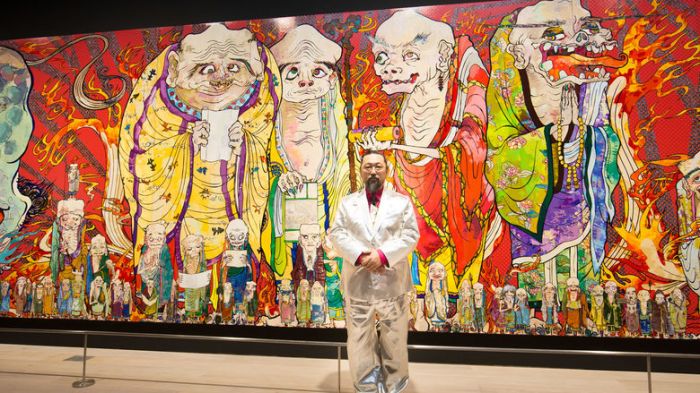
At the Takashi Murakami exhibit in Chicago’s Museum of Contemporary Art, I wondered aloud to my 20-year-old grandson, CJ Kelly, why the artist painted so many colorful frogs at the feet of the arhats. CJ mindfully revealed those are the arhats’ toenails, not frogs. Ah, toenails. Murakami’s arhats are Buddhist spirits who hesitate between two worlds, the physical and the not, to comfort suffering earthly beings. His bulbous toenails are a tribute to the noble path of those enlightened ones whose feet are moving them through their death and decay. The parade of toenails is Murakami’s day-glo gratitude for arhats who stop along the way to ease our sorrows.

Murakami called his Chicago exhibit, The Octopus Eats His Own Leg, based on an ancient Japanese adage that an octopus eats its own decrepit limb to save itself from death rot. A new leg grows back, the octopus is healed and lives a long and healthy life.

In the exhibit, the 33-foot-long painting, 100 Arhats, has 1,000 intricately painted toenails. I misinterpreted the toe protectors, thought they were frogs. After all, how could toenails mean so much to anyone but me? I harbor an unspoken repulsion of human toenails. Summer sandals expose these keratin plates sitting atop ugly toes that hardly ever match each other—some curled under, some straight, some turned outward, some inward—all on the same foot.  Toenails are often fungus-rotted discolored thick globs that women hide with colorful paint instead of covering with cool shoes. God clearly missed the boat in his design of the human toe apparatus.

But Ozzy’s coal-black, perfectly formed, hardy toenails witchy-curled out of his all-business paws, ever-ready for the hunt, the prowl. At rest, his legs stretched out before him showing off his toenails as if he’d just had a pedicure.

His body turned in on him overnight. Like the octopus, his system ate up his dying kidneys and liver but left a beleaguered heart that had to be put to rest. I now have my own arhat who will walk me through the sound of silent, unseen toenails until the hard margins at the edges of grief fade into the path.

murakami_portrait
Takashi Murakami in front of his epic work “The 500 Arhats.” (Courtesy MCA Chicago)


Keep On Truckin’— Contemplation on a Deadman by Regan Burke

In Beth Finke’s latest book, Writing Out Loud, the following brief memoir was excerpted. I post it for those who’ve asked for the full story.  Check out Beth’s book for more stories from Chicago writers: Writing Out Loud.

BethFinke-WritingOutLoud-525x8-CoverDesign-245x373

_______________________________________________________

Keep On Truckin’— Contemplation on a Deadman

I worked in politics my whole life, always hoping for the perfect politician, one who acted in the best interest of the whole. Bill Clinton could have been my hero. I loved his rallying cry in the 1992 campaign, “personal responsibility.”

But I had doubts. Could I work for a candidate who was pro capital punishment and unsure of his view on abortion? Those were two issues I thought every Democrat knew to be against and for.

The “personal responsibility” message won me over. In October 1991 I abruptly left Chicago for Arkansas to work as Clinton’s campaign scheduler, a grueling job that required 24/7 attention. One cold January night Clinton and his entourage, George Stephanopoulos and Bruce Lindsey, returned to Little Rock in a small private jet from all-important New Hampshire. I met the plane on the dark, deserted tarmac to give Clinton his next-day schedule. He descended the jet stairs with a big smile, came directly at me, grabbed my coat and ran his graceful elongated fingers up and down my long furry lapels. “Nice coat, Regan,” he whispered in my ear.

This encounter may be the reason I love Bill Clinton.

When he won, I relocated to Washington to work in his administration. I moved into the first floor condo of an 1880 townhouse on Church Street in DuPont Circle. In 1994 he passed a crime bill I thought went too far. Next he signed NAFTA, an agreement opposed by every Democrat I respected. Both policy shifts were spearheaded by White House insider, Rahm Emmanuel, who decidedly did not have the public good at the forefront of his self-serving mind. But Clinton loved him. Dissatisfaction settled in the space between my bones and muscled me awake at 3 o’clock in the morning for the next six years.

In the early still of a hot D.C. August morning in 1995, NPR told me Jerry Garcia died. I collapsed on the bathroom floor weeping over the death of something I couldn’t put words to. At 49-years-old my idealism had come to an end: my phony world of everlasting good died with Jerry Garcia. Reality glared back at me in the mirror as I brushed my hair, seeing for the first time a wrinkled face and rubbery neck. I dressed in soft yellow, a flowery cotton frock, and pinned a silk flower in my hair, ready for the grieving day.

My dog Voter squirmed away from my extra long hug and I went out the door to my old friend, Keith Lesnick waiting to drive us to work. As soon as I got in the car tears spilled out. He asked about the sadness, and I slobbered out a few words, “Jerry Garcia signed into rehab last night,” I said. “He died in his sleep.” Keith waited a few respectful minutes, and then, with one simple sentence, he opened a new, naked reality that included the unspoken caveat—don’t take yourself too seriously.

He said, “well, it’s not as if it’s Aretha Franklin.”

Hazmat Blues by Regan Burke

One hundred and seventy days into the Trump Administration I flew to Washington DC for the annual board meeting of the national anti-sexual violence organization, RAINN.org, (Rape, Abuse, Incest National Network). Lively meals with DC relatives, the board meeting and coffee afterwards with old political cronies were old-shoe comfortable and safe, though conversations periodically broke into expressions of danger. This is, after all, the nation’s company town, Trump’s ground zero.

I arrived at the Washington National Airport an hour early for the non-stop flight home to Chicago. Packed with fellow travelers, pop-up phone and sunglass vendors, fast food and maintenance workers and airline personnel, the terminal sizzled. I managed to nudge a stool into a space at a long table rigged with outlets and nose-dived into the computer-news rabbit hole: click, Trump crashed a wedding at one of his resorts, click to an old story about a sinkhole in front of Mar-a-Lago, click to a twitter storm of jokes about draining the swamp.

Annoying conversations buzzed my ears about a hazmat incident at the control tower. Click! a local TV station reports fumes from roof construction at the Leesburg, Virginia control tower has shut down all flights for 4 airports around DC. Click. Is Steve Bannon, the President’s sneaky architect of distraction, trying to terrorize awaiting airline travelers?  Or did he sabotage the timetable to turn the screw on some disagreeable Administration insider?

The announcement came. “…we don’t know when flights will continue, we’ll update you as soon as we know.” It was 10:00 pm when I learned my flight was cancelled until the next morning. The United gatekeeper told us all the hotels were booked for 50 miles around and that maintenance crews would be handing out blankets for those who’d be sleeping in the airport.  No problem, I’d just contact one of the five people I know in DC and ask to lay my aching bones down on a couch. Click. Click. All five were non-responsive. Travelers were staking out their spots on the floor. In front of the gatekeeper I pleaded, “I just cannot sleep on the floor. I’m old and have arthritis. Is there no other solution?”

He shook his head.

“How much would it cost to get to the nearest hotel?”

“Sixty miles away? About $100.”

“Oh no. Are you giving vouchers for cabs?”

“No”

I was dragging my carry-on away from any hope of a reprieve, doomed to slumping to the floor by Dunkin Donuts, when a young man pressed something in my hand.

“Please let me help you. Take this.”

A $100 bill. Before I could thank him, my FaceBook message lit up with a query from Dan Murphy whom I hadn’t seen in 10 years: Click. “FB is telling me you are nearby! Can I see you?”

And right then, I was no longer afraid to die.

Click.

Click.

Click.

A People’s History of Chicago

kevin-coval-peoples-history-chicago

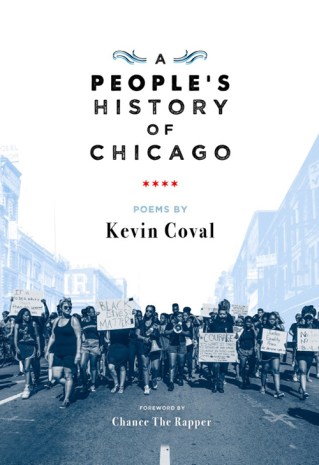
Chicago poet Kevin Coval came to a luncheon of forty older adults in the Gold Coast to read from his new book, A People’s History of Chicago. This was not Kevin’s usual audience, which is young, disaffected and enlightened high school kids from the neighborhoods. After his reading, he passed out small notebooks and pencils and asked us to write a list of what you see when you walk out your front door. Then he gave us 8 minutes to write a poem.

Kevin is the Artistic Director at Young Chicago Authors, an ongoing free workshop that meets every Saturday at Milwaukee and Division. He invited all of us to the workshop, saying “we need you.”

And so the next Saturday I climbed to the 2nd floor high-ceilinged room of bare brick walls and planked floors. Twenty chairs were arranged in a circle in the middle of the room and loose, unlined sheets of paper and pencils were in a box in the middle of the circle. This is not just organization, it’s respect.

Poet-teacher Jose Guadalupe Oliverez sat on a chair in the circle and as people emerged from the staircase, he motioned to them to join him. He asked us to state our first names, age and our high schools. A group of 16-year-olds from Crane High School and their spoken-word coach, a 19 yr old poet from Calumet City, a 16 year old Lincoln Parker home from boarding school and a 20 year old jewelry maker made up the group. I apologized, “I’m Regan and I’m old. Thank you for letting me sit in.” Jose prompted us to write lists, reading various poems for inspiration about truth and lying. He gave us 8 minutes to write. At the end, each of us recited one poem.
_____________
Lying

I get on the bus
See a cohort
Where you goin?
To the March at Trump.

You go girl, he says
thinking I’m alive in pursuit of justice

Am I? I dress for the day
with buttons and banners
Tell others I’ll see you there!
Notify on Twitter and FaceBook

Then go downtown and what?
I tell others it works
to be in the number, to yell
This is What Democracy Looks Like

I write letters, make calls, send emails
Proclaiming the what and why
but then in silent spaces
I doubt.

Does my voice matter?
I tell others theirs does, mine does.

I doubt.
Will it get better?
for me
or you
or them
or us

Am I acting, lying?
What about the rest of ‘em?
Are we all just hoping, acting, lying?
_______________

Hot and weak at the bus stop I was thinking about the racism-felt poems I’d just heard from the young poets. A woman in a McDonald’s uniform came along complaining, “Where the fuck is the bus?” She asked if I had been to the new Division Street Target and before I answered, she added, “I can’t go there. They tore down my home to build it.”

I beseeched God, “when will it ever end?”

People Say They Did the Best They Could

What My Parents Believed

No One Ever Said We Were Democrats. Neither of my parents campaigned nor wore political buttons nor wrote thoughtful letters to politicians. They were Catholics, went to Catholic schools, Catholic colleges, married in the Catholic church. They took on the mantle of Irish Catholicism as if it were a physical birthmark, a once-a-Catholic-always-a-Catholic mental tattoo unaccompanied by belief in God or Jesus. They took advantage of the culture of the sacraments— Holy Communion, Marriage, Baptism—to display how beautiful we all were in our expensive clothes, polished shoes, fashionable hair styles.

They argued. About money mostly. And other women, other men. They agreed on important things. Pope Pius XII was a backwater imbecile for invoking papal infallibility in 1950 when he proclaimed all Catholics must believe Mary didn’t suffer physical death and was assumed into heaven. This new doctrine, along with the Pope’s insisting the Church of Rome stay neutral during the Holocaust, put a stake in their religiousity.

They hated right-wing bullies like Senator Joseph McCarthy and J. Edgar Hoover. McCarthy was a reckless demagogue who ruined lives with public witch hunts and unsubstantiated accusations against communist sympathizers. FBI Director Hoover amassed power by steering favorable press and policy his way using his secret files to blackmail Congress and Presidents alike. Throughout their lives my parents derided the Red Cross for raising money for war-time troops then charging soldiers and sailors for their so-called giveaways like toothpaste, coffee and donuts. My mother eagerly showed how smart she was in these matters. After all, my parents attended college in the nation’s capitol in the years leading up to World War II. She gossiped about under-informed conversationalists, “What do you expect, they don’t even read the New York Times.”

During the war, they lived in housing provided by the Navy in Key West. With no children to mind, they spent evenings in the Officer’s Club chattering about the day’s news, forming opinions and cooling off with rum smuggled in from Cuba. The men were Navy pilots and Naval intelligence officers. Some worked in the newly-formed CIA. Anyone who didn’t drink was not to be trusted. They never went to a restaurant, nor any gathering, party, picnic, or church function unless they knew alcohol would be served.

Any friend or relative who stopped drinking was derided as a reformed drinker, as if that were a dirty word. My father eventually stopped drinking and went to Alcoholics Anonymous, but he still steered clear of social events and restaurants where there was no alcohol. With all their strong opinions about religion and politics, the foundational belief of my parents was that life without alcohol was as unsophisticated and tasteless as a Greek diner.

My father, divorced from my mother, helped me get sober in 1979. When I told my family I was in AA, my older sister, glass of wine in hand, said, “Well. Just because you’re an alcoholic, doesn’t mean everyone is.”


If You Can’t Stand the Heat, Don’t Come to My Place

When friends from out of town ask to visit, they know they’ll be sleeping on a pull-out couch. No one seems to mind. But in the summertime, when I inform them I have no air conditioning and no screens, few believe me. The original in-the-wall air conditioner in my 1959 condo conked out in 2006. Replacing it would require ripping up and rewiringth-1 the wall and I’ve never had the inclination to do so. Neither can I bring myself to replace the broken dishwasher or stove.

Hot spells can be oppressive, even claustrophobic. When heat envelops me, I sweat, swell up, get dizzy. At times I feel like I’m going to faint. The failure of my body to adjust disrupts my circadian rhythm and agitates my sleep cycle. To cool off, I sleep with my windows open for the nighttime breeze from Lake Michigan which means on weekends I hear 2:00 am passersby mixing it up from the bars down the street and cars and motorcycles gunning it on my corner. North Lake Shore Drive makes an “S” curve at Oak Street Beach right outside my building and the occasional emergency siren wakes me as it hones in on late night crashes.

Summer sleep can be exasperating. I rise with the sun at dawn because my blinds are open all the time to catch the changing light and moving clouds. Oh, there are some — I’ve run out of wall space, so I hang paintings and dangle sculptures from drapery rods in front of partially closed blinds.

When I was about 10 years old, I occasionally slept outside in the summer on a porch with no screens. Mosquitoes didn’t bother me there. But when I slept inside, the bloodsuckers buzzed my ears until they found a juicy spot to prick my skin. I figured this was because mosquitoes come inside through the screens and can’t get out. I vowed to get rid of all the screens as soon as I had control over my own surroundings. And so I did. th-3Some visitors are afraid of the mosquito-borne West Nile Virus so they spray gobs of poisonous DEET all over themselves. I’m as afraid of West Nile as I am of getting hit by a bus. Bugs fly in. Bugs fly out. Mosquitoes, moths, flies, bees, wasps — they come in, take a look around and go out.
An occasional sparrow or pigeon may fly in too, but they find their way out once Ozzy the dog wakes up and gets wind of them. City life with all the windows open, nature buzzing around, birds chirping, cars honking, buses burping, lake breezes, the sound of rain on the trees – all of it fills me with joie de vivre. I wouldn’t live any other way.

So, if you’re nostalgic for life before air conditioning, come to my place. You’ll be cooled and calmed by slow-whirring fans and iced lemonade.


Suffering the Consequences

Suffering the Consequences

In late summer 1962, I ran away from home; away from my mother, away from my three sisters, and away from our year-round Jersey Shore beach house. My mother had left my father a few years before, after we were evicted from a mid-century-modern in the Chicago suburbs.

I loved moving close to the Atlantic Ocean but not even the beloved beach down the block could keep me from escaping from my mother’s uncontrollable, screeching, violent rampages. I fled to my father, two hours away in Manhattan. He’d moved there to be close to us and to try, once again, to stay sober. My mother suspended her hatred long enough to allow a few visits between us, but when he moved into a new girlfriend’s suite in the Delmonico Hotel on Park Avenue, my mother cut off all communication with him.

When I arrived, he checked me into my own hotel room, across the hall from his and the girlfriend’s suite. I enrolled in the sophomore class at Marymount Fifth Avenue Catholic girls school, where I became fast friends with another girl who lived in a hotel—her father managed the Waldorf-Astoria. I was no stranger to hotel living. My family had lived in the Meridian Hotel in Indianapolis for a year when my parents were drinking round-the-clock and couldn’t pull it together to find a family home. At 8-years-old, I had learned to run a tab for grilled cheese sandwiches and Coca-Colas in the hotel coffee shop. I relied on the doorman to report my whereabouts to my parents when I went out to play, since they weren’t always available to ask permission. I loved that part.

In early December at the Delmonico, I woke to a fiery, closed throat and vice-gripping headache. I went by ambulance to the emergency room of New York Presbyterian Hospital and was diagnosed with mononucleosis, hepatitis and migraine. The doctor explained that mononucleosis is called the kissing disease because it’s transmitted by mouth. Oh shit. Shame ran in my veins alongside the debilitating virus. I was afraid everyone would find out I was kissing a lot of boys and having sex.

Treatment included nausea-producing morphine injections and steroids. To heal my inflamed liver I lay flat on my back for 30 days— through Christmas and New Year’s. Classmates from Marymount brought homework; friends from the Jersey Shore sneaked in beer; my Boston boyfriend came with a stuffed Wiley Coyote; a case of Reese’s Peanut Butter Cups showed up from my cousin,Therese. My mother never visited nor called.

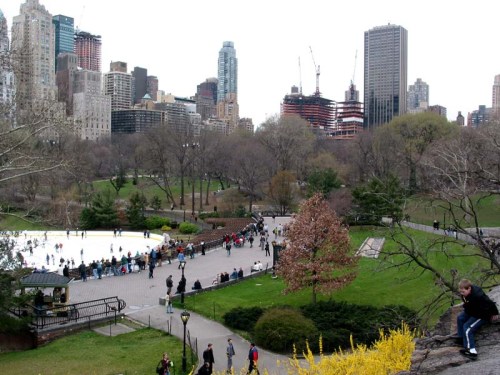
Central-Park-New-York-city-NY-6While I was in  the hospital my father rented a furnished 3-bedroom apartment
overlooking the Wollman Skating Rink in Central Park. Prolonged bedrest in the new home led to my recovery. The compulsory homework necessary for me to move on to my junior year slipped from my hands and onto the floor as I slept off my diseases. I returned to school after four months and failed that year with a final average grade of a humiliating 34.

The Tragedy of 11/9

Calling All Predators

Zoophagous and silver spooned.
Queens street smart.
Boys school ass-slapping
name-calling. Winning

at all costs no
matter how you get there. Win

Win. Win. High school lying and cheating
to win doesn’t count in the real

world but forms and shapes
the real man. Get away with it to
win. Say anything to
win. Break laws to
win. Make money to break
laws to buy lawyers and courts not

to prove but to
win.

Won and now
What?

Win more. My way.
My family. My hair. My plane.
My gold faucets. My servants. My
Mine. Yours?

Not so fast. I get mine. You
get yours. You say I need.
I say you get
it
yourself.

You cheat. You lie. You break laws.
You don’t play that way? Then
you are a loser. You lose.
You will
lose.
Again.

Weak Women care about
others. Take care of
others. Spend money on
others. Help
others.
Church. Soup kitchens. Volunteer. Weak. Soft. Losers.
I’ll keep them

that way. Don’t you
worry.

I’ll make
the world smaller. Our women. Our world. Our goods. Our military.

They will ask and ask and ask. No more mercy. No more
giveaways. Humanitarianism
– over. Negotiation is now. What do I
get for what I’m giving? Strength.

Boys. Men. White. This is your
world. What you want

I know. Have always
known. Since Queens.

Where ARE You, Mary Riley? by Regan Burke

Where ARE You, Mary Riley? by Regan Burke

Vehicles on Ridge Road held landowners and families, deliverymen, trash collectors, handymen, maids, sheep and no others because the country road rolling along the distant end of our north shore Chicago suburb past big old generational homes like yours, one modern (mine) and one sheep farm disinvited disturbances to the quiet outside while inside Meet the Press murmured on Sunday mornings before Mass and the nightly news narrated the evenings before dinner, but you, Mary Riley, clomped 5 miles down Ridge Road on your horse and brought another to me so we could trailblaze in the sheep fields and eat wild raspberries in season then ride through the back brush to your barn spying on your mysterious brothers and their polo ponies, making the best of memories in a time that held the worst for me inside my family’s rented mid-century modern that reeked of cigarettes, Scotch and Budweiser—outside, chlorine rose from the pool my mother cleaned for us so we could swim after horseback riding in the summer—then in the fall Sacred Heart Academy took us in navy blue blazers for French and Religion, The Mikado and recess and lunch with the nuns and Cuban girls from the revolution; after school I avoided the shame of the empty ice box and food cabinets and met you on Ridge Road to ride our bikes with my baby sister Stacy on the handle bars past the sheep farm to the seven-kid Burns family compound for softball and ping pong, joking around and drinking cokes in the Burns family kitchen watching horses in the fields and chickens in the coop, a respite from my house down the road where talking was dangerous and lies took over and my father was absent for long stretches, commuting to the city and flying to Mexico on extended business trips, and my mother drank all day and night and I wondered if she was still alive in the morning because she didn’t wake to wrap peanut butter and jelly sandwiches in wax paper and boil soft eggs— what about yours? she had something wrong with her, did she drink too? was she sick?— then learning to drive on the macadam driveway in the white station wagon when my little sister Erin ran over her kitten, splat! hysterics all around except me—I went numb, wise to parents not giving a damn behind the flat walnut door to the Mies-like architecture where danger lurked and drunks stumbled but where, once, pointing out the bathroom window at eye-level with a tree limb, my mother showed me a robin’s nest holding blue eggs, and when I told you, you said, my father told me your phone is disconnected because you didn’t pay the bill, and Boom! that was the end of our friendship, right there at the lunch table in front of the muchachas who didn’t speak English and the Cuban girls who did and the French nuns Mon Dieu! alarmed but inept at how to reprimand you, you double-crossing rat bastard—whatever happened to you?

Thank you, Kevin Coval, for the brief but spectacular teaching.

I Love Lucy: Meditation on Funny

I Love Lucy: Meditation on Funny

I Love Lucy. The weekly television show from October 1951 to May 1957 starred Lucille Ball as Lucy and her husband, Desi Arnaz as Ricky Ricardo. The naïve, curious, ambitious th-3and untalented I-Love-Lucy sought love and approval through show business and schemed her way into hapless situations that led to trouble for the couple and their friends, Fred and Ethel Mertz. At the end of each half-hour black-and-white show, I-Love-Lucy was forgiven and everyone hugged. From the age of five through eleven I never missed an episode.


F    U    N    N    Y


amily. Imperfections aside, I-Love-Lucy had everything I wished for my mother – vitality, ambition, curiosity, best friends, fun costumes and love for her family. In 1954 my mother drove past the 1600-seat Indiana Theater on Wabash Avenue in Terre Haute with my 8-year-old eyes peering out the open window from the backseat. Parked curbside, an oversized flamingo-pink tractor trailer emblazoned with the words, Long, Long Trailer promoted the new Lucille Ball-Desni Arnaz movie. “No, you are NOT going to that movie.” My mother and her sister insisted it was not their job to provide entertainment for their children.

nyielding. My mother’s sister, Jean Renehan, was the exact opposite of I-Love-Lucy. Whip-smart, well-informed and organized, her only ambition—to connect to Jersey Shore high society—led her to marry a charming, well-turned-out blue blood alcoholic with a dowry. Always the strongest, most graceful and best-dressed woman in the room, she wasn’t prone to bumbling mishaps—until each cocktail hour separated her from grace. She laughed with others but the only lines she delivered herself were opinionated sarcastic put-downs of those who didn’t meet her standards.

onsense. Rick Steves has recorded three different videos of the Iberian Peninsula’s Rock of Gibraltar with its infamous native monkeys. Like I-Love-Lucy, the monkeys’ obsessions get them in trouble and make people laugh. Tourists move in to pet the comical wild animals and in the blink of an eye the monkeys snatch hats, purses, lunch, keys – anything to engage the unsuspecting humans in a game of hide and seek.

incompoop. Donald Trump is the I-Love-Lucy of American politics. He announces thpreposterous schemes, gets himself in trouble and we create punch lines to make ourselves laugh. When TrumpCare passed the House of Representatives, he tweeted, “ObamaCare is dead,” and threw a victory party at the White House. It looked like he actually believed the nascent bill became law. Late-night comics played Schoolhouse
Rock’s “Just a Bill” to show the fabulist President how a bill becomes law. Unlike I Love Lucy, this is not a TV series we can turn off.

uck. The sloth is named after the human vice because it is the very definition of inactive and lethargic, two characteristics totally foreign to I-Love-Lucy. Sloths spendUnknown-2 most of their lives hanging upside down in trees. Their fur houses moths, beetles, cockroaches, fungi and algae. I recently heard about a service that will deliver a sloth to people who want to hug them. Eww. Do they know about the fur? God bless the sloth-huggers who embrace these imperfect funny creatures as I did with I-Love-Lucy.