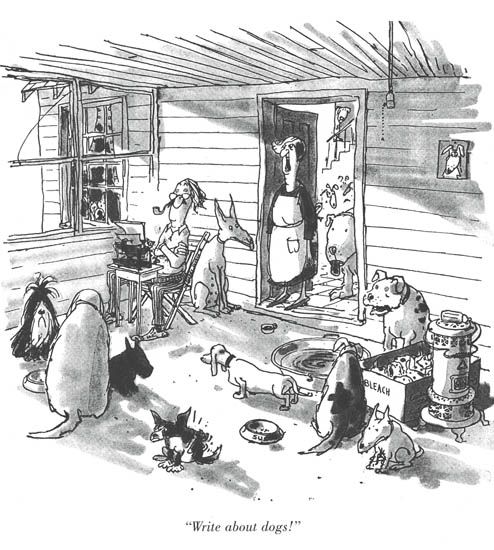
George Booth, the New Yorker cartoonist who died in November 2022, once created the funniest cartoon in memory. First of all, Booth’s silly line drawings were and remain funny enough–they don’t need captions. But the one I so love is a man sitting at his typewriter on a dilapidated porch wistfully smoking a pipe. Nine or ten dogs of different sizes and shapes laze around. There’s a bulbless socket hanging from the ceiling. His wife stands in the doorway. Caption: “Write about dogs!”
Ok. Ok. It’s not the funniest cartoon to you. But for me, a dog owner and a writer, it’s hilarious.
Obviously, the cartoon man has shouted, ‘What should I write about?’ ‘Write about dogs’ is a funny way of saying ‘write what you know’, writing’s first principle. Even fiction holds truths. Funny conversations and tales of goofy adventures are all around, like the dogs in Booth’s cartoon. I hesitate to write them because I don’t want my blog-reading friends to know how amusing their lives are to me. And what if the writing isn’t funny?
This summer I attended a free Comedy Writing Workshop taught by a professional, very intuitive, improv comedian. We didn’t have to pretend to be a tree or a bologna sandwich, though that would’ve been a kick; we simply pretended we were at job interviews and went back & forth with questions and answers. We could have answered any old way, and indeed creativity was encouraged, but everyone in this group seemed to answer like their jobs were on the line for real. And they. were not. funny.
Me? I said I was fired from my last job because I attempted to kill my husband with a stapler when he came to the office for a surprise lunch. Funny? I thought so, but no one laughed. Perhaps I actually look or sound like a murderer.
The comedy teacher smartened up to this over-55 group right away. She tailored the two-hour class to the cognition level of the twelve students she had before her. And still, no one was funny.
A friend of mine who’d recently been examined for dementia gave permission to the memory doctor to ask me how my friend had changed. Without hesitation, I answered, “She’s really funny but it’s taking her longer to get the punch line.”
Is this part of it? Aging, I mean.
Most researchers I skimmed agree that age-related cognitive decline contributes to difficulty with “humor comprehension”. The list of symptoms includes:
- An inability to understand satire
- A childlike sense of humor or enjoyment of slapstick comedy
- Laughing at things that are not particularly funny, such as a dog barking
- Taking jokes literally
- Making inappropriate comments about strangers in public
George Booth created his last New Yorker cartoon ten months before he died from complications of dementia at 96. The cartoon cover is a goofy white dog glancing at a clock. Is that funny? A dog checking the time?
If not, George and I share the same demented symptom of chuckling at things that aren’t particularly funny
.


 room or home or even all the gory details about my parent’s drinking. It means to write that I wished my mother was more like I-Love-Lucy or that on most mornings I put my finger under her nose to test for life.
 small way. We both survived the 1980s Gary Hart presidential campaigns. So when it comes to making room on the shelves for other sympathy books, the ties that bind keep Rick’s book in place.


 commandments to week-old smiles, cries in the night, a nine-month old sprinter and a child who eats only chicken. My work is to stand my ground in the whirlwind advice from mothers, aunts and grandmothers. To learn to ride a baby on the back of my bicycle. To animate words as I point to clouds, trees and cars as if I’ve never seen these things before in my life.
 actress whose director, Burke Williams, visited frequently and drank too many martinis. My father’s name was William Burke. He loved martinis. Exorcist Regan lived with her mother in Georgetown. My family had lived in Georgetown after my sisters and I were born.