Susan Keegan and I hopped in her shiny new red Cadillac Crossover in Chicago and booked out of town to Ohio.
Our mission: canvass voters for the Hillary Clinton campaign. Ohio was a battleground state where we had friends to accommodate us for the five days leading up 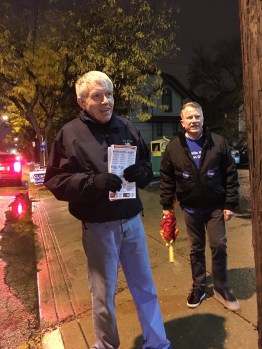
to election day. Our canvassing territory was Ohio City, a quaint restored section of Cleveland. Thirty-eight hours before we left town the Chicago Cubs won the World Series against the Cleveland Indians. The final game had taken place in Cleveland, and conscious of the seriousness of our mission to win over Cleveland voters, we vowed to keep our Cubs hats at home. I even told someone I was from Toledo to curb anticipated antagonism.
We met old and new friends – Keith from Sonoma, Carol from Washington DC, Jamie from Oakland, Dennis from Virginia and even Vivienne who flew in from Ireland for the effort to nail the Trump coffin shut in a small patch of the American body politic.
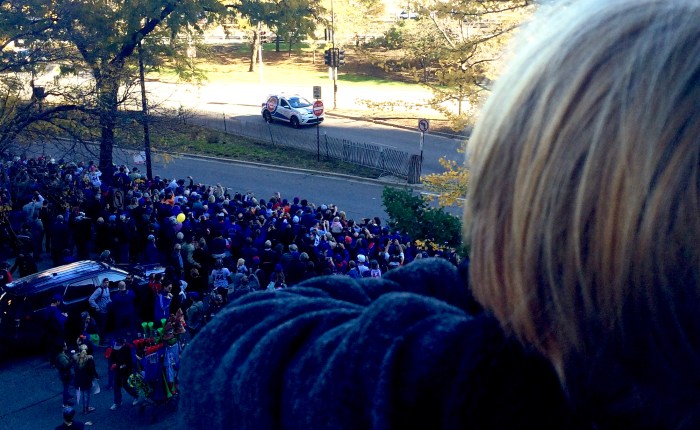
News from my iPhone said Chicago’s parade for the Cubs win would be held the next day beginning at Wrigley Field, rolling down Lake Shore Drive and Michigan Avenue to Grant Park, right past my condo building. “Oh Noooo,” I groaned in the car, “I’m going to miss it.” “Do you want to go back?” Sox fan Susan asked half-jokingly. No, we were off to do God’s work. No turning back.
I texted my 19-year old grandson, C.J, and told him to go to my place to watch the parade. He’d already been planning to bring his brother, 10-year-old John into town from their suburban home to spend the night and get a good position on the parade route. “Thanks for letting us stay,” C.J. texted, “John borrowed your Cubs hat – I hope you don’t mind.”
By the time Susan and I arrived at Cathy and Marc Dann’s vintage Tudor outside Cleveland we were exhausted from talking the entire seven-hour drive about Hillary’s winning campaign. All the polls said she was going to win. The betting community said she was going to win. Astrologers said she was going to win. The last time the Cubs won the World Series, the incumbent party won. Since Hillary was the incumbent party’s candidate, we took that as one more sign we were about to have our first woman president. Women were prohibited from voting for twelve more years after the Cubs last won the World Series in 1908. Women had won the pennant in 2016. This election was our World Series.
From my third floor balcony, C.J. and John each took iPhotos and videos of the Chicago Cubs open air buses with the players, their 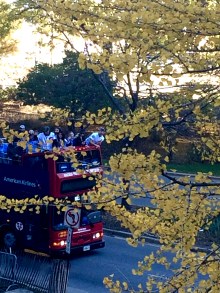 families, friends, team managers, coaches and owners as they crept down Lake Shore Drive onto Michigan Avenue. Cubs first baseman and cancer-survivor Anthony Rizzo lifted the trophy above his head as fans shouted, “We Never Quit.”
Fourteen hours after the polls closed in Ohio, Susan and I drove home. We had no trophy, no win. But we vowed, like the Cubs, to never quit.

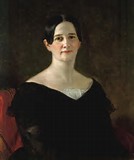

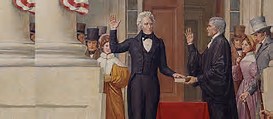 Well, Rachel, I want you to know the government peacefully transferred power from John Quincy Adams to Andrew Jackson and Old Hickory scripted your tombstone, “A being so gentle and so virtuous – slander might wound but could not dishonor.”

 1991 I abruptly left Chicago for Arkansas to work as Clinton’s campaign scheduler, a grueling job that required 24/7 attention. One cold January night Clinton and his entourage, George Stephanopoulos and Bruce Lindsey, returned to Little Rock in a small private jet from all-important New Hampshire. I met the plane on the dark, deserted tarmac to give Clinton his next day’s schedule. He descended the jet’s stairs with a big smile, came directly at me, grabbed my coat and ran his hands up and down my long furry lapels. “Nice coat, Regan,” he whispered.
 Regan Burke