The 2018 Midterms: The Saints Came Marchin’ In

I Got My Country Back.

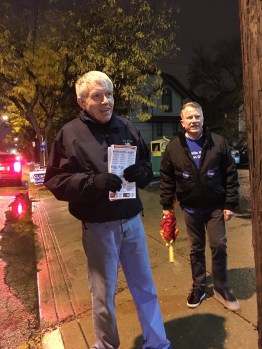
Weeks after the January 2017 presidential inauguration and Women’s March, I met with a group of women who look like me—old, white, middle-class—to discuss what we could do to help right our country. We devised a plan based on the Indivisible Handbook: meeting monthly to report on our calls and letters to elected officials stating our opinions about Cabinet secretaries, legislation and impeaching the President. We all decided the most impact we could make was to help turn the Sixth Congressional District blue, ousting six-term incumbent Republican Peter Roskam at the midterm election in 2018.

Cries at 2016 post-election presidential rallies to “lock her up,” a demand to jail Hillary Clinton awakened us to a cruel reality. This America, our country, had turned overnight into a place we’d only seen in movies like Elmer Gantry and footage from 1920’s Ku Klux Klan rallies. Little by little we discovered some of our friends, neighbors and family members had voted for a man who gloried in grabbing women by the genitals and calling immigrants murderers and rapists. At first I wondered how people could be so duped by the Reality Show President. I slowly came to realize not all are fooled. People who look like me actually like his white nationalist agenda. Yep. They like him, a tells-it-like-it-is guy, no matter how crude or criminal. I dismayed.

My enthusiasm, and that of my activist friends, turned pessimistic as we drew closer to the midterm election.

Sean Casten, an environmental scientist and political newcomer, won the Democratic primary for Congress in Illinois’ Sixth Congressional District over five women. The district includes some of Chicago’s wealthiest suburbs. I had never heard of him, knew nothing about him. But he became the object of my strongest desire.

I really wanted him to win.

The day after his November victory an interviewer asked Representative-elect Casten what he attributed his win to. Without hesitation he said, “The women. My sister, my wife, the women who showed up every day in the campaign office, the ones who phoned voters from home and knocked on doors. The women.”

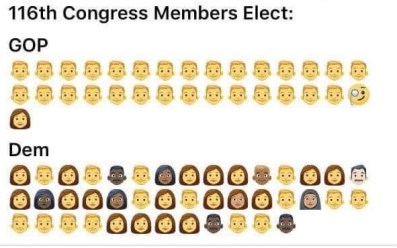
Democrats took 35 seats and counting away from the Republicans in the 2018 midterm elections. And I got my country back. I live in a country where white suburban voters fullsizeoutput_45efelected a 32-year old black woman nurse, a country that elected a Sudanese Muslim immigrant woman who wears a head covering, a country that elected two Native American women for the first time in history, a country that elected a married-with-children gay governor, a country where a lesbian became a conservative state’s attorney general. My country will have 102 Democratic and Republican women in the House in January, 12 women in the Senate and 9 women governors. In my country, a record forty-four percent of employers offered employees paid time off to vote.
In my country, the saints are marching in.
1971, 25 Years Old and Still Alive

In June 1971, I turned 25 years old and celebrated my first six months of sobriety in Alcoholics Anonymous.

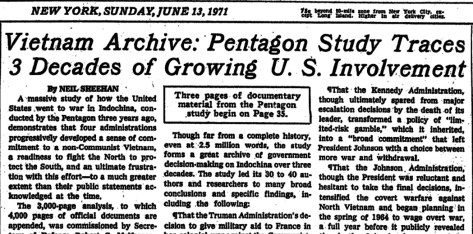
That same month, the release of the Pentagon Papers set off a firestorm of I-told-you-so outrage by Vietnam war protesters like me. All through the 1960s Washington insiders had been leaking to the press that the White House was lying about our involvement in the war in Southeast Asia. Anti-war organizations published newsletters and held NYT-pentagon-papermarches screaming at the government to pullout of Vietnam because there was no good reason for us to be there. When my son was born in 1967 I started sending streams of letters and postcards to the President and Congress begging them to end the draft. I didn’t want my son growing up in a world where he would be forced to kill another mother’s son.

My imbalanced emotional connection to the 60% of Americans who were against the war drove me to protest, argue, march and drink myself into oblivion. In December 1970, defeated, I finally collapsed, failing to escape the world of war, within and without.

Then, in my first year of recovery, the Pentagon Papers confirmed that Presidents Truman, Eisenhower, Kennedy and Johnson all lied about why we were in Vietnam. We stayed simply to save face, refusing to admit defeat. Troop numbers fell from 500,000 in 1968 to 156,000 by the end of 1971, the year The Pentagon Papers were published.

And so what? The world went on. Jim Morrison died in his bathtub in Paris. I read The Exorcist, rocked out at George Harrison’s Concert for Bangladesh and women were allowed to run the Boston Marathon.

The Pentagon Papers’ exposure of the government’s lying treachery slow-cooked beyond my consciousness. My AA meetings in Point Pleasant, NJ, seduced me with a new recipe for living, replacing the bitter stew of the wearying world. A wise woman at my meetings gave me two pieces of advice: 1) don’t comment at meetings about outside issues and, 2) wear a bra. I did both and managed to attract a ne’er-do-well fellow AA’er, ten years older. Ed professed some kind of love, so I moved in with him.

Julius Roehrs Garden Center hired me to make terrariums in glass bowls, a new fad. It 805160-03-1was my first job as a sober adult. I spent all day in a greenhouse planting miniature sedum and echeveria while having LSD flashbacks and dancing around to tunes only I could hear. My son, Joe, had been living with his grandparents for his kindergarten year and came to live with Ed and me. Disney World Orlando had just opened, so we read up on how to camp, then packed our new tent, camp stove and sleeping bags into Ed’s Mustang and drove down I-95 to the Yogi Bear Campground.
It rained. Ed and I fought. He got drunk and disappeared.

I drove Joe home—1,000 miles back to New Jersey.

When Ed showed up a few months later, we got married.

First Impressions of Bill Clinton

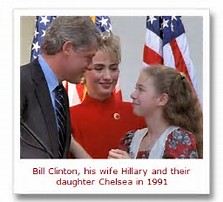
In August 1991, twelve Democratic leaders and influencers, were seated in leather armchairs at a walnut oval table in a small dining room at one of downtown Chicago’s private clubs. I was the only woman. When Governor Bill Clinton entered the room, his th-2tall navy-suited body seemed to shift the atmosphere, moving the dust molecules away from him and clearing the air as he moved. He gave a hardy salutation and proceeded to introduce himself to each person while he circumnavigated the room, one-by-one. I was halfway around the table, and when he reached me I stood and looked up to his bemused rosy face, full of laugh lines. He had a big red nose, like Santa Claus. As I tried to introduce myself, he interrupted me by saying he knew who I was— the Executive Director of the state Democratic Party. He asked if I knew my name was the same as one of King Lear’s daughters. “Yes,” I said, “My name came from her.” He leaned over and whispered let’s keep that between us since she wasn’t such a great character. And just like that we had a best-buddies pact.


He finished working the room, told us why he was thinking of running for president, and asked us to support him. He never sat down.

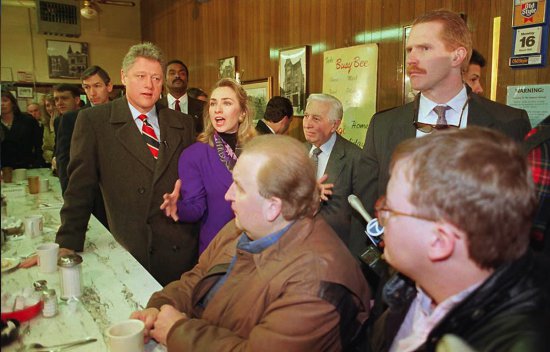
A few weeks later, Bill and Hillary entered a crowded 2nd-floor meeting room in a Chicago hotel with about 50 curious political activists who gathered to meet them for the first time. He neither ushered her in ahead of him as a well-mannered (albeit chauvinistic) gentleman nor did he make her walk behind him as an ill-mannered boor. Democratic presidential candidate Bill Clinton (L)
Side-by-side they came to us. We all jumped to our feet and cheered before he even said hello, before he shook one hand. It was two months before he announced his candidacy for President. His nascent message stressing personal responsibility for welfare recipients echoed what I’d learned in Alcoholics Anonymous — to acknowledge that I am responsible for the choices I make in my own life. Later in his presidency I despised his welfare reform policy but for now this seemingly spiritual insight vaulted my commitment to a new height. This was my guy.

The first week in October, one of Clinton’s many Chicago friends asked me to join him in driving Bill Clinton to Midway Airport. We’d been at a 100-person meet-and-greet where Clinton learned I was moving to Little Rock to work on his campaign. He looked back at me in the car and asked what my boss said when I told him I was quitting my job. My boss hoped I’d change my mind, so I told Clinton he wasn’t happy.  Clinton picked up the car phone, called my boss, thanked him for letting me have this opportunity of a lifetime and said he was happy to have me on board. He ended the call by inviting my boss to bring his family down to the Governor’s mansion for a weekend. In the back seat I imagined throwing my arms around his neck and kissing the top of his ever-loving head.

I was in Little Rock by the end of the week.

Keep On Truckin’— Contemplation on a Deadman by Regan Burke

In Beth Finke’s latest book, Writing Out Loud, the following brief memoir was excerpted. I post it for those who’ve asked for the full story.  Check out Beth’s book for more stories from Chicago writers: Writing Out Loud.

BethFinke-WritingOutLoud-525x8-CoverDesign-245x373

_______________________________________________________

Keep On Truckin’— Contemplation on a Deadman

I worked in politics my whole life, always hoping for the perfect politician, one who acted in the best interest of the whole. Bill Clinton could have been my hero. I loved his rallying cry in the 1992 campaign, “personal responsibility.”

But I had doubts. Could I work for a candidate who was pro capital punishment and unsure of his view on abortion? Those were two issues I thought every Democrat knew to be against and for.

The “personal responsibility” message won me over. In October 1991 I abruptly left Chicago for Arkansas to work as Clinton’s campaign scheduler, a grueling job that required 24/7 attention. One cold January night Clinton and his entourage, George Stephanopoulos and Bruce Lindsey, returned to Little Rock in a small private jet from all-important New Hampshire. I met the plane on the dark, deserted tarmac to give Clinton his next-day schedule. He descended the jet stairs with a big smile, came directly at me, grabbed my coat and ran his graceful elongated fingers up and down my long furry lapels. “Nice coat, Regan,” he whispered in my ear.

This encounter may be the reason I love Bill Clinton.

When he won, I relocated to Washington to work in his administration. I moved into the first floor condo of an 1880 townhouse on Church Street in DuPont Circle. In 1994 he passed a crime bill I thought went too far. Next he signed NAFTA, an agreement opposed by every Democrat I respected. Both policy shifts were spearheaded by White House insider, Rahm Emmanuel, who decidedly did not have the public good at the forefront of his self-serving mind. But Clinton loved him. Dissatisfaction settled in the space between my bones and muscled me awake at 3 o’clock in the morning for the next six years.

In the early still of a hot D.C. August morning in 1995, NPR told me Jerry Garcia died. I collapsed on the bathroom floor weeping over the death of something I couldn’t put words to. At 49-years-old my idealism had come to an end: my phony world of everlasting good died with Jerry Garcia. Reality glared back at me in the mirror as I brushed my hair, seeing for the first time a wrinkled face and rubbery neck. I dressed in soft yellow, a flowery cotton frock, and pinned a silk flower in my hair, ready for the grieving day.

My dog Voter squirmed away from my extra long hug and I went out the door to my old friend, Keith Lesnick waiting to drive us to work. As soon as I got in the car tears spilled out. He asked about the sadness, and I slobbered out a few words, “Jerry Garcia signed into rehab last night,” I said. “He died in his sleep.” Keith waited a few respectful minutes, and then, with one simple sentence, he opened a new, naked reality that included the unspoken caveat—don’t take yourself too seriously.

He said, “well, it’s not as if it’s Aretha Franklin.”

People Say They Did the Best They Could

What My Parents Believed

No One Ever Said We Were Democrats. Neither of my parents campaigned nor wore political buttons nor wrote thoughtful letters to politicians. They were Catholics, went to Catholic schools, Catholic colleges, married in the Catholic church. They took on the mantle of Irish Catholicism as if it were a physical birthmark, a once-a-Catholic-always-a-Catholic mental tattoo unaccompanied by belief in God or Jesus. They took advantage of the culture of the sacraments— Holy Communion, Marriage, Baptism—to display how beautiful we all were in our expensive clothes, polished shoes, fashionable hair styles.

They argued. About money mostly. And other women, other men. They agreed on important things. Pope Pius XII was a backwater imbecile for invoking papal infallibility in 1950 when he proclaimed all Catholics must believe Mary didn’t suffer physical death and was assumed into heaven. This new doctrine, along with the Pope’s insisting the Church of Rome stay neutral during the Holocaust, put a stake in their religiousity.

They hated right-wing bullies like Senator Joseph McCarthy and J. Edgar Hoover. McCarthy was a reckless demagogue who ruined lives with public witch hunts and unsubstantiated accusations against communist sympathizers. FBI Director Hoover amassed power by steering favorable press and policy his way using his secret files to blackmail Congress and Presidents alike. Throughout their lives my parents derided the Red Cross for raising money for war-time troops then charging soldiers and sailors for their so-called giveaways like toothpaste, coffee and donuts. My mother eagerly showed how smart she was in these matters. After all, my parents attended college in the nation’s capitol in the years leading up to World War II. She gossiped about under-informed conversationalists, “What do you expect, they don’t even read the New York Times.”

During the war, they lived in housing provided by the Navy in Key West. With no children to mind, they spent evenings in the Officer’s Club chattering about the day’s news, forming opinions and cooling off with rum smuggled in from Cuba. The men were Navy pilots and Naval intelligence officers. Some worked in the newly-formed CIA. Anyone who didn’t drink was not to be trusted. They never went to a restaurant, nor any gathering, party, picnic, or church function unless they knew alcohol would be served.

Any friend or relative who stopped drinking was derided as a reformed drinker, as if that were a dirty word. My father eventually stopped drinking and went to Alcoholics Anonymous, but he still steered clear of social events and restaurants where there was no alcohol. With all their strong opinions about religion and politics, the foundational belief of my parents was that life without alcohol was as unsophisticated and tasteless as a Greek diner.

My father, divorced from my mother, helped me get sober in 1979. When I told my family I was in AA, my older sister, glass of wine in hand, said, “Well. Just because you’re an alcoholic, doesn’t mean everyone is.”


Screaming at Hillary Clinton in Soldier Field

Screaming at Hillary Clinton in Soldier Field

Llani O’Connor and I were rabid Hillary Clinton fans during the 2008 Presidential Primary election. We exchanged did-you-hear-what-she-said exclamations all through the summer and fall of 2007 after she announced her candidacy.

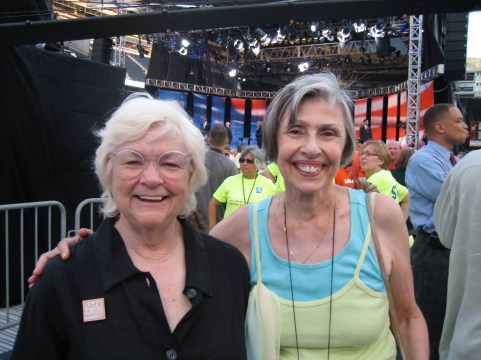
IMG_1029.JPGThis photo from August 7, 2007 shows us with sunny smiles, blouses opened to our bra-lines, red-faced, droopy-haired and sweaty at an outdoor Presidential Forum in Chicago’s Soldier Field. All seven Democratic candidates are on stage in the background: Chris Dodd, John Edwards, Bill Richardson, Joe Biden, Dennis Kucinich, Barack Obama and Hillary Clinton. It was a full 15 months before the election, and Hillary was way ahead in the polls.

I had worked as Hillary’s advance person on a few trips when I was working in the Bill Clinton Administration in the 1990s and was completely starstruck by her brilliance, kindness and sense of humor. Llani and I were ecstatic to be voting in the Primary Election that would result in the first woman presidential candidate. We knew she was going to win.

I obtained three tickets to the Soldier Field event after shamelessly begging an old friend who was an aide to Senator Joe Biden. Our third companion, Ann, drove us there, dodging and weaving down South State Street to 31st, ignoring stop signs and red lights, crossing under South Lake Shore Drive then barreling back north 17 blocks to the south parking lot of Soldier Field. We recovered quickly from the tilt-a-whirl ride and rushed into the stadium onto the field to get to the closest seats possible.

The stage was set at the fifty-yard line. Long red,white and blue panels draped behind it, and dark blue curtains hung behind the panels, blocking the back and sides of the stage. Folding chairs filled up the rest of the field.

It was 95 degrees that day – so hot that the moderator, Keith Olbermann cracked that if the candidates didn’t behave he’d cut off their air conditioning. The stadium walls offered no shade and we thumbed our noses at the heat along with the other 15,000 people, all of us 1043829789_89f65ee11b_bdancing around and singing songs for three hours waiting for the 90-minute event to start.

We were disappointed that little-known populist Dennis Kucinich received the most applause, but Hillary’s star power exploded next to the six men. We waited for the candidates to leave the stage before heading to the car for the treacherous ride home with Ann.

“Llani! Look! Hillary’s out in the audience shaking hands. Let’s go!” We plowed through hot bodies and upturned chairs to get as close to our hero as possible. Suddenly, Llani, in her baggy pink shorts, flimsy sandals and turquoise tank top climbed onto a folding chair and took off, hopping from one chair seat to another, camera in hand, shoulder bag swinging wildly and screaming at Hillary to look her way.

Traveling home the wrong way down one-way streets with Ann behind the wheel evoked little excitement after that.

Are We Getting Dragged Into Their Holy War?

Hal Lindsey’s end-times prophecies in The Late, Great Planet Earth, permeated the born-again, religious cult I joined in the early 1970’s in Toms River, New Jersey. There were about fifty of us—disparate spiritual seekers who accepted Jesus Christ as our personal the_late_great_planet_earth_coversavior, a requirement for inclusion in the exclusive Fellowship. One of the elders had broken away from a local Plymouth Brethren Church and opened the basement of his family’s large, wooded, colonial home for Bible study and Sunday services for us blue-jeaned recovering addicts and alcoholics. As a newly sobered-up ex-hippie, full of self-loathing, all I wanted was to be accepted in that Fellowship.


Based on his interpretations of the Book of Revelations, Lindsey’s book sensationalized end-of-the-world Biblical prophecies connecting them to current events as proof of the coming Rapture where Christians would be taken up to heaven and avoid Armageddon. Satan’s plans to form a one-world government and religion, as prophesied, were triggered by the establishment of the state of Israel and the World Council of Churches—both in 1948. Everywhere I looked in those days I saw Lindsey’s signs of the end times: increase in the divorce rate, recreational drugs, new technology, the gasoline shortage, religious ecumenism, and the birth of the European Union.

Church elders directed every aspect of our lives. Men were the head of the household, women submitted to them and didn’t work. We lived in separate homes but were discouraged from socializing outside the Fellowship, lest we be influenced by secular humanist ideas, like having credit cards, one of Satan’s tools to create a global economy. We didn’t put our money in The Bank of America because the bank was seeking to legalize interstate branch banking, thereby centralizing all the country’s money into a single entity, another Satanic plan.

When my son joined Little League in the first grade, I sat away from the other parents in the bleachers fearing the wrath of God if I talked to anyone outside of the Fellowship. Church members scorned me for volunteering for Jimmy Carter for President in 1976, even though he was born-again.

After four years, I extricated myself from the Fellowship, left my abusive husband in New Jersey and drove my nine-year-old son 800 miles west to Chicago for a new life. A group of Christians at LaSalle Street Church who had experienced similar religious cults nursed me back to spiritual and emotional health. The ideas of Hal Lindsey dissipated into the ether of bad dreams and gradually I no longer looked for signs of the end times.

Until now.

President Trump in his first speech to the Joint Congress announced he was not the President of the world, rather the President of us Americans.

These words, and words of White House strategist Steve Bannon announcing a nationalistic government free from links to other countries remind me of Hal Lindsey’s warning to resist Satan’s plans for a global economy and one-world government.

Are they fighting a holy war?

signs28_title
http://1timothy4-13.com/files/prophecy/signs28.html

Continue reading “Are We Getting Dragged Into Their Holy War?”

What Is My Work, You Ask?

What Is My Work, You Ask?


1962. My work is to stop laughing like a nervous little girl and start smiling like an unflappable young lady in the coffee shop on the Asbury Park boardwalk. To turn away from the seagulls fighting over dead fish on the beach and write “pancakes” and “bacon” on my notepad. To pay attention to the old telling the story of the 1934 wreck of the cruise ship SS Morro Castle on the beach. To save money for tickets to Joan Baez and Bob Dylan at the Asbury Park Convention Hall.

1967. My work is to read Dr. Benjamin Spock’s Baby and Child Care and apply its 51hjigsfuol-_sx309_bo1204203200_commandments to week-old smiles, cries in the night, a nine-month old sprinter and a child who eats only chicken. My work is to stand my ground in the whirlwind advice from mothers, aunts and grandmothers. To learn to ride a baby on the back of my bicycle. To animate words as I point to clouds, trees and cars as if I’ve never seen these things before in my life.
1976. My work is to bypass the door to the secluded basement with its graveyard of empty vodka bottles. To surrender to my new single-motherness. To trust my untrustworthy father and move from a sandy Jersey Shore cottage to a downtown Chicago highrise. My work is to know this is the best plan for a nine-year-old boy’s future happiness.

1982. My work is to dress up in business clothes, act smarter than I am, eavesdrop on everyone’s conversations in a boiler room full of political operatives, ask stupid questions and digest enough information to schedule Nancy Stevenson in places that help win votes for her husband’s campaign for governor.

1990. My work is to be a motherless child. To lament the loss of my uterus and ovaries, and, my boyfriend. To escape to Paris and London with my twelve-year old niece. To atone for all my past sins.To feign self-confidence while running the Illinois Democratic Party.

1993. My work is to take Prozac on the way to Washington to join the management class of the Clinton Administration. To imagine I have power and to hide humiliation when I’m exposed. My work is to honor the ruling class. To recognize they are human. To protect myself from evil-doers and self-promoters. My work is to mourn the loss of naiveté.

2006. My work is to shield myself and others from Cook County Government officials who believe if you are happy at your job you’re not working hard enough. To cherish those I lead for what they are today and not for what they will be tomorrow. To protect them from those who refuse to know their names.

2017. My work is to record how far my shadow falls behind me. To tell the truth about myself and trust God with where the words go and what they do when they get there. My work is to proclaim the US Constitution guarantees me the freedom to assemble publicly and express myself openly without retribution. My work is to say I love America and when the saints go marching in, oh! how I want to be in that number.

Inspired by “An Address to My Fellow Faculty,” by A. Papatya Bucak, from brevitymag.com

On Winning: The Cubs and Cleveland

On Winning: The Cubs and Cleveland

Susan Keegan and I hopped in her shiny new red Cadillac Crossover in Chicago and booked out of town to Ohio.

Our mission:  canvass voters for the Hillary Clinton campaign. Ohio was a battleground state where we had friends to accommodate us for the five days leading up img_1041
to election day. Our canvassing territory was Ohio City, a quaint restored section of Cleveland. Thirty-eight hours before we left town the Chicago Cubs won the World Series against the Cleveland Indians. The final game had taken place in Cleveland, and conscious of the seriousness of our mission to win over Cleveland voters, we vowed to keep our Cubs hats at home. I even told someone I was from Toledo to curb anticipated antagonism.

We met old and new friends  – Keith from Sonoma, Carol from Washington DC, Jamie from Oakland, Dennis from Virginia and even Vivienne who flew in from Ireland for the effort to nail the Trump coffin shut in a small patch of the American body politic.

News from my iPhone said Chicago’s parade for the Cubs win would be held the next day beginning at Wrigley Field, rolling down Lake Shore Drive and Michigan Avenue to Grant Park, right past my condo building. “Oh Noooo,” I groaned in the car, “I’m going to miss it.” “Do you want to go back?” Sox fan Susan asked half-jokingly. No, we were off to do God’s work. No turning back.

I texted my 19-year old grandson, C.J, and told him to go to my place to watch the parade. He’d already been planning to bring his brother, 10-year-old John into town from their suburban home to spend the night and get a good position on the parade route. “Thanks for letting us stay,” C.J. texted, “John borrowed your Cubs hat – I hope you don’t mind.”

By the time Susan and I arrived at Cathy and Marc Dann’s vintage Tudor outside Cleveland we were exhausted from talking the entire seven-hour drive about Hillary’s winning campaign. All the polls said she was going to win. The betting community said she was going to win. Astrologers said she was going to win. The last time the Cubs won the World Series, the incumbent party won. Since Hillary was the incumbent party’s candidate, we took that as one more sign  we were about to have our first woman president. Women were prohibited from voting for twelve more years after the Cubs last won the World Series in 1908. Women had won the pennant in 2016. This election was our World Series.

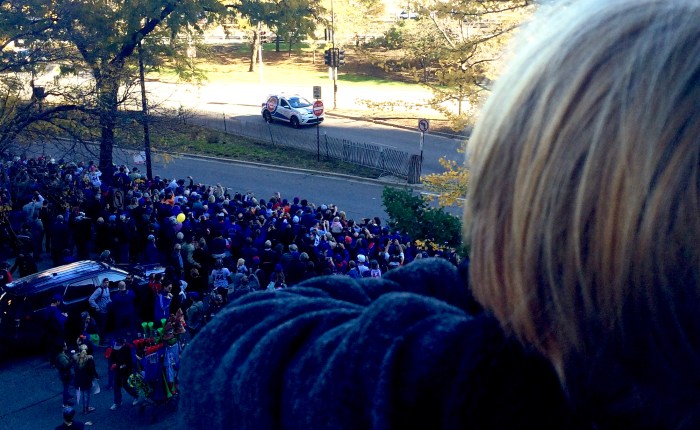
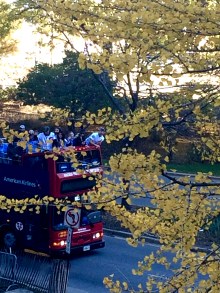
From my third floor balcony, C.J. and John each took iPhotos and videos of the Chicago Cubs open air buses with the players, their img_4826families, friends, team managers, coaches and owners as they crept down Lake Shore Drive onto Michigan Avenue. Cubs first baseman and cancer-survivor Anthony Rizzo lifted the trophy above his head as fans shouted, “We Never Quit.”
Fourteen hours after the polls closed in Ohio, Susan and I drove home. We had no trophy, no win. But we vowed, like the Cubs, to never quit.

2016: Rachel Jackson and Hillary Clinton – Slander Will Wound but Will Not Dishonor

2016: Rachel Jackson and Hillary Clinton – Slander Will Wound but Will Not Dishonor

th-2
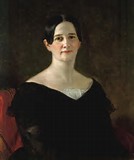
Oh, my dear Rachel Jackson — 188 years after the brutal campaign between your husband Andrew and John Quincy Adams, the citizens fear the republic will not survive the brutal campaign of 2016 for the 45th President of the United States.

The two candidates are Republican Donald Trump, a known philanderer, tax cheat and a liar; and Hillary Clinton, the first woman nominated by the Democratic Party, the same party formed by your husband in 1824.

th-4
2016 voters mistrust Hillary Clinton. Statisticians show she distorts the truth 28% of the time, compared to Trump’s lying 70% of the time. However, the public fixates on Republican propaganda that pounces on her daily for mishandling classified material when she was Secretary of State. Yes, Rachel, we have had three women Secretaries of State since women won the right to vote in 1919.

This lack of voter confidence is not the hallmark of the 2016 campaign, however.

Throughout his campaign, Trump has proclaimed Hillary and other women incompetent, liars, corrupt, pigs, fat and flawed. Trump runs beauty pageants and builds hotels. He’s been plagued by women publicly accusing him of unlawful touching. He calls them liars and shifts the conversation to stories of our 42nd President’s sex scandals. Our 42nd President, Bill Clinton, is Hillary’s husband. Trump excoriates Hillary for enabling her husband’s extramarital affairs, then he turns around and calls for Hillary’s aide de camp to be dismissed because the aide’s husband exposed himself to a series of women. Trump says the aide’s marriage to a “major sleaze” makes her a security risk.

America in 2016 is collectively depressed by the deluge of vulgarity. Voters clamor for more issues yet soak up the scurrilous, all the while exclaiming the United States will never regain her honor.

You know how this feels, my dear Rachel. The Hermitage, your beloved Nashville plantation, restored for visitors, serves up details of your death. When you married Andrew Jackson, your violently jealous first husband published a news article that you were never divorced, knowing that he lied to you about filing your divorce papers. He accused you of adultery and bigamy. Your new husband Andrew, a lawyer, rectified the situation and you remarried him legally. All this humiliation was heaped upon you before you were twenty-three years old.

Andrew Jackson fought wars and politicked around the country for the next forty years leaving you at home to manage the 1000-acre family farm. Your work kept you from the day-long carriage ride to town until the day you had to shop for your Inaugural Ball gown. It was only then, in your Nashville hotel lobby, after Andrew Jackson won the election, that you came across a campaign pamphlet accusing Andrew of adultery and running off with you, another man’s wife.  And you accused of bigamy.

Weakened by stress, depression and shame, you returned to the Hermitage and died, buried in your Inaugural ball gown. Our 7th President began his term in profound grief without you at his side.

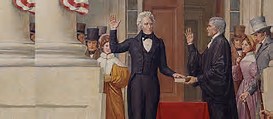
thWell, Rachel, I want you to know the government peacefully transferred power from John Quincy Adams to Andrew Jackson and Old Hickory scripted your tombstone, “A being so gentle and so virtuous – slander might wound but could not dishonor.”

On the eve of the election, our country’s history is small comfort to the downtrodden, but they will soon hope again because slander might wound the United States but it will not dishonor her.