Mikado Pintado

Mikado Pintado

At the Convent of the Sacred Heart in 1958, Mother Cleary announced at the weekly school assembly the name of the annual school play. She was uncharacteristically gleeful.

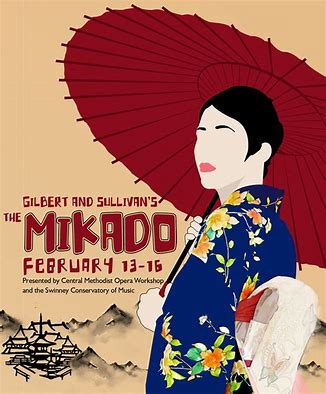
“Gilbert & Sullivan’s The Mikado will be this year’s play. We’ll start auditions next week. The entire school will take part. It will be a real pageant!”

The “convent” was a community of nuns and a Catholic girls’ school for grades five through twelve in a pastoral Chicago suburb. The nun’s surnames Riley, Doyle, O’Brien, and McCarthy would lead outsiders to think the order of the Religious of the Sacred Heart of Mary has its roots in Ireland. Not so. The order originated in France. Wealthy Irish families paid to have their well-educated daughters live and teach as “Madams” of the Sacred Heart, as they were known colloquially. 

On hearing the news of The Mikado, we in the lower grades looked at each other with a shrugged Huh? The high schoolers cheered. Full of musicians, music lovers, budding drama queens, or future dramatists, the upper grades knew their Gilbert & Sullivan.

Gilbert & Sullivan wrote their 1885 comic opera as a satire on Victorian mores, culture, and government. The plot of The Mikado is the operatic old stand-by of an adolescent boy and girl trapped in forbidden love. The forbidden in this opera is a law against flirting. Some like to think Gilbert & Sullivan used the ridiculous plot to mock England’s law against homosexuality.

The late 1880s British society, the Victorian era, is known for its sexual prudishness. As an eighth-grader in the 1950s, I doubt I knew the word “Victorian” was synonymous with hypocritical sexual repression. Do you suppose those crafty Sacred Heart nuns were trying to get some subliminal point across to their mostly virginal students?

Those in the know at school aroused curious excitement about the play, the music, the staging, and the costumes. Oh, the costumes. The Mikado is a fake Japanese story, and the buzz about the songs, the kimonos, the make-up, and those hairdos filled my dreams with whirling color.  

In Catholic schools, everyone sings in the choir throughout the year’s many feast days. When it came to my turn to audition, I had high hopes of landing a dramatic singing part. I had no idea I couldn’t carry a tune. My seventh-grade sister and I were called together to audition with Mother Cleary. 

“Oh, girls, we have the perfect parts for you! You will be dressed as mackerels and stand as sentries on either side of the stage for the entire play! Isn’t that exciting? You’ll be visible the whole time!”

“Mackerels? You mean fish?” I asked.

“Yes, yes, yes! Don’t worry; you aren’t required to attend all the rehearsals—just the last few. Mother O’Brien will contact you about your costumes.”

“I won’t be singing?”

“Oh no, dear. That isn’t a part for you.”

“Thank you, Mother.” No matter how dispirited I felt, I knew manners were required. Pretending to be grateful was more virtuous than expressing true feelings.

Our costumes were colorful green felt tunics with blue and grey scales stitched in rows around the entire body. A fin and fishtail were sewn to the back, not that it mattered since only the front was visible on stage. I loved my costume. Mother O’Brien fitted it just right. But the fish head? It was a gigantic papier-mâché exaggeration of a mackerel head with slits for us to look out. We had to wiggle into our heads in the wings and be led to our spots at each edge of the stage. The smell of fresh white paste never dissipated inside the mackerel head. 

We held silver staffs fastened to oversized cardboard hatchets. The mackerels were also executioners.

As executioner mackerels, we stood sentry throughout the play —  a constant reminder to the audience that The Mikado is about death. Self-decapitation, being buried alive, and boiling in oil are all described in The Mikado as humorous ways to die if caught flirting. Death is funny. 

I suppose for nuns cloistered in their habits, satire about death allowed them a fun escape from the reality of staring at a bleeding dead man on the cross at daily matins. My thoughts have turned to death every day before and since The Mikado because of that same bleeding dead man on the cross. But the play permitted me to laugh at death, and myself, for that matter.

As for Gilbert & Sullivan, I feel nauseous whenever I hear The Mikado’s “Pretty Little Maidens.” I suffer from a subconscious sixty-five-year-old humiliation that I buried while standing on that stage for hours, holding a weapon meant to decapitate. 

Funny or not.

County Fair

County Fair

Boosters say the Taste of Chicago is the world’s largest food festival. The world’s largest!

It’s usually held around the Fourth of July. This year, with the newly-scheduled NASCAR race taking up the festival space over Independence Day weekend, the city moved the Taste of Chicago to less touristy September 9-10.

The quaint idea of having Chicago restaurants give people a “taste” of their signature dishes appealed to the legacy-obsessed Mayor Jane Byrne in 1980. She predicted there’d be about 100,000 people showing up on the two blocks of closed-off Michigan Avenue during the three-day festival.

On the first day of the first “Taste,” my thirteen-year-old son and I waded into the sidewalk crowd at the Ohio Street entrance, heading toward the Michigan Avenue bridge. Our nostrils itched with anticipation as each aroma swirled around us until the crowd thickened to an immovable throng. Signs for hamburgers, Chinese dumplings, deep-dish pizza, and sushi were in sight, but the food was out of reach. We all moved in a slow flow of claustrophobic, sweaty goo, trying to break loose.

“Thanks, Jane,” shouted my son.

And a roaring chant rose from the street like the fumes of the smoldering barbeque ribs: Thanks, Jane! Thanks, Jane! Thanks, Jane!

Chanting turned to laughter by the time we disentangled ourselves over the bridge at Wacker Drive. And really, it was hilarious. A crowd of 250,000 showed up. Jane had blocked off streets for the Taste next to downtown office buildings with only two openings in and out.

The following year, the Taste spread out at the edge of Grant Park. My son and I stuffed ourselves with various restaurant pizzas but avoided Greek, Chinese, and Thai food. Neither of us had elevated taste buds at that point in our lives.

Chicago moved the Taste farther into spacious Grant Park in 2023. The ornate 1927 Buckingham Fountain backdropped every photo. Food tasting required an adventurous spirit and a healthy gut. I ran into Lorraine, staring at the sign over the stand selling deep-fried Oreos, crab rangoon, and fried rice. We strolled past little and big hands clutching funnel cakes, rib tips, and Seoul tacos in dinky paper bowls—a hot Cheeto burger sold for sixteen dollars. The longest lines queued up at Harold’s Chicken and Badou Senegalese Cuisine. We sniffed out Chicago Doghouse to chow down on our favorite hot dog, but my throat clogged with the invisible flying grease of deep-fried Twinkies. I couldn’t do it.

“Try a “Beyond Meat” burger,” Lorraine said.

Nope.

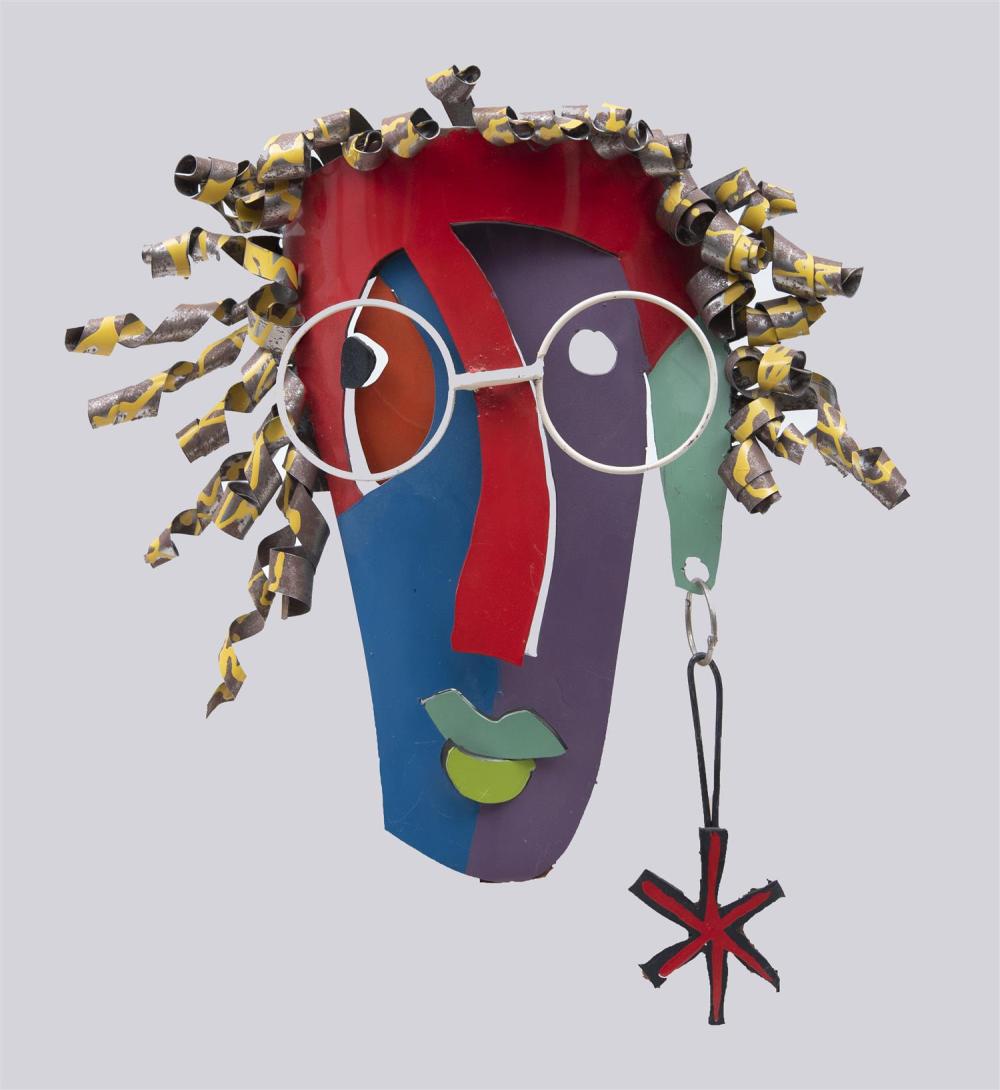
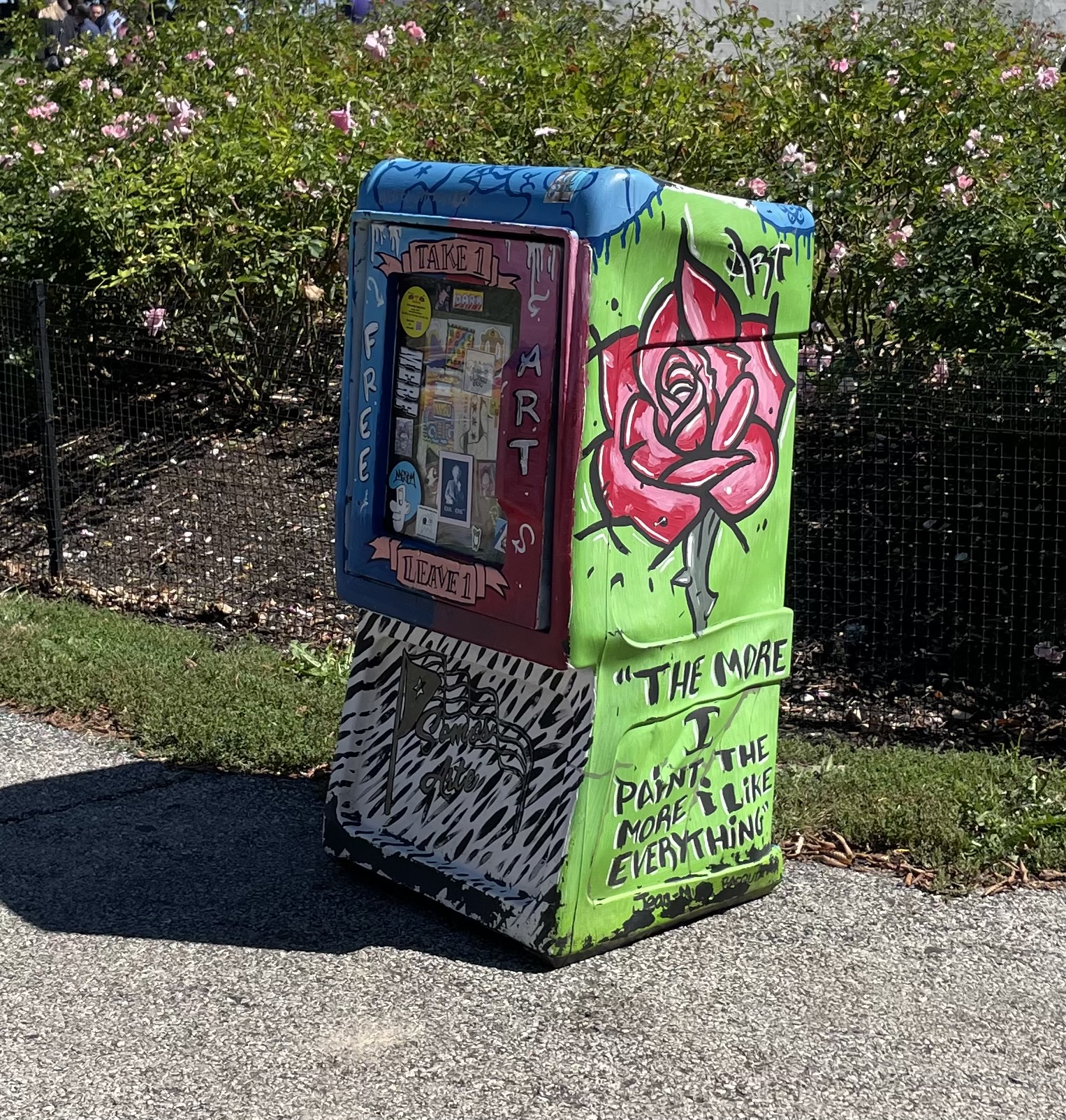
“The More I paint the more I like everything” Artist unknown. Grant Park Rose Garden, Taste of Chicago 2023

Blow-up slides, band stages, and a karaoke contest all spread out among the well-gardened rose bushes and the native hibiscus. Lorraine joined hundreds of line dancers under the “Summer Dance” tent. This was indeed Chicago’s very own county fair.

My son has developed far more sophisticated eating habits in the forty-three years since the first Taste of Chicago. This year, he would have coaxed me into tasting unfamiliar foods or, at the very least, eating a hot dog. As it was, I walked home hungry.

I wish we’d gone together.

Jobs I Could Never Do

Jobs I Could Never Do

Every spring at Walsingham Academy, Sister Walter Mary selected a few students to prepare Catholic children for their First Holy Communion. The children were patients at the local mental institution, Eastern State Hospital in Williamsburg, Virginia. I have no idea why there were young children locked up in an insane asylum. We were trained to teach these pre-Ritalin six-, seven-, and eight-year-olds to memorize answers to preposterous questions such as “Why did God make me?” from the Baltimore Catechism. 

Eastern State Mental Hospital, Williamsburg, Virginia

It was pre-HIPPA 1963. We received basic training in mental illness. A hospital attendant walked us teenage tutors through the children’s wards, pointing out caged paranoid schizophrenics, psychopaths, and catatonics in their soiled grey tunics. Some children sprang at the chain-link fences, grabbing us and screaming obscenities. We didn’t teach this group. Our students lived in cozy dormitories and wore regular clothes. 

Eastern State—the oldest psychiatric facility in the country—had been founded on the forward-thinking concept that insanity was an emotional disorder, not an aberrant behavioral condition. Treatment included exercise and social activities. Catholic parents treasured the outside instruction their little ones received. I’m not sure how much my first-grader learned because all she wanted to do was sit next to me and play with my hair. I helped her into her white veil and gloves and took her to nearby St. Bede’s, where she made her First Holy Communion with the local children. I met her parents at the church. I never saw them again, never learned her diagnosis, or if she ever left the institution.

A few years later, I worked an overnight shift at the Point Pleasant Nursing Home in New Jersey.  My job was to straighten up—put games like Monopoly, bingo, and chess in their boxes and wiggle them into overstuffed cabinets. I wrote down missing pieces of each game so the next shift could look for them in patients’ hiding spots—pockets, drawers, purses.

A completed jigsaw puzzle of an Impressionist painting lay on its box cover under a window. I put the pieces back in the box and stuffed them into the cabinet with art supplies, books, and magazines. Before my shift ended, a patient wandered into the day room. She stopped at the space where the completed jigsaw had been and looked at me, panic-stricken. She grabbed my hair in a flash, shrieked I stole her art, and smacked me in the face. By the time the nurse reached us, we were both screaming. 

In dementia, my mother, Agnes, carried an ever-present small clutch purse. At that same nursing home, the nurses gave her their old lipsticks because the click-clacking sound as she rifled in her bag calmed her down. 

The day she died, I visited the nursing home and thanked the staff for giving my mother what I couldn’t: a proper confinement of love and respect to keep her from wandering around and terrifying her fellow creatures. Only then did I ache for the parents of the Eastern State girl I’d met twenty-five years earlier.

Back to school

Back to school

By the time I’d left the eighth grade, I’d attended thirteen schools. Dealing with all those changes led to the development of uncanny protean skills, including the art of answering questions before they were asked. For instance, my mother, Agnes, an ace at avoiding small talk, taught me:

“When you meet new people say, ‘My name is Regan. It’s from Shakespeare and it means queen in Gaelic’, so you won’t have to answer all their questions.”

This tactic thwarted the name questions on the first day of any new school, especially since my grade school classmates didn’t know what the heck I was talking about. 

Word Daily, coughed up “protean” the other day, a word seen once in every 16,000 pages you might read. I never use it, though I completely click with the namesake origin, Proteus. He was a Greek sea god who knew all things, past, present, and future. Recognized as a shepherd of sea creatures, he slept among the seals and otters, which, save for the smell, appeals to the phantasms leftover from my childhood mermaid dreams.

Proteus escaped those seeking his knowledge by changing his shape to avoid answering questions. In modern parlance, not a shape-shifter, but rather someone flexible and adaptable, is protean.

Proteus sleeps with the seals. Artist: N.C. Wyeth

In the lower grades, adapting to mean-girl culture, I inevitably and reluctantly had to announce, “I repeated first grade because I was sick; then I skipped second grade.” This answered the question of why I couldn’t add or subtract. If I had remained in that first-grade school, my parenthetical nickname would have been “The Repeat” all the way to the eighth grade. The Repeats were few but well-known. We bonded with knowing glances passing silently in the hallways. 

We were Catholics. My sisters and I attended parish schools, wore parish uniforms. There was never a back-to-school ritual in our house because we never went back to a school we had been to before. The beginning of each new school year was a fresh start. 

In Terre Haute we rode our bikes; in St. Louis the school bus. In downtown Indianapolis, we caught a public bus crammed with garlic-breathed commuters. In the Chicago suburbs, a school bus, my mother’s station wagon, bicycles, and walking, all brought us each year to a new building, a new neighborhood. 

I never learned how to predict the future like Proteus (though a spiritualist on LSD once told me I had the gift of prophecy). Predicting what the next parish would be was never in the cards—it was always a mystery. My ears didn’t reach high enough to hear my parents deliberating the matter. But I could easily predict we’d be in a different school for the next grade. For better or worse, we all exhibited protean traits: flexible and adaptable. 

Early on, knowing stuff came to be my raison d’être. I became and remain an insufferable know-it-all. Geographic stability has diminished the necessity for protean mental agility of late. 

But protean knowledge? It continues to inoculate me from ever being called any version of “The Repeat”. 

Lessons Learned: God

Lessons Learned: God

First Grade—Third Grade

God is a white man with a white beard and white flowing hair, sometimes holding white stone tablets, later to be revealed as the Ten Commandments. Then He has a son, Jesus, and simultaneously is Jesus. Jesus’ mother, Mary, and God aren’t married. Then God becomes a ghost, the Holy Ghost. Then He’s all three. Three persons in one God.

All people who were ever born are sinners who can never redeem themselves. But God gives Jesus to Catholics for salvation from their sins. Only Catholics have access to Jesus. They go to heaven when they die, thanks to Jesus dying on the cross for their sins. Everyone else goes to hell.

Lesson: Everyone is bad and God only likes Catholics.

Fourth Grade—Sixth Grade

God created Adam and Eve in His likeness and placed them in Paradise, a tropical garden with no predators or stinging bugs, and all the animals, flowers, and fruit in the world. God forbade them to eat apples from the Tree of Knowledge, but they wanted to be like God, to have His knowledge, so they ate the apples. He got mad and threw them out of Paradise. They had to fend for themselves—grow their food, make their clothes, and pay attention to God.

Adam and Eve had two sons, Cain and Abel. God seemed to like Abel better. Cain got jealous and killed Abel. God punished Cain by throwing him out of his hometown into the desert.

Lesson: Avoid God.

Seventh Grade—Eighth Grade

Jews and Romans alike feared Jesus for riling up the citizenry against their oppressive power structures. The Roman king of Jerusalem sentenced Jesus to a brutal crucifixion. Even though He was a Jew, the Jews didn’t come to his defense.

When Jesus’ followers went to the tomb to see His dead body, Jesus was gone. God resurrected Jesus, body, and soul to live forever. This is what happens to Catholics. They live forever. In Paradise.

“Tiger, Tiger, Burning bright, 
In the forests of the night,
What immortal hand or eye
Could frame thy fearful symmetry.”

Lesson: I want to be a nun.

Ninth Grade

Using my leaky Esterbrook fountain pen,  I write “How can God make evil” in the margin of my English literature textbook next to William Blake’s first stanza of “The Tiger”.  

Lesson: God is confusing.

Teenage—Twenties 

I look for the heavenly in alcohol, drugs, and men. I see God. Then I don’t. 

Lesson: There is no God.

Thirties—Sixties

There is a Higher Power. Maybe God. Maybe Jesus. Maybe the Holy Spirit. Maybe Buddha. Not a Catholic. Not even a Christian.

Lesson: Keep looking.

Seventh Decade

Casting off the lifelong mantle of sinner; I’m finally hip to the knowledge no one is born bad. God does not create evil and Jesus didn’t die to save me—God doesn’t need atonement from me or Jesus. There’s no heaven. No hell. Resurrection may be so. At the end, perhaps time and space will simply let go of me and I’ll wander an endless field of puppies, aka, Paradise.

Lesson: I’m OK. 

Mara Burke RIP

Mara Burke RIP

On Thursday, March 30, a cousin called to say she’d heard my long-forgotten sister Mara had died. We’ve both heard such rumors over the years and have no way of verifying them. So we shrugged and turned our attention to stories about our grandchildren before saying goodbye. A few minutes later she texted me a post from Mara’s Facebook:

The next morning I sipped coffee with one hand as I clicked into voicemails, emails and texts. A voicemail from the previous day said, ”Yes, ma’am. My name is Frank. I’m a captain with Winchester Police. Uh trying to find some possible information about your sister Mara if you can give me a call back. My telephone number is 540xxxxxx. Thanks.”

Captain Frank said they’d responded to a wellness check nearly three weeks ago, on March 13 and was sorry to say Mara had died. The police couldn’t find any information except an emergency contact on Mara’s health records for one of my other sisters. That number was disconnected.

Their investigation drove them to Facebook looking for clues. Eventually they connected to Ellen, an old high school friend who tried staying in touch with Mara. Years ago I’d given Ellen my phone number during a time when people were still trying to help Mara get sober.

“How did she die?” I asked the Captain.

“The death certificate won’t be available for a few weeks. Nothing suspicious though. No reason for us to ask for an autopsy,” he said.

“Oh. Where’s her body?” I asked.

“At the funeral home. They are concerned about the disposition of the remains.”

The Captain felt he ought to talk to the one quasi-official designated family member whom Mara listed as her emergency contact. I said it might take me a few hours to contact her since I didn’t have her number.

“The landlord hasn’t called us yet,” said the Captain, “but we’ll need to give him a contact.”

“I’m sorry,” I said, “I guess it’s obvious we are all estranged.”

I thanked him profusely and told him to feel free to contact me again if need be.

Mara was the oldest of four sisters. I, the second born, became an unwanted character in her life from the dawn of our family story. As adults Mara and I tried here and there to be loving. She once sent me a textbook, England in Literature, from my high school English class. It has my handwritten notes in the margins. She’d salvaged the book from the rubble of our mother’s home. This cherished gift is one of the kindest gestures of my lifetime. 

But our ancestral roots of untreated alcoholism proved too tangled for Mara to weed through. I arose as an easy target for her perennial unruly emotions, especially after I joined Alcoholics Anonymous.

From her Facebook page, I see that many of Mara’s old friends loved her dearly and tried to poke through her isolation for years with little success. Ellen’s brief eulogy tells me Mara confided in her,  and Ellen loved Mara even in Mara’s brokenness.

That is the most comforting condolence of all—knowing Mara was loved.

Mara Burke, b. February 1, 1945, d. March 13, 2023

Collective Salvation

Collective Salvation

My friends and I laugh when we can’t remember the names of a TV series or old movie stars. We keep the conversation going anyway, knowing sooner or later someone will blurt out,”Paul Newman!” who starred in Cat on a Hot Tin Roof with um, what’s her name? Oh yeah, Elizabeth Taylor.

Memory isn’t the only part of the brain clogged up. It takes longer for us to get the punchline of a joke. And we worry about the one who stops getting the punchline altogether. Processing information requires sifting through a lifetime of brain clutter. It simply takes more time these days. 

When I first became aware of the rummage sale in my head, I consulted Dr. Google for tips on decluttering. Dr. Google assured me that indiscriminate shopping, getting lost, difficulty with numbers, language, dates, names and places are all part of the normal aging process called cognitive decline. Researchers say eat right, exercise, socialize and learn something new.

And consult a neurologist.

I called the Mesulum Center for Cognitive Neurology at Northwestern University. “Someone will call you back,” the receptionist said.

“Can’t I just make an appointment?”

“No. Someone needs to talk to you first.”

“I’ll wait.”

“No. Someone will call you.”

I missed the callback. Called again. Missed again. And again.

Processing TV news had become difficult. I couldn’t connect information from one sentence to the next. To understand morning radio, I had to stop getting dressed, sit down with a cup of coffee and listen. Reading was clunky. Some words on the page faded. Some didn’t. I went to the eye doctor three times within six months. She insisted my vision was fine.

A friend told me about a new choir for people with early-stage memory loss. The organizers sought volunteers to help people with the music and to round out the choir. No audition or experience required. I’d never read sheet music or sung in a choir but I love to sing. So I signed up.

The first day I hesitated to accept my songbook. Would I remember to bring it to rehearsals? Would I even remember the day and time of rehearsals? People asked me what “part” I sang. I had no idea.

“I have to sing the melody,” I said.

After a few warm-up exercises we started learning an Oklahoma medley. Alice, sitting next to me, noticed I was having trouble. The music was running ahead of me—I couldn’t catch the words. She pointed to the soprano lines and pulled out a yellow marker to highlight them.

“Sing the notes with the stems pointing up,” She whispered.

That was 2018. I mark my own music now, never forget a rehearsal and can find my place on the sheet. Months of practice pulls the music closer, though I never feel concert-ready.

In December 2022 our repertoire included songs in five languages. Each deja-vu rehearsal seemed like a new beginning. I rarely got my voice to attach the foreign words to the notes. But on concert day, my brain latched onto another dimension. I sang perfectly.

I’d say I really cleaned up.

The Day I Turned Old

The Day I Turned Old

My actual (as opposed to official) retirement began the day I walked into Fourth Presbyterian Church in Chicago and asked to volunteer for a few hours each weekday. I’d had a couple of rough years at my final payroller job and I thought volunteering would help lift me into a new way of thinking. Or, more precisely, I wanted a time-filler to keep from obsessing over the aftermath of the soul-crushing previous twenty-four months of my life.

Oh churches! There seem to be so many cries for help, until they try to find a job fit for you. I grabbed the first one offered and plunked myself down in front of a computer in the cubicle next to Vince, a friendly volunteer who was out of work but not yet retired. Our job: clean up the database. 

The database. Every pensioner I’ve met since my stint who looked to the church to help fill the first year’s lonely unproductive hours says the same thing.

“I started with the database.”

Vince knew what he was doing and in fact devised a formula and matrix for our work. I suppose it was simple. If you could pay attention. I couldn’t. At the end of each of my four hour stints, he’d spot-check my work and stay an extra hour or more to correct everything I tried to accomplish. Vince had an advantage—he was good at the game Concentration. He could spot a misspelled name in seconds-flat with his highly industrious mind.

The room next to the dreaded cubicles had been cleared of all furniture. It may have been the size of a football field. For about a year, having been diagnosed with PTSD due to the aforementioned job, my perception of size, space and time was like science fiction, all out of whack. 

One day, I heard an old Frankie Valli tune, “Sherry Baby” seeping under the door from that huge room. Of course I learned all the words—they’re pretty simple—as a teenager and never forgot them. 

“What’s going on in there?” I asked Vince. 

“Sher-er-ree, Sherr-ee, Baby…

“Oh, that’s the old people’s exercise class,” he said.

“Old people?”

“Yeah, ya’ know. CLL. The Center for Life and Learning.”

I didn’t, in fact, know. The church bulletin had notices about CLL but I never thought they were meant for me. Within the next few weeks, each day I grew grumpier and grumpier working on the database.

“Vince,” I said, “No offense, but I’d rather be in that room dancing around to “Sherry Baby” than sitting in front of a computer.” 

“Aw, yes, Regan,” he said, “But would it be as rewarding?”

Rewarding. Now there’s a loaded word. Did I really need to feel rewarded for the hours between sunrise and sunset? How about satisfied? Couldn’t I just feel satisfied?

Or, neutral?

“Vince. I’m logging out today and joining the exercise group tomorrow.”

And that day, that neutral day, is the day I turned old.

May Day! Mothering Rough Seas

For a few years, my son and I lived at the Jersey Shore with his stepfather, Jack, on the confluence of a fresh water river and a saltwater bay. The east-west Toms River begins in the swamps of the Pine Barrens, widens and swells its way east, eventually slamming into the Barnegat Bay. Sailors love the Toms River, especially during the summer’s prevailing southerlies.

I am not a sailor. 

In our family, swimming, passed down from one generation to the next, was a right of passage for a three-year old.  Water is in our blood. Our sandy backyard, bulkheaded rich brine that nourished vibrant sea creatures and, in turn, fed migratory bird colonies. Life on the water with my inquisitive six-year old was pure joy.

Jack arrived home one day with a used polystyrene Sunfish trailing his ’65 Mustang. For fifty dollars, the previous owner threw in a booklet on ‘how to sail’. A 1971 ad in Boating magazine called the thirty pound Sunfish the “Volkswagen of sailboats. A perfect learner’s boat” 

I called it a styrofoam bathtub.

Joe and I practiced our new book-learned sailing skills, 100 feet offshore, moored to the bulkhead. On our first untethered day at sea, Joe rigged the sails. We lulled away the dead calm until Joe spotted our German Shepherd swimming our way. As she approached the boat, I stood up, pointed toward shore and shouted “go home!” Which of course she did. She was, after all, a German Shepherd.

The next time Joe and I unmoored, we sailed expertly into the middle of the widest part of the river. We took turns at the tiller, successfully jibing and tacking as the wind took us west. But then we tacked to come back downriver. The sweet southerlies that had funneled us upriver suddenly turned on us like a mad dog turning on its master. The rogue wind bared its teeth. Thunderclouds whipped up the tide. And the sail luffed out of control. We. Were. Trapped.

The boat, too light for wind-churned waters, threw us around like a sea monster. I reassured Joe we were safe since we were both good swimmers. 

“We can’t leave the boat,” pleaded Joe.

“We won’t!” I assured him. But truth is, he’d seen the thought to abandon the boat cross my brow. I could swim to shore with one arm around Joe’s chest but I couldn’t pull the Sunfish with the other. 

Private docks, woods and marinas dotted the riverfront. I spotted a sliver of sand and rowed furiously. We pulled the boat up, tied it to a tree and ran to the door of a stranger who drove us home. The next day the Coast Guard towed our Sunfish home. 

“No markings on this thing,” the officer said. 

“You should name her ‘May Day.’”

At twenty-seven years old, I had no reason to believe motherhood would come naturally. All my choices to that point had been daring, radical, reckless.  Only four years before, I’d taken LSD, left toddler Joe with his father and trekked to Woodstock in a station wagon full of Rolling Rock chugging hippies. I was separated from them on the first night while swooning over Richie Havens’ performance of “Freedom”. During the muddy aftermath, I smoked opium with a stranger and hitched a ride home with him to New Jersey.

Ancestral maternal instincts swelled up out of nowhere that first day battering around in the Sunfish on the roiling Toms River. No matter how afraid I was, I had to show no fear, lest my six year old become traumatized and frightened by open water for the rest of his life. 

“Let’s try again,” I announced one day and we eagerly sailed into the prevailing southerlies on a sunny calm morning. Upriver, nature turned against us again.

“We need help,” Joe shouted in the sea spray. And we beached the boat once more.

Our sailing adventures made for wild-eyed good stories with our friends and family, but I feared my recklessness may have given Joe a subconscious dread of the sea  into adulthood.

I needn’t have given it a second thought. In his fifties now, Joe and his family leave their midwestern flatlands to vacation on tropical seas—snorkeling, bodysurfing and scuba diving. 

But.

No sailing.

Seeing Jesus

In 1949 the Soviet Union started the Cold War by detonating its first atomic bomb, blockading Berlin, and pushing its way into Poland and Eastern Europe. The voices I heard swirling above my head at cocktail hour in our Washington home implied the Russians were coming for us. Everyone acted like this was the worst thing that could ever happen. 

Air raid drills were concocted by the federal government through the National Civil Defense Administration to protect people from incoming A-bombs. Common folk-wisdom said only cockroaches would survive a nuclear attack. Nevertheless teachers were required to conduct impromptu air raid drills. They shouted, Drop!—a signal for us to jump out of our seats, crawl under our desks, fall over our knees and cover our heads. The nuns added the instruction to recite Hail Marys aloud while on the floor. 

Holy Mary, Mother of God, pray for us sinners, now and at the hour of our death. Amen.

At seven, I didn’t understand the difference between a drill and the real event. I went to my death every time I huddled under that desk. I feared the A-Bomb was the worst thing that could ever happen. But, I was not. afraid. to die. 

This is it, I’d pray. This is the day I’m going to see Jesus.

I believed Mother Mary would grab me in her arms like she did baby Jesus and take me to heaven. Why did we practice to avoid such ecstasy? 

By the time third grade rolled around, I got used to not dying under the desk. Images of children who lived after their exposure to the atomic bombs in Hiroshima and Nagasaki appeared on our small black and white television. I saw that there were worse things than death. 

Our Catholic school teachers taught that Communists who ruled Mother Russia prohibited the celebration of  the Mass. The clergy declared this was the worst thing that could ever happen. We prayed for Catholic Russia.

At home, my two sisters and I made our own breakfasts and school lunches because my mother’s alcohol intake rendered her unconscious in the mornings. We often gathered around her bed trying to figure out if she was alive. Holy Mary, Mother of God. One of us would place a finger under her nostrils to feel her breath until, with one exhale, she’d confirm that the worst that could’ve happen, hadn’t—and we’d be off to knock on neighbors’ doors scrounging rides to school. 

Those early almost-worst-that-could-happen memories have inoculated me against the mau-mauing of present-day alarmists, naysayers and fear-mongers who sermonize about the death of our democracy. Yeah-but’ers and tsk-tsk’ers want us to heed their cynical creed that our country is hopelessly overrun with insurrectionists, sexual predators, corrupt politicians and gun-toting scofflaws.

And what if these are apocalyptic times? So what? So were the 1950’s. I’ve been here before. 

Mother Mary may be out of commission these days, but I still dream of seeing Jesus.