Ghosts of Navy Pier

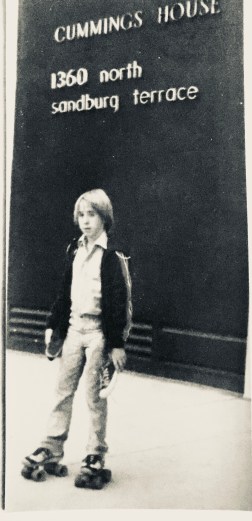
My son Joe and I bought sneaker roller skates from a typical Chicago hustler at the Dearborn Garden Walk street festival in early summer 1977. They were a novelty—yellow canvas shoes attached to shock-absorbent, sound-proof neoprene wheels. We lived in nearby Sandburg Village and skated home that day carrying our shoes.

IMG_0170
Joe Kelly, 10, on Roller Skates

The rest of the summer and into the fall, after school and work and on weekends, we’d skate around the Near North side and downtown Chicago, charting the smoothest sidewalks, the longest ride, uphill climbs and downhill coasts.

One October day we skated over to Lake Michigan’s Navy Pier. Built in 1916, Navy Pier has been used as a cargo hub, a military base, college campus, convention center, recreation center and wedding pavilion. Before its retrofit, the watery concrete jetty hosted Chicago Fest and the International Art Expo. That day in 1977 when Joe and I were skating around, the deserted mile-long slab of steely smelling cement shouldered two low-slung cargo sheds divided down the middle by a midway for tractor trailers. A few joggers who’d parked their cars in the lot in front of the pier were trotting out and back along the sun-drenched lake side, a perfect 2-mile run.

We chose the leeward route, the interior midway, because we noticed half-opened doors to the cargo sheds, though no workers were in sight.

“Let’s go look inside.” I said to Joe.

Gregarious ring-billed gulls hawked insects on the wing overhead. Otherwise, the place

IMG_0171
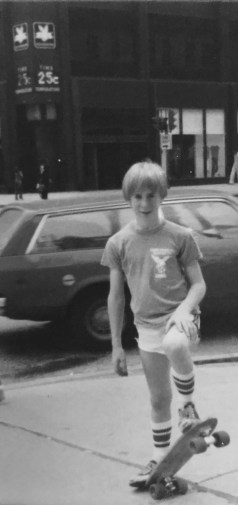
Joe Kelly, 11, on Skateboard

was noiseless. We skated off to a half-opened articulated overhead door, bent under and slid through. Our squinty eyes adjusted to the shadowy warehouse. Row after row of two-story high floats showcased Dumbo, clowns popping out of train cars, horses hanging over barn doors, dragons, Charlie Brown and Lucy, castles and fairies, Santa’s sleigh and reindeers and Old Mother Hubbard’s shoe with her big-headed children clinging to the side.

“Whoa-ho!” said Joe, “this is where they store the parade floats!”

We skated under dragon’s fire and around angels’ wings farther and farther into the semi-dark. It was the year of Star Wars and Close Encounters of the Third Kind, movies that put head-trip phantasms in our everyday journeys. The bang of an unseen door slamming shut whooshed life into the moribund creatures. The two of us tacked on our skates and sailed back through the outsized flatbeds into the light to shake off the spirits of our fright.

I once heard the old parade floats got dumped into the defunct Riverview Amusement Park, and I hope that’s true. It’d be a perfect graveyard for the ghouls on parade.

Joe took up skateboarding the next spring when he was 11 and rolled around his own
Chicago with his friends. I dumped my skates for a bicycle and I often pedal around the modernized Navy Pier. Every once in a while I get spooked by a mysterious whop. I shake myself real: those clowns popping out of that train car are not coming for me.

Heads Up! Who Said Pot is Not Addictive?

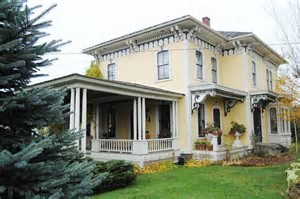
Tricia Thack and I left our husbands in New Jersey and headed to Vermont soon after I returned from peace and love and LSD and pot at the Woodstock Music Festival in August 1969. I had a 2-year old son, she had an infant and toddler daughters, so together we rented a first floor 4-bedroom apartment in a 150-year old Victorian on the Villageth Green in Pittsfield. We drew close because we had a love for beer, pot and men. New Jersey friends up for ski weekends on nearby Killington mountain, and new friends from the places we worked in the resorts all flocked to our door for after-hours hoopla.
We reveled in breaking the chains of constraint that kept us from having fun. We were always broke. When our kids needed winter clothes I, having been taught by my mother, shoplifted from stores in Rutland. Tricia spent a lot of time on the phone begging her husband and parents for money. We waitressed, cleaned hotel rooms, babysat and tried to budget. But all our money went for booze and drugs and we had trouble holding onto jobs.

Once I drove 150 miles down to Boston to buy a kilo of marijuana in a carful of other amateur pot-buyers. We heard it came from Mexico by boat and was free from sticks and seeds, insuring a higher potency than what we’d been smoking. Somewhere in the supply chain the pot was dried, pressed into bricks and wrapped in plastic. I’d never bought pot in a brick – it was a get-rich-quick scheme dreamed up by the local ski-bum-Unknownpusher guaranteed to turn our $300 investment into a $1000 profit.
In the car we had a load of fresh-rolled joints and a case of Rolling Rock to fortify us for the 6-hour round trip. At our destination, I simply handed my cash to the leader of our pack, too stoned to get out of the car. We partied all the way back up Interstate 91.

I can’t remember when someone passed me my first joint – late teens? early 20’s? I don’t know where or when. Such is the nature of cannabis. You lose track. I saw God many times, in the consciousness-raising vapors arising from Joe Cocker, the Rolling Stones and The Doors. My foray into pot dealing withered on the vine though. I smoked it all up, shared it with friends and strangers alike, unable to make any kind of clear-headed money transaction.

Tricia and I used to laugh that we ingested more drugs and alcohol in an hour than Wizard of Oz star Judy Garland did when she accidentally died that year after swallowing 10 sleeping pills and a few glasses of wine. The delusion of our invincibility propelled us to smoke more pot, drink more alcohol and swallow stronger drugs.

Against all odds I survived my addictions.  But pot? Man, it still calls my name in the night.


1971, 25 Years Old and Still Alive

In June 1971, I turned 25 years old and celebrated my first six months of sobriety in Alcoholics Anonymous.

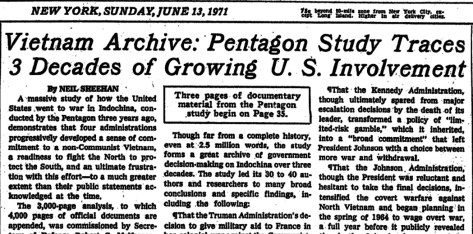
That same month, the release of the Pentagon Papers set off a firestorm of I-told-you-so outrage by Vietnam war protesters like me. All through the 1960s Washington insiders had been leaking to the press that the White House was lying about our involvement in the war in Southeast Asia. Anti-war organizations published newsletters and held NYT-pentagon-papermarches screaming at the government to pullout of Vietnam because there was no good reason for us to be there. When my son was born in 1967 I started sending streams of letters and postcards to the President and Congress begging them to end the draft. I didn’t want my son growing up in a world where he would be forced to kill another mother’s son.

My imbalanced emotional connection to the 60% of Americans who were against the war drove me to protest, argue, march and drink myself into oblivion. In December 1970, defeated, I finally collapsed, failing to escape the world of war, within and without.

Then, in my first year of recovery, the Pentagon Papers confirmed that Presidents Truman, Eisenhower, Kennedy and Johnson all lied about why we were in Vietnam. We stayed simply to save face, refusing to admit defeat. Troop numbers fell from 500,000 in 1968 to 156,000 by the end of 1971, the year The Pentagon Papers were published.

And so what? The world went on. Jim Morrison died in his bathtub in Paris. I read The Exorcist, rocked out at George Harrison’s Concert for Bangladesh and women were allowed to run the Boston Marathon.

The Pentagon Papers’ exposure of the government’s lying treachery slow-cooked beyond my consciousness. My AA meetings in Point Pleasant, NJ, seduced me with a new recipe for living, replacing the bitter stew of the wearying world. A wise woman at my meetings gave me two pieces of advice: 1) don’t comment at meetings about outside issues and, 2) wear a bra. I did both and managed to attract a ne’er-do-well fellow AA’er, ten years older. Ed professed some kind of love, so I moved in with him.

Julius Roehrs Garden Center hired me to make terrariums in glass bowls, a new fad. It 805160-03-1was my first job as a sober adult. I spent all day in a greenhouse planting miniature sedum and echeveria while having LSD flashbacks and dancing around to tunes only I could hear. My son, Joe, had been living with his grandparents for his kindergarten year and came to live with Ed and me. Disney World Orlando had just opened, so we read up on how to camp, then packed our new tent, camp stove and sleeping bags into Ed’s Mustang and drove down I-95 to the Yogi Bear Campground.

It rained. Ed and I fought. He got drunk and disappeared.

I drove Joe home—1,000 miles back to New Jersey.

When Ed showed up a few months later, we got married.

First Impressions of Bill Clinton

In August 1991, twelve Democratic leaders and influencers, were seated in leather armchairs at a walnut oval table in a small dining room at one of downtown Chicago’s private clubs. I was the only woman. When Governor Bill Clinton entered the room, his th-2tall navy-suited body seemed to shift the atmosphere, moving the dust molecules away from him and clearing the air as he moved. He gave a hardy salutation and proceeded to introduce himself to each person while he circumnavigated the room, one-by-one. I was halfway around the table, and when he reached me I stood and looked up to his bemused rosy face, full of laugh lines. He had a big red nose, like Santa Claus. As I tried to introduce myself, he interrupted me by saying he knew who I was— the Executive Director of the state Democratic Party. He asked if I knew my name was the same as one of King Lear’s daughters. “Yes,” I said, “My name came from her.” He leaned over and whispered let’s keep that between us since she wasn’t such a great character. And just like that we had a best-buddies pact.
He finished working the room, told us why he was thinking of running for president, and asked us to support him. He never sat down.

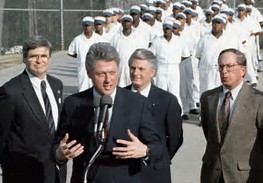
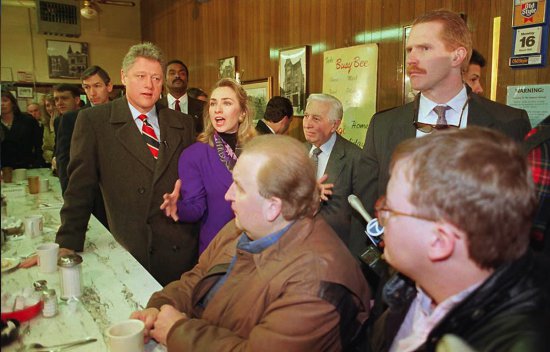
A few weeks later, Bill and Hillary entered a crowded 2nd-floor meeting room in a Chicago hotel with about 50 curious political activists who gathered to meet them for the first time. He neither ushered her in ahead of him as a well-mannered (albeit chauvinistic) gentleman nor did he make her walk behind him as an ill-mannered boor. Democratic presidential candidate Bill Clinton (L)
Side-by-side they came to us. We all jumped to our feet and cheered before he even said hello, before he shook one hand. It was two months before he announced his candidacy for President. His nascent message stressing personal responsibility for welfare recipients echoed what I’d learned in Alcoholics Anonymous — to acknowledge that I am responsible for the choices I make in my own life. Later in his presidency I despised his welfare reform policy but for now this seemingly spiritual insight vaulted my commitment to a new height. This was my guy.

The first week in October, one of Clinton’s many Chicago friends asked me to join him in driving Bill Clinton to Midway Airport. We’d been at a 100-person meet-and-greet where Clinton learned I was moving to Little Rock to work on his campaign. He looked back at me in the car and asked what my boss said when I told him I was quitting my job. My boss hoped I’d change my mind, so I told Clinton he wasn’t happy.  Clinton picked up the car phone, called my boss, thanked him for letting me have this opportunity of a lifetime and said he was happy to have me on board. He ended the call by inviting my boss to bring his family down to the Governor’s mansion for a weekend. In the back seat I imagined throwing my arms around his neck and kissing the top of his ever-loving head.

I was in Little Rock by the end of the week.

At The Shore

At The Shore

Once upon a time a long time ago I got tumbled round and round and somehow knew to go limp, relax my breath, close my eyes and not wriggle toward the sky I couldn’t see. I let myself go, with, the, flow; let the tide churn my body turned-fish-turned-seashell-turned-driftwood-turned-mermaid. Sanded, winded, exhilarated and afraid I ended up splayed out on the beach—waiting for someone to acknowledge my courage in facing the swollen ocean alone and coming out alive. But they were all in their beach chairs smoking cigarettes, drinking beer, telling jokes, gossiping, hissing—the parents, the aunts, the uncles, the friends, the neighbors.

That was the summer my father taught me to swim and I made friends with the ocean.

Twenty-two years later, second-husband Ed moved me and my child Joe into flat-roofed, low-slung stucco in the tidal flatlands of Ocean Gate, New Jersey, where freshwater Toms River flowed into saltwater Barnegat Bay and made the brackish brine off our sandy backyard abundant with sealife, birdlife and shorelife. Ed, a no-good sometime-recovering alcoholic raised in the working-class Ironbound neighborhood of Newark, had spent gobs of time at the shore and had one good characteristic—he loved nature. The first summer on the bay, he taught Joe and me to fish, crab, birdwatch and seine.

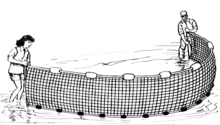
In knee-deep water, Joe’s five-year old body, barely holding up a pair of trunks, stood on one side of the seining net. He gripped its wooden pole with both hands. Holding the other pole, I stretched the net six feet to the side of Joe. On the count of “One, two, three!” we dug our poles into the bottom and slowly pulled them through the sand, dragging the 220px-Seine_(PSF)slackened mesh to the shore and heaving it waterlogged onto the beach to see what lived beneath and around our sea-shored feet. We scrambled to our catch before low-flying seabirds descended to snatch up bottom-feeding young flounder; then we examined the rest of the bounty, which always contained a variation of tangled fishing line, faded lures, pieces of styrofoam, oyster shells, mussel shells, small rocks and pebbles, and once in a while a prized jellyfish, baby turtle or blue crab.

One time an osprey flew overhead scouting out what may have been his next meal. He held something flapping herkyjerky in his talons that dropped smack on the beach in front of our seining net. Screeching like seagulls we threw up our arms, jumped up and down, pushed and pulled each other screaming for Ed. Ed grabbed a stick and an old ice chest and lifted the six-foot rat snake into captivity. That snake lived in a glass tank in the kitchen for a few months eating live frogs and mice before we released it back into the seagrass.

Once upon a time a long time ago I learned to be the mother of a boy, face fear and love nature. And she loved me back.

The Reunion by Regan Burke

In the locked ward of the Marlboro Psychiatric Hospital in Monmouth County, New Jersey, I was withdrawing from my demons – cheap wine, LSD, amphetamines and marijuana – when my long-absent father appeared before me. I was 24 years old. The last time I’d seen him, the week before I was to enter Monmouth College, I’d knocked on the door of his mid-town Manhattan apartment seeking money to pay my first year’s tuition. He was drunk, wrapped tight in a dirty blue bathrobe. He wrote me a check, then stopped payment before I could get to the Admissions Office in Long Branch, an hour down the Garden State Parkway.

Fresh out of a straight-jacket, I had no clothes or shoes of my own, having arrived at the public madhouse in an ambulance after a drug overdose. I wore a short-sleeved baggy muslin dress from the institutional collection designed and made by the permanent residents.

“You have a visitor,” the nurse said before escorting me from my cell-like room to the end of the hallway into a clean and airy space she called the Day Room. There were windows along the wall opposite the door, starting maybe six feet up from the floor and reaching the ceiling. For the first time I realized my confinement was subterranean.

My father turned toward me. His brown felt fedora, soft brimmed with a hand-creased crown, topped his elegant duds: white open-necked shirt, tweed sports jacket, gabardine trousers and cordovan wing-tips. A miasma of feelings engulfed me. I feared him. I missed him. I loved him. I hated him.

Why didn’t she say it was my father? I had no idea how to talk to him, or anyone else for that matter. My body shook and rattled as I searched for some kind of appropriate words. I knew only hippy language.

“Hey, man. Far out. You’re here. I’m a little strung out.”

He told me his story of recovery from alcoholism. He loved the effect from his first teenage beer. After that, once he picked up the first drink he binged until he was forced to stop. He had been in and out of jail for getting in fights, drunken driving and cashing bad checks. He couldn’t hold a job. In the end, he holed up in the New York apartment drinking quarts of scotch round the clock until an old friend knocked on his door.

“Had enough, Burke?”

After years of trying on his own, these bewitching words got him to open the door and allow a few men from Alcoholics Anonymous to enter his life. The obsession to drink lifted. “A miracle,” he called it.

He told me about an AA meeting at the hospital. He didn’t suggest I go, didn’t offer to take me, didn’t tell whoever was charged with moving me around my current existence. He just laid the words down. And then he left. He never removed his hat.

About 25 years into my own recovery — admitting defeat, examining resentments, practicing forgiveness, making amends and consciously increasing a spiritual life — that reunion with my father came back to me. I now know supernatural love and courage drove him to bestow his abundant legacy, the gift of sobriety.

Morrigan Go Bragh by Regan Burke

On the southwest coast of Ireland known as West Cork, I monitor a murder of grey-backed black-crowned crows cruising around the wild Irish garden of the home I’m visiting in the hills above the harbour of Baltimore, an old pirate town. I’m not a thbirdwatcher, but enough of a bird lover to know these elegant, regal beauties are not something I see in the trees in or around my home in Chicago.

I sit in the peace of soft rain watching three Grey Crows preen on the dead unpruned branches of an ancient apple tree less than 50 feet from my morning coffee. I throw kitchen scraps onto the stone veranda adjacent to the dining room to entice the 20-inch long birds to come nearer to me. They swoop gracefully from their perch, plunk down and waddle toward the bounty, as I knew they would, like their foraging junk-eating U.S. cousins, the American Black Crow.

I open my laptop and look them up. Wikipedia has not only facts and figures of the Grey Crow but also a link to Celtic myths and legends of this western European corvus. I click into the world of Irish folklore where the Grey Crow is known as a manifestation of  The Morrigan. The Morrígan is a mythical figure, a foreteller of doom and death, deriving her name from the word “mara” connoting terror or monstrousness as in night-mare. Mara is my older sister’s name. The “rigan” in mor-rigan translates as queen, as in my name, Regan. Mara-Regan equals Mor-rigan, or the nightmarish queen, manifested in the Grey Crow keeping watch o’er my morning. So here I am on my Irish vacation, hiking heather and heath, having great craic with my Irish host, Vivienne DeCourcy, when I’m reminded that my sister Mara and I are ferally joined for all time in blood and tradition.

“Mara” has a place in many traditions. It means bitter in Hebrew, demon in Sanskrit. My mother benignly named my sister, thinking it a noble Gaelic name for Mary, never researching the root of it. The human Mara lived up to the historic iterations of her name: she killed me off before I was born, bullied and tormented me as a child until, as a fully-ripened adult, she declared she no longer considered me a part of her family.

This new knowledge awakens old fears and crams them into a contemporaneous morass. Is The Morrigan perched outside my window an omen on this mid-August day in 2017 as Donald Trump is heralding white supremacy in mythological statements that intertwine fact and fiction? Some say ancient Irish bands of young lawless warrior-hunters who lived on the fringe of civilisation were dedicated to The Morrigan similar to the white supremacists’ infatuation with Trump. The tenants of this wild Irish countryside fear Trump is a modern-day Morrigan cawing out lunatic signals, picking at trash and digesting hate. I trust Trump is a temporary danger, unlike Mara whose talons are forever embedded in my soul.


Ozzy the Arhat by Regan Burke


Do the dead always visit us in the morning? I wake up listening for the click-clacking tap-dancing, rat-a-tat across my hardened floors. Ozzy had well-padded soles, wide feet and solid toenails meant to root out rats and badgers from their earthen dens. No Scottie-level potted plants ever made it past the first day, neither inside nor on my third-floor balcony. His diggers instinctively, fanatically worked their way into the soil to get to something, anything that proved his worth, duty done. Satisfied with nothing more than a dirty nose and paws, he gave me a message: don’t worry, I’ll protect you from any danger, man or beast.

At the Takashi Murakami exhibit in Chicago’s Museum of Contemporary Art, I wondered aloud to my 20-year-old grandson, CJ Kelly, why the artist painted so many colorful frogs at the feet of the arhats. CJ mindfully revealed those are the arhats’ toenails, not frogs. Ah, toenails. Murakami’s arhats are Buddhist spirits who hesitate between two worlds, the physical and the not, to comfort suffering earthly beings. His bulbous toenails are a tribute to the noble path of those enlightened ones whose feet are moving them through their death and decay. The parade of toenails is Murakami’s day-glo gratitude for arhats who stop along the way to ease our sorrows.

Murakami called his Chicago exhibit, The Octopus Eats His Own Leg, based on an ancient Japanese adage that an octopus eats its own decrepit limb to save itself from death rot. A new leg grows back, the octopus is healed and lives a long and healthy life.

In the exhibit, the 33-foot-long painting, 100 Arhats, has 1,000 intricately painted toenails. I misinterpreted the toe protectors, thought they were frogs. After all, how could toenails mean so much to anyone but me? I harbor an unspoken repulsion of human toenails. Summer sandals expose these keratin plates sitting atop ugly toes that hardly ever match each other—some curled under, some straight, some turned outward, some inward—all on the same foot.  Toenails are often fungus-rotted discolored thick globs that women hide with colorful paint instead of covering with cool shoes. God clearly missed the boat in his design of the human toe apparatus.

But Ozzy’s coal-black, perfectly formed, hardy toenails witchy-curled out of his all-business paws, ever-ready for the hunt, the prowl. At rest, his legs stretched out before him showing off his toenails as if he’d just had a pedicure.

His body turned in on him overnight. Like the octopus, his system ate up his dying kidneys and liver but left a beleaguered heart that had to be put to rest. I now have my own arhat who will walk me through the sound of silent, unseen toenails until the hard margins at the edges of grief fade into the path.

murakami_portrait
Takashi Murakami in front of his epic work “The 500 Arhats.” (Courtesy MCA Chicago)


Keep On Truckin’— Contemplation on a Deadman by Regan Burke

In Beth Finke’s latest book, Writing Out Loud, the following brief memoir was excerpted. I post it for those who’ve asked for the full story.  Check out Beth’s book for more stories from Chicago writers: Writing Out Loud.

BethFinke-WritingOutLoud-525x8-CoverDesign-245x373

_______________________________________________________

Keep On Truckin’— Contemplation on a Deadman

I worked in politics my whole life, always hoping for the perfect politician, one who acted in the best interest of the whole. Bill Clinton could have been my hero. I loved his rallying cry in the 1992 campaign, “personal responsibility.”

But I had doubts. Could I work for a candidate who was pro capital punishment and unsure of his view on abortion? Those were two issues I thought every Democrat knew to be against and for.

The “personal responsibility” message won me over. In October 1991 I abruptly left Chicago for Arkansas to work as Clinton’s campaign scheduler, a grueling job that required 24/7 attention. One cold January night Clinton and his entourage, George Stephanopoulos and Bruce Lindsey, returned to Little Rock in a small private jet from all-important New Hampshire. I met the plane on the dark, deserted tarmac to give Clinton his next-day schedule. He descended the jet stairs with a big smile, came directly at me, grabbed my coat and ran his graceful elongated fingers up and down my long furry lapels. “Nice coat, Regan,” he whispered in my ear.

This encounter may be the reason I love Bill Clinton.

When he won, I relocated to Washington to work in his administration. I moved into the first floor condo of an 1880 townhouse on Church Street in DuPont Circle. In 1994 he passed a crime bill I thought went too far. Next he signed NAFTA, an agreement opposed by every Democrat I respected. Both policy shifts were spearheaded by White House insider, Rahm Emmanuel, who decidedly did not have the public good at the forefront of his self-serving mind. But Clinton loved him. Dissatisfaction settled in the space between my bones and muscled me awake at 3 o’clock in the morning for the next six years.

In the early still of a hot D.C. August morning in 1995, NPR told me Jerry Garcia died. I collapsed on the bathroom floor weeping over the death of something I couldn’t put words to. At 49-years-old my idealism had come to an end: my phony world of everlasting good died with Jerry Garcia. Reality glared back at me in the mirror as I brushed my hair, seeing for the first time a wrinkled face and rubbery neck. I dressed in soft yellow, a flowery cotton frock, and pinned a silk flower in my hair, ready for the grieving day.

My dog Voter squirmed away from my extra long hug and I went out the door to my old friend, Keith Lesnick waiting to drive us to work. As soon as I got in the car tears spilled out. He asked about the sadness, and I slobbered out a few words, “Jerry Garcia signed into rehab last night,” I said. “He died in his sleep.” Keith waited a few respectful minutes, and then, with one simple sentence, he opened a new, naked reality that included the unspoken caveat—don’t take yourself too seriously.

He said, “well, it’s not as if it’s Aretha Franklin.”

Hazmat Blues by Regan Burke

One hundred and seventy days into the Trump Administration I flew to Washington DC for the annual board meeting of the national anti-sexual violence organization, RAINN.org, (Rape, Abuse, Incest National Network). Lively meals with DC relatives, the board meeting and coffee afterwards with old political cronies were old-shoe comfortable and safe, though conversations periodically broke into expressions of danger. This is, after all, the nation’s company town, Trump’s ground zero.

I arrived at the Washington National Airport an hour early for the non-stop flight home to Chicago. Packed with fellow travelers, pop-up phone and sunglass vendors, fast food and maintenance workers and airline personnel, the terminal sizzled. I managed to nudge a stool into a space at a long table rigged with outlets and nose-dived into the computer-news rabbit hole: click, Trump crashed a wedding at one of his resorts, click to an old story about a sinkhole in front of Mar-a-Lago, click to a twitter storm of jokes about draining the swamp.

Annoying conversations buzzed my ears about a hazmat incident at the control tower. Click! a local TV station reports fumes from roof construction at the Leesburg, Virginia control tower has shut down all flights for 4 airports around DC. Click. Is Steve Bannon, the President’s sneaky architect of distraction, trying to terrorize awaiting airline travelers?  Or did he sabotage the timetable to turn the screw on some disagreeable Administration insider?

The announcement came. “…we don’t know when flights will continue, we’ll update you as soon as we know.” It was 10:00 pm when I learned my flight was cancelled until the next morning. The United gatekeeper told us all the hotels were booked for 50 miles around and that maintenance crews would be handing out blankets for those who’d be sleeping in the airport.  No problem, I’d just contact one of the five people I know in DC and ask to lay my aching bones down on a couch. Click. Click. All five were non-responsive. Travelers were staking out their spots on the floor. In front of the gatekeeper I pleaded, “I just cannot sleep on the floor. I’m old and have arthritis. Is there no other solution?”

He shook his head.

“How much would it cost to get to the nearest hotel?”

“Sixty miles away? About $100.”

“Oh no. Are you giving vouchers for cabs?”

“No”

I was dragging my carry-on away from any hope of a reprieve, doomed to slumping to the floor by Dunkin Donuts, when a young man pressed something in my hand.

“Please let me help you. Take this.”

A $100 bill. Before I could thank him, my FaceBook message lit up with a query from Dan Murphy whom I hadn’t seen in 10 years: Click. “FB is telling me you are nearby! Can I see you?”

And right then, I was no longer afraid to die.

Click.

Click.

Click.