Author "In That Number" from local booksellers or Amazon
Author: Regan Burke
Regan Burke's book, "In That Number" was a finalist for Chicago Writers Association non-fiction Book of the Year. Her brief memoirs and personal essays appear in the Christian Science Monitor, Sun Magazine, Chicago History Museum "In This Together" Project, City Creatures, Safe 'n Sound, Easter Seals Blog. Chaleur, Rise Up Review, Bird Garden's Murder of Writers and Writing Out Loud. She lives on Potawatomi land in downtown Chicago with Elsa, the West Highland Terrier. Her main activity is reducing the weight of the here and now.
Don’t call me senior. I’m old. This is what old is, looks like, sounds like. My old may not smell like your granny. My old moves slow. Stand aside. Wait for me. Hold the door.
My old eats cooked vegetables. So take me to that restaurant. My old says f**k too, so give me that freedom. My old is curious and just because I can’t remember your name doesn’t mean I can’t hear you.
Oh, and sometimes I can’t hear you.
My old needs your company. They just told me loneliness kills. I already knew that.
My old loves to ride the bus, to look out, to see the changes on Clark Street from Chinatown to Rogers Park. My old likes change. Did you hear I didn’t?
My old feels close to heaven—like how much closer can I get? Like, can I get closer without moving into the next day, or the next week, or the next minute?
The only non-Catholics I knew as a child were our babysitters. I always felt sorry for them knowing they were headed straight to hell when they died. In 1956 we rented a four bedroom tudor built into the cliff on Lake Michigan in Wilmette, Illinois, having moved from a month-long stay in a downtown Chicago hotel where we landed after our eviction from Clayton, Missouri. To the east, the view of the lake was obscured by an over-propagated evergreen garden leading a quarter mile down to a rusty wire gate that opened to the beach. My mother hired seventeen-year old twins to watch my sisters and me on the beach so she’d not have to dress for the day and be our lifeguard. And those twins came with boyfriends—who had boats. The teenagers taught me to waterski and by the end of the summer I had my feet sloshing around in the rubber boots of a slalom, skiing far out into the lake, so unmoored at the edge of the world that I often forgot to let go of the tow rope when we we came back to shore for the drop-off. None of them were Catholic and I silently mourned for their souls, asking God why He’d be sending them to hell when they obviously didn’t deserve it. After all, they had shown me where heaven is.
Sitting at the foot of my parents bed one day, I saw a television commercial for the opening of Old Orchard Shopping Center in the next town over.
“Where’s Skokie?” I asked my mother.
“That’s where all the Jews live,” she answered.
At 10 years old, I didn’t know there were Jews alive in the world. I wanted to ask my mother how Jews were living near us and not in Jerusalem where they lived at the time of Jesus. She detested answering my questions and would have accused me of stupidity, a criticism I already couldn’t stand, so I sat back and wondered if Skokie was, in fact, hell.
When winter arrived in Wilmette I could hardly contain myself. The only thing separating me from the sledding hill next door was a mammoth pile of snow huddled around evergreen growth and a chain link fence next to our house. All the girls and all the boys, all ages and all sizes came to slide down Suicide Hill. Firemen hosed it at least once a day turning soft snow into cold hard ice. Traditional sleds, too dangerous for the slippery terrain were cast off—piled up in a Flexible Flyer junkyard off to the side at the top of the mountain. Flat cardboard slabs were the most valuable commodity. I shredded straight down on the cardboard, sitting down at first, then up on my feet. Eventually we, the first snowboarders, traded our cardboard for our boots and slid downhill on our feet.
Girls and boys had equal status on Suicide Hill. There were no rules, no lifeguards, no snowguards no unofficial guards. We all raced down the slope expecting no prize, bumping each other off into snowpiles like soccer balls, soaring like heavenly rockets. Winter stuck in our noses, but our fevered bodies rollicked in unfastened coats flapping in the wind. Medics and parents came to bandage limbs and scrapes. Ambulances carted broken bones off to Evanston Hospital. Exhaust smoke obscured our vision of cars double parked on Michigan Street where parents yelled Let’s Go!
And when the stars came out we went to No Man’s Land for hot chocolate where I eyed my non-competing competitors. We belonged together, heaven or hell.
Yeah, that’s right. And guess what? 50% of the people you meet you don’t like.
But I like everybody and everybody likes me.
Nope. They don’t. You don’t.
The lady at church in St. John’s knit, pearls and Ferragamo flats? Does she ever say hello? How about the guy who leads the meditation group? He preaches mindfulnesss but stops short when it’s time to tune in to you.
And you? Do you really like the lady in the lunch group with her pinched red lips that never stop moving?
Ok. Ok. But 50%? I think I like 75% and 75% like me.
No. They. Don’t.
The truth of it? The guy in the park who stands up and gives you his seat? He hugs you just so he can feel your boobs. You hate that but you’re nice to him ‘cause you think he likes you.
From: Regan Burke
Sent: Monday, January 15, 2018
To: Xxxxxx Xxxxxxx, Church Administrator
Subject: Snow Removal?
Xxxxx: Today I was slipping and sliding with other passers-by on the sidewalk in front of the church. A woman fell and as people were helping her up there was grumbling about the sidewalk not being shoveled. Someone said, “figures, it’s a church.”
The sidewalks are often not shoveled by the time a lot of us get to our exercise class at 10:30. And, I’m sure I don’t have to tell you, a lot of us are not as sure-footed as we’d like to be which makes getting to class when it snows a bit more treacherous.
Please do everything you can to get the sidewalks cleaned and salted (black ice!) around the church as soon as you can in the morning.
And perhaps there could be a line-item in the next budget for “good neighborliness” which would include shoveling and salting or sanding the snow and ice from the sidewalks around the church?
__________________________________
From: Xxxxx Xxxxxxx
To: Regan Burke
Regan: Thank you for your note related to snow removal.
As I’m sure you know, the church was closed yesterday in observance of MLK Day. Sidewalks were cleared early this morning. We’ll continue to attend to snow removal diligently and and thoroughly – as always.
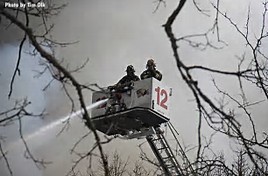
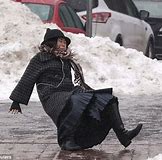
Internet photo example
Your use of the image below from the Daily Mail of an unfortunate woman taking a fall in Manhattan to suggest a Xxxxxx Church circumstance seems odd – to say the least.
________________________________
From: Regan Burke
To: Xxxxx Xxxxxxx
Dear Xxxxx: The photo is a example of what many of us who come to class are afraid of when approaching the church in the winter. Indeed there are people who don’t come to class when it snows because the sidewalks around the church have historically and notoriously been and continue to be treacherous. In other words, this is not a new problem and it’s a big problem, not just to us but to our neighbors as well. I doubt our neighbors understand why when the church is closed we don’t clean our sidewalks. I don’t understand that myself.
When I came to church at 10:15am today the sidewalk at the side entrance had not been touched. This is the accessible entrance for many of us who come to class on the bus or walk. So the snow was not in fact “removed early this morning” at that entrance.
I walked around the church this afternoon and the sidewalks on two streets, tho they were shoveled in the morning, were far from safe – the salt made them slushy and slippery. Did you take a walk around yourself?
The City of Chicago says: “Many people rely on walking and transit as their primary way to get around, and without a wide, clear path through snow and ice, it is especially difficult for people with disabilities, seniors, and children to walk safely.”
According to the Municipal Code of Chicago property owners and occupants are responsible for keeping sidewalks clear of snow and ice. Can we not, as a church, not only adhere to city ordinances, but be actively compassionate when it comes to our friends and neighbors especially “people with disabilities, seniors and children”?
________________________________________
From: Xxxxx Xxxxxxx
To: Regan Burke
Regan:
Yes, I did walk the perimeter of the building early today. I don’t agree with your assessment at all.
As my note below says, we’ll continue to attend to snow removal diligently and thoroughly — as always.
We don’t drink gin in the winter, she said when I came home drunk. As if I knew this. As if there was a difference in what I drank when I was just fooling around with my friends, just having fun, just looking at Jim and just trying to feel something I read about in the book in the drugstore.
The northeast winter had its grey, bone-chill beer, scotch and wine. But why no gin? When I said this later he said you’re so white.
And it took a lot of gin in the winter for me to finally get it.
I floated out of Northwestern Medicine’s Echo Lab, Stress Bay 3, onto the evening sidewalk four days before Christmas. All Chicago was scampering out of work, race-walking to the bus, flocking into Gino’s East and hurrying over to Michigan Avenue for holiday bargains.
Months earlier I’d run out of breath one block into my morning walk. My mind decided since I’d been overweight my entire adult life at seventy-one years old I probably had a deadly heart problem. The doctor ordered a stress test. Before I made the appointment I tried to heal myself with a no-salt, no-sugar, no-carb diet. The condition persisted. Then I thought God might heal me—if only I could remember to ask Him once in a while. In Stress Bay 3, injections shot my heart rate sky high, my breathing stretched to its outer limits, then it all parachuted back down. The whole test took ten minutes. I figured if I didn’t have a heart attack after that, God had absolved me of my lifelong mashed potatoes intake.
Flying high down Superior Street toward the twinkling Magnificent Mile, I came upon a two-foot long sprig of red eucalyptus looking up from the sidewalk.
“Hmm, this would be good to put in the vase I just bought for Bill.” I scooped up the sprig and poked it down through the tissue paper in my Crate and Barrel shopping bag. Rounding the corner at Nieman Marcus I spotted more red eucalyptus sticking out of the cement urns in front of the store.
“Oh, good, I’ll just lift another bunch.”
And there it was. Ancestral habits. Within a block I’d turned from a scavenger to a thief.
Ripping down the street toward the Water Tower it occurred to me there may be some more items for Bill’s vase outside the stores on Rush Street. I found perfect branches of red plastic berries in the four planters on Quigley Seminary’s sidewalk. I took one from each pot. Lovely.
As I came up to Oak and Rush, I stopped myself from stealing birch branches from Barney’s pots because Oak Street Bank across the street recorded activity outside. I’ve binged on enough English crime shows on Netflix to know I didn’t want to get caught on the bank’s video.
And so within five blocks of finding out my heart is not going to kill me anytime soon, I became an all-out criminal.
The next day at coffee, I spilled the beans to a normal friend. He diminished the crime saying they throw all those decorations away after Christmas anyway—trying to let me off the hook or perhaps saving himself from admitting his friend is a thief. I shared my thievery at a 12-step meeting. We all laughed as we often do whenever someone is vulnerable enough about their character flaws to tell on themselves—no letting me off the hook in that room, where God allows for admitted imperfections.
I hear some people say they knew this or that at age 5, 6, 7 or 8. They knew there was no Santa Claus or they knew their father was having an affair with the neighbor. Not me. Throughout grade school, with all evidence to the contrary, I trusted that the adults in my life knew what they were doing, didn’t lie to me and moved our family around for good reasons like better neighborhoods or better schools. Then my mother yanked us from our midwestern roots, away from my absentee father and took us to the East Coast. My sister Erin and I landed at the doorstep of my mother’s sister, Aunt Joanne, in Upper Marlboro, Maryland, with her husband Bill Dorsey and their seven children. It was mid-May when we entered St. Mary of the Assumption School where the nuns “sought to imitate Jesus Christ.” In 1959, St. Mary’s was still segregated except on the playground where I joined girls and boys, blacks and whites defiantly playing baseball all together.
The eighth grade class at St. Mary’s had spent the entire year before I got there memorizing one poem a month. In order to graduate, I had to memorize all nine poems. Not only did I rebel against this arbitrary standard, I became hysterical over it. My mother had taken two of my sisters to New Jersey to live with other family members and for the first time in my life I absolutely knew that she had gotten it wrong. I needed her with me, to defend me against the injustice of those nuns. I had sacrificed a lot for her and it was time she helped me.
The Dorseys at Bethany Beach, Delaware
Uncle Bill had a different idea. He told me I could do it, that we’d do it together. Never before had anyone sat me down and given me a pep talk. Every night after dinner for four weeks he helped me learn those lines. Poems like “Annabel Lee” by Edgar Allan Poe, “The Tyger” by William Blake, “O Captain! My Captain!” by Walt Whitman and my all-time favorite, “The Chambered Nautilus” by Oliver Wendell Holmes. Uncle Bill’s love flowed through me and poured out onto the paper, lighting up the poetry. He gave those words to me. And now, when I hear or see them, my heart pounds with a thunder of love for his eternal soul.
The Dorseys threw a party on my 13th birthday just before I graduated. They invited all their friends and children. My mother arrived from New Jersey with my baby sister. The backyard ballooned with streamers and bunting, barbecue, birthday cake, and something I’d never seen before – a keg of Budweiser. Uncle Bill gave me the first draw of the tap. I gulped it down without tasting it. My first beer. Then I had another. And another. And suddenly I loved everything around me. I knew I belonged, in that family, at that party, with those saints.
The St. Mary nuns blundered in their seeking to imitate the Christ. But Uncle Bill Dorsey? He was the real deal.
JFK was still alive the September I drove with my father in his white Cadillac Eldorado down the pike from our temporary home in Washington, DC to boarding school in Williamsburg, Virginia. My head overflowed with questions. Will they have a television? What will I do after school? How will I wash my clothes? I dared not ask my father for fear he’d mock my questioning of such mundane matters. In his silence I could hear him say, “They’re nuns. They take care of people. Stop worrying.” I wasn’t worrying, just wondering. In spoken language between us, different words seemed to have the same meaning—wonder and worry, driving and speeding, drinking and drunk.
Unfamiliar signs became our talking points.
“Look there’s Fredericksburg. Did something historic happen there?”
He told me it’s a Civil War town. 10,000 slaves ran away from the plantations there and joined the Union Army.
Slaves? I had never been in a place where slaves had lived. Monticello. Is that Jefferson’s home?
I’m not sure how much I knew of Civil War history or American history as I was entering my junior year in high school, but clearly the road signs along the highways in Virginia had awakened some schooling. Petersburg and Appomattox. My premature view of life misinformed me that places I read about in history books, like these, no longer existed.
Until then, I had lived my whole life at sea level—the flatlands at northeastern Illinois’ Lake Michigan and the New Jersey seashore. The Virginia road climbed up and down between wavelengths of blue and green, tree-lined hills with wide verdant medians. My mother used to call me a nature-lover. I guess she was right. The scenery captivated me, as if we were driving through the Garden of Eden. I imagined Paradise at the end of our journey.
“What’s the Blue Ridge Parkway?”
My father loved to drive and he’d already been on Skyline Drive, the main road through Shenandoah National Park on the Blue Ridge Parkway. Our route to Williamsburg didn’t bring us near there. Thirty years later, remembering my father’s description of the misty Blue Ridge Mountains and the hills rolling down to the Shanandoah River, I drove there myself.
At Richmond we turned southeast toward the Norfolk Naval Base, Hampton Roads and Williamsburg. I was leaving no one behind. My mother, sisters, cousins and friends lived in another place, another time with their wild summers and grey winters. A vagabond life brought me to live at Walsingham Academy run by the Sisters of Mercy, the school that housed girls from mothers who didn’t mother and fathers who didn’t father—girls who had ulcers and girls who dyed their hair.
We turned onto Jamestown Road toward my new assignment. Fear tightened my grip on reality. Had he told the Mother Superior I had mononucleosis? Got drunk? Swore? Didn’t believe in God? Had an ectopic pregnancy? Did he even know I was tired all the time, and lost? I feared and I hoped they’d care for my soul.
My cousin Therese cleaned out the old dresser in the basement next to the washer and dryer after her mother died in 2001. She found a letter my mother had written in 1943 from Key West. My mother was 22 years old, married to my father, a Navy pilot.
The letter begins with sisterly reasoning about why she isn’t using her best writing paper. “As long as you’ve seen my good stationery, I’ve decided to use this stuff.” She makes no apology about why she hasn’t written sooner: “Laziness accounts for all the weeks I haven’t written.”
My mother, Agnes, and her sister, Jean, were a year apart. They lived for a time at Georgetown Visitation College, an all-women convent school on the grounds of Georgetown University, where they met their husbands. In my mother’s letter to Jean, she gossips about former classmates. Dorothy Castle’s husband Ed was in the Navy’s “Sound School”, training to detect enemy submarines, and would soon be commanding a “sub chaser”. “Water Wings Haley, up in Miami, was waiting for a ship to get outfitted that he would command.”
She mentions that my father “will jump from Ensign to full Lt. if the Air Corps ever gets around to promotions.” And then she writes, “I personally don’t give a damn, but that’s all anyone talks about.”
Ah-ha! There’s the mother I knew, not giving a damn. And judging people who do–give a damn, that is.
She then reveals that my father’s mission, patrolling the Florida Straits between Key West and Cuba looking for German submarines, is a military secret. On liberty in Cuba, he and his fellow pilots acquire contraband —English gabardine, cigars and liquor. “We’ve become quite the rum and scotch ring. I’ve had to acquire a taste for Daiquiri’s because of the lack of gin,” she writes.
Next we read about her new bathing suit, her tan, the new officers’ club where “we have to bring in our own liquor because it’s on an Army Reservation.”
I have no idea how or when criminal activity became just another part of life to my mother, like clothes shopping or mixing a martini. Until I read her letter, I thought my father had influenced her. Her nonchalance on smuggling reminds me that she seamlessly taught me to shoplift from the A&P as a child and that she stole from her employers.
The second child of seven, she grew up in one house in Westfield, NJ where the children revered their successful father and adoring mother. Yet, like my father, she wasn’t governed by her conscience. My parents didn’t pay bills, cheated their friends and families and relied on midnight moves to escape rent-collecting landlords and hotel managers. They left me with a lifelong struggle “to give a damn.”
The day she died, I visited her last residence, a nursing home in Point Pleasant, NJ. Her closet overflowed with clothes she stole from other residents. The nurses said my mother expressed a lot of emotions in her dementia but guilt and shame were not among them.
“This is not your fault,” he said in that red-hot Cajun voice of his, ”I take full responsibility.”
I knew right then that the campaign advisors on the road with Bill Clinton were blaming me.
A few days earlier, Carville, chief strategist for the campaign, had directed me to schedule Clinton at a correctional facility in Georgia reasoning that a picture of Clinton strolling with black inmates and Georgia’s all-white male politicians would cinch Clinton’s appeal to the state’s voters.
It did.
Clinton won the Georgia primary, but not without a price. The national press and the other candidates excoriated Clinton for his racial insensitivity. Jerry Brown said Clinton and the other politicians looked “like colonial masters” trying to tell white voters “Don’t worry, we’ll keep them in their place.”
And that was all my fault.
Five months earlier I’d been asked to give up my job in Chicago and relocate to Little Rock to be Clinton’s Director of Scheduling and Advance. “You already know this, Regan,” Campaign Manager David Wilhelm reminded me, “the scheduler in any campaign has the worst job.”
It’s true. The person who plans the candidate’s calendar has an enviable yet risky position. An unplanned photo with an unscrupulous politician? Protesters blocking the entrance to an event? A rained out rally? It’s all the scheduler’s fault.
Campaign operations temporarily moved from Little Rock to the Palmer House in Chicago just before the Illinois-Michigan primaries in 1992. The extensive Chicago staff in Little Rock wanted to celebrate Clinton’s St. Patrick’s Day victories that would clinch
March 17, 1992 Palmer House Chicago
the nomination.
An old friend of mine, a Chicago policeman, volunteered to be Clinton’s driver. He called me around 2:00 am the morning before the Primary.
“Regan, that Greek guy, George, and Bruce someone were in the car telling Clinton you have to go.”
“What?”
“Yep. But Clinton said he wants to be sure you have another high-level job in the campaign.”
“Really?”
“Yeah! Dees guys are strategists? Der talkin’ ‘bout firin’ you in your hometown — and your buddy drivin’?”
We howled at the strategic error.
I was offered a job that was already filled. Wilhelm shrugged when I asked if I was fired. The New York Times reported I’d been replaced by Bruce’s wife.
I took a trip to the Bahamas, became achingly lonely and came home early. Herb and Vivienne Sirott got me into a rental apartment across the hall from them. Cook County Clerk David Orr hired me as Deputy Director of Elections. We worked hard that year to pass the National Motor Voter Act. A young community organizer, Barack Obama, walked into my office to plan a large-scale voter registration project.
Things looked good from the outside, but inside ego-busting despair maintained constant watch over my soul. Depression, sick leave, isolation, shame, all led to suicidal thoughts. Vivienne brought a psychiatrist to my apartment. That’s when I started Prozac, my first legal anti-depressant.