Every spring at Walsingham Academy, Sister Walter Mary selected a few students to prepare Catholic children for their First Holy Communion. The children were patients at the local mental institution, Eastern State Hospital in Williamsburg, Virginia. I have no idea why there were young children locked up in an insane asylum. We were trained to teach these pre-Ritalin six-, seven-, and eight-year-olds to memorize answers to preposterous questions such as “Why did God make me?” from the Baltimore Catechism.
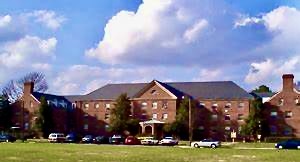
It was pre-HIPPA 1963. We received basic training in mental illness. A hospital attendant walked us teenage tutors through the children’s wards, pointing out caged paranoid schizophrenics, psychopaths, and catatonics in their soiled grey tunics. Some children sprang at the chain-link fences, grabbing us and screaming obscenities. We didn’t teach this group. Our students lived in cozy dormitories and wore regular clothes.
Eastern State—the oldest psychiatric facility in the country—had been founded on the forward-thinking concept that insanity was an emotional disorder, not an aberrant behavioral condition. Treatment included exercise and social activities. Catholic parents treasured the outside instruction their little ones received. I’m not sure how much my first-grader learned because all she wanted to do was sit next to me and play with my hair. I helped her into her white veil and gloves and took her to nearby St. Bede’s, where she made her First Holy Communion with the local children. I met her parents at the church. I never saw them again, never learned her diagnosis, or if she ever left the institution.
A few years later, I worked an overnight shift at the Point Pleasant Nursing Home in New Jersey. My job was to straighten up—put games like Monopoly, bingo, and chess in their boxes and wiggle them into overstuffed cabinets. I wrote down missing pieces of each game so the next shift could look for them in patients’ hiding spots—pockets, drawers, purses.
A completed jigsaw puzzle of an Impressionist painting lay on its box cover under a window. I put the pieces back in the box and stuffed them into the cabinet with art supplies, books, and magazines. Before my shift ended, a patient wandered into the day room. She stopped at the space where the completed jigsaw had been and looked at me, panic-stricken. She grabbed my hair in a flash, shrieked I stole her art, and smacked me in the face. By the time the nurse reached us, we were both screaming.
In dementia, my mother, Agnes, carried an ever-present small clutch purse. At that same nursing home, the nurses gave her their old lipsticks because the click-clacking sound as she rifled in her bag calmed her down.
The day she died, I visited the nursing home and thanked the staff for giving my mother what I couldn’t: a proper confinement of love and respect to keep her from wandering around and terrifying her fellow creatures. Only then did I ache for the parents of the Eastern State girl I’d met twenty-five years earlier.

 Regan Burke
thank yo
LikeLiked by 1 person
Life experiences shape who we are, even difficult circumstances make a mark. For me it is my faith which helps me focus on the experience and understanding what I have gained as well as how I address future challenges. It makes me stronger, more empathic and remains me I have a choice on how I respond.
Thanks for sharing.
Peace, hope and blessings,
LikeLiked by 1 person
my friend thanks for sharing! William Filan 1716 W George Street Chicago IL 60657 312-420-6813
Please excuse typos
>
LikeLiked by 1 person
Regan you are a real living angel 😇 and thanks for sharing this ❤️ you ALWAYS provided the best stories during our writing classes. Hugs sweetheart 😘
LikeLiked by 1 person
Thanks Jackie. Miss you!
LikeLike
And for the girl! I would venture to say one would still find similar conditions today! tho not as many thank God.
>
LikeLiked by 1 person
Powerful. I was an unaware teen and adult before the great deinstitutionalization of America, so any memoirs that take place in an institutionalized setting seems like ancient history to me. But then I suppose 60 years is a pretty long time, and since I’m 60 now, perhaps I’m moving towards ancient as well. 🙂
LikeLiked by 1 person
Wh
LikeLiked by 1 person
Very heavy stuff for a teenager. Also very interesting. Not sure wh
LikeLiked by 1 person