80th Birthday Celebration: Justice for Wrongly-Accused

Featured80th Birthday Celebration: Justice for Wrongly-Accused

Eighty years ago this week, my father, a lawyer, was in the middle of a complicated trial in the military court at the Annapolis Naval Academy. Throughout my childhood I’d heard that my father asked for a pause in the trial to visit my mother and newborn me in the hospital. My birth was announced in the newspaper as part of the daily coverage of the court proceedings.

When I was old enough to ask, I heard from both parents that my father defended Navy personnel for stealing from supply depots. They created a sympathetic narrative, as if the defendants were either wrongly accused or were poor and the crime was justified. When I was old enough to brag about my father to my friends I added color to the defendants’ stories—petty officers sending necessities home to their poor families.

In my fifties I searched the archives in the Naval Academy Library for the article announcing my birth. Before I started rolling through microfiche, I called my father and asked for some common names and dates to research besides my birth date.

“I can’t remember,” he said, “call me when you get home.”

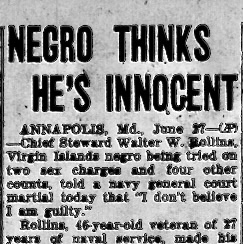
Newspaper articles from 1946 report details of my father’s part in the trial. In the Judge Advocate General’s Corps (JAG), he worked not as a defender of the disadvantaged but as a prosecutor.

The day my birth interrupted the trial, June 13, 1946, my father was about to call an important witness to testify against former Chief Steward Walter W. Rollins. Rollins, “a Negro”, was accused of throwing an all-night party in his basement quarters of the Officers’ Mess with five White people. As the trial continued, the witness testified they all played penny-ante poker from 1:30 am until 9:30 am, but no money changed hands. The unsubstantiated charges against Rollins included adultery with a White woman, a morals offense, gambling, embezzlement, misconduct and theft. He reportedly took a jug of whiskey from the Officers’ Mess. Rollins was sentenced to two years in federal prison.

None of the White people involved were held accountable, though trial records indicate Rollins felt pressured into submitting to the demands of the White partiers. After twenty-seven years of service to the Navy, Rollins was demoted to First Mate and received a bad conduct discharge.

No wonder my father dodged the truth about his JAG history at Annapolis. Until late 1944, he had been in the elite Naval Air Corps, trained on the prestigious Grumman Avenger torpedo bomber. Headquartered in Key West, he patrolled the Florida Straits for German submarines. He’d been arrested for drunken brawls and jailed for extended periods leaving his New Jersey bride alone in a strange town with no friends or family. He acquired illegal Cuban rum, cigars and dry goods, flew the contraband back to Key West and sold it to his fellow sailors.

After the war, as a new law school graduate, he reported for duty to the military court at the Naval Academy in Annapolis. He had just been commissioned a Lieutenant Commander, had been a scholarship student at Georgetown University and Law School. For all his college and post graduate years, he secretly funded extracurriculars with illegal money he earned at all-night high-stakes bridge games.

White privilege saved my father, a conspicuous law-breaker, from prison. I hope he and my mother were so ashamed of his part in ruining Rollins life that they lied about it for the rest of their lives. As a lawyer he never took on trial work again.

Walter W. Rollins was the father of Jazz legend Sonny Rollins. On his sixteenth birthday, Sonny, his mother and brother watched their father get hauled off to jail for two years. My father surely knew what I discovered in the Naval Academy archives. When I returned home to Chicago with my old newspaper printouts, I had questions. He refused to discuss it. I never overcame fear of my father’s wrath in his lifetime — not sure I’ve done so even now– and this was clearly an issue I had not the courage to pursue.

Sonny Rollins spent decades trying to clear his father’s name. In September, 2025, the Secretary of the Navy finally reversed the court-martialed conviction. Sonny died on May 25 at the age of ninety-five. One of the last things he saw was a draft of an article in The Nation reporting the story of justice for his wrongly-accused father. It appears in the July-August edition.

I’m deeply grateful for visits, gifts, celebrations and tributes for my eightieth birthday. However, reading about Walter R. Rollins’ overturned racially motivated conviction, prosecuted by my father eighty years ago, thrills to a depth I’ve never known.

The arc of the moral universe is long, but it does indeed bend towards justice.

Jesus, Pokemon and Ethiopianism

FeaturedJesus, Pokemon and Ethiopianism

At Chicago’s Harold Washington Library we waded into a steamy sea of book fans side-stroking their way toward venues of favored authors. The American Writer’s Museum had given us a full free day of writers, a literal, literary event. 

Jen Hatmaker, podcaster and author of fourteen books, slipped a throw-away into her talk about leaving her church because of patriarchy and racism. My companion and I gave each other the curious huh? look. The uninteresting story of her divorce that followed soaked up the rest of the hour. We wanted more scuttlebutt about her leaving the church, but no time to meet her — our next talk had already begun.

Navigating our way onto an elevator to the third floor for “Faith, Connection and Social Change in Black Chicago” we sat in curious anticipation. Reginald Blount, director of the Center for the Church and the Black Experience at Garrett-Evangelical Theological Seminary, interviewed Kai Parker, Assistant Professor of African American Religious History at the University of Virginia and author of City of Black Souls. These two heaved weighty thoughts onto a head-shaking well-informed audience.

Professor Parker anchored his talk to the late 19th and mid-20th century African American Protestants in Chicago. He said Ida B. Wells and others gleaned ideas from ethiopianism. She wrote that the movement for Black freedom was not just a struggle against Jim Crow, but a wider, global liberation movement against Western imperialism and racial hierarchy. Having never heard of ethiopianism, we huh?ed each other again. Parker’s words floated way above my uninformed curiosity. But no time for questions. We had thirty minutes to chase down a sandwich before the next talk. 

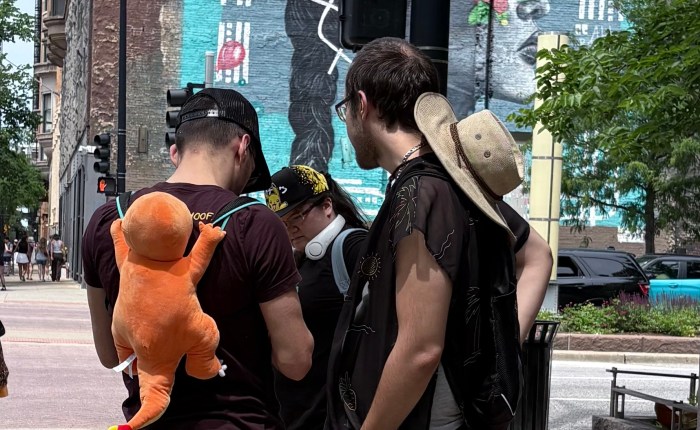
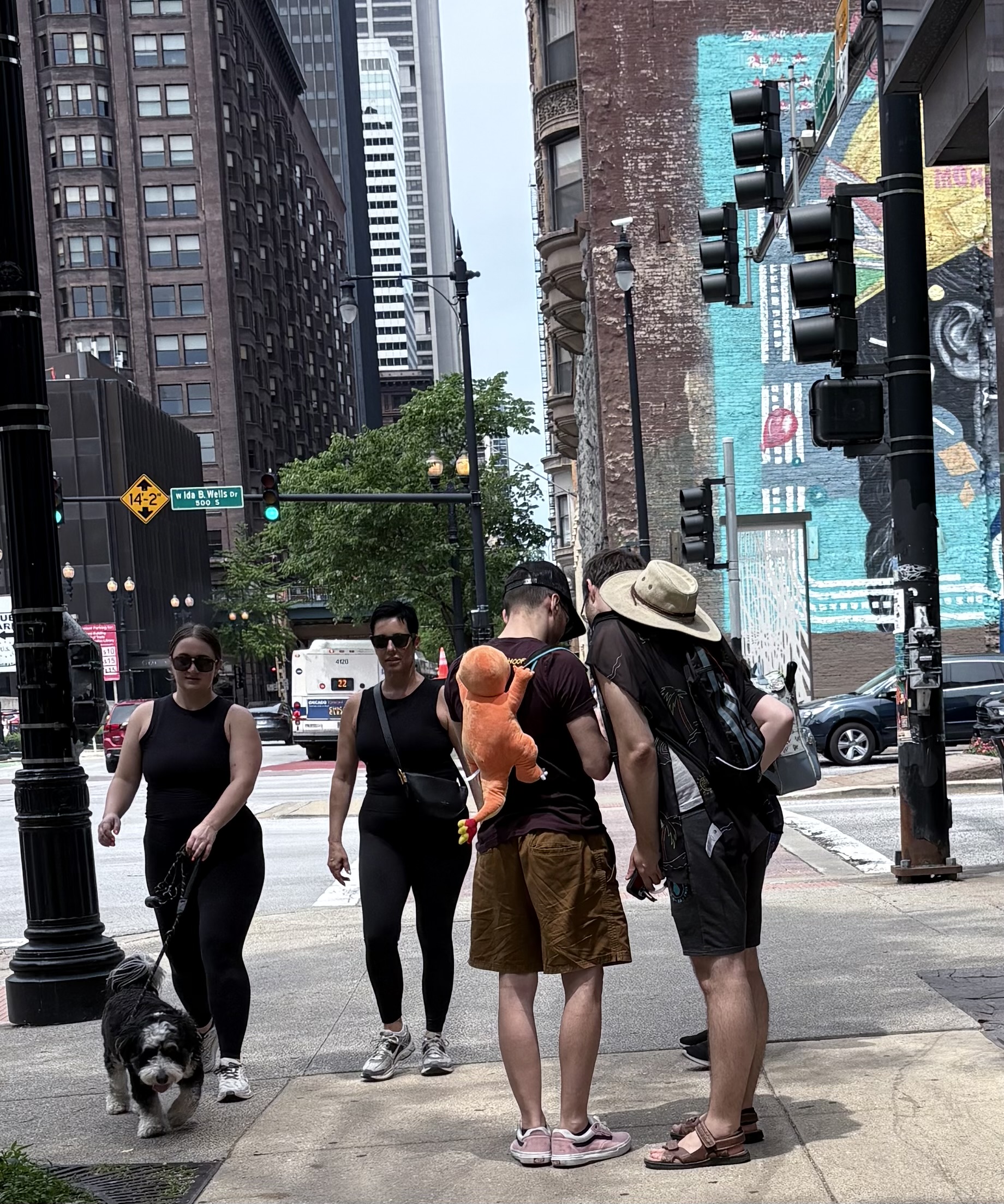
We broke out of the building onto four-lane Ida B.Wells Drive. All corners teemed with Pokemon people (were they at all curious about the street name?). Some wore foam hats of the Pokemon mascot, Pikachu. But the dead giveaway was the huddled groups walking while diving into their phones. Another huh? moment and no time to stop and ask for a Pokemon explanation. 

Rushing back to the monstrous Harold Washington Library, we found each other in the auditorium’s front row looking up at fast-talking six-foot-tall John Fugelsang. A stand-up comic, his book, Separation of Church and Hate: A Sane Person’s Guide to Taking Back the Bible from Fundamentalists, Fascists, and Flock-Fleecing Frauds, established his bible bona fides through stories about his mother, a Catholic nun, and father, a Franciscan priest. 

Fugelsang entertained us with how to talk to MAGA Christians about religion and politics.

“People get God and religion confused,” he said. “I think God is a bit too hip to join any of his unauthorized fan clubs.”

We were not confused. He was hilarious. No time to ask, “were your parents married?” and other naturally nosy huhs? about his upbringing. The next talk with Reza Azlan required settled attention.

Remember the book, Zealot? When Reza Azlan hoisted his blockbuster on us in 2013, religion teachers and leaders throughout the land were rending their garments answering boatloads of questions about a new idea of Jesus, the politically conscious revolutionary. 

Reza packed thousands of entertaining facts into the allotted time. He went overboard answering questions about how the historical Jesus has seeped into the collective psyche, evidenced by many who offhandedly say, “Jesus was political.”

Library staff herded us out of the closing HWL onto the sidewalk to — guess what? Pokemon. The Pokemon Go! Fest drew 40,000 people a day to the city. 

Exhausted, more mentally than physically, we went our separate ways home without a wrap-up coffee shop chat and chuckle on ethiopianism, Jesus and Pokemon. On the standing room only bus, chill revelers from a free day at Millennium Park’s Blues Fest were asking the bus driver how to get home.

You really gotta love Chicago.

Awesome Death Anxiety

FeaturedAwesome Death Anxiety

Journalist Kara Swisher has a six-part series on living forever or, not dying too early or some such idea. Last week, I woke from an unplanned late afternoon nap to hear her CNN interview with a wild-haired scientist about the fear of dying.

The scientist proclaimed the fear of dying motivates every human, all day, all night, from the beginning of time. Obsessive acquisitions of money, power, big houses and boats is a reaction to the base fear of dying.

The antidote to this death anxiety is awe. Awe. A.w.e. Awe.

Awe revitalizes the deep need to be alive. Embracing awe unlocks the idea that death is not just bondage but an opening. Holding both thoughts at once reduces the subconscious but crippling anxiety of death.

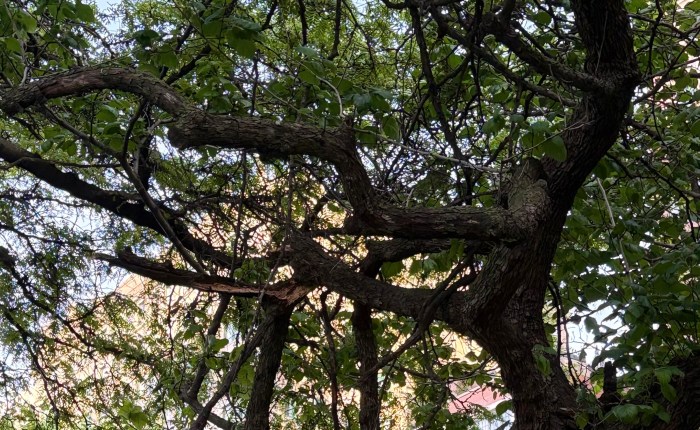
Sitting under a leafed-out hawthorn tree on a park bench, I hung onto these thoughts as I savored the look and the smell of a nearby lilac bush. Awe was working. I felt death anxiety dissipating.

The sound of a crackling branch overhead should have startled me, scared me. In the distance I saw a shouting seventh-grade-size boy running toward me. 

“What?” I inquired of myself.

“@#$%^&*” was all I heard.

He hurried up to me pointing at the tree. A midsize branch had broken off the top of the tree trunk. The mishmash of boughs below caught the crackup before it fell on me. But it was slowly crunching its way toward the ground.

I jumped off the bench into death anxiety. The boy, smiling with relief, picked up a previously grounded limb and threw it into the tree to dislodge the broken branch.

“Vamos! Vamos!” The boy yelled as he threw the branch at the suffering hawthorn over and over. 

I stood back and watched the joy-filled seventh grader doing his part to make the park safe for passersby, dog walkers and bench sitters. Awe. Some.

Along came two coutured men with their two French Bulldogs. One rushed to the boy to stop him, as if he were vandalizing the park.

“No. No. No.” I stepped in front of him. 

“That branch almost fell on me and he saved me! He’s trying to knock it out of the tree onto the ground.” 

The men were puzzled. Looking at me, back at the boy, their eyes betrayed a lifelong preconceived notion of a pre-teen Hispanic boy. I engaged them with curiosity about the dogs. Men with cute little boutique dogs love to talk about dog pedigree. Out of the corner of my eye I saw the branch come down and the boy skip away to join his family on the other side of the park.

Awe. Some.

Doomsday Prophecies: From Hal Lindsey to Trump’s NAR

Doomsday Prophecies: From Hal Lindsey to Trump’s NAR

In the early 1970s the doomsday prophecies in Hal Lindsey’s The Late Great Planet Earth, stoked my Toms River, New Jersey, Christian fundamentalist cult. Little did I know that the prophesies of the cult religion of my youth would come true through a new religious movement, the National Apostolic Reformation (NAR). Fifty years later.

Based on his interpretations of the Book of Revelations, Hal Lindsey connected end-of-the-world Biblical prophecies to current events. In his view, Satan’s plans to form a one-world government and religion were triggered by the establishment of the state of Israel and the World Council of Churches—both in 1948. 

Converts, like me, of the 1970s Jesus movement, still flash-backing to acid trips, saw signs of the end times around every corner. In our small church community, anti-globalism was our protest because Satan was using the banks to form a global economy. We boycotted the Bank of America. We refused to use credit cards. We wrote letters condemning the birth of the European Union. An increase in the divorce rate, recreational drugs, new technology, the gasoline shortage, religious ecumenism. All these signaled the diabolic end of the world, the coming of the Antichrist, or some kind of unearthly vision that terrified vulnerable young comfort-seekers.

I left the Christian cult after sobering up in Alcoholics Anonymous, divorcing an abusive husband, and moving 1,500 miles away from the scene. 

Starting in the 1980’s, unbeknownst to me, Christian fundamentalism slowly morphed into the New Apostolic Reformation. The prime NAR chronicler, Matthew D. Taylor, describes the NAR’s leadership as a “spiritual oligarchy” of apostles and prophets. Apparently God has told NAR adherents that Donald Trump is their spiritual leader. You’ll have to figure that one out for yourself, but the results are obvious. 

The NAR apostles and prophets tell Trump his job is to “advance God’s earthly kingdom so Christ can return.” Advancing the earthly kingdom is outlined in Project 2025. The elimination of abortion and women’s rights; same-sex marriage and gay rights; dismantling USAID as a stand against globalism—all the shockers in the first year of Trump 2.0 are advancing the earthly kingdom.

Venezuela is the biggest shocker so far, at least for me. Fifty years ago I learned that the Book of Revelations prophesied God would make the United States, Russia and China the world’s three spheres of influence. The United States would get the entire Western Hemisphere. Russia gets its region, and Europe. China gets all of Asia, India, Africa. This is the umbrella of national sovereignty, the opposite of international integration and the seeds of anti-globalization.

A radio broadcaster startled me on Saturday morning, January 3, with the news that the US invaded Venezuela. The long-forgotten voice of myself as a 25-year-old Jesus Freak bellowed, “Uh. Oh. Wake up. It’s happening.” 

Donald Trump, in a 2017 speech to the Joint Congress, announced he was not the President of the world. Instead, he stated, he was the President of America. These words sent a signal to anti-globalists and end-times prophets around the world.  It was a declaration that the US will once again dominate the Western Hemisphere. Vladimir Putin confidante Alexander Dugin, heard the call and issued a statement that traditionalism had won, globalism lost. 

Anthropologists say pandemic uncertainty, virtual reality, environmental issues, old-age anxiety, border disputes, memory disorder, and gender trouble put society in a self-protective liminal state, a state betwixt and between. Perhaps these unsettling markers ushered in Donald Trump as the leader of the new world order. Now that we’ve fallen over the threshold, what do we do?

I don’t know. 

But holy shit. 

Wake up. 

It’s happening.

Dead Dogs

Dead Dogs

The cat jumped from the cabinet behind the Christmas tree onto the back of the couch and slinked over to perch behind the woman sitting across from me. 

“Watch out! The cat’s behind you,” a nearby party-goer warned.

“Oh that’s ok. I like cats,” said the guest in proper guise.

Staring down the resident pet, I drifted off to a time long ago when I was in the same position as the proper guest. When I turned to greet the host’s cat  (a stupid-human gesture), she swatted me in the face, claws out.

The Christmas party conversation turned to pets.

“Do you have any pets?” I was asked.

“Oh yes, I have a Westie.”

I love my dog and I talk to her a lot, but I don’t talk about her much. My mother, Agnes, hated people who anthropomorphized their pets. Really hated them. My feelings aren’t as strong but I have the genes—an aversion to pet talk.

It turns out Agnes was onto something. As long ago as the 1870s Charles Darwin criticized the natural tendency to ascribe humanlike attributes to non-human animals. His pitch was for humans to show as much interest to the natural world of insects and plants as we do to our pets. In doing so, he opened the forbidden subject of anthropomorphism. Darwin’s England was ground zero for the upper classes treating their pets like children or stand-ins for friends. Since then, many scientific abstracts and PhD theses have tried to punctuate the negative consequences of anthropomorphism: over-spending on human-like clothes, feeding pets non-compatible human food, beautifying dogs with toxic cologne, nail polish, breath freshener and worst of all, expecting non-human animals to have human emotions.

I suspect Agnes was more drawn to anthropomorphism than her sophistication would allow. Her sobering suggestion that trees are worth adoration are probably my earliest spiritual experience of our life together. Another was her reverence in quietly revealing the nesting robin’s eggs outside the bathroom window. But she’d never stand for conversations about them. In her world, if you didn’t present a funny story based on serious articles from the New York Times or Time Magazine, you were an out and out bore. Her ghost leads me to the Never-Trumper’s Bulwark podcasts, whose tagline reads “a few laughs to wash down the crazy.”

There’s a trail of dead dogs nipping at my aging heels. I threw this into the mix at the Christmas party in order to join the pet talk.

“Do you dream about dogs from your past?” Someone asked of no one in particular.

“All my dead dogs are present,” I blurted out. 

It’s a goofy thing to say, like I’m a Buddhist or Spiritualist or the crazy white-hair in the corner with her Diet Coke. Other than my dog Henry, who talked to me during the Covid shutdown, I’ve always thought of my pets as nothing more than animals (forgetting that I, too, am an animal). No fancy garments, doggy day care or prepared meals. But as dead pals, they are sentient. Here. They may be the beings between the here and the hereafter, waiting to guide me to wherever that is. I hope so.

I’ll need protection to escape the cruel and the crazy running my country.

Knock On Wood

Knock On Wood

The activist community that confronted ICE in Chicago has quieted down for the winter since ICE commander Gregory Bovino hightailed it out of town with 100 of his 200 military combatants. Southern activists report that ICE is wreaking havoc on the streets of New Orleans and other Gulf Coast towns while training the 10,000 newly-enrolled ICE recruits. In the Upper Midwest, we’re like mama bears and cubs in hibernation. We’re squirreling away our esprit to ready ourselves for the war we expect ICE to launch over the threshold in the spring.

Oh, there are cadres of fresh revolutionaries protesting against high property taxes at winterized town halls. Indivisible and other groups are keeping the newly activated engaged with Happy Hours, Coffee Hours and Sound Baths. And eager canvassers are stepping out in the cold to knock on doors for their favorite state and local candidates.

llinois’ 2026 primary is March 17. In times past, a St. Patrick’s Day election meant a big turnout at the polls. Can you guess why? Yeah, a lot of people took the day off for the parade and voted afterwards. But Illinois Governor Pritzker has told us that Bovino and his returning troops may try to disrupt our elections. What does that mean?

No one has a clue.

Amidst all this dread of the future present, I received an unexpected message about my life story that put the worries of the world on the back burner. In 2020 Tortoise Books Chicago published a memoir I’d written thanks to the encouragement of friends. 

A few years after I retired I attended a poetry reading at the Museum of Contemporary Art. Shuffling up to Poet/Author/Moviemaker Kevin Coval, I disclosed, “I wish I could write”. 

“Everyone can write. Everyone has stories to tell,” Kevin responded. “Come Saturday afternoon to the writing class. It’s free.”

Kevin and the others welcomed me, a much older student, into the upper room of significant creatives. One day he introduced me as “one of our writers,” and a bolt-of-lightning zipped around my bones. 

Beth Finke, memoir writing teacher extraordinaire, praised my weekly essays while x’ing out the “weak” verbs and extraneous paragraphs. Writing expended a lot of brain energy and I often gave up from exhaustion. Then Beth would assign an energizing prompt like, “the tune you most remember from childhood” (Elvis’ Hound Dog). Poor thing had to listen to every detail of every step in the long saga of getting my book published.

Vivienne, an accomplice in many adventures, insisted I write a book so she could make a movie about my life. This seemed preposterous, but slipped into the maybe compartment when she wrote, produced and directed her full-length feature, “Dare to be Wild” (Netflix). It still seemed preposterous because as a friend asked me recently, “Is your life that interesting?” No. Yet, Kevin Coval attests every life is interesting.

The unexpected news I received this week puts the idea of a production, based on my book, on the front burner, in the cards, out front, on center stage, in the spotlight, on the radar, on a winning streak, ahead of the game, beating the odds, nailing it, on fire.

Knock. On. Wood.

Is That a Rat?

Is That a Rat?

Summer 2025 came to its 80 degree sunny end on September 22 at 1:19 pm. The autumnal equinox. About that time, the gardener at a building near Whole Foods was exchanging old for new in sidewalk planters. The red summer geraniums and green ferns were dug up, tossed out and replaced with lavender chrysanthemums and those curious purple cabbages. A potted plant gardener myself, I was glued to the gardener’s performance as I walked slowly by with Elsa. Two robust rats promptly jumped out of a planter onto the sidewalk so close I think they grazed my shoes (ew!) before scurrying off. Elsa’s rat-catcher terrier pedigree neglected to alert us. She was unfazed, didn’t flinch. Me? I screamed bloody murder. The gardener laughed. I suppose gardeners meet rats in the city all the time.

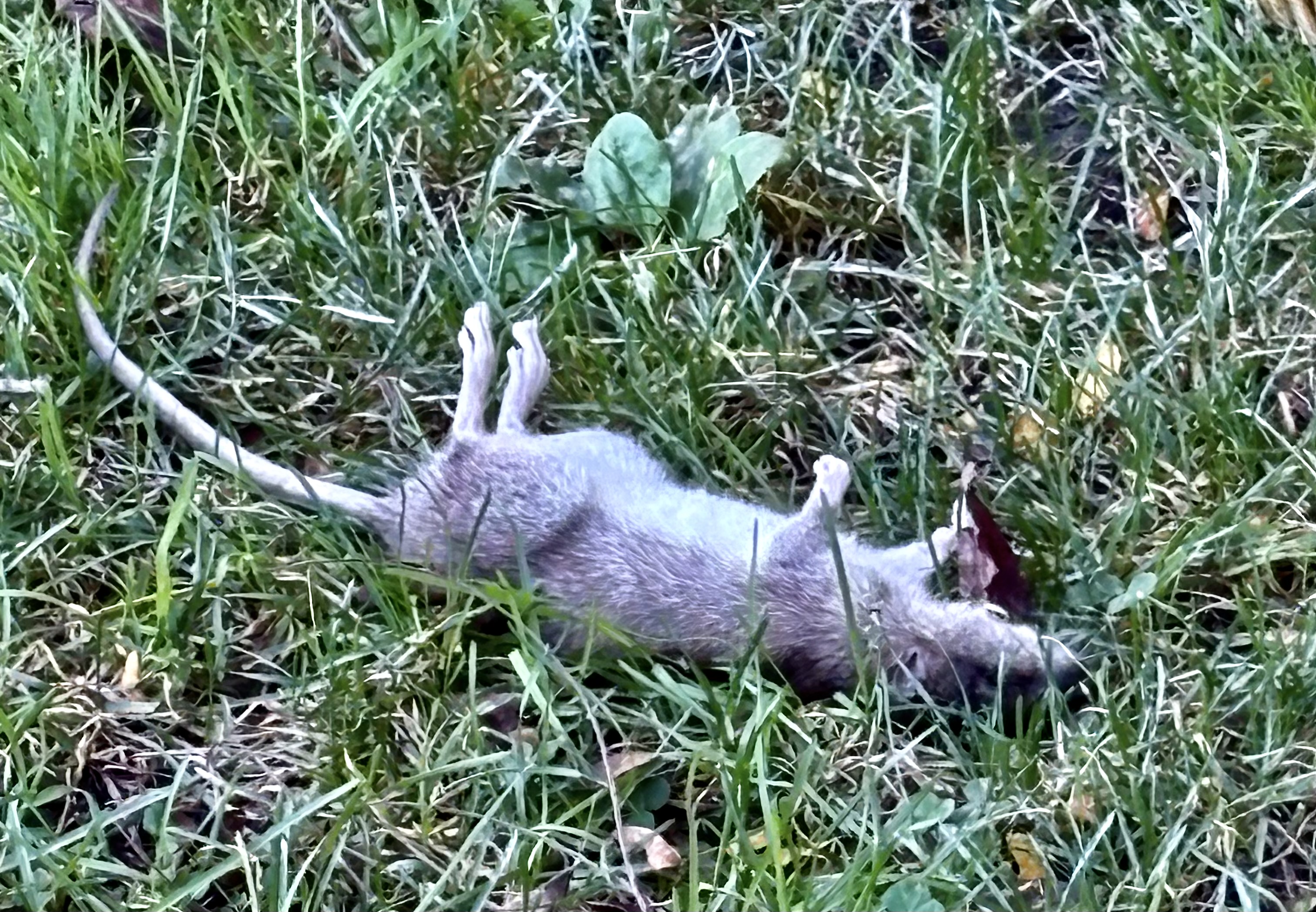
Later in the day, on our evening walk, I almost stepped on a DEAD RAT in the park, throwing terror into my dog-walking daydream.  

Dear god, what is going on?  A rat epidemic? Do rats still carry the plague? Rabies? Do we have vaccines for them? Trump would say don’t get those shots. Drink bleach. Take Intermectin. Isn’t that for parasites in pigs?

Oh, not again. Can’t I have just a few peaceful moments at the end of summer without that guy slamming into my thinking? 

Back in a voluntary meditative state to help ward off evil thoughts, I sat on a bench keeping vigil over the DEAD RAT to warn other dog owners. 

“Hey, yoo-hoo!” I shouted.

“Yes?”

“Watch out for the DEAD RAT over there by the hydrangeas!”

Ralph the dog was off his leash and just about ready to get a noseful of DEAD RAT. Ralph is a frisky German Shepherd with his senses still in tact. He smells a DEAD RAT a mile away. His grateful owner waved at me as he hurried over to pull Ralph away from the DEAD RAT.

Elsa, still unfazed, never uses her senses. She pretends her sniffer doesn’t work so she doesn’t have to chase squirrels. Her ears perk up when her name is mentioned but no other sound seems to register. And her eyes? Who knows what comes through those cloudy old pupils. Since she’ll eat anything, it’s dubious whether or not she still has a sense of taste. She had no sense of the nearby DEAD RAT.

But spatial awareness? Elsa has that in spades. She always knows where her little white body is in relationship to me. She is by my side, unleashed, whether we’re walking along a garden path or in wide open spaces.

In other words, she’s the perfect dog. 

As long as she doesn’t cozy up to a DEAD RAT.

Normal/Abnormal

Normal/Abnormal

Two nests of crow chicks fledged on my city street this past week. I wonder if the high-rise humans down the block noticed the chicks’ noisy beginning of life in the urban wild. Everyday for two weeks, I looked up from under the trees while walking Elsa. I saw the chicks poking their hungry beaks out of the nests, then stepping out to  bounce from leafy limb to limb to rooftop to balcony, squawking away. The parent crows flew farther and farther, screaming at their offspring as encouragement to get those wings flapping and join them in pursuing edible horizons. And then, quiet. They’re gone. They’ll be back, of course. But for now, the daily racket of new young crows has flown the coop.

How comforting to observe the steadfast natural order of things. These days, the built world I’ve known my whole life is breaking down so fast that I half expect the natural world to follow;  Lake Michigan to dry up and all the birds to drop from the sky. That bad? Sometimes. Experts say old-age limits short-term memory, exaggerates long-term. My long-term emotional memories are thus resistant to age-related decline. I’m in my 80th year, having just celebrated the 79th. The fear I felt watching the original Mad Max (1979),  Poseidon Adventure (1972) and Blade Runner (1982) bubbles up without reference to those movies. It simply presents itself as the world we know is over.

On the other hand, I’m convinced The Wizard of Oz gave me a love for birds, if not a curiosity about an unearthly world. Somewhere over the rainbow, bluebirds fly. Birds fly over the rainbow; why, then, oh why can’t I? 

Yeah, why can’t I?  

Every time a crow chick leaves the nest, some transcendental part of me follows. My earliest dreams were flying visions. I willed myself off the ground and flew around the neighborhood spying on people. God help me, if I had a drone. I’d probably be peeking in the windows of high-rise residences. 

There’s no question movies have influenced my core. They’re not saving me from worry, nor diverting the fear of living in a militarized police state. That long-term memory perverts itself into real and present danger. Can the now-pardoned Jan 6 insurrectionists show up as a Mad-Max-type private army? Would there be a search and rescue operation if my transatlantic ship capsized like the Poseidon? And worse, will there be an antidote for experimental robots gone bad as in Blade Runner?

Fortunately, the clouds of knowing break open every morning to a normal reality.  Recent shoulder surgery grounds me in pain. Friends gather for coffee. My granddaughter is marrying a super guy. Regulars show up at church. The same 12 Steps of Alcoholics Anonymous are read at every meeting. The “No Kings’ protest is actually a movement. The rabbits are back in the park. Elsa goes for walks. 

Normal and abnormal live side by side.

For now.

The DOGE and Aging

The DOGE and Aging

Adlai Stevenson III (1930 – 2021) entered the 1982 race for Illinois governor just as I had become unemployed. My only memory of that forsaken job, like all the others, is my shameful obsequiousness to the forgettable male boss. 
 
A journalist friend, Paul Galloway (1934-2009) interceded on my behalf to the Stevenson campaign for a volunteer position. Yes, that was necessary. And still. The sublime expression, “We don’t want nobody nobody sent,” originated in a Chicago ward campaign office. Campaigns still scrutinize volunteers with more than an eye roll. Because of my juice through the local newspaper, people were cautious about what was said around me.

I floundered around the office of Adlai Stevenson’s wife, Nancy, who was usually out campaigning. One day, I had the great fortune to be tagged to drive her to Oak Park for an event. That fluke set off a campaign-long assignment as Nancy’s driver.

Nancy and I regularly stepped into community rooms where older adults were having lunch through the federal Meals on Wheels program. Older women would clasp Nancy’s wrist, pull her ear close to their lips and whisper messages for her to take back to her husband. The Meals on Wheels crowd assumed Adlai III was his father, Adlai II, the governor when most of them were young. Nancy, who had a gentle and keen understanding of aging, let most of them hold this holy untruth. She displayed genuine kindness in her friendly interactions with old people who were in obvious cognitive decline. This helped me admit my own subconscious bias toward the aging. My ageism has changed overtime, especially now that I’m old and experience age discrimination against myself and my friends.

Meals on Wheels is funded through the Older Americans Act Nutrition Program which was permanently authorized by Congress in 1972. The purpose is three-fold: 1) reduce hunger, food insecurity, and malnutrition; 2) promote socialization; 3) promote health and well-being by preventing health-related diseases. The Program is available to adults age 60 years and older. Priority is given to low-income individuals, racial or ethnic minorities, rural communities, those with limited English proficiency, and/or those at risk of institutionalization.

One of our campaign stops was a community space in the neighborhood of Hegewich. It is located on the far south side of Chicago, known as the perfect workingman’s neighborhood. When Chicago’s steel mills shut down in the 1980s, the Polish immigrants who’d settled in Hegewich lost their jobs. They also lost their pensions. People survived on government subsistence and odd jobs.

As Nancy began her round of shaking hands, bobbing up and down to lean over to hear the messages of the elderly, she announced, “You know, my husband, Ad, voted for Meals-on-Wheels when he was a senator in Washington.”

Before she could get out another word, a large woman in the corner who looked like a George Booth cartoon yelled: 

“Yeah? Well, he oughta be here now for the corned beef! ‘Cause it stinks!”

“Well, I’ll be sure to tell Adlai!” Nancy shouted back.

Funding runs out on December 31, 2024 for the Older Americans Act and the Meals on Wheels Program. If Congress doesn’t vote to reauthorize the Act, the Nutrition Program will be at the mercy of Elon Musk and Vivek Ramaswamy’s Department of Government Efficiency (DOGE). And they have vowed to eliminate all programs that have not been reauthorized by Congress.

My guess is neither of them have come to terms with ageism.

Schadenfreude Radio

Schadenfreude Radio

The radio. How I love the radio!

Transistor radios first appeared on the shelf behind the cashier at Walgreen’s, alongside the cigarettes, in the 1950s. The purchase price was cheap enough for my mother. I can’t imagine what my life would have been had it not been for the radio. 

In our teens, we lay on the floor, smoking pot and singing to the Beatles on the radio. A friend once mused, “our lives would be more manageable if it weren’t for the radio.” Every half hour DJs stopped spinning records and announced the news. Radio news. It stirred me up for life.

The radio these days is an Amazon Echo. It is set to turn on NPR at 7:00 am in my house these days. On Sundays, I usually ignore a 7:00 am show called Hidden Brain. A neuroscientist interviews interesting enough people, but I just want to hear the news at 8. Recently I put off walking the dog and making coffee when I heard the voice of Dr. James Pennebaker on Hidden Brain. He talked about how people’s language, written and vocal, signals what’s happening inside their heads.

James Pennebaker is a social psychologist at the University of Texas-Austin. He taught me that chronic pain can be healed through expressive writing. His recipe, grounded in scientific research, consists of writing it down. Just write it down. It’s cheap, easy. And it works. My writing teacher Beth Finke and I used to call it bibliotherapy. Pennebaker’s books are sweet old friends. The same goes for Jon Kabat-Zinn’s Full Catastrophe Living, John Sarno’s Healing Back Pain, and Howard Schubiner’s Unlearn Your Pain. Thinking of these now butters my memory with gratitude. I write because these authors taught me words can heal. And, for the most part, they have.

I’m not particularly interested in interpreting the language of my friends. I don’t want to know what’s happening in their noggins as Pennebaker does with his research subjects. No, what’s tasty lately about Pennebaker is what he says about Donald Trump.

He examined Trump interviews from 2015 to 2024 and found a whopping 44% increase in words plated in the past. What’s that mean? Well, usually presidential candidates dish out rhetoric about the future. Pennebaker says Trump whips up such simple words and sentences that he can only be described as “an incredibly simplistic thinker.” 

“I can’t tell you how staggering this is,” he told Stat News. “He does not think in a complex way at all.”

I loved hearing this. And there I was again, glomming on to any tidbit that humiliates and demeans Trump. It’s called schadenfreude. I love that word but ashamed how I delight in its meaning: the experience of pleasure, joy, or self-satisfaction that comes from learning of or witnessing the troubles, failures, pain, suffering, or humiliation of another.” 

Schadenfreude is one of the delicious habits I metabolized, after using Pennebaker’s and others’ writing exercises to relieve chronic pain. Obviously this is not a vice easily kept at bay. Availing myself of some form of spirituality, like meditation, helps. And the writing, of course. 

But for now, it’s back to the radio.