God and Nature teamed up to give Chicago a few 70 degree days in March. On one of those days, Elsa hopped into the back of a Flash Cab, happy to be going anywhere in a car, even to the vet for a shot. She gave the vet a kiss, because Elsa loves attention, even if it stings. Afterwards, sunshine accompanied us on a mile walk to the park. Elsa chased a few squirrels then jumped on the bench next to me, laid down, eyes open to the sky, blinking away sleep.
I’d been softly observing the small periwinkle clumps popping out of the fallow ground here and there. Hyacinths. They were rebelliously making themselves known far away from the boundary where the rest of their family sprouted. Did you know the hyacinth root is poisonous? Yep, if Elsa digs up Hyacinths with her snout or teeth, it would precipitate an emergency vet visit.
These Hyacinth bulblets multiply slowly over years. When you see them out there on their own, you can bet the root system is strong and ancient. It’s impossible to get rid of. They always come back in the least expected place. When the grass grows an inch or two Chicago Park District employees arrive with monstrous noisy machines that gleefully mow everything down, including errant Hyacinth cells.
“Mowing the grass” is an Israeli war term coined in their conflict with Hamas in Gaza. These days we hear about the mow-the-grass theory with Trump’s war in Iran. It’s a violent approach meant to weaken Iran’s, or Hamas’, capabilities through intense surface bombing. Mow-the-grass implies that our beef with Iran is intractable. We can only manage it, akin to the Park District gardeners regularly chopping the heads off the relentless hyacinths. The roots are never destroyed. Iranians have unending seedbeds of henchman whose aim is to destroy Israel and terrorize the United States, just as those poisonous doggie land mines remain beneath the surface. Mowing the grass provides temporary relief. There is never, nor will there ever be, lasting freedom from danger.
Meanwhile, the Iran war has distracted us from Israel’s mowing the grass in the West Bank. “Settler Mind” has become a buzz word describing Israeli soldiers (IDF) who kill and maim Palestinians on their own property. The Israeli Settlers have been given free reign to burn out their Palestinian neighbors.
The US Ambassador to Israel, Mike Huckabee, avowed Christian Zionist, has stated on Israeli radio (before the explosive Tucker Carlson interview) that “biblical lands” belong to Israel. He insists on calling the West Bank “Judea and Samaria”, biblical names. Have you wondered lately why the US policy on Israel has shifted away from Trump’s Comprehensive Plan to End the Gaza Conflict? The US is sitting on the park bench softly observing Israel mow the Palestinian grass.
If the White House doesn’t remove Ambassador Huckabee soon, the Arab countries will deem the United States a non-player in any constructive role in peace in the Middle East. Their only regard for the US will be in whatever corrosive deals the individual Gulf states are cooking up with the Trump dynasty. Is that the real strategy?
At the moment, even those corrupt deals look bleak. For who can trust a small-fingered discrepant mean old would-be king?
Why did so many people ask me about watching the State of the Union speech? And not just me. Local news reporters asked people on the street.I’ve Had It Podcaster Jennifer Welch asked Resister Senator Chris Murphy of Connecticut if he was going.
“Well, hell no, I’m not going. He’s made a mockery of the State of the Union. And we don’t need to be a backdrop to his histrionics.”
Honestly, it’s not like the speech was the U.S. Women’s Hockey finals at the Olympics. It was Donald Trump’s State of the Union. The news about the number of Democratic Members of Congress and Senators not heading over to the House Chamber in the Capitol was interesting. However, it was expected. We didn’t need to see breaking news headlines about each boycotter pop out of our phones all day.
Resister Senator Raphael Warnock of Georgia preached at Trinity Church in Chicago Sunday. His sermon was titled I’ve had enough. Using the Hebrew Bible’s Isaiah, he reminded us of wicked kings. These kings and wannabe kings erase anything that looks like diversity, equity, and inclusion.
“Don’t act like this is politics as usual. This is not just politics, it’s spiritual wickedness in high places. Haven’t we had enough?”
Senator Warnock said God hates solemn assemblies that normalize this political spiritual wickedness. God hates?
“Wickedness in our lifetime is being facilitated and approved and applauded by people who are sitting in somebody’s church this morning,” preached Warnock. I’d hate that too if I were God.
Last summer, Speaker of the House Mike Johnson gathered some of his boys in prayer. They met in the basement of the Capitol. They emerged from their subterranean huddle to vote on the bill that kicked 15 million people off health care. Warnock questioned who those boys prayed to. Who did they talk to?
Senator Warnock did attend the State of the Union speech. Good for him. His ministry of solemn presence condemns the MAGA religion of those boys in the basement.
Trinity Church’s pastor, Rev. Dr. Otis Moss III and Rev. Dr. Raphael Warnock are alum of The Auburn Senior Fellows. They are two of twenty-five top leaders who bring justice-centered faith into the public square. An unprecedented cohort of changemakers, they were brought together by Auburn Seminary in New York City. You’ll see them in places like Minneapolis and Alligator Alley, No Kings rallies and detention center protests. No matter your religion or no-religion, if you ever get a chance to see one of them, go. Just go. They are listed here.
The titles of Jennifer Welch’s podcast I’ve Had It and Warnock’s preaching I’ve Had Enough are misleading. Yes, they’ve had it, had enough. But they keep going, keep speaking out, keep organizing, keep preaching.
The first vote I cast was against the Viet Nam war. It didn’t matter who the candidate was. I voted to stop the killing and maiming of Americans and Southeast Asians fighting on the other side of the world. Every vote since then has been for others. Oh, I could say I’ve voted for women’s rights, my own civil rights, or to keep Social Security and Medicare, but I’m a privileged white woman. In reality, my rights have never been directly threatened as a woman. And, though I have no personal or family wealth, I’ve never feared Social Security and Medicare cuts. My Plan B was, and is, simply to “go without.”
The Chicago Board of Elections notified me recently that I’d be receiving my mail-in ballot for the March 17, 2026 primary. Mail-in voting is perfect for me. I always know who I’m voting for. I mark my ballot, then drop it in the mailbox long before Election Day.
Most of the votes I’ve cast were for candidates who vow to protect the rights of others. The rights of women, gay rights, the civil rights of Black and Brown people all figure into my sizing up candidates for all the years I can remember.
This year? Jeez, is this year different.
I’ll mark the ballot for all my favorite candidates, but that’s a secondary reason for voting. Present times call for me to vote for myself, to be in the number, to exercise what’s left of Democracy. The witless words of the current president of the United States make me aware of the precariousness of my ballot. The other day he fantasized aloud about nationalizing elections. Here’s what those words said to me: Hey Regan, I’m not going to count your vote.
Among the “Ice Out” and “Remember Renee and Alex” signs carried by activists in sub zero fields of love across the Upper Midwest in January, slogans like these bobbed up and down in the snow-drenched crowds:
What Happened to Love?
If You’re Family’d Been Taken You’d be Here too
Hate Never Made America Great
Dark Skin is not a Crime
ICE is for Drinks not Communities
Resist the Cruelty
Never Again is Now
Grandmothers and fathers, programmers and poets, priests and ministers, rabbis, imams, and buddhists all risked their lives, reputations, livelihoods and freedoms to raise their voices in nonviolent outrage. For others.
Millions of us have always voted for others.
I’m a lesser fan of the Christian bible but there’s a passage in the gospel of Luke that goes like this: Then Jesus turned to the crowd and said, “When you see clouds beginning to form in the west, you say, ‘Here comes a shower.’ And you’re right. When the south wind blows, you say, ‘Today will be a scorcher.’ And it is. You know how to interpret the weather signs of the earth and sky, but you don’t know how to interpret the present times.”
For you and Alex and Renee and all I’ve ever cared about, I vote. For civil liberties, justice, and freedom, I vote.
But I see that present times call for selfishness.
Present times call for me, and you, to vote first for ourselves.
In the early 1970s the doomsday prophecies in Hal Lindsey’s The Late Great Planet Earth, stoked my Toms River, New Jersey, Christian fundamentalist cult. Little did I know that the prophesies of the cult religion of my youth would come true through a new religious movement, the National Apostolic Reformation (NAR). Fifty years later.
Based on his interpretations of the Book of Revelations, Hal Lindsey connected end-of-the-world Biblical prophecies to current events. In his view, Satan’s plans to form a one-world government and religion were triggered by the establishment of the state of Israel and the World Council of Churches—both in 1948.
Converts, like me, of the 1970s Jesus movement, still flash-backing to acid trips, saw signs of the end times around every corner. In our small church community, anti-globalism was our protest because Satan was using the banks to form a global economy. We boycotted the Bank of America. We refused to use credit cards. We wrote letters condemning the birth of the European Union. An increase in the divorce rate, recreational drugs, new technology, the gasoline shortage, religious ecumenism. All these signaled the diabolic end of the world, the coming of the Antichrist, or some kind of unearthly vision that terrified vulnerable young comfort-seekers.
I left the Christian cult after sobering up in Alcoholics Anonymous, divorcing an abusive husband, and moving 1,500 miles away from the scene.
Starting in the 1980’s, unbeknownst to me, Christian fundamentalism slowly morphed into the New Apostolic Reformation. The prime NAR chronicler, Matthew D. Taylor, describes the NAR’s leadership as a “spiritual oligarchy” of apostles and prophets. Apparently God has told NAR adherents that Donald Trump is their spiritual leader. You’ll have to figure that one out for yourself, but the results are obvious.
The NAR apostles and prophets tell Trump his job is to “advance God’s earthly kingdom so Christ can return.” Advancing the earthly kingdom is outlined in Project 2025. The elimination of abortion and women’s rights; same-sex marriage and gay rights; dismantling USAID as a stand against globalism—all the shockers in the first year of Trump 2.0 are advancing the earthly kingdom.
Venezuela is the biggest shocker so far, at least for me. Fifty years ago I learned that the Book of Revelations prophesied God would make the United States, Russia and China the world’s three spheres of influence. The United States would get the entire Western Hemisphere. Russia gets its region, and Europe. China gets all of Asia, India, Africa. This is the umbrella of national sovereignty, the opposite of international integration and the seeds of anti-globalization.
A radio broadcaster startled me on Saturday morning, January 3, with the news that the US invaded Venezuela. The long-forgotten voice of myself as a 25-year-old Jesus Freak bellowed, “Uh. Oh. Wake up. It’s happening.”
Donald Trump, in a 2017 speech to the Joint Congress, announced he was not the President of the world. Instead, he stated, he was the President of America. These words sent a signal to anti-globalists and end-times prophets around the world. It was a declaration that the US will once again dominate the Western Hemisphere. Vladimir Putin confidante Alexander Dugin, heard the call and issued a statement that traditionalism had won, globalism lost.
Anthropologists say pandemic uncertainty, virtual reality, environmental issues, old-age anxiety, border disputes, memory disorder, and gender trouble put society in a self-protective liminal state, a state betwixt and between. Perhaps these unsettling markers ushered in Donald Trump as the leader of the new world order. Now that we’ve fallen over the threshold, what do we do?
Adlai Stevenson III (1930 – 2021) entered the 1982 race for Illinois governor just as I had become unemployed. My only memory of that forsaken job, like all the others, is my shameful obsequiousness to the forgettable male boss.
A journalist friend, Paul Galloway (1934-2009) interceded on my behalf to the Stevenson campaign for a volunteer position. Yes, that was necessary. And still. The sublime expression, “We don’t want nobody nobody sent,” originated in a Chicago ward campaign office. Campaigns still scrutinize volunteers with more than an eye roll. Because of my juice through the local newspaper, people were cautious about what was said around me.
I floundered around the office of Adlai Stevenson’s wife, Nancy, who was usually out campaigning. One day, I had the great fortune to be tagged to drive her to Oak Park for an event. That fluke set off a campaign-long assignment as Nancy’s driver.
Nancy and I regularly stepped into community rooms where older adults were having lunch through the federal Meals on Wheels program. Older women would clasp Nancy’s wrist, pull her ear close to their lips and whisper messages for her to take back to her husband. The Meals on Wheels crowd assumed Adlai III was his father, Adlai II, the governor when most of them were young. Nancy, who had a gentle and keen understanding of aging, let most of them hold this holy untruth. She displayed genuine kindness in her friendly interactions with old people who were in obvious cognitive decline. This helped me admit my own subconscious bias toward the aging. My ageism has changed overtime, especially now that I’m old and experience age discrimination against myself and my friends.
Meals on Wheels is funded through the Older Americans Act Nutrition Program which was permanently authorized by Congress in 1972. The purpose is three-fold: 1) reduce hunger, food insecurity, and malnutrition; 2) promote socialization; 3) promote health and well-being by preventing health-related diseases. The Program is available to adults age 60 years and older. Priority is given to low-income individuals, racial or ethnic minorities, rural communities, those with limited English proficiency, and/or those at risk of institutionalization.
One of our campaign stops was a community space in the neighborhood of Hegewich. It is located on the far south side of Chicago, known as the perfect workingman’s neighborhood. When Chicago’s steel mills shut down in the 1980s, the Polish immigrants who’d settled in Hegewich lost their jobs. They also lost their pensions. People survived on government subsistence and odd jobs.
As Nancy began her round of shaking hands, bobbing up and down to lean over to hear the messages of the elderly, she announced, “You know, my husband, Ad, voted for Meals-on-Wheels when he was a senator in Washington.”
Before she could get out another word, a large woman in the corner who looked like a George Booth cartoon yelled:
“Yeah? Well, he oughta be here now for the corned beef! ‘Cause it stinks!”
“Well, I’ll be sure to tell Adlai!” Nancy shouted back.
Funding runs out on December 31, 2024 for the Older Americans Act and the Meals on Wheels Program. If Congress doesn’t vote to reauthorize the Act, the Nutrition Program will be at the mercy of Elon Musk and Vivek Ramaswamy’s Department of Government Efficiency (DOGE). And they have vowed to eliminate all programs that have not been reauthorized by Congress.
My guess is neither of them have come to terms with ageism.
Hal Lindsey’s doomsday prophecies in “The Late Great Planet Earth,” stoked the born-again Christian fundamentalists in the cult I surrendered to in the early 1970s. One hundred disparate spiritual seekers in Toms River, New Jersey, accepted Jesus Christ as a personal savior, a necessity for inclusion in the Fellowship.
Churchmen directed every aspect of the lives of their blue-jeaned outcasts. Husbands were the heads of the household, women didn’t work. We lived in separate homes but were discouraged from socializing outside the Fellowship, lest we be influenced by 1970s secular humanist ideas — like having credit cards. The proliferation of credit cards, one of Satan’s tools to create a global economy, was a sign of the end times. We boycotted the Bank of America because the bank sought to legalize interstate branch banking, thereby centralizing all the country’s money into a single entity, another Satanic plan, a.k.a. globalism.
Based on his interpretations of the Book of Revelations in the Christian Bible, Hal Lindsey in “The Late Great Planet Earth” sensationalized end-of-the-world Biblical prophecies. He connected them to current events as proof of the coming Rapture where Christians would be plucked from the earth and taken right to heaven, thus avoiding Armageddon. Satan’s plans to form a one-world government and religion, as prophesied, were triggered by the establishment of the state of Israel and the World Council of Churches — both in 1948. Everywhere I looked in the 1970s, I saw signs of the end times: an increase in the divorce rate, recreational drugs, new technology, the gasoline shortage, religious ecumenism, and the birth of the European Union.
When my son joined Little League in the first grade, I sat away from the other parents in the bleachers. I feared the wrath of God if I talked to anyone outside the Fellowship. Church members accepted my volunteering for Jimmy Carter for President in 1976 only because my husband supported Carter. They doubted his born-again bona fides because of his family policy.
After four years, I extricated myself from the Fellowship, left my abusive husband, and drove my nine-year-old son 800 miles west to a new life in Chicago. A group of Christians at La Salle Street Church who had experienced similar religious cults nursed me back to spiritual and emotional health. The ideas of Hal Lindsey dissipated into the ether of bad dreams. After a few years, I no longer looked for signs of the end times.
Until now.
Donald Trump, in a 2017 speech to the Joint Congress, announced he was not the President of the world. Instead, he stated he was the President of America. These words and those of Trump apologist Steve Bannon announcing a nationalistic government free from links to other countries sent a signal to anti-globalists around the world. Alexander Dugin, a friend of Russian President Vladimir Putin, commented on Trump’s 2024 presidential victory, proclaiming that traditionalism won and globalism lost. Alex Jones uses globalism interchangeably with the New World Order and the Deep State. Are these guys aware they’re heeding Hal Lindsey’s warning to resist Satan’s plans for a global economy and one-world government?
In Kenosha, at the door of a new white house in a new white neighborhood with curvy streets, low trees, and developer-landscaped gardens, I knocked on the storm door, bang, ba-bang, bang. A huge white Old English Bulldog slid around the corner from the kitchen. He ran to the front door and barked as loudly as his docile voice would allow. His owner barely held him back.
I shouted through the door, “I love dogs. It’s ok. Can I pet him?” We all smiled, including the dog. He came out to greet me and gently pushed his massive stubby body against my legs.
‘Hi, I’m with the Kenosha Democrats. Have you voted yet?”
“No, we’re voting tomorrow.”
“What’s his name?”
“Arnold.”
“Arnold? Like Schwarzenegger?”
“Yes.” We both cracked up as Arnold dutifully looked one to the other, pleased to hear his name.
“You know, Schwarzenegger just endorsed Kamala Harris.”
Thus, I established my purpose in knocking on her door on a bright white Saturday afternoon.
“I know!” she said. Then she mouthed the words, “I’m voting for her.”
“Oh great,” I whispered, “Thank you.”
As I crossed the street to my next house, a white SUV suddenly sped out of Arnold’s driveway. It stopped in front of me. She rolled down the window and shouted, “I’m for Kamala! Going to vote right now!”
I thought back to her open door and realized someone else had been rattling around in the kitchen. A husband? She couldn’t let her husband know she was voting for Kamala Harris? Is this a sign of renewed influence of Christian fundamentalism?
Anthropologists say that authoritarianism, old-age anxiety, border disputes, memory disorder, pandemic uncertainty, virtual reality, environmental issues, and gender trouble put society in a self-protective liminal state. We now stand in the doorway between the Biden and Trump administrations. The entire Trump presidency may turn into a self-protective liminal state.
Liminal, from the Latin, “threshold,” puts time and space betwixt and between. On liminal days, we often wander aimlessly, unsure where to go, what to do, stare out the window, quiet down. Hush. The past and the future dangle off the edge of time. Do you feel it?
“Why did God dump Trump on us again?” a friend asked, squirming in her liminal state.
“God didn’t do this,” I said. “We did it.”
It began long ago. The anti-globalist cult surrounding Trump follows bunny trails through the woods of end-times literature, movies and evangelists that we have derided, failed to understand, take seriously, refute or diffuse.
Pastor Tom Are of Fourth Presbyterian Church Chicago says, “The church is not always lost in wonder, love, and praise; sometimes, it’s just lost.”
When we step over the threshold, away from our involuntary liminality, into the perfect, friendly, and loving world created for us, we’ll find the wisdom we need to activate our role in the future. Some will join the opposition party. Some will move to Costa Rica. Some will run for office. Some will hide immigrants. Some will help women. Some will march with the saints. And some will find a no-news thin space to wait it out.
While we wait, we can practice letting go of the obsessive hope that the built world of institutions will save us. It won’t. Let it go. Instead, lean on the unseen, the un-built, and the natural world. Eat and sleep.
In the Hebrew Bible, God said to a self-pitying Elijah, “Get up! Eat something!” And after Elijah spent forty days indulging in self-care, God came back and said, “Why are you still here? Get back to it. You’ve got work to do!”
And so we do.
______________________
Reprinted from Interfaith America Magazine, November 14, 2024
Transistor radios first appeared on the shelf behind the cashier at Walgreen’s, alongside the cigarettes, in the 1950s. The purchase price was cheap enough for my mother. I can’t imagine what my life would have been had it not been for the radio.
In our teens, we lay on the floor, smoking pot and singing to the Beatles on the radio. A friend once mused, “our lives would be more manageable if it weren’t for the radio.” Every half hour DJs stopped spinning records and announced the news. Radio news. It stirred me up for life.
The radio these days is an Amazon Echo. It is set to turn on NPR at 7:00 am in my house these days. On Sundays, I usually ignore a 7:00 am show called Hidden Brain. A neuroscientist interviews interesting enough people, but I just want to hear the news at 8. Recently I put off walking the dog and making coffee when I heard the voice of Dr. James Pennebaker on Hidden Brain. He talked about how people’s language, written and vocal, signals what’s happening inside their heads.
James Pennebaker is a social psychologist at the University of Texas-Austin. He taught me that chronic pain can be healed through expressive writing. His recipe, grounded in scientific research, consists of writing it down. Just write it down. It’s cheap, easy. And it works. My writing teacher Beth Finke and I used to call it bibliotherapy. Pennebaker’s books are sweet old friends. The same goes for Jon Kabat-Zinn’s Full Catastrophe Living, John Sarno’s Healing Back Pain, and Howard Schubiner’s Unlearn Your Pain. Thinking of these now butters my memory with gratitude. I write because these authors taught me words can heal. And, for the most part, they have.
I’m not particularly interested in interpreting the language of my friends. I don’t want to know what’s happening in their noggins as Pennebaker does with his research subjects. No, what’s tasty lately about Pennebaker is what he says about Donald Trump.
He examined Trump interviews from 2015 to 2024 and found a whopping 44% increase in words plated in the past. What’s that mean? Well, usually presidential candidates dish out rhetoric about the future. Pennebaker says Trump whips up such simple words and sentences that he can only be described as “an incredibly simplistic thinker.”
“I can’t tell you how staggering this is,” he told Stat News. “He does not think in a complex way at all.”
I loved hearing this. And there I was again, glomming on to any tidbit that humiliates and demeans Trump. It’s called schadenfreude. I love that word but ashamed how I delight in its meaning: the experience of pleasure, joy, or self-satisfaction that comes from learning of or witnessing the troubles, failures, pain, suffering, or humiliation of another.”
Schadenfreude is one of the delicious habits I metabolized, after using Pennebaker’s and others’ writing exercises to relieve chronic pain. Obviously this is not a vice easily kept at bay. Availing myself of some form of spirituality, like meditation, helps. And the writing, of course.
She came to me at nine years old with an incomplete backstory. No longer a viable breeder after age five or six, the owners kept her way past her financial contribution to the family. She’d delivered two litters a year, about 100 puppies. “We just liked her,” they told me. My inquiry, “I’m an old lady dog-lover, looking for an old-lady dog companion,” hit just the right tone. “You’re an answer to our prayers.” And so I got Elsa.
The day after the attempted assassination of the former president, I hungered for Sunday air. You know, the first day of the week kind of air, where everything starts over. Air that requires nothing. No lofty thoughts, no reflection, no opinions, judgments, or conclusions. Sunday air. I breathe Sunday air when singing a well-known hymn like “It is well with My Soul”.
When peace like a river, attendeth my way
When sorrows like sea billows roll
Whatever my lot
Thou hast taught me to say
It is well, it is well, with my soul
And when the preacher elevates my being with no effort on my part, I breathe in the Sunday air of love.
Sunday air was unattainable at church last week, though. It was not well with my soul. Right off, the preacher prayed “for former President Trump, grateful he did not succumb to political violence. This world is in love with violence, a violence that threatens the best in us, so renew in us a commitment to the Christ, who calls us to turn the other cheek, to love our neighbor, to love our enemies.” On receiving this, I sucked in a big chunk of we’re-gonna-lose and couldn’t seem to exhale.
The sermon choked off any puff of relief— a parable about prayer that meant nothing to me. My diaphragm would have swelled during hymn-singing, but the tunes were unfamiliar yawns.
And so, airless, I vamoosed to the outdoors, home to fetch Elsa for a trip to the park to watch tennis players sweat it out. She was too hot to sniff around the edges and lazed in the shade instead. Until a tennis ball bounced toward her behind the chain link fence. She bolted for it and dug into the wire to try to slay that green fuzzy rodent stunt double. She would have broken her teeth to get to it. A tennis player picked up the ball, a good ball, and tossed it over the fence with big Sunday air to Elsa, who received it with the gusto of a kid catching bubbles. She flaunted her prize using all the primal dog moves that delight dog-loving humans. I never knew she was a ball dog.
Echoing Bill Maher, Bulwark podcaster Tim Miller asked his spirit guide and Managing Editor, Sam Stein:
“Can I say Trump is the luckiest dog on the planet?”
“No! You can’t say that.”
“I can’t?” Asked Miler.
“No! It’s not lucky to be almost assassinated.” Said Stein.
Metaphors have frittered away from me. To be fair, they hadn’t much choice. In conveying messages to contemporaries over the past few years, whether speaking, emailing, texting or DM’ing, I’ve developed a necessary plain spokenness, lest the meaning be misconstrued, misunderstood or confusing. Fallout from this mind-bending prosaic language is living at a level of plain thinking, another aspect of old age (I’m 78) that I wish I’d been warned about.
While watching Joe Biden perform at the now-famous CNN debate in June, I came unstrung in the grip of knowing that Biden’s plain-thinking, plain-speaking style was killing any chance of beating Trump in the November election.
“Oh. my. god. He’s like my neighbor Ray,” I thought. Ray, who used to converse like a college professor and remember your name like you were his student, but now he talks only sports and weather. Ray, who cannot grasp metaphors unless they’re baseball sayings he’s used all his life, like “on the ball” or “step up to the plate” when he motions for you to exit the elevator before him.
On an unsually quiet afternoon, that is to say, no sirens, no gas-powered lawn mowers, no garbage trucks beep, beep, beeping as they backed out of the alley, I was studying David Montero’s new book, The Stolen Wealth of Slavery: A Case for Reparations. My book group decided to read two chapters at a time in order to absorb a history none of us had ever known. The premise that the intellect is stimulated through awe and wonder has proven true in this group, with this book. Montero’s research thoroughly tracks how the free labor of Black people in the South became the basis of the entire US economy and her dominance over world markets. His writing is loaded with similes and metaphors.
“The energies of three million enslaved people were organized into an industry, industrial enterprises were increasingly fertilized by slavery, and the output of the system was shipped across the world.”
(All of a sudden, a swift “click-clum” in the room interrupted my reading. I turned and saw a ragged chunk of dried-up old paint on the floor, fallen from the ceiling. Surely there’s a metaphor here. Chip off the old block? Chip on your shoulder? Paint the town red? Naw. Nothing. I got nothing.)
In the chapter, “The Union Must Perish,” Montero included a white abolitionist’s account of his travels to the slave market of Virginia. Published in the New York Daily Tribune in 1850, part of it reads:
“…this was the most heart-sickening sight I ever saw. I involuntarily exclaimed, “Is it possible that this is permited in my own native country—the country I have loved so well, and whose institutions I have exultingly pointed to as an example for the world. If this is Christianity, don’t call me a Christian.”
The emotons expressed are precisely what I feel now that the Trump-appointed United States Supreme Court ruled that the President is unbound from the rule of law and can freely engage in criminal activity. Our Christian Nationalist Supreme Court looks forward to the next president closing the borders to anyone but White Christian Europeans, slashing gay rights, civil rights, and women’s rights, and requiring biblical education in public schools. Echoing the 1850 abolitionist, if this is Christianity, don’t call me a Christian.
In my twenties I accepted Jesus Christ as my personal savior in order to belong to the bible fellowship I had been attending with my friends. I “became” (as if that were possible) a born-again Christian just before Jimmy Carter, also a born-again Christian, announced his candidacy for President.
I volunteered every spare moment for Carter’s campaign, a Democrat who proclaimed himself a sinner, saved by Jesus, just like me. After he was elected, some men and women in my small community bible fellowship preached that Carter was a tool of the devil, because he promoted sex education and family planning in public schools (today’s purity tests are abortion and gay rights). I had naively become part of a Christian sub-culture that wanted no government interference in family matters. These Christians yoked Carter’s actions to his character and denounced the whole man as the anti-christ. That’s what evangelical Christians did then.
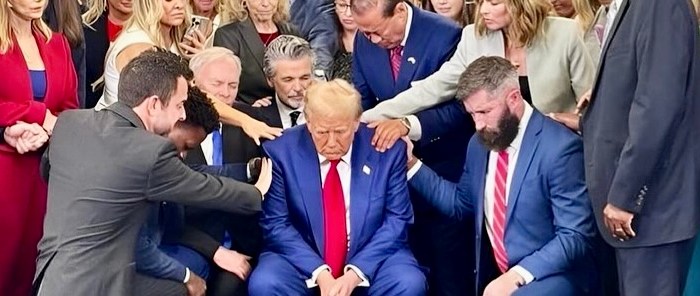
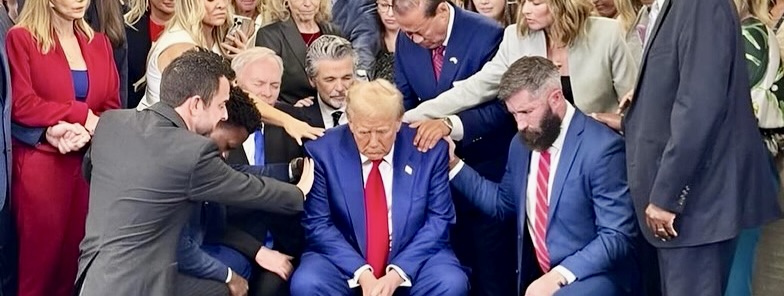
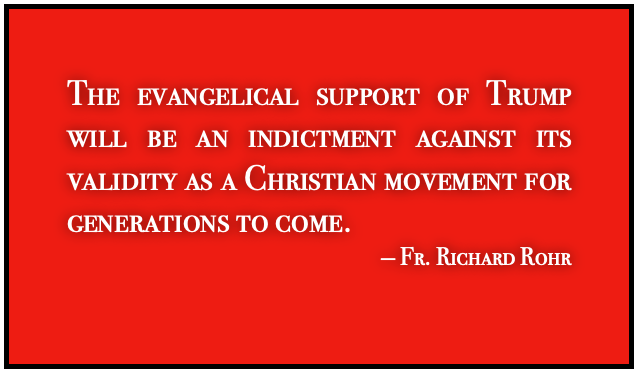
What Evangelical Christians do now is the exact opposite. Those who support Donald Trump have an ends-justify-the-means theology. As long as abortion is outlawed and gay rights are quashed, the means to get there (coercing Ukraine to dig up dirt on his potential political opponent) are not only ok, but justified, even applauded. Donald Trump’s interior life is not considered important or relevant, nor is the outward display of his character. They worship the end product.
In his book, Prayers of the Cosmos, Neil Douglas-Klotz notes that Aramaic, the language of Jesus “…does not draw sharp lines between means and ends, or between inner quality and outer action.”There are no words in this ancient language for an ends-justify-the means psychology: a person with unrepentant character defects is so unlikely to perform noble deeds that it cannot even be talked about. Logic follows that a person who provides immoral leadership is likely to be of ignoble character.
A guy named Josemaria Escriva de Balaguer established an ultra-conservative, ultra-secret Catholic lay organization in 1928, Opus Dei. Followers learn to abandon their principles, that the ends always justify the means. They believe Trump was chosen by God to protect the unborn fetus and restore Judeo-Christian moral order. Trump’s Attorney General, Bill Barr is Opus Dei (as are other Trump appointees). Doesn’t this explain a lot?
I left that Christian cult years ago. However, I understand, even admire, their members’ rejection of Jimmy Carter because they considered his views on sex education immoral. I disagreed with their opinions but I too measured his character by words and deeds and came to a different conclusion. Perhaps this ancient Aramaic Jesus language trickles into a collective consciousness enabling some to see inner qualities and outer actions as one big squishy blob and accept or reject that whole person.
I keep asking myself what’s wrong with those Evangelical Christian (and conservative Catholic) Trump supporters. Don’t they care that his morally corrupt outsides match his morally incontinent insides? Their religious fervor veils their eyes to the hypocrisy Jesus condemned. They justify the deeds of their beloved lawbreaking reprobate. Have their souls separated from their minds? Or as Rev. William Barber has said, “After this year (with Trump) if you don’t believe in the devil there’s somethin wrong with your fuckin mind.”











 Regan Burke