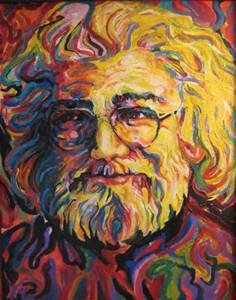
In the Attics of My Life, Jerry Garcia Lives

In the Attics of My Life, Jerry Garcia Lives

I worked in politics my whole life, always hoping for the perfect politician. The world view I dreamed up included good people who ultimately acted in the best interest of the whole.  Bill Clinton could have been my hero. I loved his rallying cry in the 1992 campaign, “personal responsibility.”

But I had doubts. Could I work for a candidate who was pro capital punishment and unsure of his view on abortion? Those were two issues I thought every Democrat knew to be against and for.

The “personal responsibility” message won me over. In th-11991 I abruptly left Chicago for Arkansas to work as Clinton’s campaign scheduler, a grueling job that required 24/7 attention. One cold January night Clinton and his entourage, George Stephanopoulos and Bruce Lindsey, returned to Little Rock in a small private jet from all-important New Hampshire. I met the plane on the dark, deserted tarmac to give Clinton his next day’s schedule. He descended the jet’s stairs with a big smile, came directly at me, grabbed my coat and ran his hands up and down my long furry lapels. “Nice coat, Regan,” he whispered.

This encounter may be the reason I love Bill Clinton.

When he won, I relocated to Washington to work in his administration. I moved into the first floor condo of an 1880 townhouse on Church Street in DuPont Circle. In 1994 he passed a crime bill I thought went too far. Next he signed NAFTA, an agreement opposed by every Democrat I respected. Both policy shifts were spearheaded by White House insider, Rahm Emmanuel, who decidedly did not have the public good at the forefront of his self-serving mind. But Clinton loved him. Dissatisfaction settled in the space between my bones and muscled me awake at 3 o’clock in the morning for the next seven years.

In the still of an August morning in 1995 NPR told me Jerry Garcia died. I collapsed on the bathroom floor weeping over the death of something I couldn’t put words to. At 49-years-old my idealism had come to an end: my false world of everlasting good died with Jerry Garcia. Reality glared back at me in the mirror as I brushed my hair, seeing for the first time a wrinkled face and rubbery neck. I dressed in a soft yellow, flowery cotton frock and pinned a silk flower in my hair, ready for the grieving day.

My dog Voter squirmed away from my extra long hug and I went out the door to my old friend, Keith Lesnick waiting to drive us to work. As soon as I got in the car tears spilled out. He asked about the sadness, and I slobbered out a few words, “Jerry Garcia signed into rehab last night,” I said. “He died in his sleep.” Keith waited a few respectful minutes, and then, with one simple sentence, he opened a new, naked reality that included the unspoken caveat of don’t take yourself too seriously.

He said, “well, it’s not as if it’s Aretha Franklin.”
Biking Around the Bomb

 Bicycle Grace by Regan Burke

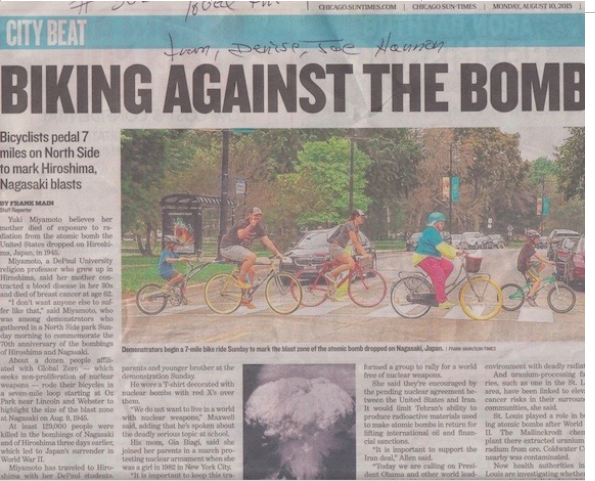
The photo shows 2 athletic young men, 2 children and me, a plump old lady, pedaling east across Stockton Drive, a tree-lined street that sidewinds Chicago’s Lincoln Park Zoo.

The photo appeared in the City Beat section of the Chicago Tribune August 10, 2015 with the headline, “Biking Against the Bomb.” The caption reads “Demonstrators begin a 7-mile bike ride Sunday to mark the blast zone of the atomic bomb dropped on Nagasaki, Japan.”  My bike has a big yellow front tire, a black whitewall rear tire and red basket. I’m sporting neon pink ankle-length trousers, lime-green sneakers, and a “Bike Around the Bomb” extra-large short-sleeve turquoise t-shirt snugly over my long-sleeve lemon shirt. The t-shirt just happens to be the same color as my helmet and eyeglasses. My bike posture befits a 69-year old short grandmother with bulging thighs and donut midriff.

I stand out in the photo.

You see my hands gripping the handlebars of my beloved town bike. What you don’t see is God caressing those hands with high-fives. The day this photo was taken, that bicycle grace relieved me of the physical pain of moral certitude.

When I was in my 50’s, I worked in downtown Chicago overlooking the Daley Center. Every month a group of bicyclists, Critical Mass, gather in the plaza before their raucous ride through city streets. How I longed to join them! But I’d been derailed from lifelong bike-riding by fibromyalgia. After I retired I downshifted into wheelchair-bound despondency.

Suicidal thoughts took me to the velodrome of alternative therapies. Round and round I went to anyone, anything that might relieve my suffering mind-body. Eventually meditation led to feldenkrais, writing therapy, pain relief, and a bicycle.

I’ve marched in peace demonstrations since the 1960’s so “Biking Against the Bomb” was the perfect foray into group cycling since I regained mobility. Educated by nuns, I learned about peace huddled under my 1st-grade desk hiding from a possible atomic bomb. Pray for peace. God required peace by every means possible.

President Truman had written his own moral code a year before I was born. In August, 1945 he murdered 180,000 Japanese civilians with atomic bombs. An unnamed fear took root in my fetal shroud and sprouted in the dappled shade of A-bomb-talk throughout my youth. This genetic consequence chained me to the spokes of peace activism.

At my meditation group I tried to describe my day of bicycle grace but spiritual gobbledegook fell out of my mouth and I self-consciously coasted to the end of my sharing with, ”I think I could ride with Critical Mass now.”

Group-think chattered: “Oh no. Not them. Scofflaws. Sail through stop signs. Wheel around pedestrians. Weave in and out of traffic. Lawless.”

I said, “But they have a police escort.”

“Yeah. Unruly fringe group. Take over the street and piss off drivers.”

I went home, opened my computer, defaulted to moral certitude and clicked “going” on the next Critical Mass event listed on FaceBook.Biking