The Peace of Non Closure

The Peace of Non Closure

A new concept popped up at the outset of a recent anti-racist training session. Among the familiar “courageous-conversation” ground rules, the leader added, “We commit to non-closure. (pause) Right?”

Whoa, really? My fellow attendees all yes’d the speaker as if they knew this already. I thought I must have ignored an inboxed message, or, in my long season of retirement, missed another new corporate buzz word. Non-closure.

On the brink of Juneteenth, the half-day session promised to address the backlash to Diversity, Equity and Inclusion programs and policies. That morning all of nature said yes! to Chicago. I wanted to say yes! too, and take a long walk in the park with my dog. Instead, I reluctantly ambled over to the dingy conference room in a church basement near my home. Anti-racism churned inside me and I had no organized outlet. I was curious to see if there was anything new.  Answers.

But here I was, swallowing a commitment to non-closure. No answers, no conclusions, no plans, no fantasies of what might be. Of the numerous anti-racism trainings I’ve attended since the murder of George Floyd this may be the first time I recognized that it’s safe to be in that liminal space of unknowing, of ambiguity. There would be no meaning-making, no sense-making, no closure.

Facilitators from Crossroads, an antiracism training organization, gathered us together, not to tell us what they know, but to find out what we know. They see, feel, but even more, they sense, not just a political backlash in anti-racism work but, an active softening in community and personal commitment. 

The air is leaking out of the tires.

This week Donald Trump and I had birthdays. We’re the same age. Several friends asked me how I planned to celebrate.

“I don’t really celebrate my birthday.”

“Why not?” Asked my favorite poet.

I had no answer. 

He asked about my writing.

“I’ve been thinking lately I may not write anymore.”

“Why?” He asked.

Another why question. And no good answer. Is that a failing? No answer? Does it mean I’m not sufficiently self-reflective?

Liminal, from the Latin, “threshold” puts time and space betwixt and between. On liminal days, birthdays dangle off the edge of time. The past no longer haunts me, the future no longer calls me. I neither wait nor wonder. Indeed, birthdays are liminal days.

Anthropologists say that memory disorder, pandemic uncertainty, authoritarianism, virtual reality, border disputes, old-age anxiety, environmental issues, and gender trouble put society in a self-protective liminal state. Whew! Thank you God. This beloved gift  allows me to live on the threshold where social norms, like answering the question “why” or reading every damn email are temporarily suspended. 

In the ninth grade, when I was consumed with past and future popularity by any means, I was inconveniently tormented with one living and one dead poet: T.S. Eliot and Alfred Lord Tennyson. A lot has been written about the spiritual liminality, the non-closure of their work. It’s only now (or is it?) that I see why these vexing lines captured me:

Tennyson’s Ulysses:
Yet all experience is an arch wherethro' 
Gleams that untravell'd world whose margin fades 
For ever and forever when I move.
TS Eliot’s Four Quartets:
Time past and time future
What might have been and what has been
Point to one end, which is always present
.

Cold Wars

Cold Wars

The 2019 Polar Vortex slid down from the North Pole, threatening to lock Chicago into subzero stillness. I prepared for the warring cold by teeing up the entire 18-hour series of The Marvelous Mrs. Mazel. Then I threw stale bread crumbs onto my balcony to nourish the house sparrows, finches, and chickadees before they huddled together in eaves and cracked soffits to wait it out. I shuttered in and Dapped all the little crevices around the balcony door that were spritzing air into my not-so-insulated living room. That was the extent of my preparation for the coldest two days ever recorded in Chicago.

Day one brought minus 23 degrees. I woke to a thick film of silver ice covering all the windows. The ice curtain obscured the humanity moving around behind the windows across the street and any fool pedestrian walking in the feels-like-minus 40.

My binge-watching was interrupted mid-morning by a thrashing whomp, whomp whomp on the concealed balcony. I inched toward a clearing in the frosty glass.

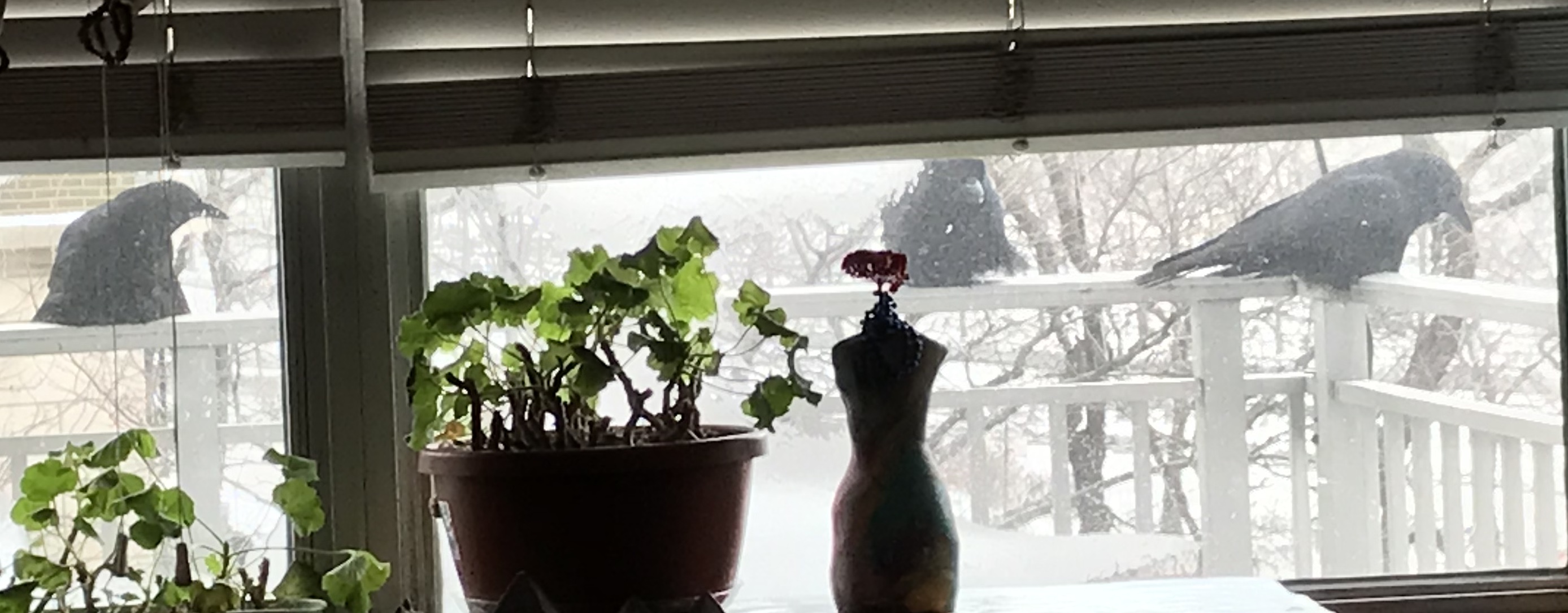
A murder of crows had come to forage.

The much-studied American Black Crow might be the most intelligent animal other than primates. They hide their food and come back for it. If a crow looks you in the eye, she will remember you, follow you down the street, and caw at you for attention like a wild pet. 

On day two, the temperature was 21 degrees below. The ice wall on my windows melted enough for a small lookout. I abandoned Mrs. Mazel and placed a chair well away from the clearing to observe the crows without startling them. They first landed in late morning. A mighty set of black wings fluttered a plumped-up body onto the balcony railing, and the rest followed—a family of five dipping to the balcony floor for leftovers. They flew off and came back. Again. And again. And again. I remained still throughout, trying to lock eyes with the birds. In the afternoon, the weather broke and allowed the dog and me to walk outside—under the watchful eyes of noisy new friends.

The first cold days of 2023 were predicted for the weekend after Thanksgiving. Though nowhere near the 2019 plunge, 30-degree temperatures heightened awareness of asylum-seeking families living on cardboard slabs outside police stations. I sought diversion through another favorite TV series, Julia.

The TV automatically tuned in CNN, though, where there was live coverage of the hostages being released from Gaza. A mysterious and curious need for every scrap of information gripped me. Who are they? What are their stories? Where are they going? I saw six women over the age of 70. One 85-year-old was helped onto a bus. I winced, feeling my own arthritic pain. Four children appeared—ages 2, 4, 5, and 9. I squinted to see if they were clutching teddy bears.

After watching for two tearful days, unrelenting shivers overcame me. And when I took the dog for a walk, that murder of crows cawed to us from the barren trees.

The Fresh Coast

The Fresh Coast

When some people speak of the Midwest

They talk as if she’s the jilted cinderella 

Whose prince neglected, and I must defend her,

Not always cold, no oceans or mountains, sister,

But 600,000 sandhill cranes wade in her water.

The east coast comes to play sport, play act, pay 

To play, play around, play the innocent, put in play.

The west coast comes to run by, run. 

They say nothing eventful happens to her.

Then they blame her for Trump.


So Fly Mother

There’s no North Star to navigate me through today’s rapidly expanding and changing vernacular. I’ll bet my parents felt this and probably theirs before them. In my early teens I used the word “cool” in a conversation with my mother. I forget everything about that conversation except she snapped.

“Stop using that word. You sound like a degenerate beatnik.”

Oh. My. GoD. That’s exactly what I wanted to be. I’ve used cool ever since to describe things I like, assuming whatever I like falls into the universal “cool” column.

“Awesome” took the place of cool in the public square when I wasn’t looking. I’m mildly annoyed at the overuse of awesome but at least people use it close to its true meaning, unlike cool which confounds us with all its meanings: aloof, care-free, chill, funky, and in the case of Barack Obama—sophisticated, elegant and unflappable.

The Webopedia has a comprehensive list of texting language. ROFL means rolling on floor laughing. LMK means let me know. And my favorite, STFU means shut the fuck up which is teetering on the cliff of overuse in the aftermath of the painful November 2016 election and the reign of the twittering emperor.

Nothing stumps me more than hip hop language. Until recently I thought hip hop and its musical sister, rap, glorified pimps, whores, violence, drug dealing and guns. But I’ve met writers in the hip hop world who are neither gangsters nor malevolent. I see a world of hip hop creatives whose first thought every morning is to write. it. down. Like rock ’n’ roll before it, hip hop is a creative outlet for young people who are on to us, who use poetry, music, fashion, video and street art to proclaim their intolerance of our white privilege.

The words though are tough. I get the word homie, meaning a good friend as if from the neighborhood or home. “Hoe” a diminutive form of whore is used as a general insult, much like bitch. But, it’s elevated to a type of red badge of courage for poet Britteney Black Rose Kapri who titled her book Black Queer Hoe. I like it but as a former barfly who sold herself for Rolling Rock, I can’t bring myself to use it—yet. For that matter as a former drug addict I bristle at the use of the word dope as a substitute for cool, as in the HBO series, Two Dope Queens.

Recently I participated in an intergenerational poetry workshop taught by Kevin Coval, Chicago’s Hip Hop Chronicler. Kevin MC’d a performance of us workshoppers and our poems at Lookingglass Theater. He introduced me as “so fly”, and I immediately thought of Super Fly. The slang “fly” dates back farther than the 1971 movie though. In my teens I heard “fly” in 1920’s African American Fast Talkin’ Blues on old scratchy 78 RPM records. It was someone like Blind Lemon Jefferson or Lead Belly who used the word fly to describe a stylish, snappy, sophisticated woman. My 1960’s beatnik-wannabe friends and I never adopted fly in place of cool because it sounded too black.

BOCn5vf4SLqbLC+5R+QVewThey all called my mother cool behind her back not because she dressed in black turtlenecks like a degenerate beatnik but because with her acid tongue and casual elegance she let them drink beer in her living room and laughed at all their jokes.
I accept Kevin’s compliment with gratitude, but I will never be as fly as my mother was.

When The Saints Came Marching In


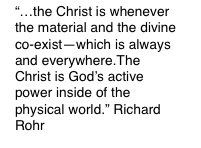
I hear some people say they knew this or that at age 5, 6, 7 or 8. They knew there was no Santa Claus or they knew their father was having an affair with the neighbor. Not me. Throughout grade school, with all evidence to the contrary, I trusted that the adults in my life knew what they were doing, didn’t lie to me and moved our family around for good reasons like better neighborhoods or better schools. Then my mother yanked us from our midwestern roots, away from my absentee father and took us to the East Coast. My sister Erin and I landed at the doorstep of my mother’s sister, Aunt Joanne, in Upper Marlboro, Maryland, with her husband Bill Dorsey and their seven children. It was Christ-Rohrmid-May when we entered St. Mary of the Assumption School where the nuns “sought to imitate Jesus Christ.”  In 1959, St. Mary’s was still segregated except on the playground where I joined girls and boys, blacks and whites defiantly playing baseball all together.
The eighth grade class at St. Mary’s had spent the entire year before I got there memorizing one poem a month. In order to graduate, I had to memorize all nine poems. Not only did I rebel against this arbitrary standard, I became hysterical over it. My mother had taken two of my sisters to New Jersey to live with other family members and for the first time in my life I absolutely knew that she had gotten it wrong. I needed her with me, to defend me against the injustice of those nuns. I had sacrificed a lot for her and it was time she helped me.

img021
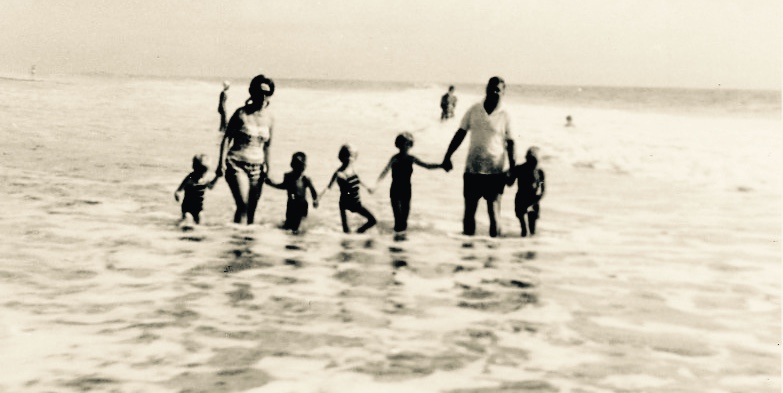
The Dorseys at Bethany Beach, Delaware

Uncle Bill had a different idea. He told me I could do it, that we’d do it together. Never before had anyone sat me down and given me a pep talk. Every night after dinner for four weeks he helped me learn those lines. Poems like “Annabel Lee” by Edgar Allan Poe, “The Tyger” by William Blake, “O Captain! My Captain!” by Walt Whitman and my all-time favorite, “The Chambered Nautilus” by Oliver Wendell Holmes. Uncle Bill’s love flowed through me and poured out onto the paper, lighting up the poetry. He gave those words to me. And now, when I hear or see them, my heart pounds with a thunder of love for his eternal soul.

The Dorseys threw a party on my 13th birthday just before I graduated. They invited all their friends and children. My mother arrived from New Jersey with my baby sister. The backyard ballooned with streamers and bunting, barbecue, birthday cake, and something I’d never seen before – a keg of Budweiser. Uncle Bill gave me the first draw of the tap. I gulped it down without tasting it. My first beer. Then I had another. And another. And suddenly I loved everything around me. I knew I belonged, in that family, at that party, with those saints.

The St. Mary nuns blundered in their seeking to imitate the Christ. But Uncle Bill Dorsey? He was the real deal.

A People’s History of Chicago

kevin-coval-peoples-history-chicago

Chicago poet Kevin Coval came to a luncheon of forty older adults in the Gold Coast to read from his new book, A People’s History of Chicago. This was not Kevin’s usual audience, which is young, disaffected and enlightened high school kids from the neighborhoods. After his reading, he passed out small notebooks and pencils and asked us to write a list of what you see when you walk out your front door. Then he gave us 8 minutes to write a poem.

Kevin is the Artistic Director at Young Chicago Authors, an ongoing free workshop that meets every Saturday at Milwaukee and Division. He invited all of us to the workshop, saying “we need you.”

And so the next Saturday I climbed to the 2nd floor high-ceilinged room of bare brick walls and planked floors. Twenty chairs were arranged in a circle in the middle of the room and loose, unlined sheets of paper and pencils were in a box in the middle of the circle. This is not just organization, it’s respect.

Poet-teacher Jose Guadalupe Oliverez sat on a chair in the circle and as people emerged from the staircase, he motioned to them to join him. He asked us to state our first names, age and our high schools. A group of 16-year-olds from Crane High School and their spoken-word coach, a 19 yr old poet from Calumet City, a 16 year old Lincoln Parker home from boarding school and a 20 year old jewelry maker made up the group. I apologized, “I’m Regan and I’m old. Thank you for letting me sit in.” Jose prompted us to write lists, reading various poems for inspiration about truth and lying. He gave us 8 minutes to write. At the end, each of us recited one poem.
_____________
Lying

I get on the bus
See a cohort
Where you goin?
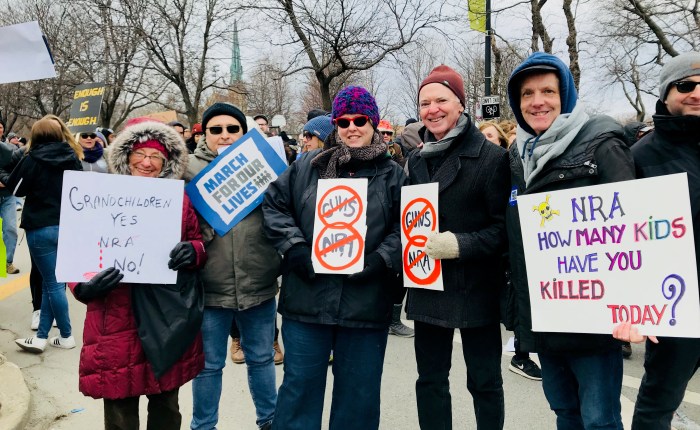
To the March at Trump.

You go girl, he says
thinking I’m alive in pursuit of justice

Am I? I dress for the day
with buttons and banners
Tell others I’ll see you there!
Notify on Twitter and FaceBook

Then go downtown and what?
I tell others it works
to be in the number, to yell
This is What Democracy Looks Like

I write letters, make calls, send emails
Proclaiming the what and why
but then in silent spaces
I doubt.

Does my voice matter?
I tell others theirs does, mine does.

I doubt.
Will it get better?
for me
or you
or them
or us

Am I acting, lying?
What about the rest of ‘em?
Are we all just hoping, acting, lying?
_______________

Hot and weak at the bus stop I was thinking about the racism-felt poems I’d just heard from the young poets. A woman in a McDonald’s uniform came along complaining, “Where the fuck is the bus?” She asked if I had been to the new Division Street Target and before I answered, she added, “I can’t go there. They tore down my home to build it.”

I beseeched God, “when will it ever end?”

How to Survive Grade School: Leave Thy Low-Vaulted Past

How to Survive Grade School: Leave Thy Low-Vaulted Past


First Grade  You have chicken pox and can’t go to school. You have mumps and can’t go to school. You have measles and can’t go to school. We’re all going to live in a hotel for a while so you can’t go to school.

Second Grade We’re moving to a new town and you’ll be going to a new school. The nun says you can’t read so you have to repeat First Grade.

First Grade We’ll buy you a bicycle to take your mind off your shame. What color do you want? Green? Ok. Oh, your sisters want bicycles too, blue and red.

Second Grade The nun says you read well enough to advance to Third Grade.

Third Grade Why don’t you know how to multipy? Come to the convent after school. We’ll have snacks and I’ll teach you arithmetic. You’ll be late going home. Can you cross the street by yourself?

Fourth Grade We’re moving to a new town and a new school. We’re moving again and you’re going to another new school. We’ll be living in a hotel until we find a home. You’ll be riding the public bus to school.

Fifth Grade We’re moving to another town and a new school. We’ll be living in a hotel until we find a home. March to class. March to lunch. March to recess. No talking in the hallway. No talking in the classroom. No talking at lunch. We’re moving into a house in another town and another school. They don’t wear uniforms, so let’s go shopping. Whew! No uniforms. No marching. And lots of talking.

Sixth Grade Hey new girl! Let’s sneak into the church at recess and read the booklet about sex. Let’s go ice skating after school and play Steal the Bacon with the boys. Want to join Girl Scouts? We’ll go camping and collect badges. We’ll sneak off in the middle of the night to meet the boys. I hear the nuns sent you home for wearing a sweatshirt to school. It’s ok. You just have to know the rules.

Seventh Grade We’re moving to another town and a new school. You have to iron your own white shirts, polish your brogues. Learn French. Work harder on arithmetic. You and your sister are playing palace guards, dressed in frog costumes, in Gilbert and Sullivan’s The Mikado. Ride your bike to play summer softball. Ride your bike to Cathy Riley’s, then ride her horses into wild raspberry fields.

Eighth Grade You’re on your way to win the all-school trophy for all-around best student. Keep up your grades, sports, tutoring and extra credit projects. We’re moving to a new town without your father. You’ll be living with relatives for the last six weeks of the school year. The school requires all eighth graders to memorize nine poems in order to graduate, including Oliver Wendall Holmes’ The Chambered Nautilus:

Build thee more stately mansions, O my soul,
As the swift seasons roll

Leave thy low-vaulted past!

Let each new temple, nobler than the last,
Shut thee from heaven with a dome more vast,
Till thou at length art free,
Leaving thine outgrown shell by life’s unresting sea!

What Is My Work, You Ask?

What Is My Work, You Ask?


1962. My work is to stop laughing like a nervous little girl and start smiling like an unflappable young lady in the coffee shop on the Asbury Park boardwalk. To turn away from the seagulls fighting over dead fish on the beach and write “pancakes” and “bacon” on my notepad. To pay attention to the old telling the story of the 1934 wreck of the cruise ship SS Morro Castle on the beach. To save money for tickets to Joan Baez and Bob Dylan at the Asbury Park Convention Hall.

1967. My work is to read Dr. Benjamin Spock’s Baby and Child Care and apply its 51hjigsfuol-_sx309_bo1204203200_commandments to week-old smiles, cries in the night, a nine-month old sprinter and a child who eats only chicken. My work is to stand my ground in the whirlwind advice from mothers, aunts and grandmothers. To learn to ride a baby on the back of my bicycle. To animate words as I point to clouds, trees and cars as if I’ve never seen these things before in my life.

1976. My work is to bypass the door to the secluded basement with its graveyard of empty vodka bottles. To surrender to my new single-motherness. To trust my untrustworthy father and move from a sandy Jersey Shore cottage to a downtown Chicago highrise. My work is to know this is the best plan for a nine-year-old boy’s future happiness.

1982. My work is to dress up in business clothes, act smarter than I am, eavesdrop on everyone’s conversations in a boiler room full of political operatives, ask stupid questions and digest enough information to schedule Nancy Stevenson in places that help win votes for her husband’s campaign for governor.

1990. My work is to be a motherless child. To lament the loss of my uterus and ovaries, and, my boyfriend. To escape to Paris and London with my twelve-year old niece. To atone for all my past sins.To feign self-confidence while running the Illinois Democratic Party.

1993. My work is to take Prozac on the way to Washington to join the management class of the Clinton Administration. To imagine I have power and to hide humiliation when I’m exposed. My work is to honor the ruling class. To recognize they are human. To protect myself from evil-doers and self-promoters. My work is to mourn the loss of naiveté.

2006. My work is to shield myself and others from Cook County Government officials who believe if you are happy at your job you’re not working hard enough. To cherish those I lead for what they are today and not for what they will be tomorrow. To protect them from those who refuse to know their names.

2017. My work is to record how far my shadow falls behind me. To tell the truth about myself and trust God with where the words go and what they do when they get there. My work is to proclaim the US Constitution guarantees me the freedom to assemble publicly and express myself openly without retribution. My work is to say I love America and when the saints go marching in, oh! how I want to be in that number.

Inspired by “An Address to My Fellow Faculty,” by A. Papatya Bucak, from brevitymag.com

Hippies At Thanksgiving

Ode to Thanksgiving

th-2

Vermont with Tricia Thack and our children in her ’62 Ford
To escape husbands and dull lives at the Jersey Shore
Route 100 Pittsfield apartments at the Village Green
A four-bedroom apartment on the ground floor
With sheltered hippies, ski bums, drop-outs, in-betweens
Divorcees, dharma bums, dogs, cats and a runaway queen
Working snow season ten miles up the road
Bars, restaurants, ski lifts, tourists by the busload

California hippies made yogurt
We ate it plain no mediocre
East Coast hippies found health food stores
Raw cashews, unsulphured raisins, no carnivores
Steam the vegetables
Sunflower seed salad incredible
Eat brown rice
Don’t eat meat, except bacon

October 1969
Friendships accelerated deeply on pot and wine
Music-fueled astral planes
Snowshoes with children in tricky terrains
Thanksgiving dinner hearkened merrymakers from the mountain
Mishmash beans soaked in apple-cider-vinegar foamy fountain
Simmered four hours with smashed garlic cloves
Vegetables landed willy-nilly into crackling oil skillet on the stove
Chopped tomatoes, peppers, onions, zucchini, squash, mushrooms, celery
Washed brown rice seethed unstirred roguishly
Cool beans hot rice folded into vegetables simmering glimmering
A bland bowl for the children fingering
Honey dollop, crushed marijuana, basil, jalapeños, paprika, ginger, pepper, ever so
Settled on low heat emitting brewed fragrance of Old Mexico
Aroma announced time to eat Mishmash and pour sauternes
Apple wine and marijuana released the kitchen from worldly concerns

Cool cats appeared extra marijuana added to Mishmash haplessly
California hippies topped off stew with yogurt joyfully
We relished the sweet and savory peace of our groovy family