Featured

Cops at the Door

In Resma Menakem’s book, My Grandmother’s Hands, we learn that racialized trauma lives in the bodies of White Americans. Not Europeans. Not Asians. Not Russians. White Americans. There’s evidence that the DNA of Black African Americans and, in a different way, of White Americans, has changed as the result of enslaving Black Africans within the past four centuries. If you’re a White American, the trauma has been passed down from your White ancestors and will be passed along to your White progeny.

Reading this introduction, I paused. For a long while. Did I want to go this deep in recognizing and ridding myself of my own racism? Not really. I’m exhausted by introspection on racism, which I’ve been drawn to and stuck on since the murder of George Floyd. But my book group is engaged in a six-week study and I like them.

Its unclear whether certain strings of DNA draws generational traumatized people to law enforcement. Or, do we all have the same traits, and then police work brings out reptilian responses managing Black bodies? In White neighborhoods, policemen jump to a heightened state of control and figure out a way (legal or not) to remove Black people, well, really young Black men, especially when they’re sighted walking down the street hooded and slouched.

When the police go to court to defend these arrests, they say, “residents were afraid for their lives.” If they’ve roughed up, maimed or killed a Black defendant during the arrest or in the jail cell, the judge and jury are persuaded it was self defense with the simple words, “I was afraid for my life.”

This chapter in the book, “White-body Supremacy and the Police Body” seemingly had nothing to do with me. As an old White woman, I have little interaction with the police. But during the meditation exercises at the end of the chapter a memory busted out of my subconscious.

In the mid-1990s I answered a knock at the door to two White policemen. They questioned me about an altercation I had that morning with my car and a new BMW. Both of us were squeezing into one lane of an off-ramp and I banged into her car. She rolled down her window, screaming obscenities, yelling at me to pull over. I did not. I sped up, drove straight home, closed all the curtains and dove into a pint of ice cream. The police plainly stated my actions could be a hit and run. My lizard brain impulsively launched into a devious defense.

“Did you see her?”

“Well, you must see how afraid I was? She scared me to death. I was afraid to pull over. What if she had a gun?”

She was Black. The policemen backed up, put away their notebooks.

“We understand. Don’t worry. She doesn’t have your address. We won’t pursue it.”

The book begins with a quote from Charles M. Blow: “One doesn’t have to operate with great malice to do great harm. The absence of empathy and understanding is sufficient.”

MLK Jr teaches this. So does Jesus. And now, reminded of that ugly part of me, I have to learn the practice of empathy and understanding.

Someday.
Killing the January Blues

Killing the January Blues

Early in my sobriety, a therapist told me to volunteer in order to get out of my depression. I almost went for her throat.

“That’s your advice? How can I help anyone when I can hardly get out of bed?”

In Alcoholics Anonymous, we’re told self-centeredness is a common trait that leads to drunkenness; it’s suggested that serving others will help keep us sober. 

“It’s a spiritual principle. Don’t overthink it. Just go help someone.” An AA meeting-goer told me when I was whining about the blues one January.

After years of campaigning by activists, members of Congress, and Coretta Scott King, President Ronald Reagan finally signed a bill creating a  federal holiday in honor of Dr. Martin Luther King, Jr. Observed on the third Monday of January, dear Martin was first celebrated in 1986.

“You don’t have to have a college degree to serve. You don’t have to make your subject and verb agree to serve. You only need a heart full of grace. A soul generated by love.” MLK told us.

Grace is an indulgent gift from the cosmos. A heart full of love sounds too godly for my rebellious nature. For some, it comes naturally. Not for me. I meet many people I don’t want to love or serve. I balk. This is why I must be told to commit to love, commit to serve.  Every day, I’m reminded of the promised rewards: freedom from melancholy and self-pity. The promise is appealing—and attainable.

During the month of January, organizations, politicians, GenXers, and citizen elders all celebrate MLK through service to others. Rush University Medical Center in Chicago offers a few easy opportunities.

  • Celebrate at a hybrid event: “A Lesson from Dr. King: Health Equity is  Everyone’s Business,” on Wednesday, January 17, from 1:00 -2:00 pm. Experts share how to work towards ensuring everyone has access to their highest level of health. Click  here if you’d like more information.
  • Volunteer in person in Chicago distributing 300 meals on Friday, January 19, from 10:30 am to 12:30 pm. Multiple volunteer roles are available (preparers, packers, and drivers). Want to help? Click here for more info.
  • Mentor with the Community Health Mentor Program. Teach first-year graduate students about living with chronic conditions (high blood pressure, diabetes, alcoholism), as well as guide them in becoming patient-centered practitioners. All Community Health Mentor meetings will be on Zoom. Mentors receive up to sixty dollars in gift cards for participating in the training and all three meetings. The meeting dates are Wednesdays, January 24, February 14, and March 20, between 1 pm -6 pm for 60-90 minutes. Click here for more info or email Hannah Weitzman, Program Coordinator, at hannah_weitzman@rush.edu.

Dispelling my preoccupation with self is a lifelong endeavor. It’s comforting that MLK recognized this is true for many, which is why he gave us all the big quote:

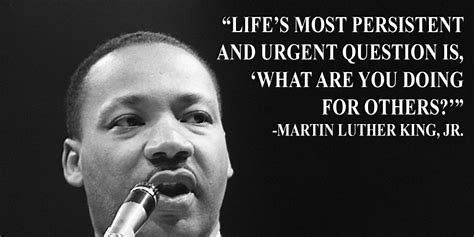
“Life’s most persistent and urgent question is, ‘What are you doing for others?”

Here’s to honoring the legacy. Happy New Year.