On day two of the Democratic National Convention, I came face-to-face with a tall, long-haired, familiar beauty outside my local coffee shop in downtown Chicago.
“Hi! Are you Caitlin?”
“I am.”
“You’re at my coffee shop!”
“I love this place; come here every morning,” Caitlin said.
“Oh, gosh, I wish my friends were here to meet you. We’ve all been gathering for coffee in the Ritz Hotel lobby looking for you!”
“I wish I could meet them too!” She said.
“Well, I can’t speak for them, but I love you. My whole family loves you.”
And so went my encounter with Caitlin Collins of CNN. Neighborhood friends and I camped out in various hotel lobbies during Convention week hoping to spot famous people. We’re political junkies, more likely to screech at Mitch Landrieu, former mayor of New Orleans, than Golden Globe winner Greta Gerwig. Oh, there are exceptions. I longed to see Billy Porter. Why him? As soon as President Joe Biden announced he was stepping aside for Vice President Kamala Harris, Billy Porter jumped out of the starting gate to endorse her. Also, I love his outfits.
In January 2024, Convention organizers declared they needed 12,000 volunteers. Unenthusiastically, almost reluctantly, some of us registered on the convoluted DNC volunteer website in February, March, April, never receiving acknowledgment or confirmation. My constant refrain to anyone who asked (or didn’t ask) was: sign up—you never know what will happen. When the Biden-Harris Handover came down, the volunteer pool immediately swelled to 30,000, a nascent signal of unabashed support for Kamala Harris for President. Would-be volunteers came from around the country thinking they’d grab a plum “slot” from the AI-driven robot volunteer organizer. A few days before the Convention started, I was called to the basement of the United Center with about 100 others to “unfurl” flags as they rolled in from the loading dock. We were gleeful. Some were called back for various duties at the Convention. Not me. I never did secure a volunteer gig to check credentials, or sort the garbage for recyclables, or greet people at hotels, or direct delegates to buses.
On the afternoon of Convention day four, I received a text, “I’m leaving a pass for you at the desk of my hotel,” from a lovely I’d known thirty years ago in the Clinton Administration. I hiked up my skirt, jumped on my three-wheel ADA electric scooter, and navigated my way through the exterior United Center maze of Secret Service, Chicago Police, Cook County Sheriffs, metal fencing, magnetometers, hawkers, protesters, volunteers, and a mile-long line of faithful ticket-holders. Vivienne from County Cork and Mark from St.Louis in section 202 texted every few minutes with updated instructions on how to squeeze through the crowds and get to the seat they were defending for my grateful butt.
“I just got in a fight,” texted Mark. “Standing firm. I told them you were waiting for the elevator. Viv meeting you.” Finally, from my cherished seat, I texted David, who I passed outside on the pedestrian line. “No seats.”
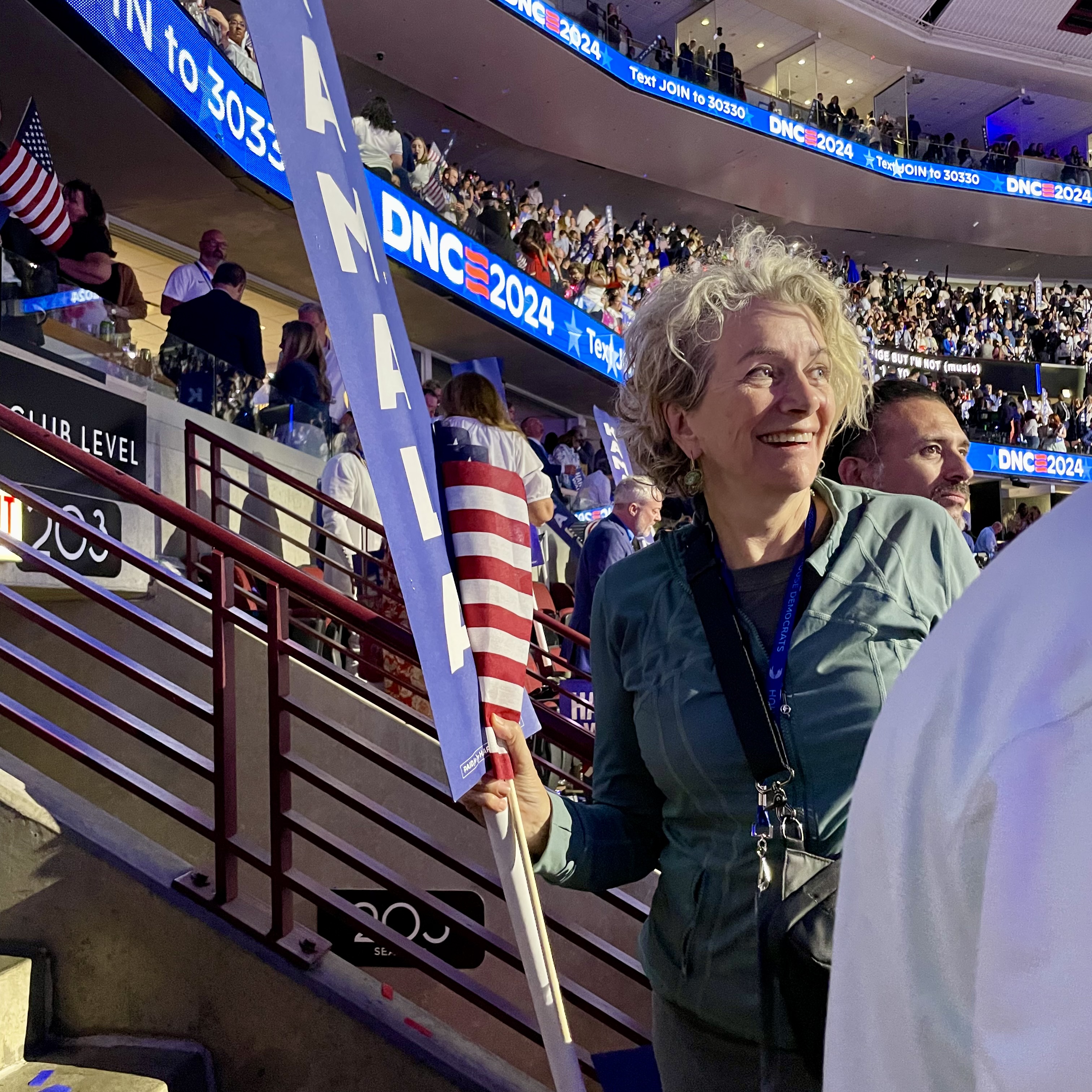
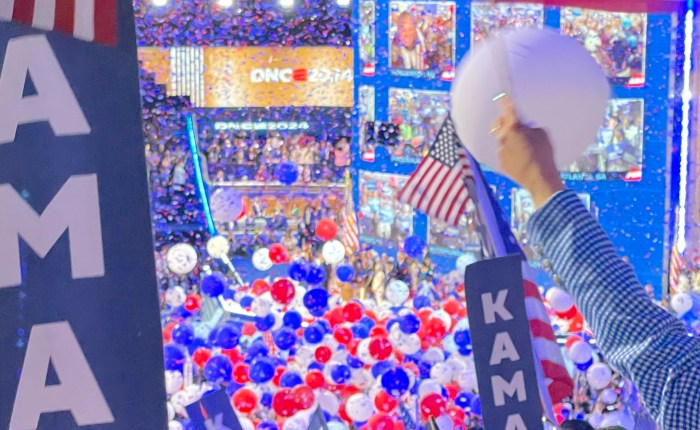
Lucky doesn’t begin to describe how it felt to be in Section 202 of the United Center on August 22, 2024, for Kamala Harris’ acceptance speech—the most blessed hurly-burly hoopla in memory.
Or, in the words of Irish Vivienne, “Best craic a’ me life.”
___________
“Craic is laughing at cellular level, finding the humour in everything and making yourself laugh when thinking about it all.”
 promulgating the idea that addiction is a biological disorder from a dysfunctional brain – not inherited and certainly not a moral failing.
 Regan Burke