A People’s History of Chicago

kevin-coval-peoples-history-chicago

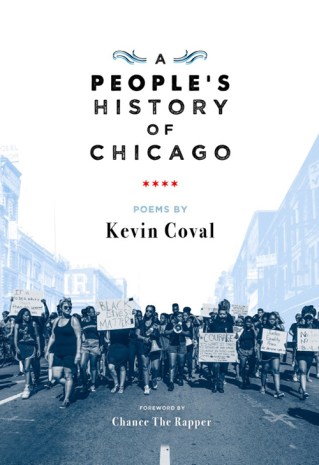
Chicago poet Kevin Coval came to a luncheon of forty older adults in the Gold Coast to read from his new book, A People’s History of Chicago. This was not Kevin’s usual audience, which is young, disaffected and enlightened high school kids from the neighborhoods. After his reading, he passed out small notebooks and pencils and asked us to write a list of what you see when you walk out your front door. Then he gave us 8 minutes to write a poem.

Kevin is the Artistic Director at Young Chicago Authors, an ongoing free workshop that meets every Saturday at Milwaukee and Division. He invited all of us to the workshop, saying “we need you.”

And so the next Saturday I climbed to the 2nd floor high-ceilinged room of bare brick walls and planked floors. Twenty chairs were arranged in a circle in the middle of the room and loose, unlined sheets of paper and pencils were in a box in the middle of the circle. This is not just organization, it’s respect.

Poet-teacher Jose Guadalupe Oliverez sat on a chair in the circle and as people emerged from the staircase, he motioned to them to join him. He asked us to state our first names, age and our high schools. A group of 16-year-olds from Crane High School and their spoken-word coach, a 19 yr old poet from Calumet City, a 16 year old Lincoln Parker home from boarding school and a 20 year old jewelry maker made up the group. I apologized, “I’m Regan and I’m old. Thank you for letting me sit in.” Jose prompted us to write lists, reading various poems for inspiration about truth and lying. He gave us 8 minutes to write. At the end, each of us recited one poem.
_____________
Lying

I get on the bus
See a cohort
Where you goin?
To the March at Trump.

You go girl, he says
thinking I’m alive in pursuit of justice

Am I? I dress for the day
with buttons and banners
Tell others I’ll see you there!
Notify on Twitter and FaceBook

Then go downtown and what?
I tell others it works
to be in the number, to yell
This is What Democracy Looks Like

I write letters, make calls, send emails
Proclaiming the what and why
but then in silent spaces
I doubt.

Does my voice matter?
I tell others theirs does, mine does.

I doubt.
Will it get better?
for me
or you
or them
or us

Am I acting, lying?
What about the rest of ‘em?
Are we all just hoping, acting, lying?
_______________

Hot and weak at the bus stop I was thinking about the racism-felt poems I’d just heard from the young poets. A woman in a McDonald’s uniform came along complaining, “Where the fuck is the bus?” She asked if I had been to the new Division Street Target and before I answered, she added, “I can’t go there. They tore down my home to build it.”

I beseeched God, “when will it ever end?”

Acting Against Type

Acting Against Type

Sitting in my church pew for the last 45 years I’ve heard from time to time that characters in the Old Testament are types of Christ. For instance, the Jonah story — spending three days and nights in the belly of a whale before the big fish spat him out on the beach is a type of Christ because the tale is a foretelling of Jesus spending three days in hell after he died, then emerging from his tomb onto the shores of Christianity. I don’t know why all this typology is necessary to connect the Old Testament to the New or, for that matter, what it has to do with me.

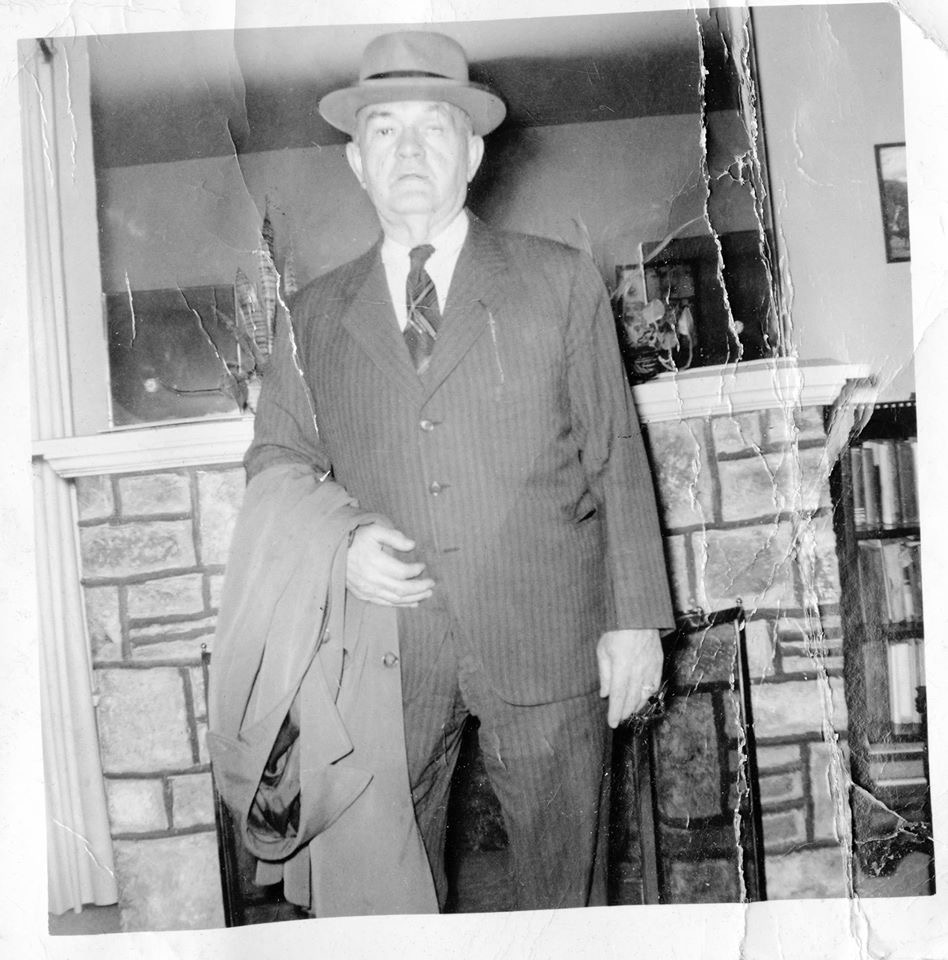
Grandpa Bill Burke

I suspect looking to the past to explain the present is a natural phenomenon, one we’ve used to nail each generation’s stake in the Oregon Trail of human history. Christian typology fortifies this grand obsession. Just as actors fruitlessly try to escape typecasting by choosing roles that are opposite their types, we cannot escape the age-old pull of seeing signs of our type in those who’ve gone before us.

A cousin named Barb Violi found me a few years ago through FaceBook. My father had spoken of his sister once or twice, but  he never mentioned she had children, or that he visited them in Memphis from time to time. When I visited Barb for the first time in her home in Omaha last month, she shouted, “Oh my God, you look just like Grandpa.”

IMG_1534
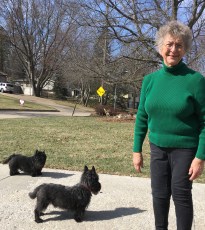
Barb Violi with Zoe & Louie

Looking for signs of my type in them, I was hungry for Barb’s memories about Grandpa and our other relatives. There were a few similarities in the dead forebears but nothing like that of Barb herself who is a rabid Democrat, cultivates indoor geraniums, loves her Scottish Terriers, swims and rides her bicycle and has art-covered walls. Her yard is full of birdhouses and flamingo planters. We are the same type

Barb told me our grandmother’s name was Katherine. My father was the type who kept secrets. He’d never mentioned her. She was killed in a car accident when he was a toddler in Terre Haute. My son unwittingly named his daughter Katherine with no knowledge of his great-grandmother’s name. My father’s father, whose looks I favor, had a girlfriend, Stacy, whom my father secretly visited in Indianapolis. My father named his youngest daughter, my sister, Stacy. My mother, who was an east-coast snob, couldn’t have known the connection because she would never have stood for naming Stacy after anyone connected to my father. Barb disclosed that most of my father’s relatives were not the drinking type. My mother found non-drinkers the ultimate in lower life forms. The only thing lower: Midwesterners.

Unknown
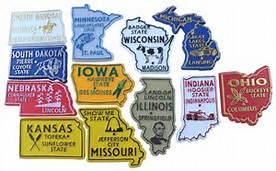
The Midwest

I keep looking for some ancestral typecasting to blame for my body shape, my alcoholism, my arthritis, my murderous thoughts. Jesus and Buddha both taught that we are who we are in the moment, unyoked from the past or the future.

Adhering to this spiritual axiom requires me to act against type.

Something Fishy at the Spring Migration on the Platte River

Something Fishy at the Spring Migration on the Platte River

Something’s fishy. Is it fate? Chance? God?

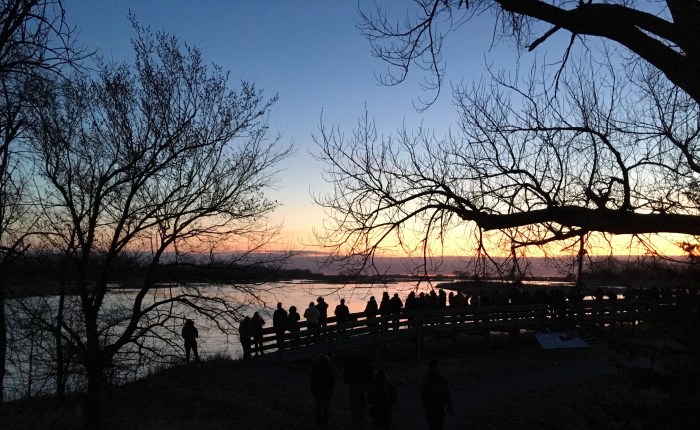
On the Platte River in central Nebraska I gather with friends from Chicago for the spring migration of the Sandhill Cranes. We arrive at our rented cabin just in time for the dusk fly-in ¼ mile down the road at the Audubon Rowe Viewing Stand on Elm Island Road. On the boardwalk-like stands we parrot the 100-plus birdwatchers as they steer their binoculars toward the goose-like honking in the sky. The bugling cries grow louder as the cranes start to

appear. Thousands of birds swirl in the overhead vortex down into the shallow river with their spindly feet splayed like landing gear on an airplane. It takes about two hours for the birds to land in their overnight roosts on the sandy Platte. We press our binoculars into our eye sockets until the very last bird nudges itself into place, snuggling alongside its friends in the water for the night.

sandhill_crane_usfws
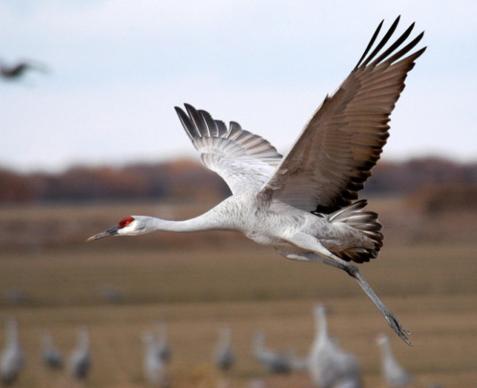
Sandhill Crane

The long-beaked crimson-headed North American Sandhill Crane coexisted with dinosaurs, making it one of the world’s oldest bird species. For six weeks every spring, 600,000 of these five-foot tall grey beauties stop in Central Nebraska.

At dawn, Peter, Amy, Anne, Laurie and I make our way back to the riverbank for the lift-off. The cranes yak each other awake in one of nature’s most melodic cacophonies. They fly off in waves after socializing for a long stretch extending their time on the river to mid-morning. During the day they forage in the corn fields adjacent to our cabin, packing in calories for their long trip north.

Murmuring overtakes the viewing stand. The nature-loving brood from Illinois, California, New Jersey and  Florida grow collectively quiet to hear the cranes’ every cackle, trill and honk. Conversations spring up, “I was in New Jersey once. Drove out route 80 to 70 to 35 to the Atlantic Ocean.” Why do men always talk in numbered roads?

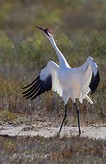
I overhear an Audubon tour guide whisper on down the line to her group, “right there, below that white roof at the river’s bend, there’s a whooping crane.” I focus my binoculars. There it is.

th-2
Whooping Crane

There are 500 whooping cranes in the wild in North America. And I just saw one.

I run to my pals at water’s edge repressing a squeal, “There’s a whooping crane!” We are silenced by the stark white ladle-shaped body of the whooper shuffling among the blue-grey hoards of Sandhills over a mile upriver. We report the news to strangers around us, lending our binoculars to latecomers, cooing when the big white bird stretches its wings in view of our naked eyes. I whisper to Peter and Amy, “if I see a river otter before we head for home you can throw me from the plane because my life will be complete.”

th
River Otters

An hour later Peter nudges me. “there’s an otter.” And so it is. Fishing around in the water, diving down and popping up, nature’s graceful pet latches onto a tangle of twigs and leaves, twirling around and around as it floats downstream under the bridge away from sight.

Yes, something happened on the Platte. Was it you, God? You, who are both fishy and honorable? You, the everlasting instant.


Inspired by the hymn “You, Lord, Are Both Lamb and Shepherd” (“Christus Paradox”) by Sylvia Dunstan (1955-1993) who drafted these words on a commuter bus “after a particularly bad day at the jail” where she was serving as chaplain:
“You, Lord, are both Lamb and Shepherd.
You, Lord, are both prince and slave.
You, peace-maker and sword-bringer
of the way you took and gave.
You, the everlasting instant;
you, whom we both scorn and crave.*

What Is My Work, You Ask?

What Is My Work, You Ask?


1962. My work is to stop laughing like a nervous little girl and start smiling like an unflappable young lady in the coffee shop on the Asbury Park boardwalk. To turn away from the seagulls fighting over dead fish on the beach and write “pancakes” and “bacon” on my notepad. To pay attention to the old telling the story of the 1934 wreck of the cruise ship SS Morro Castle on the beach. To save money for tickets to Joan Baez and Bob Dylan at the Asbury Park Convention Hall.

1967. My work is to read Dr. Benjamin Spock’s Baby and Child Care and apply its 51hjigsfuol-_sx309_bo1204203200_commandments to week-old smiles, cries in the night, a nine-month old sprinter and a child who eats only chicken. My work is to stand my ground in the whirlwind advice from mothers, aunts and grandmothers. To learn to ride a baby on the back of my bicycle. To animate words as I point to clouds, trees and cars as if I’ve never seen these things before in my life.

1976. My work is to bypass the door to the secluded basement with its graveyard of empty vodka bottles. To surrender to my new single-motherness. To trust my untrustworthy father and move from a sandy Jersey Shore cottage to a downtown Chicago highrise. My work is to know this is the best plan for a nine-year-old boy’s future happiness.

1982. My work is to dress up in business clothes, act smarter than I am, eavesdrop on everyone’s conversations in a boiler room full of political operatives, ask stupid questions and digest enough information to schedule Nancy Stevenson in places that help win votes for her husband’s campaign for governor.

1990. My work is to be a motherless child. To lament the loss of my uterus and ovaries, and, my boyfriend. To escape to Paris and London with my twelve-year old niece. To atone for all my past sins.To feign self-confidence while running the Illinois Democratic Party.

1993. My work is to take Prozac on the way to Washington to join the management class of the Clinton Administration. To imagine I have power and to hide humiliation when I’m exposed. My work is to honor the ruling class. To recognize they are human. To protect myself from evil-doers and self-promoters. My work is to mourn the loss of naiveté.

2006. My work is to shield myself and others from Cook County Government officials who believe if you are happy at your job you’re not working hard enough. To cherish those I lead for what they are today and not for what they will be tomorrow. To protect them from those who refuse to know their names.

2017. My work is to record how far my shadow falls behind me. To tell the truth about myself and trust God with where the words go and what they do when they get there. My work is to proclaim the US Constitution guarantees me the freedom to assemble publicly and express myself openly without retribution. My work is to say I love America and when the saints go marching in, oh! how I want to be in that number.

Inspired by “An Address to My Fellow Faculty,” by A. Papatya Bucak, from brevitymag.com