Film School with Vivienne

Film School with Vivienne


The elevator opened to a lit-up scene of human statues in the closed-for-business City Hall lobby.

“Cut! Close that elevator door!”

I slinked back into the elevator, up to the 4th floor Elections Department and flew to the telephone in my office where, in the Saturday morning quiet, I had just finished the 1993 voter registration plan.

I called my high-rise neighbor, Vivienne de Courcy. “You have to come down here right now!”

“Ach. Can’t possibly. Bogged down. Writing,” said Vivienne, a frustrated 9-5 insurance lawyer who spent Saturdays grinding out movie scripts.

“You must — they’re shooting a movie in the lobby. We can get access with my I.D.”  Vivienne and I loved sifting through the credits at the end of movies trying to figure out what everyone did, but we’d never been on a movie set.

Chicago’s City Hall squats on one city block with doors at Randolph, LaSalle, Washington, and Clark Streets. I hurried to the Washington Street side of the building down the stairs to the lobby. Flyers were posted in the stairwell: Lobby Closed Saturday Noon for Filming of The Fugitive. When did they put those up?

I ran down the hallway, shoved open the polished brass doors and caught my uninhibited, garrulous sidekick swinging her long legs out of a taxi on Washington Street.

Vivienne’s knockout looks never suffered from uncombed hair and no make-up. Flinging her camel-hair cape over her shoulder she shivered in the March wind, grabbed my arm and skipped inside. I muttered quick instructions: don’t embarrass me, don’t say a word, don’t make me laugh, do not get me in trouble.

Crew Only signs sat on food tables along the corridor. Perched at the table near the rotunda we hawk-eyed bowls of popcorn. Vivienne whispered her intuitive movie-credits knowledge. That’s the Director. Production Assistant. There’s the Script Supervisor. Which one is the Grip? Dunno.

A crew member gestured to the popcorn, assuming we were extras. Vivienne helped herself. What? Don’t do that!

And then, Action! Harrison Ford came running down the circa-1911 polished marble staircase across the wide rotunda zig-zagging through the crowd of extras I had witnessed by the elevators. Cut! He walked back upstairs. Action! He came running down again chased by Tommy Lee Jones.

Oh my god, he’s coming this way. “Vivienne! Say something!” Harrison Ford sauntered over to munch popcorn. I shoved Vivienne toward him. He said hello and she asked him how he liked Chicago.

“Is that an Irish accent?”

“’Tis.”

“How do YOU like Chicago?”

“I love it.”

“Well, I love popcorn.”  He smiled and strolled away.

My starstruck legs wobbled. Back at my side with a handful of popcorn, Vivienne shimmered. Turning toward the exit we faced crew and extras gathered for the catered lunch behind us.

“Are you two extras? What’s that I.D. around your neck?”

We skedaddled down the hallway, fluttered out the doors and whooped it up all the way home.


Vivienne de Courcy’s first feature length movie. “Dare to be Wild” is premiering at the Palm Beach Film Festival in April, 2016. She currently resides in Ireland and London.

You read that out loud in class?

bethfinke's avatarSafe & Sound blog

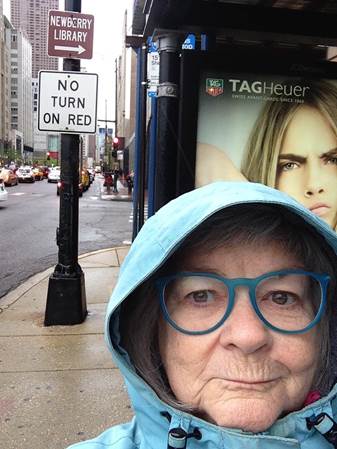
Regan-Burke That’s Regan, today’s guest blogger, peaking out of her hood at a Chicago bus stop.

It was a lucky day for me when Regan Burke turned up for one of my memoir-writing classes. A civil rights activist, Regan was a White House staffer during the Clinton presidency and has colorful – and moving – stories to tell. She files away unusual words she hears and cleverly shoehorns one or two of them into each essay – you’ll find one here in her guest post about the value of honesty in memoir-writing.

There’s a Lacuna in My Story

by Regan Burke

Sometimes I email the essays I write for my memoir classes to a good friend.

She tends to find my work imprudent and irresponsible.

”You read that aloud in class?” she’ll ask. “Yep,” I answer. “I did.”

I have a strong motivation for writing the truth. A book by Dr…

View original post 449 more words

Hippies At Thanksgiving

Ode to Thanksgiving

th-2

Vermont with Tricia Thack and our children in her ’62 Ford
To escape husbands and dull lives at the Jersey Shore
Route 100 Pittsfield apartments at the Village Green
A four-bedroom apartment on the ground floor
With sheltered hippies, ski bums, drop-outs, in-betweens
Divorcees, dharma bums, dogs, cats and a runaway queen
Working snow season ten miles up the road
Bars, restaurants, ski lifts, tourists by the busload

California hippies made yogurt
We ate it plain no mediocre
East Coast hippies found health food stores
Raw cashews, unsulphured raisins, no carnivores
Steam the vegetables
Sunflower seed salad incredible
Eat brown rice
Don’t eat meat, except bacon

October 1969
Friendships accelerated deeply on pot and wine
Music-fueled astral planes
Snowshoes with children in tricky terrains
Thanksgiving dinner hearkened merrymakers from the mountain
Mishmash beans soaked in apple-cider-vinegar foamy fountain
Simmered four hours with smashed garlic cloves
Vegetables landed willy-nilly into crackling oil skillet on the stove
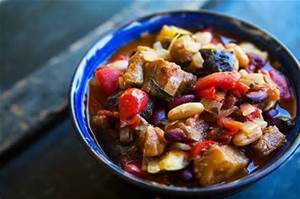
Chopped tomatoes, peppers, onions, zucchini, squash, mushrooms, celery
Washed brown rice seethed unstirred roguishly
Cool beans hot rice folded into vegetables simmering glimmering
A bland bowl for the children fingering
Honey dollop, crushed marijuana, basil, jalapeños, paprika, ginger, pepper, ever so
Settled on low heat emitting brewed fragrance of Old Mexico
Aroma announced time to eat Mishmash and pour sauternes
Apple wine and marijuana released the kitchen from worldly concerns

Cool cats appeared extra marijuana added to Mishmash haplessly
California hippies topped off stew with yogurt joyfully
We relished the sweet and savory peace of our groovy family

La Dolce Vita in Cinque Terre

It took six months in 1998 to organize our jitter-filled lives around a two-week vacation in Vernazza, a thousand-year-old fishing village in Cinque Terre on the Italian Riviera.

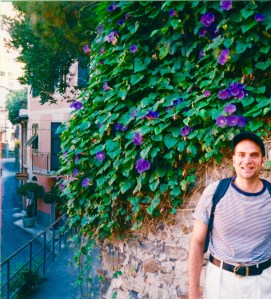
Vernazza RoccoRooco, Kristina, Mark and I left the 19th century train station and rolled our overstuffed suitcases 20 minutes up a cobblestone switchback twined in purple morning glories. Our home abroad sat 1300 feet above the Mediterranean Sea and overlooked a village of 1000 happy Italians. We arrived at LaTorre midday, when the sea is dark turquoise and the sun swells the nose-tickling lemon and olive trees.
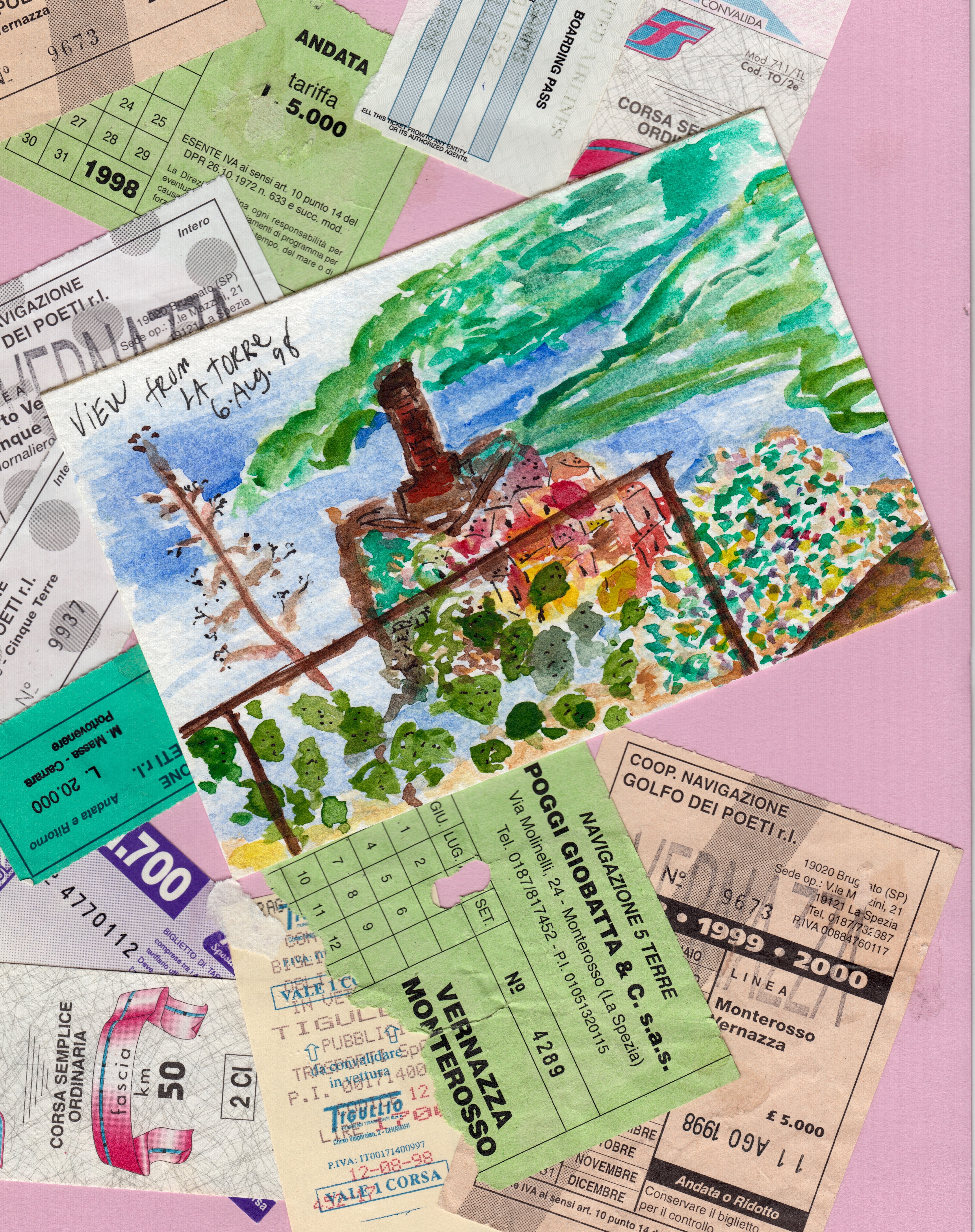
LaTorre is a 13th century pirate lookout with a galley kitchen, a modern bathroom, a luminous living-dining area and an alcove captain’s bedroom. Three other beds were lofted into stacked platforms in a stone tower, and the only way to get to them was by rope ladders. We staked out our sleeping arrangements and headed back down the path to the village.

Like bloodhounds we followed the scent of ground basil and garlic around the village into a ristorante on the piazza at the harbor. Our first meal was homemade bread dipped in fresh pesto,Vernazza’s culinary legacy to the world.

Some days we hiked the village-to-village trail along the sea, returning to Vernazza by water taxi. Other days the train took us to Le Spezia, Portofino, Pisa Vernazzaand Lucca. At night we lounged on LaTorre’s heirloom terrace in front of the twinkling lights of passing boats on the navy blue horizon.

And then the phone rang.

John Funderburk  was on the line frantic to let me know that a journalist was about to call me wanting information about Monica Lewinsky. John was a fellow political appointee in the Clinton Administration and he recommended I consult with a lawyer before taking the call. Perfect vacation bliss was now teetering at the cliff of a darkened sea.

My D.C. job occasionally had me organizing publicity and logistics at events for the President’s appearance. In the Spring of 1997 I’d been advancing a small fundraiser in a Washington hotel when an old friend from Indianapolis came into the room through the metal detectors right after Monica Lewinsky. Lewinsky was known among advance people as a Clinton stalker, so I asked my Hoosier friend to shield the President from her potential clutch as he passed by.

A half a year later news broke about a Grand Jury investigation into Clinton’s relationship with former White House intern Lewinsky. Back in Indianapolis my friend panicked that he would be hauled before the Grand Jury. So he held a press conference about his brief encounter with Lewinsky – and mentioned my name.

The sudden jolt of reality stirred our Dolce Vita quartet in Italy to hatch hilarious mad scenarios to confound the intruding journalist. When the call came, Rocco answered. “Prrrronto! Si? Si? Sorry. No Inglese! Ciao!”

Che finito, we returned to our intermezzo between the acts of the crazy world.

Biking Around the Bomb

 Bicycle Grace by Regan Burke

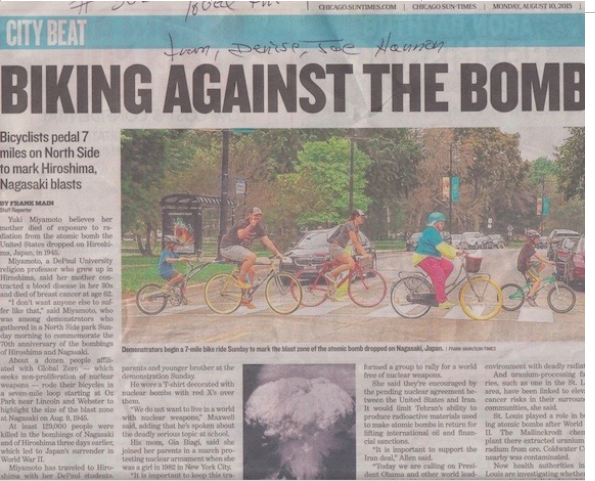
The photo shows 2 athletic young men, 2 children and me, a plump old lady, pedaling east across Stockton Drive, a tree-lined street that sidewinds Chicago’s Lincoln Park Zoo.

The photo appeared in the City Beat section of the Chicago Tribune August 10, 2015 with the headline, “Biking Against the Bomb.” The caption reads “Demonstrators begin a 7-mile bike ride Sunday to mark the blast zone of the atomic bomb dropped on Nagasaki, Japan.”  My bike has a big yellow front tire, a black whitewall rear tire and red basket. I’m sporting neon pink ankle-length trousers, lime-green sneakers, and a “Bike Around the Bomb” extra-large short-sleeve turquoise t-shirt snugly over my long-sleeve lemon shirt. The t-shirt just happens to be the same color as my helmet and eyeglasses. My bike posture befits a 69-year old short grandmother with bulging thighs and donut midriff.

I stand out in the photo.

You see my hands gripping the handlebars of my beloved town bike. What you don’t see is God caressing those hands with high-fives. The day this photo was taken, that bicycle grace relieved me of the physical pain of moral certitude.

When I was in my 50’s, I worked in downtown Chicago overlooking the Daley Center. Every month a group of bicyclists, Critical Mass, gather in the plaza before their raucous ride through city streets. How I longed to join them! But I’d been derailed from lifelong bike-riding by fibromyalgia. After I retired I downshifted into wheelchair-bound despondency.

Suicidal thoughts took me to the velodrome of alternative therapies. Round and round I went to anyone, anything that might relieve my suffering mind-body. Eventually meditation led to feldenkrais, writing therapy, pain relief, and a bicycle.

I’ve marched in peace demonstrations since the 1960’s so “Biking Against the Bomb” was the perfect foray into group cycling since I regained mobility. Educated by nuns, I learned about peace huddled under my 1st-grade desk hiding from a possible atomic bomb. Pray for peace. God required peace by every means possible.

President Truman had written his own moral code a year before I was born. In August, 1945 he murdered 180,000 Japanese civilians with atomic bombs. An unnamed fear took root in my fetal shroud and sprouted in the dappled shade of A-bomb-talk throughout my youth. This genetic consequence chained me to the spokes of peace activism.

At my meditation group I tried to describe my day of bicycle grace but spiritual gobbledegook fell out of my mouth and I self-consciously coasted to the end of my sharing with, ”I think I could ride with Critical Mass now.”

Group-think chattered: “Oh no. Not them. Scofflaws. Sail through stop signs. Wheel around pedestrians. Weave in and out of traffic. Lawless.”

I said, “But they have a police escort.”

“Yeah. Unruly fringe group. Take over the street and piss off drivers.”

I went home, opened my computer, defaulted to moral certitude and clicked “going” on the next Critical Mass event listed on FaceBook.Biking