Writing the Body with Beth Finke

Last Friday night author Beth Finke and I participated in an event called “Body Language—Reading and Discussions about Writing the Body.”The event was held at Access Living, a non-profit advocacy organization in Chicago that delivers programs and services to people with disabilities.

As a writer in one of Beth’s memoir-writing classes, I’m included in her latest book, Writing Out Loud. The book tells Beth’s story about teaching memoir to older adults, and I gladly accepted the invitation to get on stage with Beth and interview her about her writing and teaching. After introductions, I asked some of the obvious questions most people want to know:

  • What was it like to get fired from your job when you lost your sight?
  • How did you get started leading memoir-writing classes?

The shocker came when I asked, “What other jobs have you had since going blind?” Beth answered by “reading” a passage from her book about auditioning to pose in the nude for an art class. She pulled out a phone-size gadget with her passage teed up, put in earplugs and flipped the switch that talked the words in her ear as she perfectly mouthed these words out loud to the audience:

My robe was still on when I backed up to the table and hitched myself up. Crouching down, I felt the tabletop’s edges to be sure I wouldn’t fall off, then stood up and unbuttoned my robe.

I’d been told to strike six poses, eventually ending up in a reclining position. Had I been able to see that first model do her audition, I might have had a better idea of what was expected. I was suddenly so concerned with coming up with six different poses that I forgot I was naked.

I posed.

The department must have been pretty desperate for models, especially ones middle-aged or older and willing to work mornings. Most models are students who liked sleeping in.

I passed the audition.

Access Living is a leading force in the national disability advocacy community. The audience included people from their extensive list of volunteers, clients, personal assistants, board members and friends. Executive Vice President Jim Charlton even brought students from his classes at the University of Illinois Institute on Disability and Human Development.

Next up after Beth’s interview was a reading from artist Riva Lehrer’s upcoming memoir, Golem Girl. Riva read a riveting account from her magnificently written manuscript about growing up at the Condon School for Crippled Children in Cincinnati. A slide show moved from photo to photo behind her as she read. It showed lovely old black and white yearbook pictures of the school, the students and the teachers.

Riva works at Access Living, is an adjunct professor in Medical Humanities at Northwestern University, and was born with spina bifida. Her paintings focus on physical and cultural representations of hers and others disabilities. Golem Girl will be published by Penguin/Random House next year.

The most startling part of the evening came as questions from the audience started flying. An audience member said she’d read Beth’s book Writing Out Loud and asked if she was writing another. Jessica said she writes, too and asked if Beth ever would start a class for younger people near where she lives, in Skokie. Then, Kapow! Someone asked Riva how she was able to accomplish so much after being ridiculed relentlessly as a child because of her disability.

“I’ve been called crip, gimp, freak, retard, midget, you-name-it,” she acknowledged. “In the Condon school, because we all had something, I felt safe, not so different. Outside of school I was always scared.”

She said that when she first started working alongside so many other people with disabilities at Access Living, she felt safe at work like she always had at school. “I was afraid to go out the door at the end of the workday.” She credited Susan Nussbaum, her friend and colleague at Access Living, for helping her navigate the outside world. “You just have to rely on others.”

fullsizeoutput_3e71
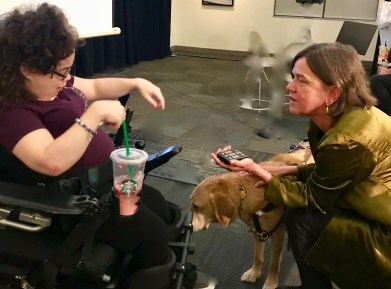
Jessica, Beth Finke and Whitney

Afterwards I walked around the room to chit-chat. When I returned to Beth she was leaning into Jessica showing her how to work the reading gadget so Jessica, who uses a wheelchair and has limited sight, could read her own stories out loud to her own audience.

Just before we left, Beth’s guide dog, Whitney, uncharacteristically stood up and lifted her head high enough for Jessica to pet her.


1968 Democratic Convention, or How I Became an Alcoholic

1968 Democratic Convention, or How I Became an Alcoholic


When my first husband, labeled Madman Murphy by his Princeton colleagues, came to the end of his Sociology degree in 1968, the campus uncharacteristically fire-cracked with small anti-war rallies, civil rights demonstrations and teach-ins on avoiding the draft. I spent all my free time campaigning for the Democratic Presidential peace candidate, Minnesota Senator Eugene McCarthy, in nearby Trenton with our toddler Joe hanging in an Army surplus knapsack on my back. Campus memorial services for Martin Luther King, Jr. ignited nascent embers in the Ivy League gentleman conscience. Bobby Kennedy’s funeral train passed by Princeton Junction on the weekend Madman Murphy graduated. We partied through the summer at the Jersey Shore. Murphy lifeguarded, Baby Joe and I frolicked on the beach, and we delighted in the safety of the light of day.

At night Murphy and I took turns babysitting and joining friends at our favorite watering holes. I started smoking pot and argued with everyone over the Viet Nam war. Jersey Shore barflies had nothing on me, after all, I’d been schooled by Princeton peace activists and Ramparts Magazine.

President Lyndon Johnson did not seek reelection. After Bobby Kennedy’s assassination in June, Eugene McCarthy, the intellectual standard-bearer of peace and justice, was left to shepherd the world toward a Democratic victory in his frenzied campaign for President.

In the summer, I tutored a young cousin in elementary arithmetic and sentence structure. I used my cash to buy stationery and postage stamps and took to writing letters to Bobby Kennedy delegates asking them to vote for McCarthy at the Democratic Convention in Chicago that August. I’d pontificate daily to friends and strangers on the beach and in the bars to test out new reasons to support McCarthy over the late-arriving establishment candidate Senator Hubert Humphrey. I fully expected my work to pay off at the Convention and longed to be at the youth festival planned in my hometown to celebrate McCarthy’s victory.

By the time I joined friends at a neighborhood Jersey Shore saloon to watch the Convention on TV, news accounts of the protests and riots were interrupting coverage of the political speeches inside the Convention Hall. But that didn’t matter to me. Soon all would be well. McCarthy would clinch the nomination and beat Richard Nixon in November. No doubt about it.

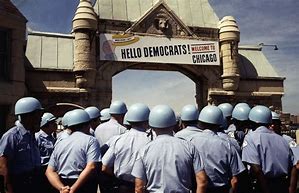
The unthinkable startled me out of innocent political bliss. The TV flashed back and forth between white men bullying peace delegates inside and police beating peace activists outside. Mayor Richard J. Daley ordered the police to shoot to kill. People who looked like me were dripping in blood.

th-6
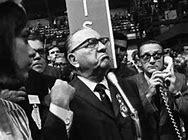
Chicago Mayor Richard J. Daley at 1968 Democratic National Convention

What was happening? Eighty percent of primary voters were anti-war. We won the battle and I was sure we’d beaten back the war machine. The delegates rejected McCarthy and his peace plank, nominated Hubert Humphrey and iced out Democratic activists. 

And me? I added martinis, LSD, mescaline, speed, librium and cocaine to my diet. I could see no future. By the time the next presidential election rolled around in 1972, AA meetings monopolized my time and I did nothing but slap a George McGovern for President bumper sticker on my VW.

Father Hungry

Father Hungry
71_big
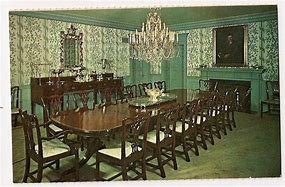
Arkansas Governor’s Mansion

The week before Thanksgiving, 1991, I called my father from Little Rock to tell him Governor Clinton had told all campaign staff to go visit their families. 

“He said we’ll be busy and out of touch from December until the end of the primary season,” I said, letting my father know I’d be back in Chicago on Thursday. 

“What are your plans for Thanksgiving?”

I was so caught up in the excitement of my co-workers’ plans to visit their families that I’d forgotten my father never made plans to celebrate holidays. Nor birthdays. Nor graduations. Nor milestones of any kind.

“Dorothy doesn’t want you joining us for Thanksgiving,” my father told me over the phone.

I can’t remember whether they were married yet or whether Dorothy was still just another one of the girlfriends. I had no particular ax to grind with her outside of her unnerving naiveté. She actually believed my father was going to provide a secure home for her and her son. When she showed me her engagement ring the previous summer and asked why I didn’t jump for joy that they were to be married, I thoughtlessly answered, “You’re kidding, right?” 

Like she knew what I knew.

Furious, alone and full of self-pity, I abandoned the trip to my home town and settled into catching up on the never-ending details of planning events, logistics, contingencies and recruiting new advance people for my candidate. When asked, I’d feign, “I’m spending Thanksgiving in Chicago with my father.”

The hunger to be normal is one of my fatal flaws.

But Governor Clinton was on to me. Late that Wednesday evening he called out of the blue and invited me to “come on over to the house” for Thanksgiving.

I drove into the guest parking lot at the Arkansas Governor’s Mansion about 3:00 pm and recognized cars that belonged to staffers from the Governor’s office as well as the campaign. Bill answered the door, introduced me all around and took me into the kitchen to meet the chef.

He bragged that Clarence was the best cook in Arkansas, that he was once on death row for murder but that shouldn’t scare me because he’d pardoned him.

“Thas right. Thas right,” said Clarence.

People who study psychology say if a girl grows up craving attention from her father she will gorge herself on various substitutes to satisfy the longing. I certainly proved that theory while stuffing myself at the Clintons’ dinner table that Thanksgiving. The Governor kept telling Clarence to bring out more food. He insisted we all eat up, and my self-consciousness around overeating in public disappeared into 2nd and 3rd helpings.

After dinner Governor Clinton had us all go “out back” to play touch football. I sat on the sidelines with Hillary and others. The First Lady laughed and joked with us about the goofy footballers and told funny stories about Clinton’s well-reported inept sports activities.

On the way back to my apartment, I stopped by the campaign office to type some final touches into Clinton’s schedule for the next week in New Hampshire. Alone, but no longer angry, lonely or hungry, I paused, called my father and wished him a Happy Thanksgiving.

Hooligans in the Temple

Hooligans in the Temple

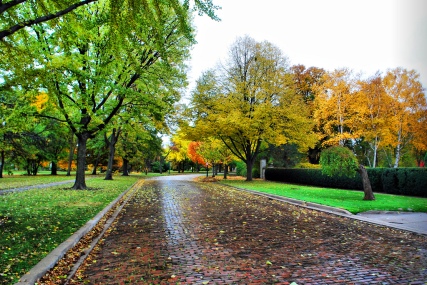
Standing in the driveway at 1000 Michigan Avenue in Wilmette, where we had lived for about a month, I posed with my tennis racket and ball while Erin snapped my picture with our family’s 1958 Kodak Brownie 127. We were playing in front of the garage doors on the west side of the house, an architectural oddity built into the side of the cliff overlooking Lake Michigan. The sun overhead lobbed burning sunbeams at my squinty-eyed face. Over my shoulder drooping into the curvy flagstone stairway leading down to our front door an overgrown lilac tree emitted a deep purple mid-June fragrance I’ve never forgotten. A robin strung together a complex trill from the upper branches of the evergreens that hugged the short driveway. My mother, not a naturalist in any sense of the word, somehow knew to teach Erin and me to recognize a robin’s song and the scent of lilacs.

We threw our rackets into our bike baskets, squeezed balls into the pockets of our Bermuda shorts and pedaled down red-bricked Michigan Avenue to our tennis lessons at

4035095366_c65a5df4af_b
Red Brick Road Michigan Avenue Wilmette

Gillson Park. Erin, a year younger, always aced her lessons and I always muddled through mine. We were both athletic enough but Erin outdid me in tennis. I was proud of her, and jealous.

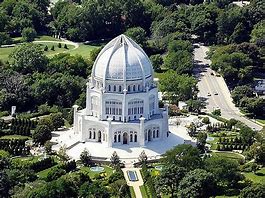
Before heading home we rode over to Sheridan Road to the Bahia Temple. It had been open only a few years but neighborhood rumors said the big white Temple would soon be closed to the public. We laid our bikes in the greenish-blue lawn, climbed the white stairs and nonchalantly strolled around the outside. All the white doors were open but we saw no one. The stillness unnerved us. Holy. No chairs or pews sat in the white circular sanctuary. We pulled away from the white marble floor and creeped up three flights of white stairs to the white balcony. We peeked into the hush of the white holy. It was a long way down. I held a tennis ball over the white railing and looked at Erin. Her wide open face said,”let it go.” The ball fell into the white center of the sacred white floor. We froze. No one appeared. Then Erin dropped her tennis ball over the balcony. We crouched down and listened for the echoing plunk-a-plunk, then tore down the stairs and out to our bikes without looking back.

Halfway home we laughed so hard we fell into the thick grass by the side of the road. We got up and pedaled as fast as we could looking over our shoulders all the way home. We stashed our bikes in the garage as if they were evidence, and kept the secret between us until school started in the fall. Feeling invincible, we bragged about the tennis balls in the Temple to our classmates. Our crime, never exposed to adults-in-charge, fell into my ever-increasing life-bucket labeled “what I got away with.”


Prostitutes and Protein: My Father’s Anti-Social Diet

Prostitutes and Protein: My Father’s Anti-Social Diet

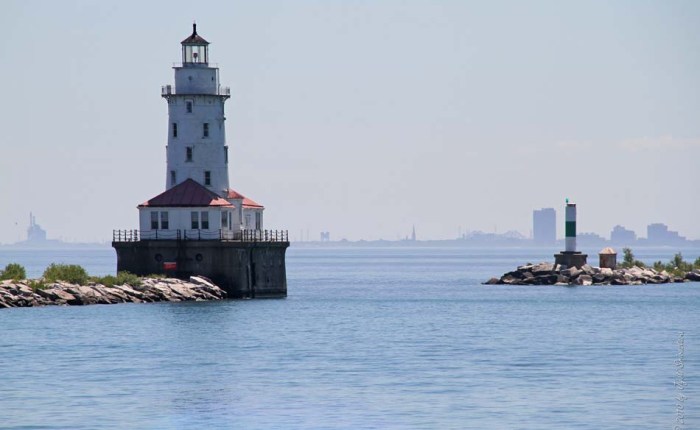
From Lake Point Tower’s third floor 3-acre resident-only garden, I peered through my binoculars out past Navy Pier to the Harbor Lighthouse by the locks at the mouth of the Chicago River. My father’s latest girlfriend pitter-pattered up beside me in her high-heeled sandals and gossamer brown bikini and said, “I fucked someone out there once.” My father, clad in Gucci swimming trunks, was striking a favorite yoga pose—standing th-4on his head within sight of all the bathers and sun worshipers around the pool. I sensed, in that instant, that this, my favorite spot in all Chicago, would be tainted for the rest of my life.

He prided himself on choosing a reformed prostitute matriculating at the University of Chicago to move in with him. We were both around 33 and I was celebrating the yearly anniversary of my last drink at AA meetings. She celebrated her reformation announcing milestones like,“It’s been 90 days since my last trick.” They had a few things in common including their food intake which they discussed constantly. Avid devotees of the Dr. Atkins Diet, they packed their 57th floor fridge with a lot of white protein—cottage cheese, plain yogurt, eggs, chicken and tuna salad and sugar-free Vernor’s ginger ale. They disdained calorie counting (though she kept a chart) and instead tracked protein grams and carbohydrates.

In the early 1980’s Dr. Atkins’ high-protein low-carbohydrate diet bubbled up everywhere in Alcoholics Anonymous. My father cornered newcomers and hammered a Dr. Atkins wedge into their soggy brains as he handed over his phone number and said, “Call me anytime.” Whenever he saw someone at an AA meeting holding a donut he’d explain that a no-sugar low-carb diet keeps the blood sugar regulated and in turn, reduces the craving for alcohol. Beginners were known to eat all-protein tuna fish right out of the can to follow his dictates.

The grocery store on the second floor had a deli counter with a superior version of my favorite food, cole slaw. After the day on the terrace, I purchased a pint each of cole slaw and tuna fish salad, rode up to their apartment and faced the former prostitute in the kitchen.

“Don’t let your father see you eating that cole slaw. It’s loaded with carbs.”

I’m pretty sure I knew cole slaw was not loaded with carbs, but she scared me so much I hid the offensive food in the closet until I left for home.

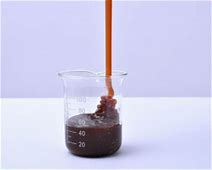
The kitchen counter groaned with the makings for a maniacal high protein drink. The bartender-grade electric mixer stood over pricey containers from Sherwyn’s Health Foods. Powdered desiccated liver, brewer’s yeast, magnesium, Vitamin C and flax seed were carefully measured and poured into the glass jar with liquid amino acids,

th-1
Liquid Lecithin

sunflower oil and liquid lecithin, a brown substance that could lubricate a car. The concoction reached digestive jubilation when blended together with ice cubes and water.

She, like those before and after her, looted the towels when she split, but left the kitchen counter intact. He binged on coffee Haagen-Das for a few days before resuming his sociopathic eating habits.

Impressionists Impression

Impressionists Impression

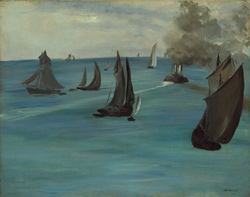
Kicking up the milky stairs we head to the second floor, Gallery 201, 19th Century French Impressionists. We shimmy and shiver onto the planked floor, shh! Into high ceilings we rendezvous with my Impressionists. I show them off to you as if they are my own. Here’s the Renoir fruit bowl and there’s Manet’s train station. Oh! and the Degas dancers and Monet’s gardens.

81535
Édouard Manet
French, 1832-1883
Steamboat Leaving Boulogne, 1864

You stagger at what to look at next, having studied but never seen the flabbergast of beauty before you. I suck in my cheeks in a quiet whistle to the tune of the hush in the gallery, swaying with silent vibrations.

And I whisper to you, “These are real.”

Christmas Stress Test 2017

I floated out of Northwestern Medicine’s Echo Lab, Stress Bay 3, onto the evening sidewalk four days before Christmas. All Chicago was scampering out of work, race-walking to the bus, flocking into Gino’s East and hurrying over to Michigan Avenue for holiday bargains.

Months earlier I’d run out of breath one block into my morning walk. My mind decided since I’d been overweight my entire adult life at seventy-one years old I probably had a deadly heart problem. The doctor ordered a stress test. Before I made the appointment I tried to heal myself with a no-salt, no-sugar, no-carb diet. The condition persisted. Then I thought God might heal me—if only I could remember to ask Him once in a while. In 110x70_what_causes_heart_palpitations_slideshowStress Bay 3, injections shot my heart rate sky high, my breathing stretched to its outer limits, then it all parachuted back down. The whole test took ten minutes. I figured if I didn’t have a heart attack after that, God had absolved me of my lifelong mashed potatoes intake.

Flying high down Superior Street toward the twinkling Magnificent Mile, I came upon a two-foot long sprig of red eucalyptus looking up from the sidewalk.

“Hmm, this would be good to put in the vase I just bought for Bill.” I scooped up the sprig and poked it down through the tissue paper in my Crate and Barrel shopping bag. Rounding the corner at Nieman Marcus I spotted more red eucalyptus sticking out of the cement urns in front of the store.

“Oh, good, I’ll just lift another bunch.”IMG_0504 (1)

And there it was. Ancestral habits. Within a block I’d turned from a scavenger to a thief.

Ripping down the street toward the Water Tower it occurred to me there may be some more items for Bill’s vase outside the stores on Rush Street. I found perfect branches of red plastic berries in the four planters on Quigley Seminary’s sidewalk. I took one from each pot. Lovely.

As I came up to Oak and Rush, I stopped myself from stealing birch branches from Barney’s pots because Oak Street Bank across the street recorded activity outside. I’ve binged on enough English crime shows on Netflix to know I didn’t want to get caught on the bank’s video.

And so within five blocks of finding out my heart is not going to kill me anytime soon, I became an all-out criminal.

The next day at coffee, I spilled the beans to a normal friend. He diminished the crime saying they throw all those decorations away after Christmas anyway—trying to let me off the hook or perhaps saving himself from admitting his friend is a thief. I shared my thievery at a 12-step meeting. We all laughed as we often do whenever someone is vulnerable enough about their character flaws to tell on themselves—no letting me off the hook in that room, where God allows for admitted imperfections.

Journey to Paradise

JFK was still alive the September I drove with my father in his white Cadillac Eldorado down the pike from our temporary home in Washington, DC to boarding school in Williamsburg, Virginia. My head overflowed with questions. Will they have a television? What will I do after school? How will I wash my clothes? I dared not ask my father for fear he’d mock my questioning of such mundane matters. In his silence I could hear him say, “They’re nuns. They take care of people. Stop worrying.” I wasn’t worrying, just wondering. In spoken language between us, different words seemed to have the same meaning—wonder and worry, driving and speeding, drinking and drunk.

Unfamiliar signs became our talking points.

“Look there’s Fredericksburg. Did something historic happen there?”

He told me it’s a Civil War town. 10,000 slaves ran away from the plantations there and joined the Union Army.

Slaves? I had never been in a place where slaves had lived. Monticello. Is that Jefferson’s home?

I’m not sure how much I knew of Civil War history or American history as I was entering my junior year in high school, but clearly the road signs along the highways in Virginia had awakened some schooling. Petersburg and Appomattox. My premature view of life misinformed me that places I read about in history books, like these, no longer existed.

Until then, I had lived my whole life at sea level—the flatlands at northeastern Illinois’ Lake Michigan and the New Jersey seashore. The Virginia road climbed up and down between wavelengths of blue and green, tree-lined hills with wide verdant medians. My mother used to call me a nature-lover. I guess she was right. The scenery captivated me, as if we were driving through the Garden of Eden. I imagined Paradise at the end of our journey.

“What’s the Blue Ridge Parkway?”

My father loved to drive and he’d already been on Skyline Drive, the main road through Shenandoah National Park on the Blue Ridge Parkway. Our route to Williamsburg didn’t bring us near there. Thirty years later, remembering my father’s description of the misty Blue Ridge Mountains and the hills rolling down to the Shanandoah River, I drove there myself.

At Richmond we turned southeast toward the Norfolk Naval Base, Hampton Roads and Williamsburg. I was leaving no one behind. My mother, sisters, cousins and friends lived in another place, another time with their wild summers and grey winters. A vagabond life brought me to live at Walsingham Academy run by the Sisters of Mercy, the school that housed girls from mothers who didn’t mother and fathers who didn’t father—girls who had ulcers and girls who dyed their hair.

We turned onto Jamestown Road toward my new assignment. Fear tightened my grip on reality. Had he told the Mother Superior I had mononucleosis? Got drunk? Swore? Didn’t believe in God? Had an ectopic pregnancy? Did he even know I was tired all the time, and lost? I feared and I hoped they’d care for my soul.

When James Carville Tried to Save Me


James Carville called in early March 1992.

“This is not your fault,” he said in that red-hot Cajun voice of his, ”I take full responsibility.”

I knew right then that the campaign advisors on the road with Bill Clinton were blaming me.

A few days earlier, Carville, chief strategist for the campaign, had directed me to schedule Clinton at a correctional facility in Georgia reasoning that a picture of Clinton strolling with black inmates and Georgia’s all-white male politicians would cinch Clinton’s appeal to the state’s voters.

It did.th

Clinton won the Georgia primary, but not without a price. The national press and the other candidates excoriated Clinton for his racial insensitivity. Jerry Brown said Clinton and the other politicians looked “like colonial masters” trying to tell white voters “Don’t worry, we’ll keep them in their place.”

And that was all my fault.

Five months earlier I’d been asked to give up my job in Chicago and relocate to Little Rock to be Clinton’s Director of Scheduling and Advance.  “You already know this, Regan,” Campaign Manager David Wilhelm reminded me, “the scheduler in any campaign has the worst job.”

It’s true. The person who plans the candidate’s calendar has an enviable yet risky position. An unplanned photo with an unscrupulous politician? Protesters blocking the entrance to an event? A rained out rally? It’s all the scheduler’s fault.

Campaign operations temporarily moved from Little Rock to the Palmer House in Chicago just before the Illinois-Michigan primaries in 1992. The extensive Chicago staff in Little Rock wanted to celebrate Clinton’s St. Patrick’s Day victories that would clinch

th-2
March 17, 1992 Palmer House Chicago

the nomination.

An old friend of mine, a Chicago policeman, volunteered to be Clinton’s driver. He called me around 2:00 am the morning before the Primary.

“Regan, that Greek guy, George, and Bruce someone were in the car telling Clinton you have to go.”

“What?”

“Yep. But Clinton said he wants to be sure you have another high-level job in the campaign.”

“Really?”

“Yeah! Dees guys are strategists? Der talkin’ ‘bout firin’ you in your hometown — and your buddy drivin’?”

We howled at the strategic error.

I was offered a job that was already filled. Wilhelm shrugged when I asked if I was fired. The New York Times reported I’d been replaced by Bruce’s wife.

I took a trip to the Bahamas, became achingly lonely and came home early. Herb and Vivienne Sirott got me into a rental apartment across the hall from them.  Cook County Clerk David Orr hired me as Deputy Director of Elections. We worked hard that year to pass the National Motor Voter Act. A young community organizer, Barack Obama, walked into my office to plan a large-scale voter registration project.

Things looked good from the outside, but inside ego-busting despair maintained constant watch over my soul. Depression, sick leave, isolation, shame, all led to suicidal thoughts. Vivienne brought a psychiatrist to my apartment. That’s when I started Prozac, my first legal anti-depressant.


Ghosts of Navy Pier

My son Joe and I bought sneaker roller skates from a typical Chicago hustler at the Dearborn Garden Walk street festival in early summer 1977. They were a novelty—yellow canvas shoes attached to shock-absorbent, sound-proof neoprene wheels. We lived in nearby Sandburg Village and skated home that day carrying our shoes.

IMG_0170
Joe Kelly, 10, on Roller Skates

The rest of the summer and into the fall, after school and work and on weekends, we’d skate around the Near North side and downtown Chicago, charting the smoothest sidewalks, the longest ride, uphill climbs and downhill coasts.

One October day we skated over to Lake Michigan’s Navy Pier. Built in 1916, Navy Pier has been used as a cargo hub, a military base, college campus, convention center, recreation center and wedding pavilion. Before its retrofit, the watery concrete jetty hosted Chicago Fest and the International Art Expo. That day in 1977 when Joe and I were skating around, the deserted mile-long slab of steely smelling cement shouldered two low-slung cargo sheds divided down the middle by a midway for tractor trailers. A few joggers who’d parked their cars in the lot in front of the pier were trotting out and back along the sun-drenched lake side, a perfect 2-mile run.

We chose the leeward route, the interior midway, because we noticed half-opened doors to the cargo sheds, though no workers were in sight.

“Let’s go look inside.” I said to Joe.

Gregarious ring-billed gulls hawked insects on the wing overhead. Otherwise, the place

IMG_0171
Joe Kelly, 11, on Skateboard

was noiseless. We skated off to a half-opened articulated overhead door, bent under and slid through. Our squinty eyes adjusted to the shadowy warehouse. Row after row of two-story high floats showcased Dumbo, clowns popping out of train cars, horses hanging over barn doors, dragons, Charlie Brown and Lucy, castles and fairies, Santa’s sleigh and reindeers and Old Mother Hubbard’s shoe with her big-headed children clinging to the side.

“Whoa-ho!” said Joe, “this is where they store the parade floats!”

We skated under dragon’s fire and around angels’ wings farther and farther into the semi-dark. It was the year of Star Wars and Close Encounters of the Third Kind, movies that put head-trip phantasms in our everyday journeys. The bang of an unseen door slamming shut whooshed life into the moribund creatures. The two of us tacked on our skates and sailed back through the outsized flatbeds into the light to shake off the spirits of our fright.

I once heard the old parade floats got dumped into the defunct Riverview Amusement Park, and I hope that’s true. It’d be a perfect graveyard for the ghouls on parade.

Joe took up skateboarding the next spring when he was 11 and rolled around his own
Chicago with his friends. I dumped my skates for a bicycle and I often pedal around the modernized Navy Pier. Every once in a while I get spooked by a mysterious whop. I shake myself real: those clowns popping out of that train car are not coming for me.