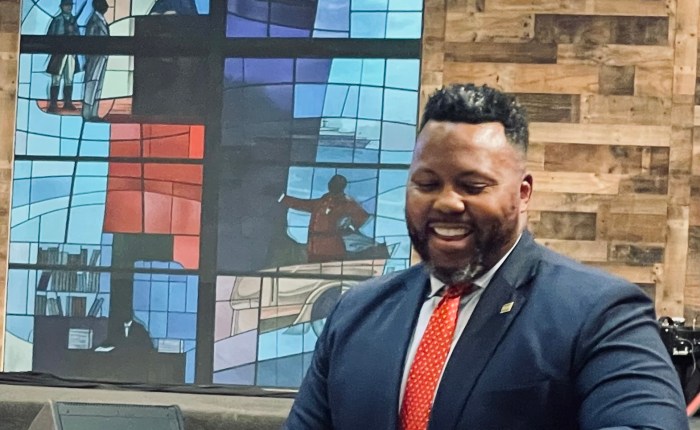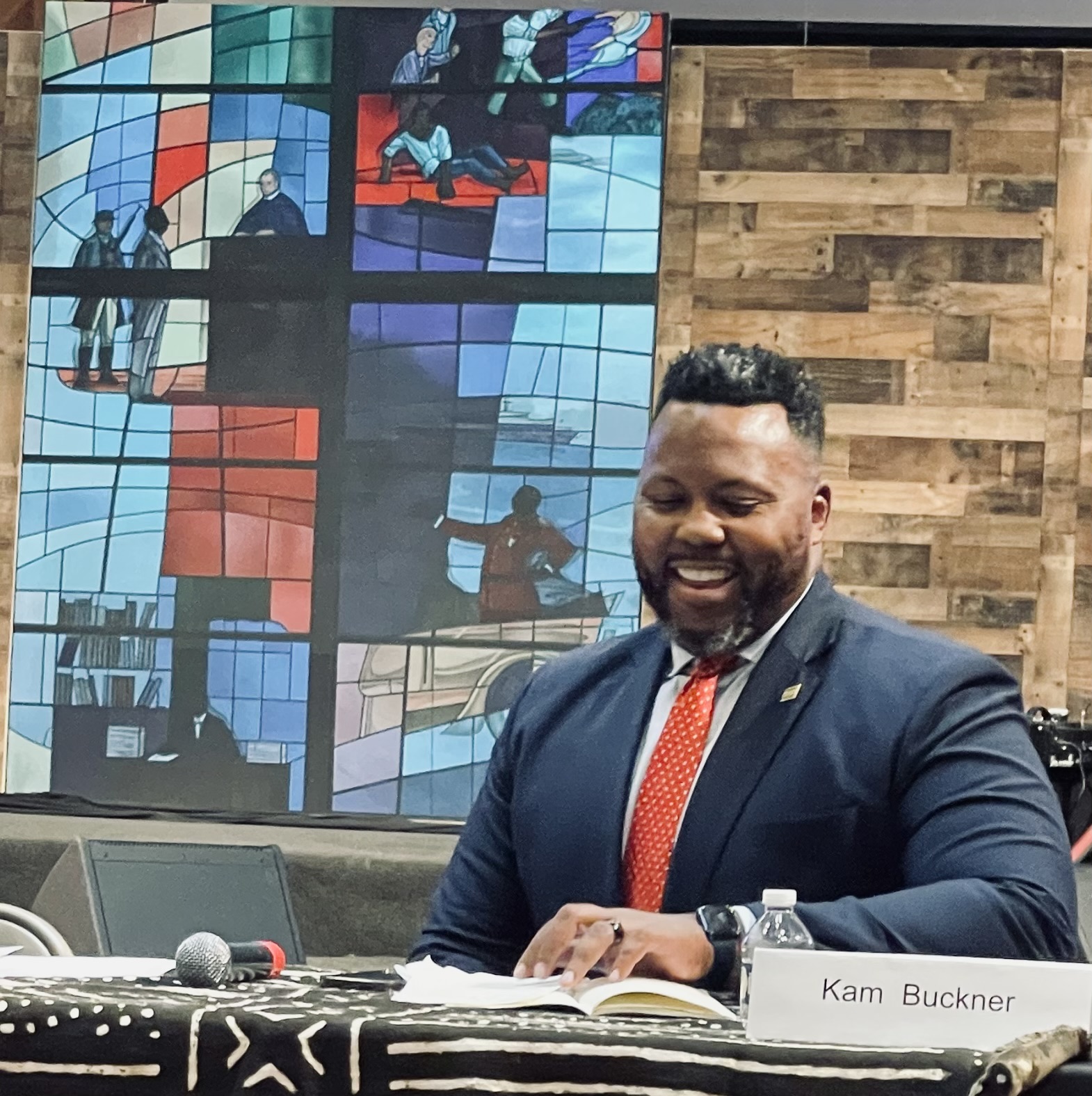
In early 2019 Skyline Village Chicago invited newly minted state representative Kam Buckner to meet his north side constituents at their monthly luncheon. Buckner blew in twenty minutes late, having raced from the state capitol in downstate Springfield. He flashed an enormous smile, introduced himself, then launched into a captivating and detailed description of budget negotiations with legislative leaders. We felt like we were insiders.
He’d been in office for two months.
A political impasse had left Illinois with no state budget for most of the three years leading up to 2019. Many services had been cut, and the stalemate adversely affected Illinois’ economy and credit rating. Reports of the multi-faceted budget process sounded politically intricate. A person next to me at the luncheon whispered, “Isn’t he too new to be negotiating the budget?”
That’s my friend, Kam Buckner.
“I’ve wanted to be Mayor of Chicago since I was 12 years old. I’m a son of Chicago, I love this city, and I want to make it the best version of itself.”
He’s the thirty-seven year old lawyer, former big ten footballer running for mayor. He worked for Senator Durbin in Washington and Mayor Mitch Landrieu in New Orleans.
The Buckner family tree grew its branches out of Mississippi mud and grafted itself onto Chicago’s big shoulders during the Second Great Migration. The blues, born in Mississippi and raised in Chicago came up from the south with them. Chicago’s Staple Singers and Jennifer Hudson are Buckner cousins. At Kam’s inaugural party in Springfield, he hit the stage to belt out a full-throated “Two Dollar Blues” with the band.
The day I met Kam was also the day the Chicago Bears announced they might move the team to Arlington Park. I asked Buckner if the Bears were fishing for state money to stay in Chicago. “Of course,” he answered. “I’ve already spoken to the governor about legislation to prevent that.”
This is a guy who hits the ground running.
In 2019 I’d been part of a group at my church that studied education equity, which is so complicated we disbanded. The next thing I knew Kam Buckner passed a bill to ensure schools receive funding based on the need of the students, rather than evidence of achievement. That’s equity. He’s been in the trenches on criminal justice reform, known as the SAFTE-T Act and negotiated the celebrated energy bill which legislates zero carbon emission by 2045, a boon for climate change.
At the dedication of adult playground equipment in my neighborhood park, a friend mentioned to Kam that cities in China have similar equipment. “I lived in China for six months and saw it everywhere,” he said. “What? You lived in China?’
Activists for safe streets and public transportation are Buckner’s biggest supporters. He rides the trains. Takes notes. Talks to passengers. Has a plan.
At a Sunday afternoon mayoral forum the candidates were peppered with the usual questions on crime, education, housing. Afterwards, a long line waited for selfies and handshakes with Kam Buckner while the other candidates packed up to leave.
“He’d make a great mayor,” a stranger said, “but I’m not votin’ for him. I’m afraid he’s gonna lose.”
“A cynic is a man who, when he smells flowers, looks around for a coffin.” —H.L. Mencken
Whenever I’m asked where I’m from, I hesitate. It takes a moment to wrangle shame to the ground long enough to scare up the truest truth to tell. The aftereffect of my parents’ inability to halt their rodeo boozing long enough to pay the rent accounts for a long trail of midnight moves.
Annapolis, Maryland; three different homes in Washington DC, two in Terre Haute Indiana, a hotel in Indianapolis, two homes in St.Louis, a hotel in Chicago, homes in Kenilworth, Wilmette, and Lake Forest, Illinois, two cottages in Sea Girt, New Jersey, two New York apartments, a Williamsburg, Virginia boarding school and back to Sea Girt.
At that point, after fourteen or fifteen schools, with a lick and a promise, I barely graduated from Manasquan high school. I spent the last year drinking and smoking in the school parking lot with a posse of flirty no-goods. I dropped out of Monmouth College, married, had a baby, moved to Vermont, divorced, got addicted to loco weed, moved to Point Pleasant, New Jersey, married again, joined a cult, divorced again. When I was twenty-nine years old I moved with my son back to Chicago, where I’ve mostly lived for forty-seven years as a tenderfoot, sober alcoholic.
What do I say? I like to say I’m from the Midwest, like Bob Dylan, with God on my side.
Oh my name it ain’t nothin’
My age it means less
The country I come from
Is called the Midwest
My three sisters say they are from New Jersey as if it has all the romance of Bruce Springsteen’s Jersey Girl.
So don’t bother me cause I ain’t got no time
I’m on my way to see that girl of mine
Nothing else matters in this whole wide world
When you’re in love with a Jersey girl
There are a lot of cool people at the Jersey Shore. I had a stable of romantic encounters like Springsteen’s Jersey Girl—on the beach, in the backseat of Mustang convertibles, in public bathrooms of raucous bars. Jersey boys drink beer. Morning. Noon. And Night. Not me. I drank gin. They have mononucleosis and venereal diseases. They drive drunk and kill you with sarcasm. And still they seek the girl from the right neighborhood, the right school, and the right family. I’m lucky I made it out of there alive.
In the Midwest of my girlhood, I knocked on neighbors’ doors for a ride to school when I couldn’t wake up my mother or our car was out of gas. They helped me look for my missing dog, Lefty, in a snowstorm. When that rodeo was dusting up inside my home and danger was afoot, they taught me to hide in trees.
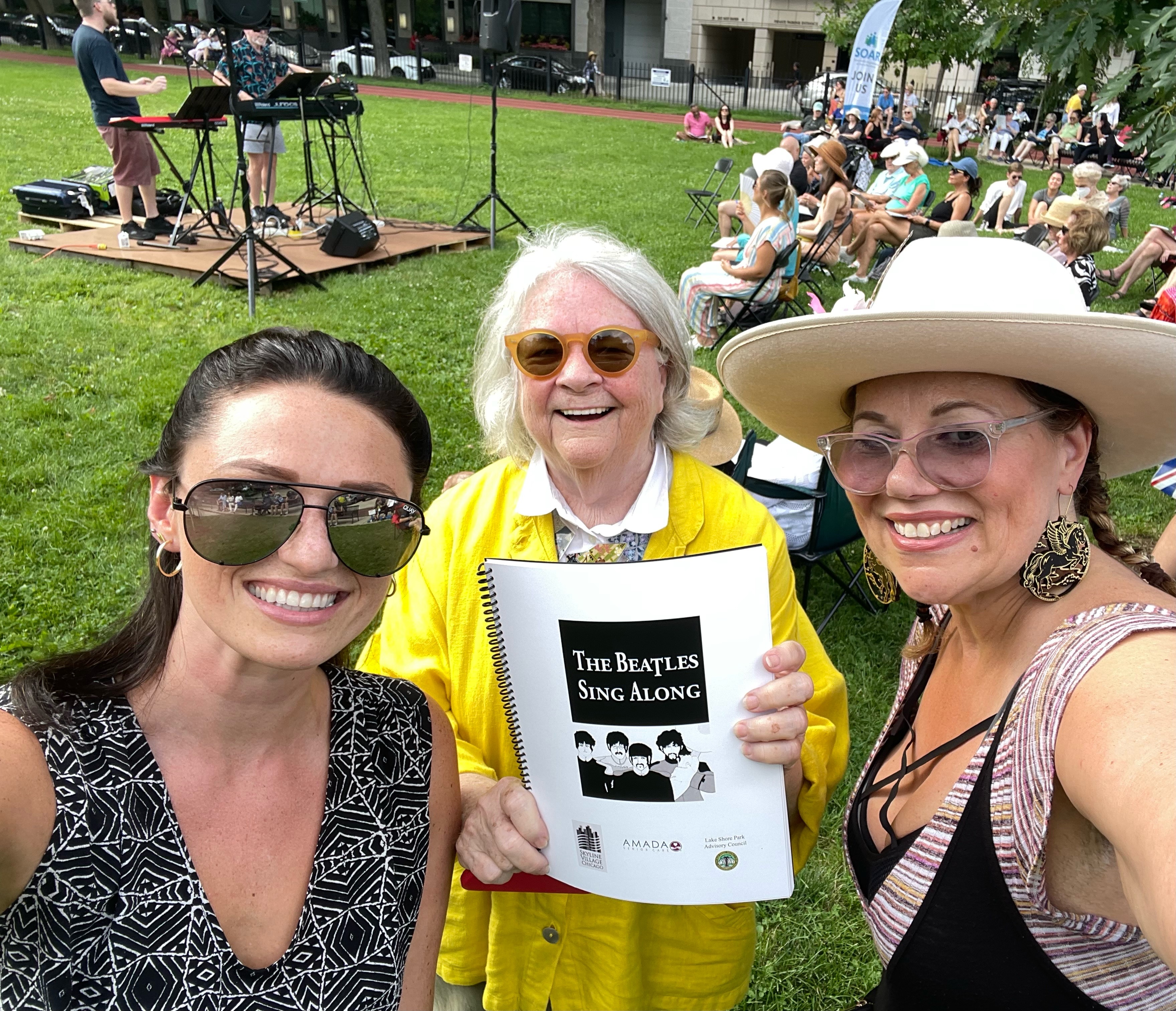
Midwestern fun: Beatles Sing Along
When I arrived back in Chicago to a corral of footloose midwestern strangers in the 1970s, I expected bound-for-glory hellos and found them. A friend from fifth grade I hadn’t seen in sixty-five years read my book recently and sent me a note: “you always belonged to us.”
My actual (as opposed to official) retirement began the day I walked into Fourth Presbyterian Church in Chicago and asked to volunteer for a few hours each weekday. I’d had a couple of rough years at my final payroller job and I thought volunteering would help lift me into a new way of thinking. Or, more precisely, I wanted a time-filler to keep from obsessing over the aftermath of the soul-crushing previous twenty-four months of my life.
Oh churches! There seem to be so many cries for help, until they try to find a job fit for you. I grabbed the first one offered and plunked myself down in front of a computer in the cubicle next to Vince, a friendly volunteer who was out of work but not yet retired. Our job: clean up the database.
The database. Every pensioner I’ve met since my stint who looked to the church to help fill the first year’s lonely unproductive hours says the same thing.
“I started with the database.”
Vince knew what he was doing and in fact devised a formula and matrix for our work. I suppose it was simple. If you could pay attention. I couldn’t. At the end of each of my four hour stints, he’d spot-check my work and stay an extra hour or more to correct everything I tried to accomplish. Vince had an advantage—he was good at the game Concentration. He could spot a misspelled name in seconds-flat with his highly industrious mind.
The room next to the dreaded cubicles had been cleared of all furniture. It may have been the size of a football field. For about a year, having been diagnosed with PTSD due to the aforementioned job, my perception of size, space and time was like science fiction, all out of whack.
One day, I heard an old Frankie Valli tune, “Sherry Baby” seeping under the door from that huge room. Of course I learned all the words—they’re pretty simple—as a teenager and never forgot them.
“What’s going on in there?” I asked Vince.
“Sher-er-ree, Sherr-ee, Baby… ”
“Oh, that’s the old people’s exercise class,” he said.
“Old people?”
“Yeah, ya’ know. CLL. The Center for Life and Learning.”
I didn’t, in fact, know. The church bulletin had notices about CLL but I never thought they were meant for me. Within the next few weeks, each day I grew grumpier and grumpier working on the database.
“Vince,” I said, “No offense, but I’d rather be in that room dancing around to “Sherry Baby” than sitting in front of a computer.”
“Aw, yes, Regan,” he said, “But would it be as rewarding?”
Rewarding. Now there’s a loaded word. Did I really need to feel rewarded for the hours between sunrise and sunset? How about satisfied? Couldn’t I just feel satisfied?
Or, neutral?
“Vince. I’m logging out today and joining the exercise group tomorrow.”
And that day, that neutral day, is the day I turned old.
In the past few years, whenever Ian would visit Chicago, he’d hole up in his hotel for hours working on some project for his job. I’d see him only at our favorite restaurants at mealtime. But this past Labor Day weekend, Ian came to Chicago freed from an old job, celebrating a new.
Our first night at a cherished outdoor restaurant was full of laughs about the ins and outs of “onboarding” the new job and the logistics of moving to Washington, where he hadn’t lived for twenty years. On Saturday afternoon I caught up with him in the lobby of his hotel. We walked a few blocks to the Art Institute for the last of the Bisa Butler exhibit next to the popular Impressionists gallery.
Early Saturday morning Ian had run a 5k in Chicago’s Beverly neighborhood. To get to the southwest side he’d taken the CTA train to 95th Street, then hopped a bus. Throughout our walk to and within the Art Institute, he reported his experiences on the Red Line.
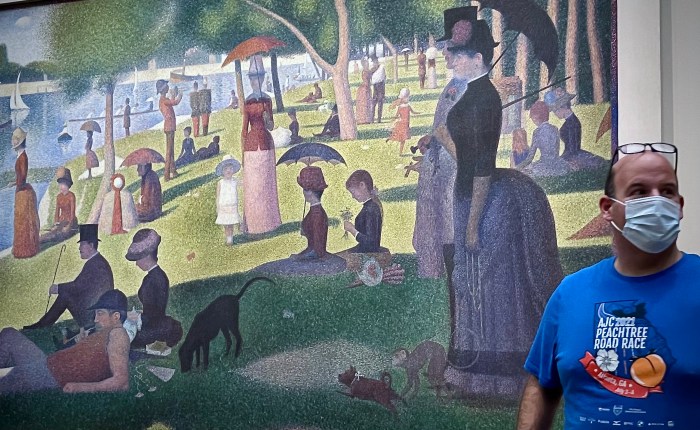
“Are people living on the Red Line?” he asked while studying Georges Seurat’s Sunday in the Park. He’d entered the train under Grand Avenue at 6:00 a.m. and had trouble finding a seat for all the passengers and their belongings. A woman in a work uniform demanded a scofflaw in the corner stop smoking. An argument broke out among all the passengers at that end. “Leave him alone! He deserves to have a smoke whenever he wants,” a burly agitator shouted.
“You have libertarians in Chicago?” Ian asked.
Visiting Paul Gauguin. Art Institute Chicago. Labor Day2021.
In the Paul Gaughin gallery, Ian elaborated on how, at every stop beginning at Roosevelt Road, a young hustler stood in the doorway with his arms stretched out to keep the doors from closing.
“Gimme money! I’m not letting the doors go til y’all gimme some money,” he yelled to no one in particular until an exasperated hostage would give in. After a few stops Ian fled that car and ran onto another. When he finally disembarked at 95th, a policeman asked him why he was on the Red Line. Like he should know better.
Ambling among Claude Monet’s Water Lilies, I heard why he’d moved from his Michigan Avenue hotel after his return from the morning 5K in Beverly. The hotel was trashy—meaning real trash. There were food containers and empty Starbucks cups all over the lobby. The trash bins were overflowing. No sign of the maintenance crew. Boisterous tourists and children occupied every available lobby seat.
By the time we reached Georgia O’Keefe’s Sky Above Clouds IV, I looked back at the packed galleries. I hadn’t been in a crowded indoor space since before the pandemic. Suddenly my throat closed and my legs wobbled.
“I gotta get outta here,” I half-whispered to Ian. We darted through the less-crowded Modern Wing, out to late-summer Monroe Street and tender-loving Lake Michigan.
Every day I look more like my father with one major exception. He was obsessed with his looks, particularly his weight.
His man at Gucci dressed him in snazzy Italian tweed, buckled loafers and the branded red, green and tan striped garters to hold his cashmere socks in place.
Every time he lost weight he’d preen before the store mirror as the tailor tucked a little in here, a little in there. He delighted in the Gucci salesmen fussing over him like clucking hens admiring their brood. When I accompanied him on these shopping trips, I wished for a fashion shield to surround my rainbow-colored, unstructured and untailored wardrobe. Funds from my part-time receptionist job required me to shop in Marshall Field’s “Last Chance” room.
An avid devotee of the Dr. Atkins’ low-carbohydrate diet, he packed his fifty-seventh-floor fridge with white protein—cottage cheese, plain yogurt, eggs, chicken, tuna salad—plus sugar-free Vernor’s ginger ale. He disdained calorie counting and instead tracked protein grams and carbohydrates.
His favorite topic of conversation was his diet. When I didn’t change the subject fast enough, my food intake brought on unwanted rhetorical questions. “What’s in that bowl?” He’d ask already knowing it was carb-forbidden spaghetti or ice cream.
The Atkins diet was all the rage in Alcoholics Anonymous. My father cornered newcomers and hammered a Dr. Atkins wedge into their soggy brains before jotting down his phone number and saying, “Call me anytime.” Whenever he saw someone at an AA meeting holding a donut, he’d explain that a no-sugar low-carb diet keeps the blood sugar regulated and, in turn, reduces the craving for alcohol. Beginners were known to eat all-protein tuna fish right out of the can, in accordance with his dictates.
The grocery store on the second floor of his building had a deli counter with a superior version of my favorite food, cole slaw. I once purchased a pint. He caught me at his kitchen counter about to take a forkful.
“You’re not going to eat those carbs here, are you?”
His kitchen counter was strewn with the maniacal makings of a high protein drink. Next to the bartender-grade electric mixer stood pricey containers from Sherwyn’s Health Foods: powdered desiccated liver, brewer’s yeast, magnesium, Vitamin C, flax seed, liquid amino acids, sunflower oil, and liquid lecithin, a brown goo that could lubricate a car. My kitchen had potato chips hidden in cabinets and Hershey bars squirreled away in the freezer.
For a few years in the 1980s I spent weekends at the three-acre garden on the third floor of his building, Lake Point Tower. I’d spend time peering through binoculars spotting gulls, hawks and bufflehead ducks at the confluence of the Chicago River and Lake Michigan. My father, clad only in Gucci swimming trunks, would strike a favorite yoga pose—standing on his head—within sight of all the bathers and sun worshipers around the nearby pool.
As much as he tried, he couldn’t escape hangdog jowls and double chins as he aged.
The coronavirus shutdown forces me to sit in silent contemplation, doing my best to control the one thing I think I can—my thoughts.
American buddhists say people in the West are afraid of solitude, of being alone. That’s not my fear. I fear the future.When the threat of coronavirus is over, will I ever leave home again? Will I ever chance gathering with friends or strangers in a group for a common purpose, a protest march, choir practice, church, AA meetings? Lunch even? How would I fit into the world with no connection outside of myself and Henry the dog?What would be my purpose? No wonder loneliness shortens life. It will kill you, this lack of purpose.
Hmm. Two fast-walkers below my window dressed head to toe in black spandex, masked like bandits.What are they talking about?Are they planning to rob the bank on the corner?Do they know the polar ice cap is melting and will soon spill over into Michigan Avenue? Perhaps they’re headed to Northwestern to get tested for coronavirus.I hope they bow to the angels fluttering around the Emergency Room.
Down the street gardeners dig up winter to plant spring by the goldfish pond. Those goldfish swam around that manmade pond the entire winter.
Out with winter. In with spring
Blackbirds jump from branch to branch on the budding leafless tress awaiting the gardeners’ departure.They swoop in for a scratch-around in the fresh mulch, but ignore the goldfish.They’re not fishers.
The backup whistle on the garbage truck that normally blends in with early morning noise?It now pierces the street from the otherwise empty alley.Cars are so infrequent these days that instead of tires rolling over the road with a steady hum, their sound breaks the air with a hiss. hiss. hiss. Where are they going?If I had a car I’d be driving around too.I’d drive up and down the Drive to be close to my own wild lake.The mayor closed the lake path and parks for good reason.Chicago loves to be out.We’d gather there, on the lakefront, congregate.Spread the virus.
Those words are my thoughts from five minutes of meditation. This is how I talk to myself. How embarrassing. My interior life is a tragic waste of imagination—that grammar, those articles, prepositions and pronouns. The mundane. Oh, to be a poet.
On Being’s Krista Tippett hosted Stephen Batchelor, a Tibetan Buddhist on Sunday morning. His new book, The Art of Solitude, made a fitting subject for the Shutdown era. He said indulging in myself leads to inward wisdom and outward compassion. The integration of the two make me fully human. I’m game to be fully human, to be wise and compassionate.
But for now, I must get control of my thoughts.
Alone on Oak Street Chicago 11:00 am April 27, 2020
Tyrone bragged that his friend brought a gun to school. In the six months I’d known him he’d told me a few tales, like he and his little brother went to Winter Wonderland at Navy Pier. He didn’t have a little brother, but I often held my confrontational tongue with him in an effort to give him space to be himself. I thought if I earned his trust, eventually he’d stop trying to beguile me with fanciful stories.
He was my seven year-old charge in a weekly volunteer tutoring program. During our first getting-to-know-you session we followed a Q & A script developed by the program administrators. We both had dogs. He had a baby sister. I had grandchildren. He went to a school on Chicago’s west side. I was not sure who mothered him. He mentioned an aunt and a grandmother. He proudly mentioned his father. He wasn’t explicit, and looked away in silence when I pressed for details, what does he do? I eased off to save him from having to think up a story. And really, I didn’t want to know.
The tutoring session consists of helping kids with their homework, creating art projects and playing board games. Tyrone didn’t need help with homework. I guided him while he wrote down answers to math problems and filled in words in sentences. He never got anything wrong, and I praised him for being so smart. I helped him put his homework neatly in his backpack. When I started to reach in and straighten other things in his backpack, he balked at that intrusion. He often hid a football or basketball in there and feared others would see. I surmised he was prohibited from bringing balls to school, and he thought they may be forbidden at tutoring as well. Maybe he was afraid for other reasons.
When I quizzed him about the details of the gun, he said he saw it in his friend’s backpack, that his friend found it in the backyard and that it had bullets in it. I asked if he told his teacher. “No! He’s my best friend!”

Research finds youth from risk-filled backgrounds who successfully transition to the adult world of employment and good citizenship have had the consistent presence of a caring adult. Tutoring programs give kids this opportunity. As a first-time tutor, I attended orientation where consistency and trust were emphasized.
I connected with Tyrone in summer camp. Some kids would point to volunteers and brag, “That’s my tutor!” Having no information about what a tutor is, Tyrone asked me to be his tutor. Yes, I committed to years-long care and support of Tyrone beginning that fall.
I doubted Tyrone’s tale about the gun, but gun-in-school carries weight. I couldn’t bear it alone. I consulted with a supervisor. She knew Tyrone’s caregiver.
“I’ll take care of it,” she said.
The next week he came to tutoring with his sidestep story: his friend brought gum to school. When next I arrived for duty, Tyrone was absent. I knew he’d not return. He dropped out of tutoring and so did I.
Was I right in reporting Tyrone’s story? I doubted myself for months. I switched my volunteering from one-on-one tutoring to leading groups of first graders in meditation. A supervisor caught me in the hall one evening and casually mentioned the gun was no tale.
Tyrone’s friend had walked into first grade with a loaded hand gun in his backpack.
Blood-curdling screams wake us in the middle of the seventy degree night. We call the doorman. We call 911. A lot of mother-fuckin’s shreik up the side of the building and yaw into our open windows. We look out, say, Oh, it’s Black people. Stay out of it. Next day in the laundry room we hear, A Black girl stabbed her boyfriend on our corner. On our corner? How do we know it was her boyfriend? What else would it be? Her pimp? We hear it. We repeat it. The pimp got stabbed on the corner.
We watch a crazy guy with no shoes keening mother-fuckers on the Magnificent Mile sidewalk frightening white shoppers. We say, Oh he’s that dirty Brown guy. He’s always around. He’ll find his way. We cross the street.
Before the sun drops behind the high rises on the west side we walk our dogs in the park. We notice a commotion in the bushes. We peek. Two Black men screwing. We run across the street and snitch to the Drake Hotel doorman, each of us bumbling over white words for the deed. Animals, the doorman says, Stay out of it. At the coffee shop we laugh about the out-of-town hotel guests looking out their windows at such a sight in broad daylight.
In the elevator we talk about the nice Black couple who moved into dead Mrs. Smith’s unit. We think they are so well-dressed, so articulate, not like other Black people. We wonder if they know the Black family in unit 2507. We think this. We say this.
The church asks us to fill out a Racial Equity Survey. Huh? We look at each other, look around at the hundreds gathered on Sunday morning. We see three Black people. No Black families. Do we see racial inequity in the church? How are we to answer?
We hear a Black preacher on inter-faith night. He talks about racism. Racism ended when we elected President Obama, right? We think this. We say this. To the Black preacher. We thought the Black preacher would talk about his faith journey, but he talked about his Black journey. We lose interest.
On President’s Day we trudge down the street in our Uggs slippin’ and slidin’ on the street in front of the white church. We help a woman who falls into the fretted wrought iron fence. We use our white cuss words. Damn it, why don’t they shovel the sidewalk? Oh, you know, their Black workers hate the cold. We think this. We say this. We repeat this.
We haul old white bones onto the bus with our canes and walkers and shopping bags. No seats. A Black woman in her Sheraton Hotel housekeeper uniform jumps out of her seat, yells at two fully-formed white dudes. Get your motherfuckin asses up. Don’t you have any respect for your elders?
And we are reminded. Black people take care of us. Have always taken care of us.
When the Vietnam war was over, there were no patriotic homecomings for returning veterans—no sympathetic bystanders thanking soldiers for their service. The American public shunned them. The same politicians who sent them to die for no good reason
denied their health care for post-traumatic stress and any cancerous effects of the US-deployed Agent Orange.
I’d been working on Adlai Stevenson’s campaign for Governor in June, 1986, when Chicago held a long overdue welcome home parade for her Vietnam War Veterans. One of Adlai’s supporters, Kitty Kurth, asked if I would round up some volunteers to help organize the march with the vets.
When I asked my unemployed friend, Alice, to join me in the march, she asked, “How much will I get paid?”
“Nothing,” I answered, “it’s volunteering.”
“You want me to walk for four hours with people I don’t know, for nothing?”
My acceptance of the call to volunteer with the parade, forced me to confront my shameful scorn in the sixties and seventies for returning Vietnam vets. As I slow-walked with 200,000 battle-scarred military men and women in silence through downtown Chicago, a redemptive veil flittered around me. I felt honored to be among them.
I can’t remember the first time I ever volunteered for anything. My family considered volunteering beneath them. They ridiculed me as a a naive idealist at best, a do-gooding loser at worst. Perhaps I started volunteering as a show of rebellion. Perhaps I sought refuge in something meaningful. I’ve abandoned friends, family and many living-wage jobs to work on political campaigns, for no money, surviving on unemployment benefits or credit cards. By the time my volunteering spawned a paid position for work I love, I’d racked up a lot of experience and a lot of financial distress.
Kitty and I kept in touch. We saw each other at various political events and campaigns. Then in July 1991, she asked me to volunteer with Comic Relief at the Chicago Theater, a star studded Tribute to Michael Jordan to raise money for homelessness. Assigned to greet Jane Curtin at O’Hare Airport, I escorted her downtown in a limousine, led her to the dressing room and kept her on time for her performance. All the volunteers hung out backstage and met Billy Crystal (a real jerk), Patty LaBelle (the nicest person in the world), George Wendt (another jerk) and Siskel and Ebert. Roger Ebert asked me every detail of my car ride with Jane Curtin. He greeted her by quoting some of her lines from the Saturday Night Live Coneheads skit. He was as starstruck as I was.
At intermission, Michael Jordan appeared backstage to meet and take photos with the volunteers.
When I later bragged to Alice about Comic Relief, she was furious I didn’t include her.
“Well, you have to pay your dues,” I said.
“What’s that mean?” she asked.
Kitty has a lively communications firm and invites me to events she knows I’ll enjoy. Alice, like my family, derided me as a naive idealist. But I discovered life is more meaningful and a lot more entertaining when I just say yes. I’m not ready to give that up. Not yet.
Recently NPR/WBEZ reporter Monica Eng called me about a question I submitted to WBEZ’s Curious City. She asked if I’d like to meet her at the Illinois water testing lab at UIC. Here’s what happened.
Regan Burke used to love taking her dog, Usher, down to Oak Street Beach for morning walks — until about a decade ago, when she says a lifeguard came up to her and told her to get her dog out of the water because E. coli levels were too high.
Ever since, Regan’s been worried about water safety at Chicago beaches.
Still, for a while, she felt confident the city was responsibly warning people and closing beaches when fecal bacteria (measured through E.coli) got too high.
“In the early 2000s, they really reported that every day, and you’d hear it on WBEZ,” she recalls. “It was on the regular Chicago news. But I don’t hear it at all now.”
So Regan wrote in to Curious City with a few questions:
Is that water safe for dogs? Why don’t they close the beaches for E. coli anymore? Are Chicago beaches safe [from bacteria]?
The answer to that last question depends on a lot of things, like which beach you visit, what day you visit, and how old and healthy you are. But it’s an important question because, on most summer days, at least one Chicago beach has elevated fecal bacteria levels. In fact, one city beach recently saw a level more than 300 times the federal notification level — and remained open. Also, the public appears to be confused about how to interpret the city’s new swim advisory system. And so, in an effort to clear up any such confusion, we offer this handy primer on fecal bacteria on Chicago beaches.
Regan Burke used to love taking her dog, Usher, down to Oak Street Beach for morning walks — until a lifeguard came up to her and told her to get her dog out of the water because of high E. coli levels. (Courtesy Regan Burke)
How do I find out how dirty a beach is?
Each morning at dawn, University of Illinois at Chicago researchers collect two water samples from at least 20 Chicago beaches. The samples are delivered to a UIC lab where they are tested for enterococci, a fecal indicator bacteria. The park district then takes the two readings for each beach and calculates a geometric mean (which is not the method recommended by the EPA; more on that later).
The city communicates its recommendations to beachgoers in three ways: on the park district’s website, through the city’s data portal, and through a flag system at the beach. Here’s how you can find it online:
Keep in mind that the Chicago Park District only posts the average (geometric mean). If you’re good with spreadsheets and you’d like to find the highest sample at your favorite beach on a given day, go to the city’s data portal after 1 p.m., export the data into Excel, and then sort to find the correct day and beach. Look under the “DNA sample” columns to find that day’s readings.
You can also check the flags posted at each beach:
How can I stay safe?
Check the levels for your beach before you go. If fecal bacteria levels are anywhere near 1000 CCE, UIC public health scientists Sam Dorevitch and Abhilasha Shrestha say to consider avoiding contact with the water, particularly if you are:
Elderly
Very young
Immune-compromised
Pregnant
Or have an open wound
If you go to the beach before the website is updated, keep in mind that hard rains the previous day often result in high fecal levels the next morning.
If you swim on a day when levels exceed 1000 CCE, be careful not to swallow water or dunk your head.
Always wash your hands after swimming, especially before eating.
What can I do to make beaches safer?
Clean up your:
Food
Garbage
Diapers
Pet poop
Don’t feed the birds.
Wait. What? The city doesn’t follow EPA suggestions on when to warn people?
That’s right. The EPA suggests advising the public to take precautions when any single sample is above 1,000 CCE. The Chicago Park District, however, determines whether to notify the public based on the geometric mean of its two samples (which will always be lower than the highest single sample). In its 2012 guidance, the EPA suggests using the geometric mean “to assess the longer-term health of the waterbody”; not to determine whether to issue a daily warning. None of this EPA guidance is legally enforceable; it’s just a suggestion based on extensive research.
Officials from the park district defended their use of the geometric mean in a statement, saying: “Densities of [fecal indicator bacteria] are highly variable in ambient waters therefore a measure based off of a distribution, such as [geometric mean]…, are more robust than single estimates.”
Chicago Beach Poop By the Numbers, 2018 Edition
We crunched enterococci data from last summer, totaling 101 days. Below are some highlights, which take into account the differing standards used by the city and suggested by the EPA. Here are some highlights:
And what about the dogs and E. coli?
Chicago veterinarian Dr. Vaishaili Joshi says that dogs are exposed to E. coli all the time and usually don’t get sick. But, like humans, “immunocompromised pets, juveniles and seniors may be at higher risk of infection secondary to heavy exposure.”
More about our questioner
Regan Burke is a Chicago writer who worked in local and national politics — for Gary Hart, Bill Clinton and Adlai Stevenson — for most of her professional life. She details that part of her life in the upcoming book, I Want To Be In That Number, which she says is all about “politics and nervous breakdowns.”
As Regan grew up in Chicago and around the Midwest, she says her mom would often tease her for being a “nature lover.”
“I always thought of myself as a city person, but I do love nature,” she says. “That’s one of the reasons I’m more interested and cognizant of what’s outside my window than what’s inside my apartment.”
When she heard the final answers to her questions about the nature on the lake, she had a couple of reactions.
“Well, I’m very impressed at the level of testing that they do on the Chicago beaches,” she says. “But, at the same time, we don’t get the results until 1:30 in the afternoon.”
Still, Regan was pleased to hear that dogs are not very susceptible to E. coli., despite what the lifeguard seemed to imply.
But when she heard that the city will never puts up a red flag or close a beach, even when fecal levels skyrocket, she was not pleased.
“That, to me, is appalling,” Regan says. “The idea that at 1000 CCE there is a health risk — I can buy that. But when it’s 300,000 and they don’t close the beaches? I mean, how sick are people getting? And people go to the beach with their dogs, their children and their grandchildren. They must close the beaches when that happens. It’s just appalling.”
The 9 minute audio story has more information. Listen here.