Some years ago, Cappi Quigley fetched me at the Nashville Airport to spend Thanksgiving weekend with her daughters and their families. She wore black to offset one of her imaginative, color-drenched, wow necklaces.
“Before we go to the house, we must stop at an art gallery downtown,” she said.
That was Cappi. She loved sharing our mutual folk art obsession.
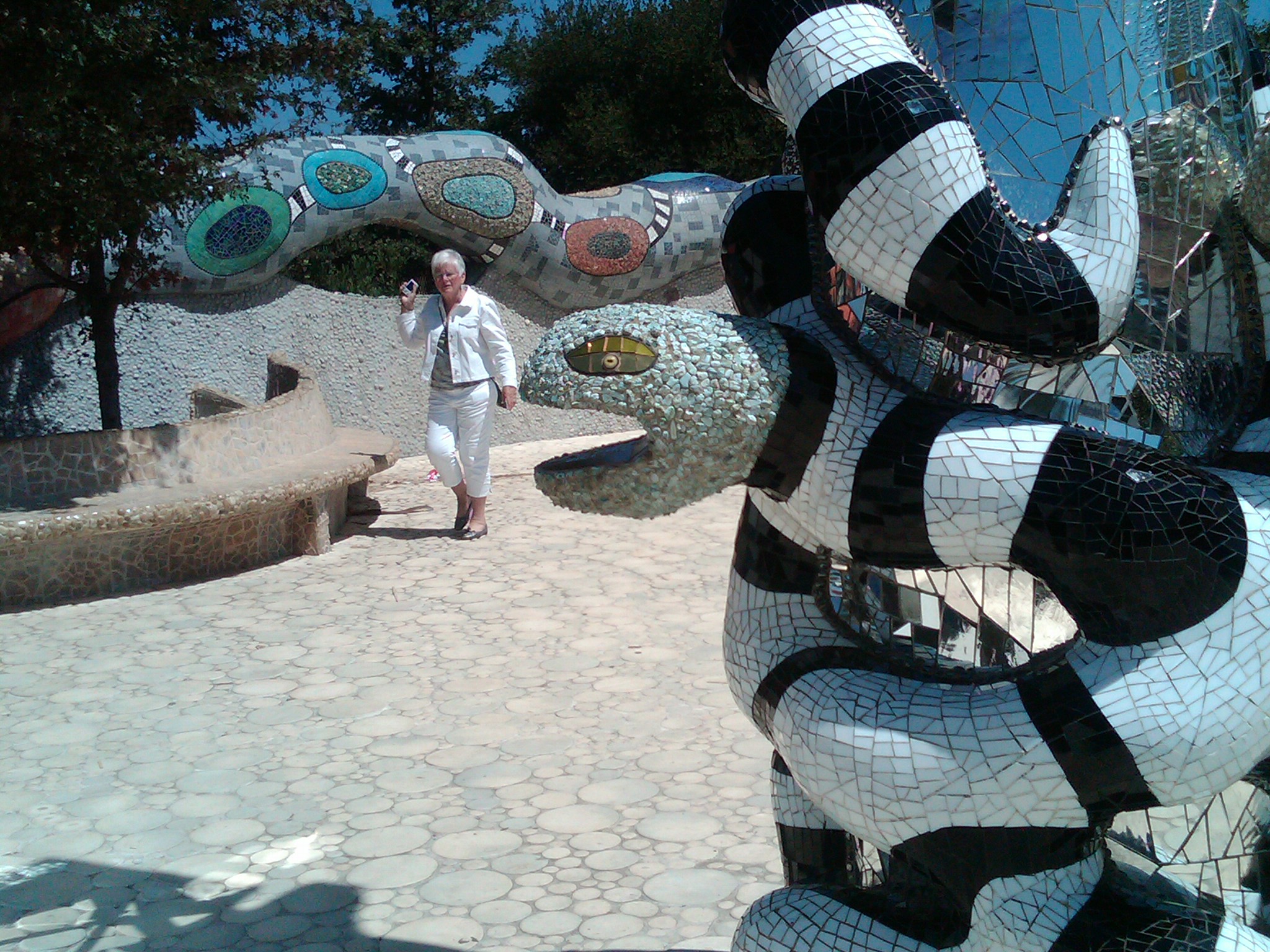
Cappi was visiting me in Chicago when feminist artist Niki de Saint Phalle’s whimsical, large-scale kaleidoscope animals, monsters, and figures were exhibited outside the Garfield Park Conservatory. She made her way to the west side on her own to see “the Niki.” And then couldn’t wait to take me there on the green line.
Cappi Quigley, 2011, at Queen Califia’s Magical Circle, Escondido, CA
We had similar tastes in most everything. Whenever I visited her in California, we ate from the ripened fields around San Luis Obispo. On one visit, we dined for a week on nothing but fresh-picked strawberries and avocadoes.
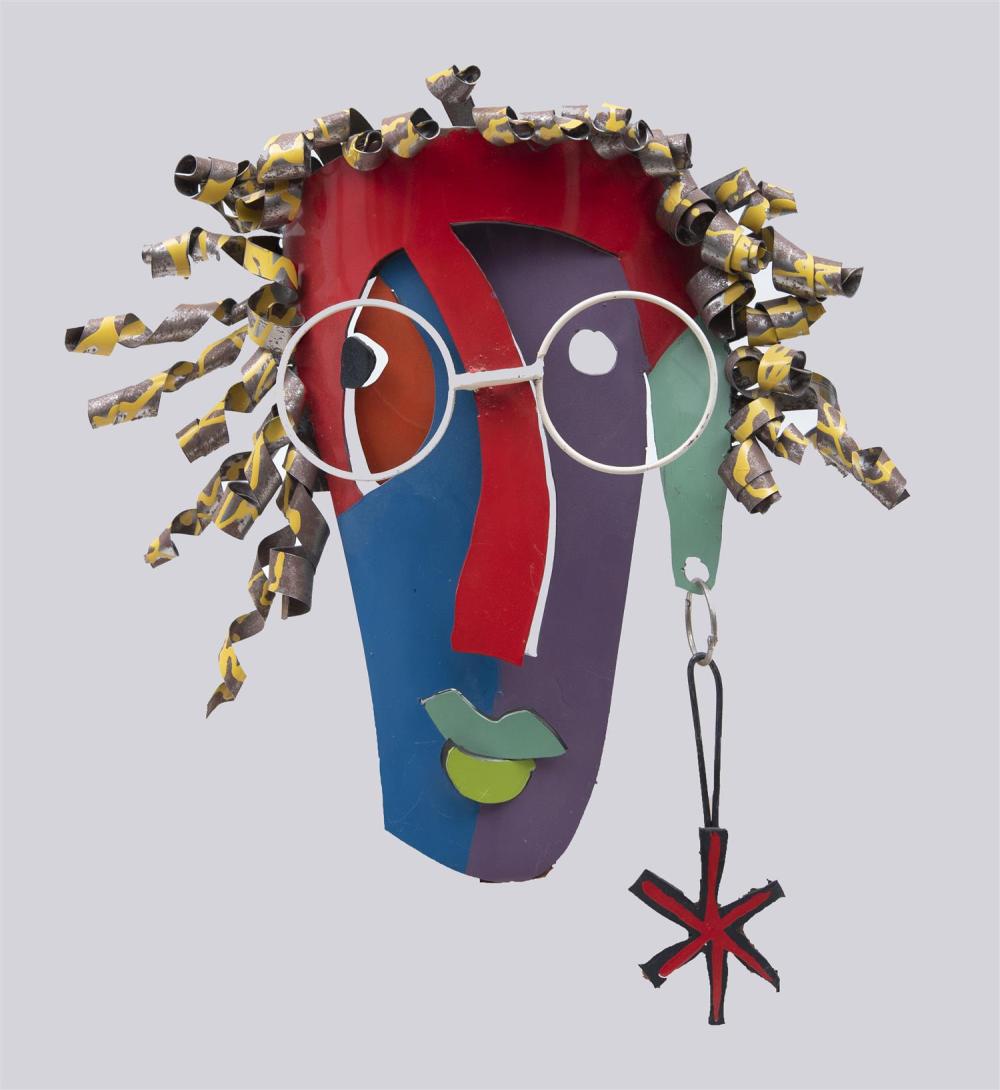
Cappi hurried me through the large, tantalizing rooms at the Nashville Arts Company to the attached warehouse in the back. The floor and walls were full of metal sculptures of every size and dimension. Each one painted in rainbow colors. There were playful metal masks with flowers springing off their hats, some waving flags, some with large eyeglasses, and some holding birds. One wall was filled with life-size avant-garde metal guitars. On the floor, an arrangement of Picasso-type chairs sat around a mesmerizing metal table.
The Arts Company in Nashville represented Brother Mel Meyer, a Marionist monk from St. Louis. Some of each of his creations were on display: metal sculptures, watercolors, stained glass, acrylic on canvas, handmade paper, and textiles. I cherish my Brother Mel metal wall sculpture of a woman with big red glasses, which I bought on the spot. Cappi and I bonded anew over our love and awe for Brother Mel. She subsequently visited his gallery and workshop in St. Louis. Brother Mel was well represented in her Central Coast home.
Brother Mel Meyer, St. Louis 20th Century
We got on the road in a state of hyperconsciousness. Tennessee red maples and golden ginkgoes illumined our spirits. Fireplace pine spritzed the air. Aware of the weekend schedule, we quickened our pace down West End Avenue. Out of nowhere and without warning, an ancient oak tree silently uprooted, toppled over, and bounced down, laying itself out across the road in front of us. The front of the car rested in leafy branches.
I’m not sure how many times we screamed, ‘Oh my god,’ or when we stopped shaking. Without words, we exchanged seats. I backed up, turned around, and drove home. Throughout the weekend, we failed to get an attentive audience for the story of our near miss. Only Cappi and I could know we’d been spirited into a new dimension of living.
Niki de Saint Phalle died in 2002, around the time Cappi and I swooned over her work. We mourned for Brother Mel Meyer in 2013. Cappi Quigley joined them in September 2023. They all left us their own technicolor visions of Paradise.
As a veteran churchgoer, I’ve logged about 3,650 hours in the Sunday pew. My childhood church clocked in at one hour a week for Catholic Mass. When I came to my senses at eighteen, I abandoned churchgoing. After a long period of barstool arguments on the God-is-dead theme, I started up churchgoing again at the Metaphysical Center, where I received a “reading” from a medium. The two-hour-long talk between the spiritualist and his dead interlocutor revealed that I had been Harriet Beecher Stowe in a former life.
I like that. Harriet Beecher Stowe, one of the world’s most famous abolitionists, wrote Uncle Tom’s Cabin after receiving a vision during a church service. Church is indeed a good place for visions. Clare of Assisi, Joan of Arc, and Theresa of Avila are famous Christian visionaries. And, of course, there’s the fearless Miss Harriet Tubman herself, who led enslaved people through the Underground Railroad at night, led by her visions.
After I learned as much as my addled brain could absorb in metaphysical spiritualism, I sobered up and joined a Christian fundamentalist cult. It was so extreme that the elders admonished me for making friends at Little League games with parents who were not our kind of Christian. To extricate myself from that legalistic life, I spent a year drinking jugs of vodka in my basement. Turning again to Alcoholics Anonymous, I sobered up through the holy love of AA veterans.
Since 1979, I’ve been attending a Presbyterian church in downtown Chicago. Yet, I never call myself a Presbyterian. Why? I’m not too sure. Perhaps the residual PTSD from the Christian cult or, Catholicism or, spiritualism protects me from assigning myself religious labels. More likely, I’m not altogether sure I believe what they believe.
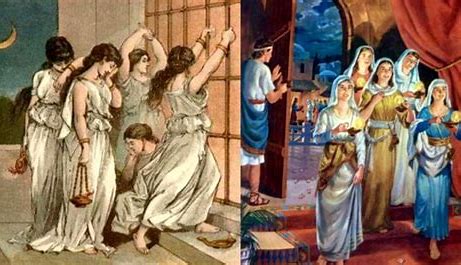
Last Sunday, churchgoers throughout the land heard the parable of the ten virgins, or bridesmaids as they say in today’s lingo. The seven-day wedding feast in ancient times couldn’t begin until the bridegroom arrived. In the story, five wise bridesmaids had working oil lamps when the groom arrived late at night, and they all entered the gate to the feast. The other five foolish bridesmaids were out buying lamp oil and got locked out of the party. In previous preachings, I’d heard Jesus’ explanation of his parable is that we must always be ready, have our lamps lit, awaiting his coming (or was it his second coming?). No wonder I’ve been a nervous wreck my whole life, constantly failing to be ready for Jesus. I really hate parables.
The church’s new pastor spun the story as a lesson in patience. Be patient because we never know when God will present a reason to throw a party. I had to listen again to him on YouTube because I swear I heard that ominous “Jesus is coming” sermon. This is one of the blessings and curses of old age. My brain holds years-old information, which is a blessing. But that information is a curse when it doesn’t make room for new ideas.
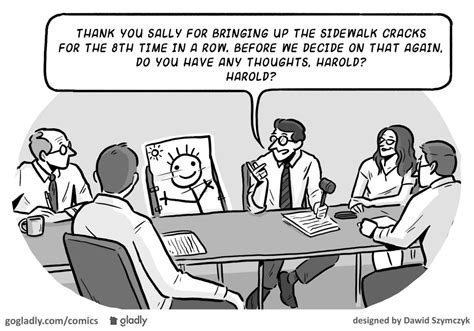
Alex Lubischer, a playwriting teacher at Chicago’s Goodman Theater, taught my beginning playwriting class that every play has its own interior logic that doesn’t have to be bound to reality. I’ve seen plenty of those, good and bad. He prompted us to write a short “bad” play that included a fire escape, a talking animal, a fur coat and a Venmo payment. I can’t guarantee my bad play, The Condo Board, has any interior logic, but it is definitely not bound to reality. The characters and their dialogs are fictional. However, you may see a similarity or two if you’ve ever been to a condo board meeting.
The Condo Board
SET: COURTYARD—48 UNIT FOUR-STORY BRICK BUILDING-EVENING
WE OPEN in a three-sided courtyard. It’s the end of summer. Onlookers sit in their open windows around the courtyard, on the lumpy grass, or lean against the building, waiting for the condo board meeting to start. In a 4th-floor window, a well-dressed, emaciated man with a straw fedora is stretched out on the windowsill. He’s drinking from a whiskey bottle and smoking.
Board members sit in a circle of mismatched folding chairs. Fire escapes are fixed to all three walls. Potted red geraniums fill the 3rd-floor landing of one. A bicycle is locked to the 2nd-floor railing of another. An old rag rug lays over the 4th-floor railing of another. In the center of the building, a cement sidewalk leads from the back door to the grassy courtyard’s edge.
(PAUL, 49, the Condo Board President, balances a spiral notebook and some loose papers on his lap. The sleeves of his white dress shirt are rolled up. He’s wearing khakis and fancy sneakers and holding a pen.)
PAUL. The meeting will come to order. Do we have a quorum?
(BIANCA, 35, building manager, sits next to PAULwith a clipboard stuffed with papers. She’s slight and perky, long dark ponytail, wearing an ill-fitting grey suit.)
BIANCA. No.
(NORA, 50, board member, sitting next to BIANCA. Blonde bob, 1950s flowered fitted dress, pearls, shiny barrette, round wire-rim eyeglasses, white socks, classic white Keds.)
NORA. I talked to Barry an hour ago. He said he’s coming. He agrees to paint the meeting room aqua.
(BARRY, 45, board member, paraclimbs down the fire escape from the 4th floor like a chimpanzee, stopping to do chin-ups on the metal bars. Fit, athletic, Margaritaville T-shirt, shorts, black sneakers.)
BARRY. I’m coming! I’m coming!
PAUL. (Strains his neck to see BARRY.)
What are you doing on the fire escape?
BARRY. (Lands on the ground and walks to a chair next to NORA. NORA perks up.)
Since we’re meeting in the courtyard, I thought I’d get a workout on my way down. It’s faster than that rickety old elevator.
NORA. (Shouts at no one in particular.)
When will the meeting room be finished? It’s gonna be too cold out here next month. Can we paint it aqua?
PAUL. (Looks at BIANCA.)
Do we have a quorum?
BIANCA. Yes.
PAUL. Did everyone read the minutes from the last meeting?
(The emaciated man, hugging his bottle, falls out of his 4th-floor window into the bushes below. His hat flies off in the direction of the meeting. No one notices.)
BARRY. My name is spelled wrong.
(SUSAN, 55, board member, next to BARRY, bleach blonde straightened long hair, fake diamond ring, tight white t-shirt, blue jean jacket, tie-dyed tights, ankle bracelet, oversized pink sneakers.)
SUSAN. I didn’t get the minutes.
BIANCA. Minutes are in everyone’s board pack.
SUSAN. Not mine.
PAUL. Do we have a motion to approve the minutes with the correction of BARRY’s name?
(CARMEN, 45, board member, next to PAUL, black unruly hair, thick eye makeup, red lips, hoop earrings, head scarf, bangle bracelets, ruffle blouse, stuffed into blue jeans.)
CARMEN. (Signals a silent thumbs-up motion)
PAUL. All in favor?
SUSAN. Don’t we need a second?
PAUL. What?
SUSAN. A second, someone to second the motion.
PAUL. How about you?
SUSAN. (Shaking her head)
Oh no, I’m not gonna have my name in no minutes.
(MARCO, 33, board member next to Carmen, tall, black slicked back hair, goatee, sleeveless t-shirt, tattoos, tight jeans, pointed tie shoes, aviator sunglasses.)
MARCO. I second.
PAUL. All in favor?
NORA. When will the meeting room be finished? Does everyone like aqua?
PAUL. Can we have the Treasurer’s report?
BIANCA. The Treasurer isn’t here.
PAUL. That’s Mark. Did he sell his unit?
(Pause. No one answers.)
BIANCA. Tsk. I’ll do the Treasurer’s Report. We have 239,241 dollars in operating.
PAUL. Motion to approve the Treasurer’s Report?
BARRY. I move to approve the Treasurer’s Report.
PAUL. (Gives Susan the evil eye.)
All in favor?
ALL. Ay
MARCO. I’ll volunteer to take over the Treasurer spot.
PAUL. Ok. Let’s table that ’til next meeting.
NORA. Wait. Hear that? Someone’s playing rap music. I hate rap music. When will the aqua board room be painted?
CARMEN. I’ll be right back.
(she stands and walks off, shouting over her shoulder).
I have to get my fur coat. It’s too cold out here. (voice fades)
(BOARD members talk all at the same time about nothing in particular)
PAUL. Order, please. BIANCA, let’s have the Manager’s Report.
NORA. (curled over, swinging her legs, muttering toward the audience)
Finally. The meeting room.
(GREG 35, board member, next to MARCO, sandy hair, Rolling Stones t-shirt, blue jeans, Converse sneakers, skateboard at his feet)
GREG. Carmen! Carmen! Your parrot got out!
BARRY. I’ll get him.
(BARRY paraclimbs up and around the fire escapes, trying to capture the PARROT.)
(PARROT, played by a child, green & red feathered costume, yellow beaked mask, hooked up to circus wires from the ceiling, flies up and perches on a fire escape railing.)
PARROT. Squawk! Squawk! Squawk!
BARRY. (mutters toward PARROT.)
Yeah, we’re writing you out of the building, Buddy.
(Various Board members and onlookers simultaneously try to catch the PARROT and shoo him back into CARMEN’s open window. The PARROT flies around squawking and settles on CARMEN’s window ledge.)
PAUL. Order! Leave the PARROT. BIANCA! Please. The Manager’s Report? Order everyone!
(BARRY swings back down from the fire escape and returns to his seat.)
BIANCA. First up, Owners are complaining about the PARROT squawking.
CARMEN. (arriving back in the courtyard with her fake fur coat) Aw, C’mon. He’s not that loud.
(She blows a kiss up at the PARROT.)
Are you sweet boy?
PARROT. (PARROT bounces onto the fire escape.)
Squawk! Squawk! Squawk!
SUSAN. I move we prohibit parrots from living in the building.
(PARROT flies around squawking and dive-bombing members of the board.)
PAUL. Is there a second?
SUSAN. Now you ask for a second?
PAUL. Do I hear a second?
CARMEN. My PARROT is an Emotional Support Animal protected by the government.
(To the PARROT)
C’mere baby.
(PARROT sits on Carmen’s shoulder.)
GREG. Carmen, you must recuse yourself from this discussion as a board member.
CARMEN. Ok, but my PARROT is an Emotional Support Animal.
(BARRY rolls his eyes. Greg and Marco stare at their phones.)
NORA. Can we talk about the meeting room? Painting it aqua? How about teal?
PAUL. (Ignores NORA.)
There’s a motion on the table.
MARCO. What motion?
GREG. (elbows MARCO)
The motion to kick the parrot out of the building.
(Whispers to MARCO)
Did you get the 50k? I Venmoed to you just before the meeting.
NORA. (Crosses her arms and legs, turns away, looks toward the audience)
I thought the motion was to paint the meeting room turquoise. Or was it aqua?
MARCO. (whispers to GREG)
Thanks, man. That new casino already wiped me out.
PAUL. (Looking around at the board members).
Is there a second to the motion about the PARROT?
(No response. Everyone looks around but not at PAUL or each other, then look at their phones)
PAUL. Hearing none, the motion fails.
PARROT. Squawk! Squawk! Squawk!
SUSAN. (Jumps up)
Wait a minute, we didn’t even discuss it!
BARRY. The motion failed. End of. Let’s move on.
(Winks to CARMEN. Talks loud so the whole building can hear.)
This is not going away, sister. We all hate that thing.
CARMEN. That’s not true.
(Looking around the building)
Who hates the PARROT?
ALL. (muttering) Not Me. Not Me.
BARRY. Let’s move on.
PAUL. Next item on the Agenda is recycling. BIANCA?
BIANCA. Okay, everyone wants recycling. We pay a recycling company $12,000 a year to come every Tuesday to pick up, and the blue bin is always empty. I propose we end the contract.
SUSAN. NO! I recycle all the time.
ALL. So do I! So do I!
BIANCA. Well, if everyone is recycling, why is the bin always empty?
BARRY. It’s that homeless guy who lives in the alley. He takes them plastic bottles and sells ‘em.
NORA. (Looking at Barry.) Are we going to paint the meeting room turquoise or what?
(BARRY puts his arm around NORA and whispers in her ear. NORA blushes and looks at her phone.)
PAUL. Is there a motion to end the recycling contract?
GREG. I move to end the contract.
(GREG nudges MARCO)
MARCO. I second.
PAUL. All in favor?
ALL. Ay.
PARROT. Squawk! Squawk! Squawk!
CARMEN. I move we adjourn.
BARRY. (Standing in front of his chair, stretching, and doing squats.)
What did we just vote on?
PAUL. We still have items on the agenda — the cable company upgrade, fixing the front sidewalk, and security cameras.
CARMEN. I still move to adjourn.
BARRY. I second.
(Winks at Carmen)
Let’s go to your place and watch the game.
NORA. (Smiling, Looks up from her phone.)
Did we vote to paint the meeting room yet?
PAUL. All in favor to adjourn?
ALL. Ay. Ay. Ay.
PARROT (On CARMEN’s shoulder as she walks off with BARRY)
Squawk
(NORA walks off, smiling, staring at a fire escape.)
GREG. (Huddles with PAUL and MARCO, looks at PAUL) Let’s go to yours and decide on the rest of these contracts. My brother-in-law has a security company we can use for those cameras.
MARCO. My girlfriend is the bookkeeper at a cement company. I know the boss. They do sidewalks.
BIANCA. (Overhears and walks over)
My dad can get us a deal from Comcast.
PAUL. Ok. Ok. Might as well. We’ll never get anywhere otherwise. (All four walk off together, chattering.)
(Onlookers in the courtyard amble off. Others linger in their windows, some smoking and looking at the sky. Someone waters a geranium and then stares at the sky. The man who fell into the bushes scrambles out of the branches and wobbles over to one of the chairs, hugging his bottle).
(NORA appears in the courtyard wearing a painter’s shirt with a bucket of aqua paint. She picks up the man’s hat and puts it on his head. He nods and takes a swig. She begins painting a fire escape as she hums “Blue Skies.” Onlookers look down at her and blissfully return to staring into the dark blue sky, humming along.)
Candles, Israel-Gaza, and a World We Don’t Have Yet
Jonathan and Sandy Miller founded “Sounds Good” choirs for older Chicago adults in 2016. Two years later, they added “Good Memories” choirs for those with dementia and early-stage Alzheimer’s. Having no background in singing and an inability to carry a tune or read music, I hesitated to volunteer to help people with following their sheet music. But Sandy and Jonathan said a fuller group would give people a better choir experience. So I joined.
I’d been worried that I had slid into a period of ever-increasing cognitive decline myself. In researching what was happening to me, I’d read that singing, particularly choir singing, could help stitch together busted nerve endings in the brain. It has. Learning to match the notes to the words, concentrating on reading the music, and trying to vocalize it seems to replenish bits of lost grey matter. Choir singing enlarges my world by healing the brain.
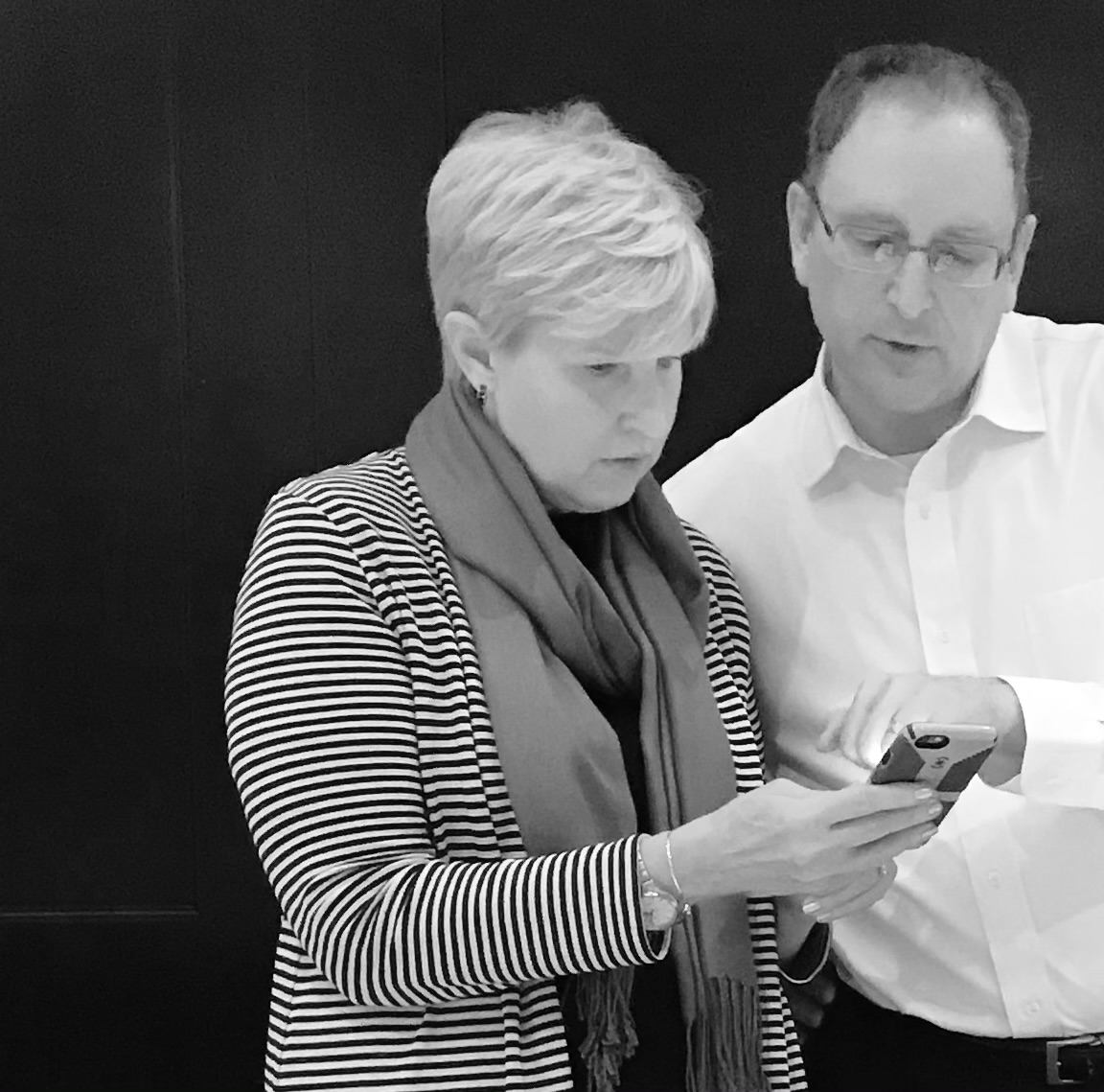
Sandy & Jonathan Miller, Founders of Sounds Good/Good Memories Choirs
Little did I know that the world of Jonathan and Sandy Miller is a body, mind, and soul experience. The following essay was posted on the Sounds Good website. Jonathan Miller doesn’t “preach’” as our choirmaster. But he and Sandy exemplify every good quality expressed here.
Come hear the fruits of these labors at our concert in Chicago on Dec. 21, 2:00 pm, 4th Presbyterian Church, 880 N. Michigan Ave.
Candles, Israel-Gaza, and a World We Don’t Have Yet
by Jonathan Miller
We have been rehearsing “Light One Candle” in all of the Sounds Good Choirs for many weeks. When Linda Powell and I picked the song for this fall’s concerts, we had no idea how timely it would seem now—almost prophetic. It suddenly feels deeply relevant, especially when seen in the context of events unfolding in Israel and Gaza. What is happening there horrifies me as a Jew and breaks my heart as a human being. My heart cries out at the suffering that has taken place and is bracing for yet more suffering to come.
Look anywhere in your news feed for thirty seconds, and you’ll see it: we have not learned how to live together. A song, therefore, that acknowledges pain and suffering is a good thing right now. A song about “the terrible sacrifice justice and freedom demand” is a wise and timely song.
Light one candle for the Maccabee children With thanks that their light didn’t die Light one candle for the pain they endured When their right to exist was denied
Peter Yarrow wrote “Light One Candle” in 1982 when war broke out between Lebanon and Israel; he said that he hoped the song would take hold in people’s hearts like “Blowin’ in the Wind” had captured American hearts during the Vietnam War. The song holds up the example of the “Maccabee children”—those Jews who stood up for themselves when the Romans took over the Temple in Jerusalem around 165 BCE—as a source of inspiration, resistance, and courage.
History gives us many such role models of courage. Sandy and I recently went to a fundraiser for the nonprofit “Facing History and Ourselves.” Facing History equips middle- and high-school teachers and administrators to embrace a thoughtful, rigorous approach to history to promote civic engagement, a sense of empowerment, and the investigative rigor to understand how injustice happens—so we don’t have to repeat past mistakes. Their training and curriculum resources encourage deep inquiry. They show students how to ask the tough questions. They foster in an entire school (not just a social studies classroom, which is super cool) an orientation toward challenging entrenched attitudes about race, bullying, homophobia, and other volatile topics. A young woman spoke at the fundraiser; she had studied with Facing History in high school and had just graduated from college. Her words were an inspiring lesson in honesty and bravery. She said her college “worked hard to get Latinx students there, but they didn’t make us feel welcome when we arrived.” She spoke of fighting to raise awareness of the issue, to help create safe spaces for Latinx students at her college, and of her vision to shape a career that combines her passion for reproductive rights with her concern for immigrant women.
Light one candle for the strength that we need To never become our own foe And light one candle for those who are suffering Pain we learned so long ago
The event concluded with a conversation between Jonathan Eig, whose recent biography of Dr. Martin Luther King, Jr. has met with critical acclaim, and Adam Green of the University of Chicago, whose scholarly work includes post-emancipation African-American history, cultural studies, and urban studies. The conversation was about Dr. King’s legacy for us in our time; it was fascinating, and I felt stretched in a wonderful way afterward. The conversation took a deep dive into, among other things, our tendency to put leaders on pedestals; the seminal influences on King’s life and thinking, including Coretta Scott King and Rosa Parks; and King’s own way of stretching himself to take on bigger and bigger problems, even when it was very difficult, and of continuing to find and engage with people whose views differed widely from his own, including Stokely Carmichael and the toughest Vice Lords gang leaders in Chicago.
Light one candle for the terrible sacrifice Justice and freedom demand
Toward the end of the conversation, Adam Green reminded the audience about Howard Thurman’s 1948 book, “Jesus and the Disinherited,” one of my favorite books. A mentor to Dr. King, Howard Thurman was dean of the chapel at Boston University and one of the most influential theologians of the 20th century. In this book, Thurman speaks to the downtrodden of the time: Americans of African descent, against whom Jim Crow relentlessly hurled insult upon humiliation upon pain upon injustice. However, rather than encouraging African Americans to succumb to rage, violence, hate, or disconnection, Thurman exhorted just the opposite: moral courage, a conviction that their own basic goodness, in concert with others, could turn the tide, and a sense, using Christian language, of “committing myself to the redemption of everyone.”
Echoing Gandhi, who said, “Nonviolence requires more courage than violence,” Dr. King said, “We will meet suffering with soul force.” When we do not follow the crowd by succumbing to fear or fearmongering, we can look our situation squarely in the eye and begin to tell the truth of the situation. Following this example, we must insist on goodness and truth-telling from ourselves first, holding ourselves to a higher standard rooted in compassion, what Abraham Joshua Heschel calls “moral grandeur and spiritual audacity.” This, in turn, creates a virtuous cycle of people committed to making the entire situation work for all concerned. I especially like how Buddhist nun Pema Chödrön describes King’s mindset: “For me to be healed, everyone has to be healed.” If my life gets better, but you are left in the dust, does that really work in the long run?
Light one candle for all we believe in That anger not tear us apart And light one candle to find us together With peace as the song in our hearts
A worldview where we all mattered… what would our planet look like if that’s what we all strove for? How would we have to enlarge our sense of who “we” are if we wanted that sort of society? Can we challenge ourselves, individually and collectively, to do that? I’d like to find out. I’m not sure we can survive as a species if we don’t.
What all these wise people are pointing to is not conventional thinking, and I don’t claim to be good at it. If it were easy to create a bigger box that could hold us all, what King called “a revolution of values,” we would have done it by now. But I want that world: an America, for example, where I don’t have to choose between health insurance and food or between living in my car and paying rent and where I don’t have to endure ridicule for wanting that. I want a world where my character and skills matter more than my skin color. I want a world where caring for my children or parents doesn’t mean I have to quit my job. I want to be able to love whom I choose, make choices about my own body, and live with dignity in a place that I can afford. And of course, I want a world where the gifts and experiences of older adults are celebrated. It may take us still more centuries to “light one candle to find us together with peace as the song in our hearts,” but it’s the right direction. Let’s go there.
Don’t let the light go out! It’s lasted for so many years! Don’t let the light go out! Let it shine through our hope and our tears.
The morning after my last colonoscopy, I stood in line at Starbucks to satisfy a sudden obsession for a flat white, not my usual coffee drink. A familiar tune came through the surround sound subwoofers. My toes began tapping involuntarily until the song’s words remembered my voice from long, long ago and softly fell freely from my lips.
Thunder only happens when it’s raining
Players only love you when they’re playing.
Dreams. Stevie Nicks. I imagined myself wiggling my hips and flailing my arms—an unwise move for a not-so-sure-footed roly-poly 77-year-old.
Feldenkrais teacher Deborah Darr says, “Imagine you’re doing the movements you can’t physically do.” She taught me that imagination can so deeply engage the mind that the body feels like it’s moving when it’s not. So, on my way home from Starbucks, I imagined myself line-dancing down the street humming Dreams.
By the time I got home, I was physically exhausted. I clicked into a meeting of Alcoholics Anonymous on Zoom. I’ve been attending AA meetings for over 50 years and often ho-hum to myself, “I’ve heard this story already…nothing new,” even if I’ve never seen the speaker before in my life. On this day, I zeroed in on the story so wholly that I felt every cheap drink, every disgusting hangover, every regrettable hook-up, and every sickening word of his drunken story. When he talked about getting sober, my stomach balled up, remembering the agony of those early days of sobriety with uncontrollable sweaty shakes and tears. The love he felt from fellow sober alcoholics and for his family sticking with him filled me, too. Love and gratitude seeped into my every pore.
The growing ball in my stomach erupted at the emotional and physical powerlessness, and I ran to the bathroom and puked.
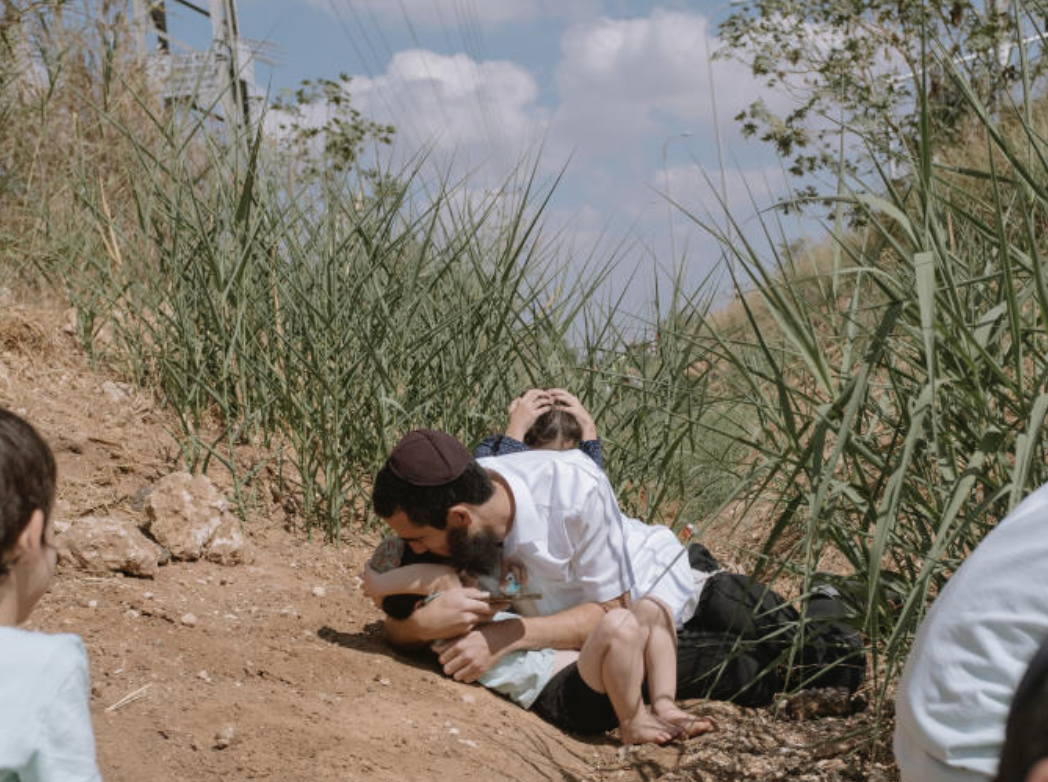
(AP Photo/Dor Kedmi)ASSOCIATED PRESS
Seeking distraction, I turned on the TV. Hamas terrorists had tunneled under the Gaza-Israel border a few days before and riddled Jewish babies with bullets. News outlets had taken a few days to get the images to us. I wept watching the photos and videos, hearing children crying out for their mothers, watching helpless fathers, and reporters describing families on the move. Displaced. Terrified. Confused. Grieving.
I reached in my purse for the forgotten mound of papers handed to me as I left the “colonoscopy suite.” Was I supposed to read them sooner? I don’t know. But I saw why I was so giddy, twirly, and happy in the morning and so emotionally flattened later. Fentanyl. The doctor shot fentanyl in my arm before snipping a bit of chitterling from my innards. Fentanyl is so powerful that I forgot biopsy results were coming my way.
The doctor sent me a note within a few days. “All clear,” he wrote.
Just one veinful of fentanyl laid down a new neuro path in my brain, allowing the deepest of joys and sorrows. Since then, if I’m tuned in, boundless joy arises from the hope of alcoholic stories—and bottomless sorrow from images of bloodied children being carried to unsafe safety.
Boosters say the Taste of Chicago is the world’s largest food festival. The world’s largest!
It’s usually held around the Fourth of July. This year, with the newly-scheduled NASCAR race taking up the festival space over Independence Day weekend, the city moved the Taste of Chicago to less touristy September 9-10.
The quaint idea of having Chicago restaurants give people a “taste” of their signature dishes appealed to the legacy-obsessed Mayor Jane Byrne in 1980. She predicted there’d be about 100,000 people showing up on the two blocks of closed-off Michigan Avenue during the three-day festival.
On the first day of the first “Taste,” my thirteen-year-old son and I waded into the sidewalk crowd at the Ohio Street entrance, heading toward the Michigan Avenue bridge. Our nostrils itched with anticipation as each aroma swirled around us until the crowd thickened to an immovable throng. Signs for hamburgers, Chinese dumplings, deep-dish pizza, and sushi were in sight, but the food was out of reach. We all moved in a slow flow of claustrophobic, sweaty goo, trying to break loose.
“Thanks, Jane,” shouted my son.
And a roaring chant rose from the street like the fumes of the smoldering barbeque ribs: Thanks, Jane! Thanks, Jane! Thanks, Jane!
Chanting turned to laughter by the time we disentangled ourselves over the bridge at Wacker Drive. And really, it was hilarious. A crowd of 250,000 showed up. Jane had blocked off streets for the Taste next to downtown office buildings with only two openings in and out.
The following year, the Taste spread out at the edge of Grant Park. My son and I stuffed ourselves with various restaurant pizzas but avoided Greek, Chinese, and Thai food. Neither of us had elevated taste buds at that point in our lives.
Chicago moved the Taste farther into spacious Grant Park in 2023. The ornate 1927 Buckingham Fountain backdropped every photo. Food tasting required an adventurous spirit and a healthy gut. I ran into Lorraine, staring at the sign over the stand selling deep-fried Oreos, crab rangoon, and fried rice. We strolled past little and big hands clutching funnel cakes, rib tips, and Seoul tacos in dinky paper bowls—a hot Cheeto burger sold for sixteen dollars. The longest lines queued up at Harold’s Chicken and Badou Senegalese Cuisine. We sniffed out Chicago Doghouse to chow down on our favorite hot dog, but my throat clogged with the invisible flying grease of deep-fried Twinkies. I couldn’t do it.
“Try a “Beyond Meat” burger,” Lorraine said.
Nope.
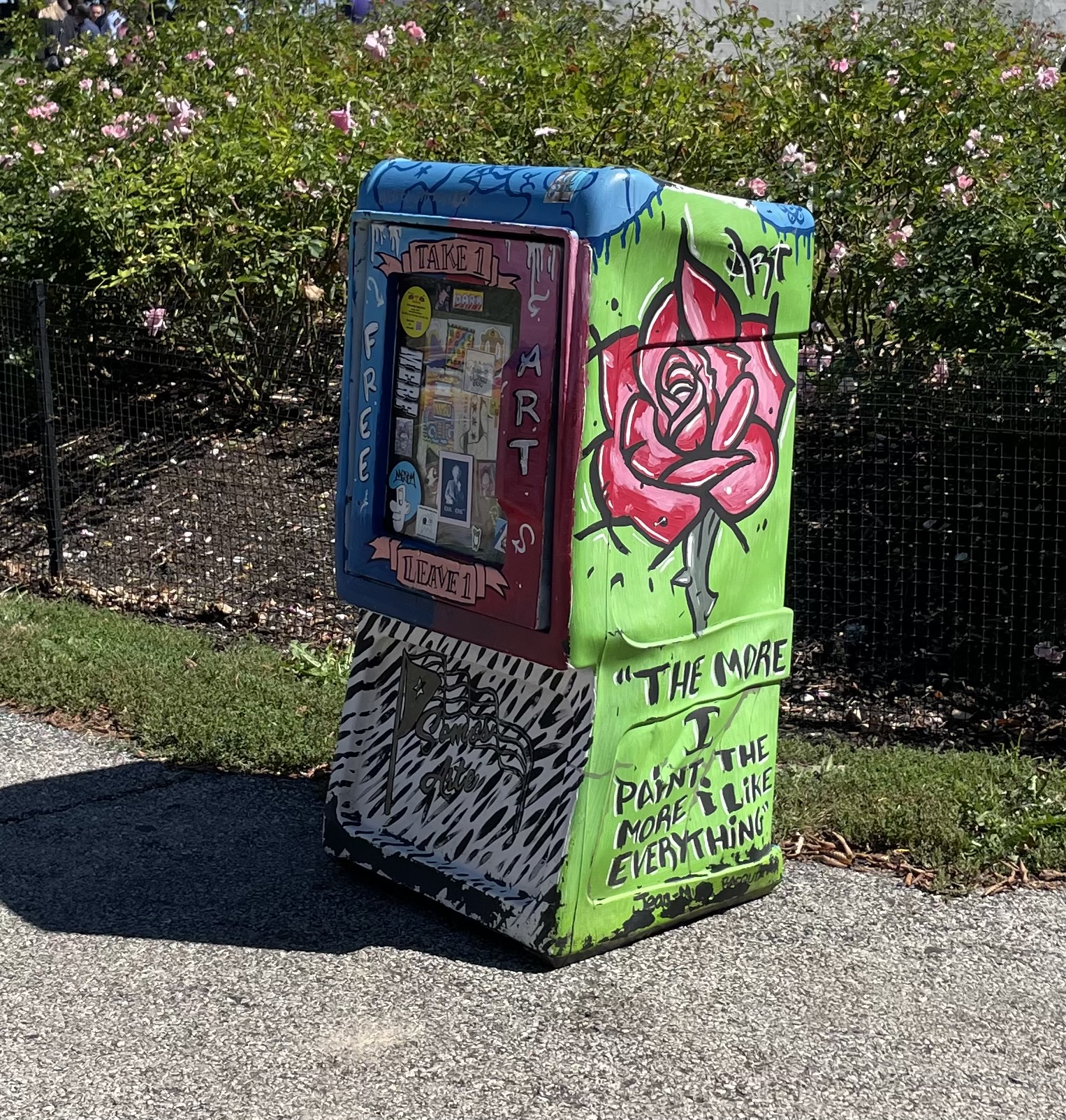
“The More I paint the more I like everything” Artist unknown. Grant Park Rose Garden, Taste of Chicago 2023
Blow-up slides, band stages, and a karaoke contest all spread out among the well-gardened rose bushes and the native hibiscus. Lorraine joined hundreds of line dancers under the “Summer Dance” tent. This was indeed Chicago’s very own county fair.
My son has developed far more sophisticated eating habits in the forty-three years since the first Taste of Chicago. This year, he would have coaxed me into tasting unfamiliar foods or, at the very least, eating a hot dog. As it was, I walked home hungry.
God! How I love WebMD! This online ingenious, comprehensive, and reliable health and medical source has saved me from many time-gnawing trips to the Emergency Room.
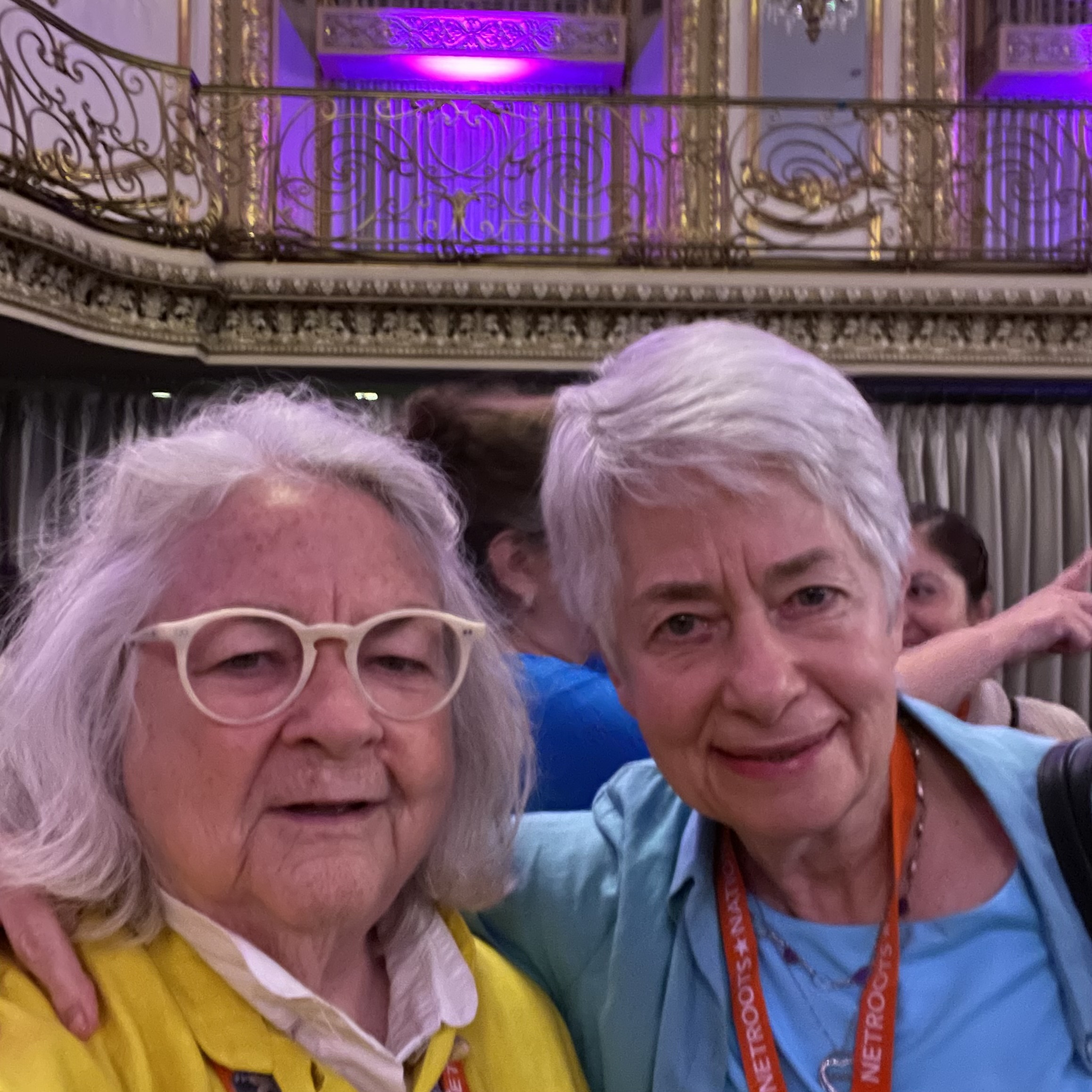
Last week I found myself at the bus stop on State Street near the Hilton Hotel with a “Netroots Nation” Convention credential swinging from my neck. I have no memory of the previous four hours. Zilch. I’d planned to attend the Netroots Nation Convention at the Hilton; the swinging credential assured me I’d at least registered.
Are you thinking I may have experienced an alcoholic blackout? Nope. Those days are long gone. I haven’t had a drink in forty-five years. Arriving home around 9:30 pm, I dove right into my laptop and searched for “lost memories”, which returned a description of something I’d hoped hadn’t happened to me:
“Losing time, or having large blocks of time for which one has no memory is a symptom of Dissociative Identity Disorder. Sometimes a person will lose so much time that they “wake up” in an unfamiliar town or place. This is called Dissociative Fugue.
Uh-oh. That sounds like the multiple personalities portrayed by Sally Field in the horror movie, “Sybil”. I’d hoped I didn’t murder anyone, or go to some stranger’s hotel room whilst in a fugue state. I searched further—typed “sudden memory loss”:
“Transient global amnesia, TGA, is a sudden loss of memory. It’s an alarming but harmless condition. Symptoms usually last for hours and then memory returns. It has no lasting consequences. Doctors aren’t sure what causes it. It’s more common in people over 50 and with a history of migraines.
Whoa! That’s me! Thank you WebMD and for the good news:
“TGA …is not caused by a neurological condition like epilepsy or stroke. With TGA, you remember who you are and recognize the people you know well.
Netroots Nation’s mission is “to bring together online citizens across America, inject progressive voices into the national conversation, and advance the values of justice, equality, and community in our nation’s politics.” Their annual convention in my hometown came at the right time for my aging activism. Chicago had just elected a progressive, smart, kind-hearted new mayor, Brandon Johnson. I believe with my whole heart that within a few years, Chicago will be a role model of common solutions for all American cities. At the convention, I’d hoped to replenish my quiver’s rah-rah-cis-boom-bah that had fizzled since Mayor Johnson’s inauguration.
In the late afternoon of the TGA incident, I planned to attend an event in the Waldorf Room, “Solidarity Across Differences: Organizing When We Disagree.” There’s no evidence I was there. But I was somewhere. My little black-and-white pocket notebook has three new quotes in my handwriting:
“There’s a collective out there that wants to shrink the hope of the possible.” Emma Tai, Director United Working Families—the grassroots organization that helped elect Brandon Johnson
“Chicago is a town that’s gonna show the world what the future looks like.” Randi Weingarten, President American Federation of Teachers
“Safety is not blue lights.” Brandon Johnson, Chicago Mayor
My iPhone displays several close-up photos of Mayor Johnson giving a speech, two selfies at the food table, and one selfie with Heather Booth a long-time political activist from Washington, DC. With the exception of the food table, these are exactly what I would have photographed, had I been in my right mind, proving once again how competent my online doctor, WebMD, is.
“…in TGA the patient cannot acquire new memories but otherwise can function normally; personal identity is retained…”
Whew! What a relief; between the notebook inscriptions and my photos, I have proof I acted my best self, and confirmation I had all the symptoms of an episode of TGA, Transient Global Amnesia.
Do I feel safe? Absolutely. Dr. WebMD tells me there’s rarely more than one occurrence. And no one has come forward to tell me I acted like Sybil.
Most gay anthem playlists include these songs: I Will Survive by Gloria Gaynor, Freedom! ’90 by George Michael, Vogue by Madonna, I’m Coming Out by Diana Ross, anything by Beyonce, Cher, Donna Summers, Lady Gaga and of course, Billy Porter. But no recognition for the song Born Free.
I recently attended a friend’s bon voyage picnic with my new dog. 99% of the picnickers were men. They adored my fluffy little white Westie with her pink-lined pricked ears.
“What’s her name?” One guy asked.
“Elsa,” I answered.
He and his companion then broke out singing Born Free. Others joined in the serenade.
Born free, free as the wind blows…
I looked straight at my friend with a questioning side smile and squinty eyes.
“Gay,” was his answer.
“Some kind of anthem?” I asked.
“Yep. From the movie.”
“Oh, I get it. Elsa. The lioness. Wanna go with me & Elsa to the Pride parade?” I asked him.
“Absolutely not!” he exclaimed.
None of my gay friends express interest in Pride hoopla. At least not to me. But in social gatherings, I’ve overheard one or more talking about some cute guy they’d met at the Parade. It’s understandable. The Parade covers a lot of geography and seems to have no time constraints. If you live in Parade neighborhoods, you’re bound to meet a cute guy or two passing by.
The rejection of Pride celebrations is a bit more puzzling. I’m not particularly drawn to St. Patrick’s Day parties and parades, but neither am I celebrating Irish freedom. After the first official Chicago Pride parade in 1981, I celebrated gay liberation at a raucous party in Lincoln Park . Plenty of our gay friends were invited. But they didn’t show. Perhaps they excluded us from their Pride activities because gay liberation didn’t belong to us? Nor we to it?
Political friends wave the flag, not necessarily to show they’re gay, but, as I do, to support gay rights. Showing the colors this year is especially important because recent laws in other states restrict gay freedom, including drag shows.
On a stroll down Michigan Avenue the other day, I was overwhelmed by the display of rainbow colors in front of my church. There are ribbons tied to each iron fence post spelling out the iconic colors of gay pride—for the entire block in front of the church.
“So colorful,” I mentioned to my walking companion.
“Doesn’t it make you feel kinda bad?” She asked.
“Whaddya mean?”
“Well, it’s a celebration for gays. And you’re not.”
Some of the church’s older adults asked to celebrate gay rights by having a drag show for their small group. The church denied the request. I’m excluded from men’s bible study, twenty-somethings and couples church groups. And like those, perhaps celebrating gay freedom with events like drag shows, really is (inadvertently) reserved for gays only.
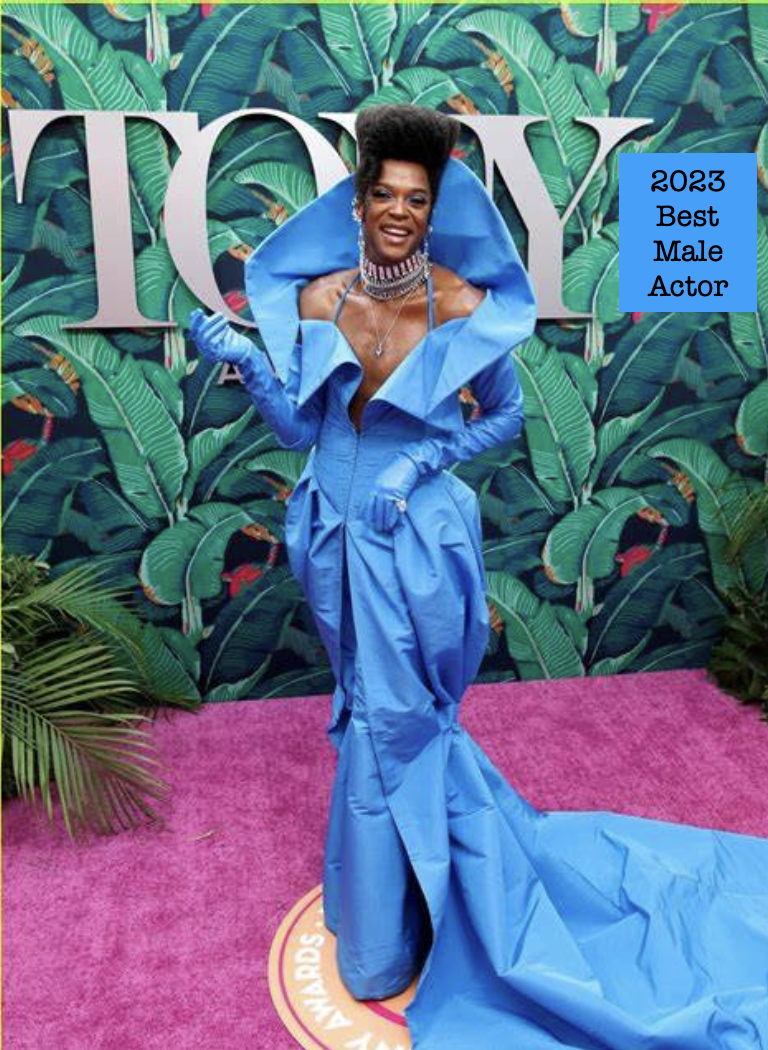
Fortunately, I can honor the entire queer nation by re-watching this year’s Tony Awards.
Meanwhile, song compilers need to include Born Free in gay anthem song lists.
Two neglected shoeboxes of faded and forgotten memories sit on the top shelf of my bedroom closet. They are filled with negatives, a noun I’ve not heard nor used since the Aughts gave us cameras on our mobile phones. I had used all types of cameras in my life from a Kodak Brownie to a 35 millimeter Pentax until photographic film and developing became too expensive in the 2000s. All my cameras had film that I’d drop off at the corner drug store or a camera shop for developing. I’d then mark time for a week or more waiting to hear that my pictures were ready for pick-up. The much anticipated package included the developed photos and their corresponding negatives.
A negative is the reversed image of the picture that can be used to develop another print. They were produced on small strips or sheets of transparent plastic film. Eight or ten miniature negative images appeared on each dark strip. If I wanted to reproduce a photo, I’d hold the plastic film up to the light, protect it from my fingerprints, search for the picture I wanted, cut the tiny square from the strip, and take it to the store for developing.
There’s no logical reason I packed old negatives in archival boxes and stored them on the top shelf of my closet. In order to get to them, I need to unfold the step stool, risk pinching a finger or two, and trust my balance will hold as I climb each step to reach the shelf. I have no intention of ever looking through the negatives in order to develop old photos. Most of the corresponding pictures may be in musty albums in my bookcase. I’m never drawn to those either.
A few years ago I acquired a photo scanner. I offered to pay my teenage grandson to digitize my photos as a summer job.
“I don’t know how to do that,” he answered.
“It’s easy. I’ll show you. You can do it at home and upload to your computer.”
“Naaw, I don’t think I’d like that.”
All hope drifted away then, that any of my relations would be interested in the photographic documentation of my life. I can’t blame him. I was never curious about details of my parents’ or grandparents’ lives until recently. How can I tell him that when he nears his sixties or seventies he’s going to find himself wondering what I and his other ancestors did during our lives? More importantly, how will he come to know that factors outside his control, passed down generation after generation may be the source of his own physical or mental hardships?
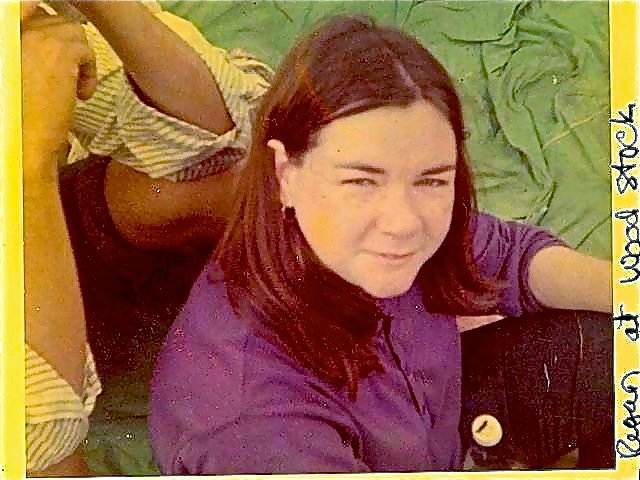
A production of the rock opera Tommy will be onstage this summer at Chicago’s Goodman Theater.
“Wow! You saw Tommy at Woodstock?” exclaimed a theater-goer when we were in line to purchase tickets.
Woodstock cachet seems to increase with every passing era. Forget the old photos. My-grandmother-went-to-Woodstock is probably the only legacy my grandchildren will ever need.
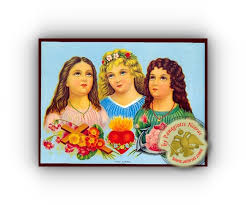
Saints Faith, Hope and Charity Catholic parish in Winnetka, Illinois, is named for three virgins martyred in second century Rome during the reign of Hadrian. The girls, ages twelve, ten and nine were boiled in tar and beheaded for their refusal to denounce Jesus.
My two sisters and I attended Saints Faith, Hope & Charity school in the late fifties at about the same ages as the boiled virgins. I entered the fifth grade after the school year started, having attended the Cathedral School in downtown Chicago for a few weeks while my parents finagled a new home in the northern suburbs. We’d just been run out of St. Louis for failure to pay our bills.
Outwardly I was accustomed to masking the shame and embarrassment of our alcoholic family life. I donned my most congenial personality for the girls at “Faith Hope”. I needn’t have. The girls greeted me like a new puppy. Everyone wanted to call me their friend and invite me to their homes after school. At Kathy White’s house, we all gathered in the basement and played very competitive dodgeball. But the girls themselves weren’t competitive. These girls all seemed like best friends.
The Faith Hope Dominican Sisters, were the kindest of any nuns I’d encountered at the ten or twelve Catholic schools I’d previously attended. Whenever one of the Faith Hope sisters discovered I’d forgotten my lunch, I was treated to a sandwich in the convent dining room. I overheard rumblings at home that the mother superior may have called my parents about the missing lunches but I never heard about it at school.
Faith Hope’s lively playground burst into jump rope, hopscotch, steal-the-bacon and ball games. In the winter girls and boys alike played king of the hill on huge snow piles.
One day on the playground, Helen Smith gathered some girls to sneak off to the church. She wanted to show us a secret booklet her older brother told her about. We edged into the vestibule as she reached up to a high shelf and pulled down, “Secrets of Marriage”. Helen read aloud descriptions of a man’s penis planting a seed into a woman’s vagina to form a baby.
“Ewww!” we screeched.
“That’s disgusting.”
Some of us ran out, hid in the folds of a giant spruce and giggled ourselves into oblivion. Others stayed inside and learned more details.
Faith Hope’s pastor, Monsignor Thomas Burke, a charming powerhouse of a priest, didn’t evoke fear or condemnation like other priests I’d known. He connected. We weren’t related, but Monsignor Burke, who told me Regan means “queen” in Gaelic, joked that all the Burkes in the Midwest were cousins.
During my seventh grade year, our evicted family moved away. I felt like one of those martyred sisters from the first century, boiled in anger. I was certain I’d never find as happy a time as I’d had at Faith Hope.
A Faith Hope friend I hadn’t seen in sixty years sent me a note after she’d read my book, In That Number. It simply said, “You belonged to us.”




 History gives us many such role models of courage. Sandy and I recently went to a fundraiser for the nonprofit “Facing History and Ourselves.” Facing History equips middle- and high-school teachers and administrators to embrace a thoughtful, rigorous approach to history to promote civic engagement, a sense of empowerment, and the investigative rigor to understand how injustice happens—so we don’t have to repeat past mistakes. Their training and curriculum resources encourage deep inquiry. They show students how to ask the tough questions. They foster in an entire school (not just a social studies classroom, which is super cool) an orientation toward challenging entrenched attitudes about race, bullying, homophobia, and other volatile topics. A young woman spoke at the fundraiser; she had studied with Facing History in high school and had just graduated from college. Her words were an inspiring lesson in honesty and bravery. She said her college “worked hard to get Latinx students there, but they didn’t make us feel welcome when we arrived.” She spoke of fighting to raise awareness of the issue, to help create safe spaces for Latinx students at her college, and of her vision to shape a career that combines her passion for reproductive rights with her concern for immigrant women.