Texas Goodness

Texas Goodness

Something fluttered around me, as if I’d stepped into a web of butterflies. But I hadn’t. Butterflies were off in the distance. On the Nature Boardwalk surrounding the marshy South Pond in Lincoln Park I was soaking in the August-blooming bubblegum-colored big-flowered swamp mallows. And there on a daisy branch sat a goldfinch. And another, on a farther branch. Hidden in the yellow coneflowers were a few more, pecking at seeds. Goldfinches had entered my airspace as they headed for the wild prairie flowers at the swamp’s edge. Goodness nurturing goodness.  
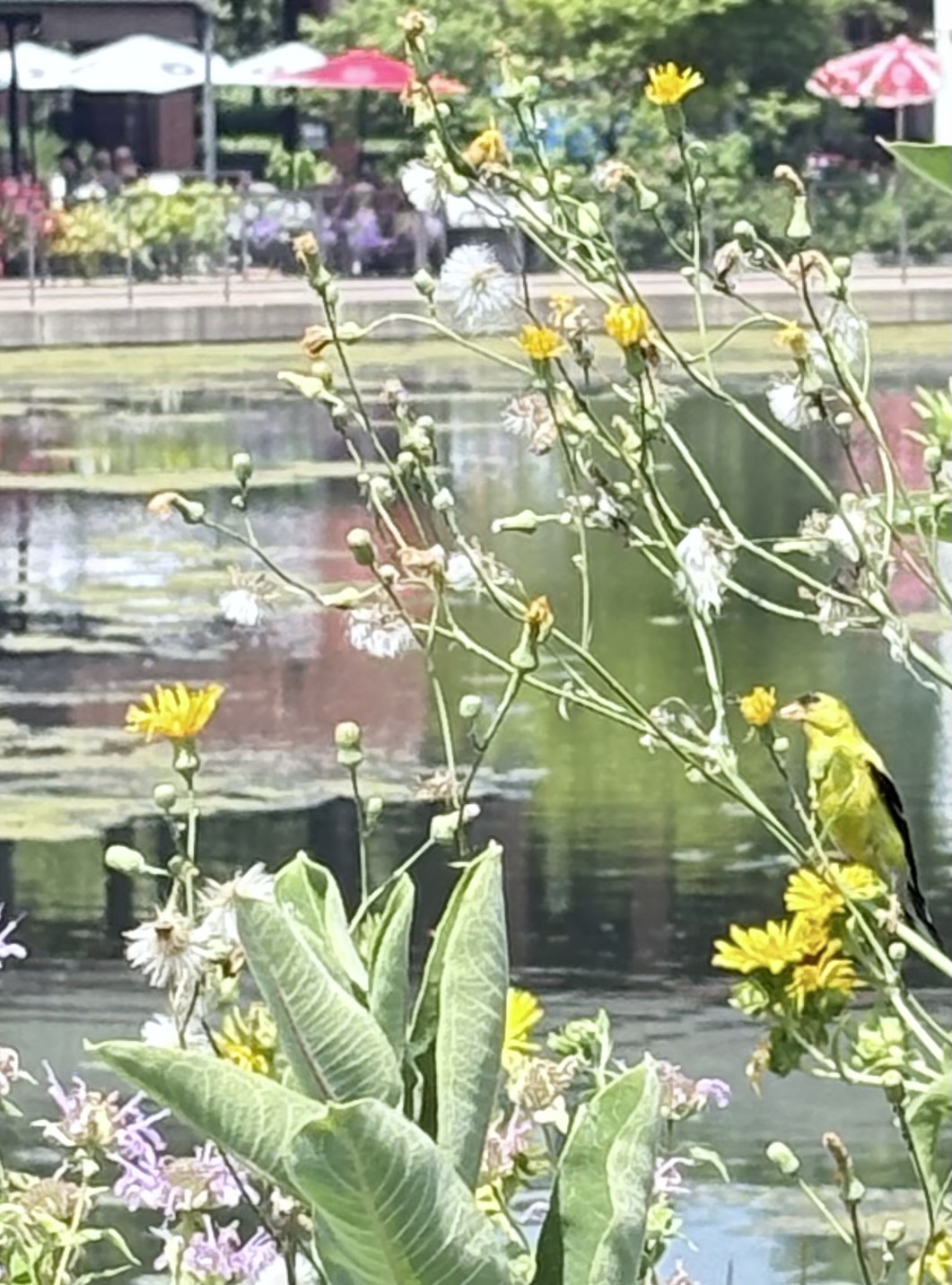
My held-breath whispered, “You know, Regan, God did not have to give us the goldfinch.” At that moment, as others before it, I believed in God. The previous morning, fearing all goodness had vanished from the earth, I assumed God, like the butterflies, had flittered off in the distance, out of sight, out of the picture.

I lost my faith in goodness for the umpteenth time the day President Trump told Texas Governor Greg Abbott to redistrict Texas in order to gain five more gerrymandered Republican Congressional seats. Americans, who vote with their pockets, are realizing everything they buy to survive in this world since Trump became President has skyrocketed. Because of that, commentators suggest Trump is afraid we’ll all vote against his MAGA party in the 2026 mid-term elections yielding more Democrats in Congress. Cynics say Trump needs more Republicans in Congress in case he declares an “election emergency” and tells Congress to appoint him for another term. 

No one need explain redistricting to me. In the 1980s I worked in the Illinois legislature where computerized gerrymandering was invented in the basement. Drawing legislative lines to benefit Democratic incumbents was de riguer, not just acceptable, but expected. No one uttered the word gerrymander then. Today, Illinoisans are surprised to hear Republicans scoffing that their state takes the cake on gerrymandering. The secret is out.

Republican Governor Abbott yielded to Trump’s demand. He introduced a newly drawn map with the five added Republican Congressional seats to the Texas legislature. The Democratic Texas lawmakers promptly left the state. The Texas legislature needs those Democrats in the Austin capital to make up the necessary quorum to vote on that map. 

And those Texas Freedom Fighters, as they’re described at Jesse Jackson’s Rainbow PUSH Coalition, are housed in a high-security hotel outside of Chicago. They’ve had bomb scares and death threats. They cannot move around without security. I can’t think of a lower hell than being far from home stowed away in an exurb hotel with no end in sight.

One of the exiled Texans, James Talarico from Austin, attends a Christian seminary to ground himself in the fight against White Christian Nationalism that’s roiling the Texas legislature. A nurturing goodness, he speaks of hope and love and responsibility to the United States.

These Texans, these democracy heroes, are saving us from the worst of gut-wrenching trumpism. When the day comes to proclaim their victory, let’s stroll around the Nature Boardwalk among the goldfinches, daisies and butterflies, nurturing goodness. 

Maybe then God will come back into the picture.

More about James Talarico
Contribute to the Texas Democrats

Magpie Wedding Guests

Magpie Wedding Guests

The Merlin app in my iPhone reported two singing Magpies above the deck built into the trees surrounding the wedding. Standing at the rail with my 19-year old grandson, we looked to the sounds — to one side of the dense forest, then to the other.

“We should be able to see them,” I said. “They’re the size of a crow, with white bellies and flashy black wings.” 

The Merlin Bird-ID developed by the Cornell Lab of Ornithology, identifies birds by their song. It works like this: I open the app, Merlin tells me the name of the bird it hears, and I look for that bird. I’m satisfied, thrilled actually, with knowing who they are even if I don’t spot them.

We were in Salt Lake City for Kirby and Nate Green’s wedding. My granddaughter. I had walked around my hotel neighborhood earlier looking for birds. Many North American birds, like the Magpie, never come over to my side of the Mississippi River in Chicago. They stay out West. On my morning walk, I spotted only the ubiquitous house sparrow.

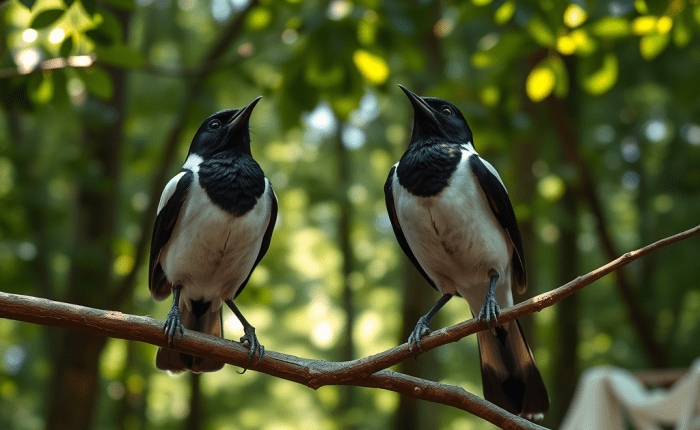
Magpies! Known as the world’s most intelligent animal, they are in the equally-smart crow family. Magpies have even been observed mimicking human speech. Trying to spot the Magpies on the on the deck, I thought of a time I visited Los Olivos, California. 

In the garden of a gift shop, I noticed a gregarious Magpie couple roosting on a shed.

“Look them in the eye!” 

The proprietor instructed me to interact with the birds because of my exaggerated curiosity. My friend, Cappi Quigley, tried unsuccessfully to lure me away to the California artists’ original wares displayed around the garden.

“They are wild pets,” the owner explained. “They’ll follow you, protect you. Lock onto their eyes and you will not be forgotten.”

We drove out of Los Olivos five miles up Figueroa Mountain Road to Michael Jackson’s Neverland Ranch for a look-see. MJ had been dead for about two years then. We managed to snap each other’s photos in front of Neverland’s iron gates, just as the guard shooed us away.

Two Magpies yacked and magged at us the whole time from low hanging olive trees. They had followed us up from Los Olivos and all the way back to town, swooping down on the car and yelling, as if they were warning us away from Michael Jackson’s ranch.

Folklorists report that Native Americans believe the sight of a single Magpie brings bad luck. But a pair of Magpies, as heard in the trees above the wedding, brings joy. I heard the Magpies again as Kirby and Nate exchanged their vows. There is a world where we might believe that those two Magpies have found their way from the trees above the wedding to Kirby and Nate’s backyard. And that the Magpies will roost on the shed, bringing joy to Kirby and Nate’s lives together as long as they live. 

Normal/Abnormal

Normal/Abnormal

Two nests of crow chicks fledged on my city street this past week. I wonder if the high-rise humans down the block noticed the chicks’ noisy beginning of life in the urban wild. Everyday for two weeks, I looked up from under the trees while walking Elsa. I saw the chicks poking their hungry beaks out of the nests, then stepping out to  bounce from leafy limb to limb to rooftop to balcony, squawking away. The parent crows flew farther and farther, screaming at their offspring as encouragement to get those wings flapping and join them in pursuing edible horizons. And then, quiet. They’re gone. They’ll be back, of course. But for now, the daily racket of new young crows has flown the coop.

How comforting to observe the steadfast natural order of things. These days, the built world I’ve known my whole life is breaking down so fast that I half expect the natural world to follow;  Lake Michigan to dry up and all the birds to drop from the sky. That bad? Sometimes. Experts say old-age limits short-term memory, exaggerates long-term. My long-term emotional memories are thus resistant to age-related decline. I’m in my 80th year, having just celebrated the 79th. The fear I felt watching the original Mad Max (1979),  Poseidon Adventure (1972) and Blade Runner (1982) bubbles up without reference to those movies. It simply presents itself as the world we know is over.

On the other hand, I’m convinced The Wizard of Oz gave me a love for birds, if not a curiosity about an unearthly world. Somewhere over the rainbow, bluebirds fly. Birds fly over the rainbow; why, then, oh why can’t I? 

Yeah, why can’t I?  

Every time a crow chick leaves the nest, some transcendental part of me follows. My earliest dreams were flying visions. I willed myself off the ground and flew around the neighborhood spying on people. God help me, if I had a drone. I’d probably be peeking in the windows of high-rise residences. 

There’s no question movies have influenced my core. They’re not saving me from worry, nor diverting the fear of living in a militarized police state. That long-term memory perverts itself into real and present danger. Can the now-pardoned Jan 6 insurrectionists show up as a Mad-Max-type private army? Would there be a search and rescue operation if my transatlantic ship capsized like the Poseidon? And worse, will there be an antidote for experimental robots gone bad as in Blade Runner?

Fortunately, the clouds of knowing break open every morning to a normal reality.  Recent shoulder surgery grounds me in pain. Friends gather for coffee. My granddaughter is marrying a super guy. Regulars show up at church. The same 12 Steps of Alcoholics Anonymous are read at every meeting. The “No Kings’ protest is actually a movement. The rabbits are back in the park. Elsa goes for walks. 

Normal and abnormal live side by side.

For now.

Fear of Kudzu City

Fear of Kudzu City


The gardeners in the small neighborhood park I call my own, butchered the beauty out of the spring flowers and attendant bird migration. In their zeal to prune away the dead and diseased tree branches, they yanked out all non-native “invasive” species. This disrupted the seasonal pattern of our expectations. As I wandered through the other day, a neighbor with her spaniel in tow stopped me.

“What happened to our flowers?” She yelled across the boxwood.
“The gardeners mulched it all into last years’ compost.” I said. I don’t know her, but here we were joined by a sudden mutual experience.
“They went too far! Can’t you do something about it?” 

Me? I must have spoken with authority about the Chicago Park District’s program to remove invasive species and introduce native plants. As usual, I imparted knowledge based on next to nothing. Last summer as my allergies exploded, I read an article in the Chicago Tribune about the Park District planting more allergen-producing native plants, like goldenrod.  A passing employee of the Chicago Park District once educated me on the park’s introduction of native plants, especially those glorious hibiscus. And a neighbor who is a volunteer gardener at the Lincoln Park Zoo spends her summer eliminating “invasives”. That’s the extent of my knowledge on the subject.

“You can go to the Park District Board meetings and ask about it,” was my know-it-all answer.

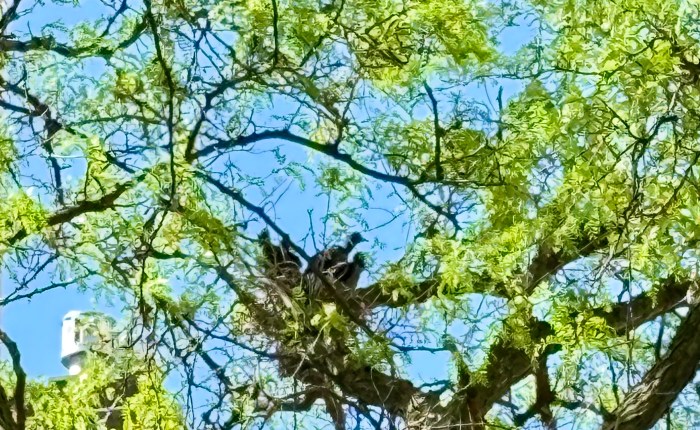
But Nature has once again reigned supreme in my city neighborhood. On my street, there is no human control over the crow’s nest and its four chicks that are flapping around in the branches. I watch them strengthen their young wings to fly out from their birthplace and fend for themselves. Wildlife never needs permission to be. But it does need protection.


The New York Times reported this week on one of Chicago’s best nature stories. The Lakeside Center at McCormick Place applied a treatment on its glass building to deter migrating birds from banging into it. Last year up to 1,000 birds died in one night at McCormick Place. This year, the deaths, due to the widow treatment, were down by 95%. Chicago’s unpopular mayor should take credit. For some of us this fact alone is enough to vote for his reelection.

Unfortunately there’s no treatment we can apply to protect ourselves from bumping up against the current man-made enemy that is called the United States of America. What can protect us from dirty air and water unleashed by industrial, vehicle and power plant toxins?

I envision a doomsday scenario, a post-apocalyptic environment like “the Last of Us.” Will my city’s native species die off and be replaced by invasive, toxic-loving kudzu? The White Christian Nationalists setting ecological policy have abandoned the Bible as their guide. Genesis 2:15, in all versions, clearly states we must tend to God’s creation.

NIV: The Lord God took the man and put him in the Garden of Eden to work it and take care of it.

KJV: And the LORD God took the man, and put him into the garden of Eden to dress it and to keep it.

NLT: The LORD God placed the man in the Garden of Eden to tend and watch over it.

CSB: The LORD God took the man and placed him in the garden of Eden to work it and watch over it.


NYT: An Illinois Building Was a Bird Killer. A Simple Change Made a World of Difference.


Chicago’s Urban Wildlife: Embracing Pluralism and Nature

Chicago’s Urban Wildlife: Embracing Pluralism and Nature

All over early-morning Chicago, garbage trucks back in and out of alleys using rapid beep-beep-beep signals announcing their hulking presence. Elsa the dog and I are indifferent to this annoyance as we take our morning walk. But in mid-April, we both jumped to attention. We heard what seemed like a hundred garbage trucks backing up. The wildly unfamiliar bellowed from a block down the street.

“What’s going on Elsa?” I shouted down to my agitated Westie on the sidewalk. All of a sudden two honking Sandhill Cranes flew through the center of the street below the treetops. Their wingspan swooped past us from sidewalk to sidewalk as they glided and bellowed toward Lake Michigan. 

Elsa flew into a barking rage. I lost my breath. My knees buckled. The Sandhill Crane is an ancient animal whose sole purpose is entertainment.

I love these four-foot high red-headed trumpeting birds. I once traveled to the Platte River on the edge of Nebraska’s Sandhills for their spring migration. My friends and I joined serious birders on the 5:00 am riverbank to view 600,000 roosting Sandhill Cranes. Their summer and winter homes are the northern and southern edges of the Great Plains. They are North Americans, Midwesterners.

Where did this duo come from and where were they going? They were likely in a flock following the Great Lakes Flyway, the migration route to their summer home in the boundary waters between the U.S. and Canada. Perhaps they were lured away by a mischief of rats feasting on the overflowing garbage bins in the alleys of nearby restaurants. Did a garage truck disturb their hunt? Whatever the story, I am deeply grateful they strayed from the flock and flew into my morning fugue.

Fugue? Yes, lately every morning I awake in a seemingly altered state. Oh, I tend a regular household routine, brain-fogged by radio news from the psycho-battleground that is my home country. Any diversion is welcome, particularly wildlife making its way through my city street.

But diversions, like bird spotting, are fleeting. The pluralistic society we’ve known as democracy is under siege. Pluralism, a word as ancient as the Sandhills themselves, one we learned in middle school, has been displaced of late by DEI or Diversity, Equity and Inclusion. DEI was corporate America’s answer to the communal guilt stemming from the sight of George Floyd’s on-air murder. The lofty goal of transforming Human Resource departments into offices of Diversity, Equity and Inclusion crashed and burned on the heels of Donald Trump’s name-calling presidential candidate Kamala Harris a “DEI” hire. Little did we know then, the summer of 2024. The weaponizing of DEI was not a diversion. Instead, it was a tactic in a larger strategy to destroy pluralism and make America White and Christian.

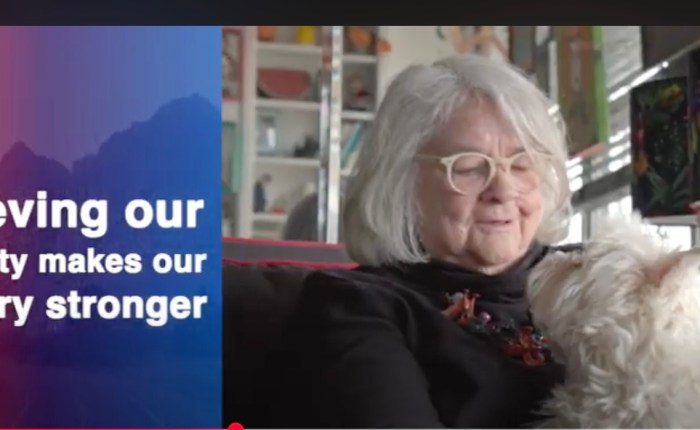
Interfaith America, the nation’s premier interfaith organization, has come to the battlefield now — taking the case for pluralism to the streets. A giant digital billboard in one of the most diverse locations in the country, Times Square, New York City, shows Interfaith America’s devotion to American pluralism. The message: diversity makes our country stronger. I’m in here, proud to represent my cohort, old white ladies with their dogs. Take a look.

‘There’s a special providence in the fall of a sparrow’

‘There’s a special providence in the fall of a sparrow’
There’s a special providence in the fall of a sparrow.

If it be now, ’tis not to come.

If it be not to come, it will be now.

If it be not now, yet it will come – the readiness is all.

— Hamlet

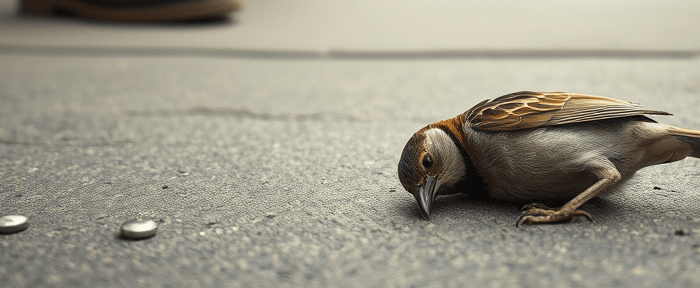
A sparrow fell from the sky and plopped down next to me on a sidewalk corner beside the church as neighbors, shoppers, and tourists bustled to their places.

“Damn! That’s disgusting!” Said a snap-back-hatted young man sidestepping around the splat. Looking the revenant himself as if returning from a dead weekend that probably started out fun on Friday night, he looked up. Was he searching for someone behind the clouds to blame?

“Look at it. So gross!” Looking down now, seemingly blaming the sparrow for its dead ugly existence.

Perhaps because I was headed to church, the sparrow’s lasting legacy in the bible came to mind. Scriptures tell us to look at how God cares for the lowly sparrow as a metaphor for how that same God cares even more for humans. But here I was, staring at a dead bird. Did that God in the bible throw the bird down beside me so I’d know who’s in charge around here? Is it an omen of a bad year ahead? A symbol of immortality? A sign to repent?

There’s a peregrine falcon nest directly east on Lake Michigan in the intake crib of Chicago’s water system. Those tricky raptors attack other birds in mid-air and sometimes miss their prey as they swoop down to catch them. On my dog walks, I’m constantly on the lookout for bird carcasses (sometimes impaled in the bushes) because Elsa will sneak a forbidden lick if I’m not vigilant.  I assumed the unfortunate sparrow was one of these victims.

If God set this complicated natural aerodynamic food chain in motion, so be it. I’ll accept that God. However, no God is going to snap me to attention about the upcoming election or remind me of some regrettable remark I’ve made by throwing foreboding dead birds at me. The same force may have set all the emotions of fear and regret in my DNA, but a god that powerful better not have my same human characteristics. I’m conscious of an impersonal force, something outside of myself, an unexplained presence. I believe there’s a higher power, that I call God. Holding that power out as a relatable, reasoned person that acts as a mean-spirited human, to get my attention is not my idea of a god. At least not today, or, not at this moment.

The ubiquitous house sparrow is not native to the United States, I’ve been told by birders. They chirp most of the US awake in the morning and nest outside our homes’ nooks and crannies. At Chicago’s Navy Pier, if you try to eat McDonald’s fries outside, you’ll be sharing them with sparrows. If you look at your phone outside the Pancake House to catch up on text messages, sparrows will swoop in and pluck at the remnants of your Dutch Baby. This diminutive invasive species is so plentiful that I give it short shrift, ignore it, as if it’s not important.

Until one drops from the sky on my way to church.

____________________________


Smelly Lilacs

Smelly Lilacs

The tulips were showing their last droopy colors. The iris’ were ready to pop for a week or two of runway-like exhibitionism. The trees in the small park were half-dressed, embarrassed by their young fresh leaves, waiting for their green siblings to fill in around them. 

And oh those smelly lilacs. 

Their short-lived incarnation makes me holler 

thank you Jesus. 

And then, the warblers.

Every spring is the same. Year after year. And yet, every single time, I’m shocked out of winter doldrums by the sheer variety of beauty and fragrance in the cultivated and in the wild city gardens. A text or an email or an article from birding organizations will remind me to listen for migrating warblers. They pass through as the tulips fade. I hear them. Never see them. 

Warblers visit Chicago on their way up north from Central and South America. They’re tiny. My old eyes are acclimated to spotting bigger birds—starlings, blackbirds, crows. Even sparrows are larger than warblers. I look, but mistake the warbler for a leaf or a twig, even a large bug.

But the other day, on an unusually seventy-five-degree May morning, I passed under a tree while Elsa sniffed around the ground cover for messages from new and old pals. I heard a symphony of birdsong overhead and looked straight up to see tiny bright-colored warblers flitting from branch to branch, hunting insects. 

I switched on my iPhone, pressed the Merlin bird app, and recorded a Tennessee Warbler, Yellow Warbler, Yellowthroat, and American Redstart all singing their wee hearts out within shouting distance. I suddenly realized I was in a bird “fallout,” a phenomenon that occurs when curious weather slams into migrating songbirds in the air and they descend into the trees below. 

The weather systems predict the number of songbirds that may be migrating over Chicago on spring nights. Attracted to their reflections in the windows of highrises, they accidentally kill themselves by flying into lit buildings.

The uncommon migration fallout happened twelve hours after Chicago’s unusual sky-drenching from the northern lights—yes, the northern lights! The aurora borealis: blazing bits shooting out of the sun, hitting the diluting atmosphere with undulating ribbons that lit up the Chicago night. All this only a month after a solar eclipse. 

Hyde Park residents Meghan Hassett and her husband Max Smith captured the northern lights from Promontory Point Friday, May 10, 2024. Provided by Meghan Hassett

In the park, a dog-walking neighbor neared with Zeus, stopped, and looked up. 

“Whatcha lookin at?”

“Warblers.”

“Oh,” and he continued on. He lives in my building and told me a few days before that he’s planning a hiking trip to the Rockies because he “likes nature.”

Me too.

Spirits, Good & Bad

Spirits, Good & Bad

Halloween was brought to the New World by my ancestors, refugees from the Irish Potato  Famine of 1845-1849. My amateurish genealogical sleuthing has churned up relatives in the Irish diaspora of rural Kentucky. Burkes, Flynns and Kilroys first appear during the Famine years. Place of birth on their official census records simply say: Ireland. Lineage dead ends there since the British, who ruled Ireland at the time, destroyed native records. Of eight million people, one million died and 2.1 million poverty-stricken souls emigrated during the four years of the Famine.

In 1844, English politician Benjamin Disraeli explained the “Irish problem”: “a starving population, an absentee aristocracy, an alien-established Protestant church, and in addition, the weakest executive in the world.” 

England left the Irish to die.

No wonder the Irish brought their dead ancestors, their heritage, their superstitions to the United States. When the harvest season ended on the night of October 31, Irish immigrants welcomed the spirits to walk among them. It was a celebration, a comfortable reunion between the world of the living and the familiarity of their dead. Little Patricks and Deirdres traipsed door-to-door on that one hallowed night seeking food for the incoming family spirits.

In short order Halloween in America became scary. Demons and witches took over, leaving me with nightmares, still. I cannot, will not watch fright movies. I get the heebie jeebies just looking at trailers for the entire Halloween franchise with Jamie Lee Curtis (though I love her).

The only reason I ever watched the movie, The Exorcist, is that the writer knew my parents and named the demon-possessed girl, Regan, after me. It chills me now even writing about her.

I’ve never been visited from beyond-the-veil by the devil, dead relatives or friends. Poets say spirit ancestors are flying around in the bodies of birds, particularly cardinals. Ethnologists have discovered that every culture honors spirits. From Christian angels to Buddhist arhats, depictions of creatures trapped between the living and the dead grace every ancient wall.

New research suggests people who experience the presence of ethereal beings, immerse themselves in practices that make the brain more porous, more receptive. I do that. I call it meditation. I don’t have the same experiences as indigenous peoples, but my twenty-minute practice of imagining my thoughts passing by on clouds, brings one nanosecond of pure joy. I choose to call this God, bypassing all the intermediaries. 

Author and mystical scholar Rev. Dr. Barbara Holmes had a visit from a dead aunt as a child. She shared the experience with the multiple generations of relatives sitting on the porch of their Gullah home in South Carolina. “Let us know if she comes to you again,” said one of the aunts. Their Africana heritage incudes a shared belief that the dead come back and talk to you.

My Irish-American parents buried their heirloom traditions, including the dead visiting the living, in order to assimilate into conventional white America. Halloween was a peasant holiday to be avoided. As was St.Patrick’s Day. 

Yes, the notion of the presence of the supernatural still scares me.

But I do love birds.

Shutdown Week 4: Shame

House sparrows have been chirping at my window. They’re abundant on my city street and in the spring they emerge from their winter hiding places looking for food. Last year for the first time, European starlings appeared. Sometimes I think I hear robins and cardinals but starlings mimic the sounds of other birds. They’re trying to trick me into putting bird seed out for the more colorful birds, not knowing I love them equally. 

Gutsy red-winged blackbirds abruptly premiered on the railing of my balcony, sucking the breath out of me. Their distinctive one-second long, loud musical trill called me from the breakfast table. Jet black bodies shouldered with red and yellow feathers held on fearlessly as I moved closer to the window. For years I’ve had black furniture with red and yellow highlights, imitating red-winged blackbirds. 

A friend called from Florida to say Happy Easter as I was tethering Henry for his morning walk.

“It’s Easter?” 

“Yes! It’s Easter,” and we laughed in that old familiar way, like we just discovered each of our days slips from one to another like egg after egg slipping into boiling water. We starting talking about the Shutdown. I extended Henry’s walk farther along Lake Shore Drive sensing a longer iPhone conversation.

“I can’t watch the news. Can’t talk about him,” she said.

I understand, of course. It’s what we all say and like all of us, she ended up talking about it anyway—said the Democrats need to present an answer to the question “why” to win in November. 

“The Democrats have moved their convention to August about the same time as my book release,” I said. “Let’s go to Milwaukee and sell books out of the trunk of the car, a trunk show!” We’ve had such adventures in the past, but plans cannot be made until the Shutdown is resolved. 

The outside world has been a physical threat since St. Patrick’s Day. At first I was in danger of someone sneezing on me. I’m in the vulnerable group. Now others are in danger of me sneezing on them. I may be an asymptomatic coronavirus carrier. 

Henry and I ended up sitting in the bus stop sheltered by an unexpected spring warmth. IMG_0871Walkers have taken to the street lately because the sidewalks aren’t wide enough to keep the reqiured social distancing. A woman in an ominous medical mask, six feet into the street, walked by and gave me a long evil eye. I’ve been wearing a cowgirl bandana for my mask and I neglected to re-cover my face after it slipped down when I was on the phone. Shaming eyes have replaced smiles and waves on the street. Watch out if you forget your mask. You’ll need to mend your wounds with a Brene Brown Ted Talk on shame from the daggers shooting out of your neighbors’ gaze.
The Stay Home battle cry presents no threat though. Settling into social isolation, I watch masked neighbors from the window.

And I pray for a visitation from the woodpecker I heard the other day.

Birds of a Feather

Birds of a Feather

On a ridge near the Fox River John and I soft-footed along the sidewalk stopping here and there for Henry, my terrier, to sniff unfamiliar markers deposited at the base of old-growth trees by squirrels, chipmunks, and, of course, dogs. I asked John the usual grandmotherly questions about school, his grades, homework. Science is his favorite subject and he likes moving from class to class now that he’s in Middle School. He pointed out homes of his school ’s vice-principal, classmates, older kids he knew. He said there are often turkey vultures shuffling around this lawn or that, looking for dead worms and garter snakes. 

“Did you know vultures ride the thermals?” He asked. And I knew what he was thinking—he wishes he could spread his arms like wings and let the thermals airlift him into the sky. I do too. We probably have the same dream.

Further along we saw a robin jumping across the grass.

“I never see robins in the city except in the park,” I said, “do you think that’s the robin singing?” 

“No, that’s a cardinal. In the trees. A robin goes yeep.yeep.yeep. A cardinal goes schwee-eet. schwee-eet,” he said.

When we returned to his house, we headed for the deck off the kitchen. He asked if Henry and I wanted a drink, then disappeared inside for a few minutes. He came back through the door caressing a lizard that stretched from his neck to his waist. 

Catching me staring at the hummingbird feeder dangling from the railing, he said, “We haven’t seen a hummingbird since we put up the feeder. But there are lots of yellow finches flying in and out of the lilac tree.”

I have no clue what 12-year old boys are supposed to know. There was a time when he carried a pocket computer around with him so he could play Mario at every possible moment. After a few years, Mario took a backseat to Minecraft and I thought cyber games would possess him for the rest of his life. So I was thrilled to hear these lessons in bird behavior so confidently plucked from deep within his genetic code.  

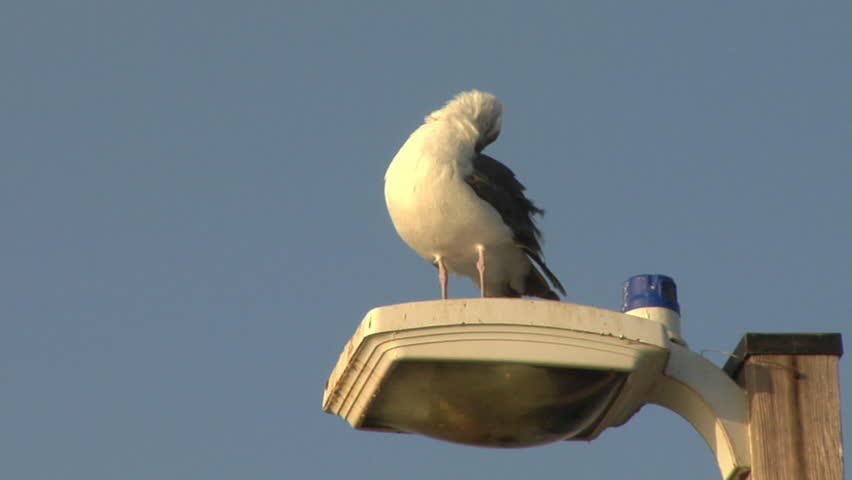
I shouldn’t be surprised. As a fledgling, before he could talk but after he’d learned to walk, his mother and I took him to Target. While we loaded bags in the car, John sat 1motionless in the shopping cart transfixed by a seagull preening in the sun at the top of a lamppost. A few years later, John and I were sitting on the sunny side of Navy Pier, taking a lunch break after whiffling around first-grader attractions in the Children’s Museum. Sparrows started hopping around our table and John surrendered his bagful of beloved McDonald’s fries to the birds. Crouching down on the pavement stretching his arm as far as it would go with a soggy cold fry dangling between his thumb and finger he tried to get the birds to eat from his hand. The outstretched arm tired and weakened so he propped it up with his other arm and went for at least a half hour. 

I rue that I see him so infrequently. But I’m comforted by my brood of friends with the same grandmother’s lamentation. Like birds on a wire we gather and chirp about our grandchildren, clucking out their accomplishments, funny remarks and milestones, ending with a feathered sigh.