Am I Having a Panic Attack?

Am I Having a Panic Attack?

Waiting in examination room #5 for the skin doctor, I suddenly felt separated from the real world. Where was everyone? Was I in the right place? The right day? The right office? Where was I? Space stretched thin like over-rolled pie crust. I focused on deep breathing but knew I had to get out of there fast.

There’s nothing wrong with my skin. My mother called it “cheap Irish skin” because the sun burns it bright red, never a gold-plated tan. Splotches of actinic keratosis or “AK” from years of sun exposure periodically scale up on my face. The dermatologist unholsters an aerosol can from her belt and shoots liquid nitrogen on my AKs during twice-yearly visits. It creates instant frostbite on the dead cells, freezing the AKs in place. It doesn’t hurt. There’s no downside, no need for alarm and certainly no reason to have a panic attack.

“Anything else I need to look at?” the dermatologist asked.

No. This wasn’t the time for new concerns about my skin. I was on the verge of collapse.

By the time I got down the elevator into a lobby chair, hyperventilation was threatening to kill me. I thought I’d been in exam room #5 for a few hours but when I checked the time only thirty minutes had passed. Why were my legs so weak? I focused on my breathing until I recovered.

Looking for understanding, I later mentioned the discomfort to a friend, who happens to be a doctor.

“What did they do for you?”

“Nothing. I didn’t tell them.”

“What? Are you crazy? If your blood pressure spiked you could’ve had a heart attack.”

She didn’t understand. It was impossible for me to report my condition at the time. The pinched air sucked the words from my mouth. I couldn’t talk. I thought I was going crazy.

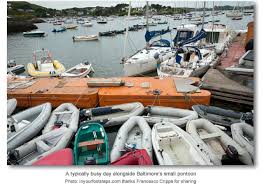
Panic attacks started in earnest a few years ago without any warning (not that I’d have recognized the warnings). I visited an old friend in the hamlet of Baltimore, a sailing community on the rugged southwest Irish coast. Vivienne and her friends were boarding a rubber inflatable one day for transport to a sailboat moored in Roaring Water Bay. She shouted “Get in!” as she crawled into the idling dinghy.images-3
“I can’t!”

“Yes you can. Get in! Get in!”

“I can’t! I can’t!”

I yelled at her over the roar and hum of end-of-summer harbor noise.

“Go without me!”

I ran to the bait shop restroom, then dragged myself to a wind-slapped bench and recuperated under the shade of a wild fuchsia hedgerow.

Later Vivienne joined me on the deck of the waterfront cafe. “I panicked,” I said. She understood. Convenient word, panic. 

Last year I panicked at different times in several US airports. There’s a simple solution to that—stay out of them. Now I face the unpredictability of panic striking at any moment and for no reason. I’ve considered revealing this malady to my friends in case I’m in their company if it happens again. I wouldn’t want anyone rushing me off to the emergency room because they don’t understand. But whenever I mentally rehearse the words, the room sways. I can hear the questions, “what are you afraid of?” and “why do you think this happens?”. 

The difference between me and Henry the dog is that as the human animal, I’m able to understand my psychology and articulate that understanding to others. But the stigma of perceived weakness stills me into secrecy. 

How would I know if Henry, the non-human animal, encounters panic attacks?

Tale of Two Friends

Tale of Two Friends

When the Vietnam war was over, there were no patriotic homecomings for returning veterans—no sympathetic bystanders thanking soldiers for their service. The American public shunned them. The same politicians who sent them to die for no good reason

denied their health care for post-traumatic stress and any cancerous effects of the US-deployed Agent Orange.

I’d been working on Adlai Stevenson’s campaign for Governor in June, 1986, when Chicago held a long overdue welcome home parade for her Vietnam War Veterans. One of Adlai’s supporters, Kitty Kurth, asked if I would round up some volunteers to help organize the march with the vets.

When I asked my unemployed friend, Alice, to join me in the march, she asked, “How much will I get paid?”

“Nothing,” I answered, “it’s volunteering.”

“You want me to walk for four hours with people I don’t know, for nothing?”

My acceptance of the call to volunteer with the parade, forced me to confront my shameful scorn in the sixties and seventies for returning Vietnam vets. As I slow-walked with 200,000 battle-scarred military men and women in silence through downtown Chicago, a redemptive veil flittered around me. I felt honored to be among them.

I can’t remember the first time I ever volunteered for anything. My family considered volunteering beneath them. They ridiculed me as a a naive idealist at best, a do-gooding loser at worst. Perhaps I started volunteering as a show of rebellion. Perhaps I sought refuge in something meaningful. I’ve abandoned friends, family and many living-wage jobs to work on political campaigns, for no money, surviving on unemployment benefits or credit cards. By the time my volunteering spawned a paid position for work I love, I’d racked up a lot of experience and a lot of financial distress.

Kitty and I kept in touch. We saw each other at various political events and campaigns. Then in July 1991, she asked me to volunteer with Comic Relief at the Chicago Theater, a star studded Tribute to Michael Jordan to raise money for homelessness. Assigned to greet Jane Curtin at O’Hare Airport, I escorted her downtown in a limousine, led her to the dressing room and kept her on time for her performance. All the volunteers hung out backstage and met Billy Crystal (a real jerk), Patty LaBelle (the nicest person in the world), George Wendt (another jerk) and Siskel and Ebert. Roger Ebert asked me every detail of my car ride with Jane Curtin. He greeted her by quoting some of her lines from3cb4ef3277b51b27070c9f70f7c10864 the Saturday Night Live Coneheads skit. He was as starstruck as I was.


At intermission, Michael Jordan appeared backstage to meet and take photos with the volunteers.

When I later bragged to Alice about Comic Relief, she was furious I didn’t include her.

“Well, you have to pay your dues,” I said.

“What’s that mean?” she asked.

Kitty has a lively communications firm and invites me to events she knows I’ll enjoy. Alice, like my family, derided me as a naive idealist. But I discovered life is more meaningful and a lot more entertaining when I just say yes. I’m not ready to give that up. Not yet.

Irish Buffet

Irish Buffet

A Hero’s Kitchen

I have no memory of my mother’s cooking before she left my father. After their Midwest life of drunken brawls, evictions and midnight moves, she relocated my sisters and me to the unfamiliar Jersey Shore as we approached adolescence.

The kitchen appeared to be an afterthought in our new four bedroom stucco: four corner doors led to the living room, the backyard, the driveway and the dining room. The backyard door swung open and shut on one side of the stove. The fridge sat on the other side, leaving no wiggle room between it and the stove, it and the living room door. It’s as if no one was expected to cook in there.

In an attempt to provide a semblance of order in her new-found single motherdom, Agnes sat her four daughters down to a gourmet dinner every night. Chopping and mixing occurred on the space between the stovetop burners or on the drain area of the sink opposite the stove. An unspoken rule kept food preparation away from the dining room table.

Agnes insisted my sisters and I learn to use the pressure cooker she’d acquired to whip up potato salad in the summer and mashed potatoes in the winter. After the lid blew off and the contents hit the ceiling, I never went near it again. Her recipe for pressure cooker spaghetti sauce required bunches of fresh basil, and Agnes could only find that at the summer farm stand. I don’t know how much the recipe called for, but she dropped so images-1 2much of it into the tomato sauce it came out like basil stew, delicious over spaghetti but awkward to twirl around a fork.
She thought gourmet cooking meant stirring wine into every dish, usually at the last minute. That way the alcohol wouldn’t cook off. She added wine to chile con carne, shrimp newburg, chicken a la king, beef stroganoff and all au jus sauces. My sisters and I exchanged glances when dinner guests remarked on the richness of the sauce. We’d dare not say anything about Agnes’ cuisine, especially the wine additive, for fear of her embarrassing reprisals like, “what do you know about cooking?”

Agnes cherished continental dining. We sat down to dinner around 8:30 depending on how long she stretched the cocktail hour. My sisters and I fought every night about whose turn it was to clean up. We were so tired by the end of dinner we often left dirty dishes piled in the sink. No one ever took the garbage out. Two or three grocery bags full of empty beer cans continually took up precious kitchen floor space. A friend once referred to the sight of it as an “Irish buffet” which Agnes thought hilarious.

As her alcoholism progressed, Agnes’ dinner-table attempt at a normal life fell by the wayside. But for a few brief years, in that tiny trashy kitchen, Agnes was a culinary hero.


One Giant Leap: Into The Slough of Despond

One Giant Leap: Into The Slough of Despond

I stepped onto the Aeroflot plane at the Frankfurt airport knowing it had the worst safety record of any airline in the world. In April 1996, four years after the dissolution of the Soviet Union, Aeroflot was still evolving from a state-owned to a privately-owned airline. The flight attendants wore drab suits rather than uniforms. They served all ten passengers boiled beef with a cheesy mayonnaise sauce. The seats were cardboard thin. Lights flickered on and off sporadically throughout the entire four hour flight to St. Petersburg.

As a member of President Clinton’s Advance team, I took a later flight out of Washington than the rest of the group. Each of us had Russian-speaking US Embassy counterparts in St. Petersburg and mine was meeting me at the airport when I landed.

In flight, I mulled over the phone briefing I’d received from the State Department’s Russia desk as I packed my bags in my cozy apartment in DuPont Circle.

“Don’t talk to anyone you don’t know,” she informed me. “Use only US Embassy vehicles and drivers. Exchange your money with the US Embassy staff at the hotel. Don’t eat food outside the hotel. Drink only bottled water. You’ll be followed wherever you go. Your room will be bugged. Beware of street vendors. They’re illegal and probably pickpockets.”

“Food?” I asked.

“Yes. We assume all the food and water has been contaminated with fallout from the nuclear accident at Chernobyl. The food and water in the hotel are brought in from Helsinki.”

At the utilitarian grey airport, Russian military manned the entry checkpoints. A soldier tried to tell me in Russian that I wasn’t allowed entry. I tried to tell him in English that an Embassy official was waiting for me. 

I was among a group of people in the federal government who were frequently assigned to overseas White House “advance” teams for the Clintons. None of the requests were mandatory. But my love for art and the chance to see the treasures in St. Petersburg’s renowned art museums compelled me to jump at the chance. Until then, I declined trips to anywhere that was a war zone, required inoculations for diseases or had a reputation for kidnapping Americans. I naively thought of St. Petersburg as a safe city. I had no idea what post-Soviet Russia was like.

When I finally saw the American diplomat in the deserted terminal, he stated the Russians delayed all the Americans in President Clinton’s party. Later in the week, as our team was on an official walk-through of the Hermitage Museum, a Secret Service agent asked me if I was the one “detained” at the airport. 

“Don’t ever travel alone to Russia again,” he said. 

We drove to the 120 year-old neoclassical Grand Hotel Europe in Nevsky Prospekt, the neighborhood where Dostoevsky set Crime and Punishment in 1866. Stepping inside, I faced marble floors, gilded walls and breathtaking stained glass. 

I set out to walk around Nevsky Prospekt, imagining Raskolnikov skulking around every corner. What I found was a sea of red-eyed people wrapped in nondescript clothes, fixated on the sidewalks. Furtive street vendors sold Beatles nesting dolls, artifacts from the Soviet era and peasant folk art. Russians teetered on the lintel between communism and capitalism. All their safeguards were gone—pensions, free education, health care and food safety. Uncertainty shrouded St. Petersburg streets. 

This city of revival palaces, Baroque monasteries and treasured art, became the most depressing place I’d ever visited. I’m reminded of that time in today’s shoulder-drooped America as we witness our autocratic-loving President driving us off democracy’s cliff into the slough of tyranny.

Out of the Closet: I Am A Christian

Out of the Closet: I Am A Christian

“We have this totally warped idea of what Christianity should be like when it comes to the public sphere, and it’s mostly about exclusion….no matter where you are politically, the gospel is so much about inclusion and decency and humility and care for the least among us. (How does ) a wealthy, powerful, chest-thumping, self-oriented, philandering figure like (Donald Trump) have any credibility at all among religious people.” – Pete Buttigieg

The Moral Majority, established in 1979, was predominately a Southern-oriented organization of the Republican Party’s Christian Right, but its national influence grew throughout the 1980s to the point where I was embarrassed to call myself a Christian. It was already hard, since I grew up in the Catholic church where only Protestants called themselves Christian. Catholics never did. Because of Democratic Presidential candidate Pete Buttigieg’s reclaiming Christianity for the Democratic Party, I can finally come out of the closet. I am a Christian.

When I marched into a church confessional and announced to the priest I no longer believed salvation was available to Catholics only, he said, “then you are no longer a Catholic.” I expected more of an argument, but at age 18, I felt I’d been set free. And adrift.

Until that moment, through all the alcoholic parental rages, multiple midnight moves, changes in schools and churches, only one place made me feel at home—the pew on Sunday morning where I heard Jesus loved me. 

Daniel and Philip Berrigan were my heroes then. The brothers were Catholic priests who’d been convicted of destroying military draft records in protest to the Vietnam war. I searched for a pew in their radical faith, but stumbled instead into the despair of drug and alcohol addiction. Another patriarchal Christian (but non-Catholic) church found me and delivered the familial message, Jesus loves you. Desperate to belong, I swallowed their conservative biblical fundamentalism for four years before I fled that oppressive pew. 

I tried to be a non-churchgoer. It was impossible. I’m at home in a pew on Sunday morning. I sought a simple pew in a simple church. They are easy to find, those simple churches. I hopped from one to the other long enough to know people by their names, feeling satisfied but longing for a more high-octane Jesus message. A lot of post-Watergate Christian pulpits were delivering bromides—safe words and a kindly gospel. Where was the social gospel of the Berrigans, Thomas Merton, Martin Luther King? Where were the Christian anarchists?

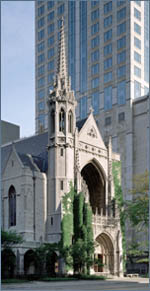
I lamented to a friend who suggested Fourth Presbyterian Church. For the first few years FourthPresbyterianChurchChicagoat Chicago’s Gold Coast Gothic Revival landmark, I arrived late and left early. I sat in the last pew, never opened the pew Bible, the songbook or recited the prayers. I didn’t belong there. I didn’t have the right clothes, right politics or right job. Indeed, I had no right to sit in well-ordered Presbyterianism.


Gradually I moved closer to the pulpit. I wanted to catch every word of Reverend Elam Davies’ sermons. Davies was slight of build, but a mighty orator. His spoken words came from deep inside his heritage, as if the whole of his native Wales was belting them out.

The first ten minutes of every sermon had me in sorrow. Sorrow for my selfishness, sorrow for my recklessness, sorrow for my sins. The next ten minutes had me laughing. Laughing for joy that Jesus knew all those sorrows and loved me anyway. The last ten minutes moved me to action. Action to protest policies that deprived people of basic human rights, action to help relieve indignities suffered by the victims of such policies.

When Elam Davies retired in 1984, I thought I’d be on the prowl for another pew. But each of the succeeding preachers have delivered similar bedrock messages that tell me every week: Jesus loves you. It’s been almost forty years since I first hid in that pew on North Michigan Avenue. I may not belong there still, but I no longer hide and the preaching makes me feel at home.

Dead Socks (Thank you Bruce Springsteen)

Dead Socks (Thank you Bruce Springsteen)

In Buddhist practice, one is urged to consider how to live well by reflecting on one’s death. 


When I was a young mother I watched a woman at the laundromat put her family’s socks in a mesh bag that she threw in the washer. “So none of them get eaten by the machine,” she informed me. I couldn’t imagine such a thing. It seemed extravagant, even lazy. Why didn’t she just look in the machines?

For all of my adult working life I wore pantyhose. I washed them in the sink and threw them over the shower rod to dry. They were (and are!) the ugliest piece of unworn clothing in existence, made more so by scary movies where criminals pull pantyhose over their heads to disguise themselves when they rape, kill or mug their victims.

Now that I no longer dress for business all my socks are bright cotton, primary colors. Whenever I do the laundry I love hanging wet socks on the foldable clothes rack in my bedroom. If I were an artist I’d paint the explosion of color hanging to dry. I diligently scour the washing machine in my building’s laundry room as I cannot afford to let even one errant sock get trapped and forgotten. This has worked for many years, sparing me the anguish of making decisions about left behind socks. 

Until Henry came to me. 

A few months into our life together, seven year old Henry and I were out for a walk. I bent over to scoop up his morning duty and stared down into a roll of turquoise cotton. Putting two and two together, I rushed home to inspect the bottom rung of the clothes dryer. One missing turquoise sock.

Oh Henry. This sixteen pound West Highland Terrier, without the advantage of a full set of teeth, supplements his dog food with cardboard boxes, cotton garments and paper. He’s sneaky but sometimes he brazenly waits at the printer for paper to eject and tries to gobble it up before I pry it from his clamped jaws. The other day, I looked over from my morning awakening and noticed the bottom corner of the cotton drapes had been Henry’s midnight snack.

You may wonder if Henry gets sick. Yes, he sometimes lays around more than usual. So far a bulging stomach seems to be the only side effect.IMG_0344

I panic though. I spray vinegar to make the reachable distasteful. But the unpredictability of his foraging renders me useless to keep him from harm. I’m sure his suicide is imminent.

And so, reflecting on his death, I sing to my sentient canid– my version of the Buddhist practice of living well. 

(To the tune of Bruce Springsteen’s “Oh Mary Don’t You Weep”)

Well dogs are quirky don’t you know. They eat stuff that we’d forgo. Sneaky eating’s got me worried. Oh Henry don’t you go.

Oh Henry! don’t you die, don’t go. Oh Henry! don’t you die, don’t go. Sneaky eating’s got me worried. Oh Henry don’t you go.

When I see your stomach ache, my heart starts to palpitate. Sneaky eating’s got me worried. Oh Henry don’t you go.

Paper, cardboard, pill bottle’os. Playbills, books and hanging clothes. Sneaky eating’s got me worried. Oh Henry! don’t you go.

Oh Henry! don’t you die, don’t go. Oh Henry! don’t you die, don’t go. Sneaky eating’s got me worried. Oh Henry! don’t you die.

I hope he sinks his teeth into the message.


Listen to Bruce: Oh Mary Don’t You Weep


Curious City: Scoop on the Poop at Chicago Beaches

Curious City: Scoop on the Poop at Chicago Beaches
 Recently NPR/WBEZ reporter Monica Eng called me about a question I submitted to WBEZ’s Curious City. She asked if I’d like to meet her at the Illinois water testing lab at UIC. Here’s what happened.

Regan Burke used to love taking her dog, Usher, down to Oak Street Beach for morning walks — until about a decade ago, when she says a lifeguard came up to her and told her to get her dog out of the water because E. coli levels were too high.

Ever since, Regan’s been worried about water safety at Chicago beaches.

Still, for a while, she felt confident the city was responsibly warning people and closing beaches when fecal bacteria (measured through E.coli) got too high.

“In the early 2000s, they really reported that every day, and you’d hear it on WBEZ,” she recalls. “It was on the regular Chicago news. But I don’t hear it at all now.”

So Regan wrote in to Curious City with a few questions:

Is that water safe for dogs? Why don’t they close the beaches for E. coli anymore? Are Chicago beaches safe [from bacteria]?

The answer to that last question depends on a lot of things, like which beach you visit, what day you visit, and how old and healthy you are. But it’s an important question because, on most summer days, at least one Chicago beach has elevated fecal bacteria levels. In fact, one city beach recently saw a level more than 300 times the federal notification level — and remained open. Also, the public appears to be confused about how to interpret the city’s new swim advisory system. And so, in an effort to clear up any such confusion, we offer this handy primer on fecal bacteria on Chicago beaches.

Regan Burke used to love taking her dog, Usher, down to Oak Street Beach for morning walks — until a lifeguard came up to her and told her to get her dog out of the water because of high E. coli levels. (Courtesy Regan Burke)

Regan Burke used to love taking her dog, Usher, down to Oak Street Beach for morning walks — until a lifeguard came up to her and told her to get her dog out of the water because of high E. coli levels. (Courtesy Regan Burke)

How do I find out how dirty a beach is?

Each morning at dawn, University of Illinois at Chicago researchers collect two water samples from at least 20 Chicago beaches. The samples are delivered to a UIC lab where they are tested for enterococci, a fecal indicator bacteria. The park district then takes the two readings for each beach and calculates a geometric mean (which is not the method recommended by the EPA; more on that later).

The city communicates its recommendations to beachgoers in three ways: on the park district’s website, through the city’s data portal, and through a flag system at the beach. Here’s how you can find it online:

Keep in mind that the Chicago Park District only posts the average (geometric mean). If you’re good with spreadsheets and you’d like to find the highest sample at your favorite beach on a given day, go to the city’s data portal after 1 p.m., export the data into Excel, and then sort to find the correct day and beach. Look under the “DNA sample” columns to find that day’s readings.

You can also check the flags posted at each beach:

Beach flags graphic

How can I stay safe?

Check the levels for your beach before you go. If fecal bacteria levels are anywhere near 1000 CCE, UIC public health scientists Sam Dorevitch and Abhilasha Shrestha say to consider avoiding contact with the water, particularly if you are:

  • Elderly
  • Very young
  • Immune-compromised
  • Pregnant
  • Or have an open wound
  • If you go to the beach before the website is updated, keep in mind that hard rains the previous day often result in high fecal levels the next morning.
  • If you swim on a day when levels exceed 1000 CCE, be careful not to swallow water or dunk your head.
  • Always wash your hands after swimming, especially before eating.

What can I do to make beaches safer?

  • Clean up your:
    • Food
    • Garbage
    • Diapers
    • Pet poop
  • Don’t feed the birds.

Wait. What? The city doesn’t follow EPA suggestions on when to warn people?

That’s right. The EPA suggests advising the public to take precautions when any single sample is above 1,000 CCE. The Chicago Park District, however, determines whether to notify the public based on the geometric mean of its two samples (which will always be lower than the highest single sample). In its 2012 guidance, the EPA suggests using the geometric mean “to assess the longer-term health of the waterbody”; not to determine whether to issue a daily warning. None of this EPA guidance is legally enforceable; it’s just a suggestion based on extensive research.

Officials from the park district defended their use of the geometric mean in a statement, saying: “Densities of [fecal indicator bacteria] are highly variable in ambient waters therefore a measure based off of a distribution, such as [geometric mean]…, are more robust than single estimates.”

Chicago Beach Poop By the Numbers, 2018 Edition

We crunched enterococci data from last summer, totaling 101 days. Below are some highlights, which take into account the differing standards used by the city and suggested by the EPA. Here are some highlights:

And what about the dogs and E. coli?

Chicago veterinarian Dr. Vaishaili Joshi says that dogs are exposed to E. coli all the time and usually don’t get sick. But, like humans, “immunocompromised pets, juveniles and seniors may be at higher risk of infection secondary to heavy exposure.”

More about our questioner

Regan Burke is a Chicago writer who worked in local and national politics — for Gary Hart, Bill Clinton and Adlai Stevenson — for most of her professional life. She details that part of her life in the upcoming book, I Want To Be In That Number, which she says is all about “politics and nervous breakdowns.”

As Regan grew up in Chicago and around the Midwest, she says her mom would often tease her for being a “nature lover.”

“I always thought of myself as a city person, but I do love nature,” she says. “That’s one of the reasons I’m more interested and cognizant of what’s outside my window than what’s inside my apartment.”

When she heard the final answers to her questions about the nature on the lake, she had a couple of reactions.

“Well, I’m very impressed at the level of testing that they do on the Chicago beaches,” she says. “But, at the same time, we don’t get the results until 1:30 in the afternoon.”

Still, Regan was pleased to hear that dogs are not very susceptible to E. coli., despite what the lifeguard seemed to imply.

But when she heard that the city will never puts up a red flag or close a beach, even when fecal levels skyrocket, she was not pleased.

“That, to me, is appalling,” Regan says. “The idea that at 1000 CCE there is a health risk — I can buy that. But when it’s 300,000 and they don’t close the beaches? I mean, how sick are people getting? And people go to the beach with their dogs, their children and their grandchildren. They must close the beaches when that happens. It’s just appalling.”

The 9 minute audio story has more information. Listen here.

Submit your own question to Curious City here.

Follow Monica Eng:  @monicaeng.

Poop flag by Katherine Nagasawa/WBEZ


Bodies of Grace Notes

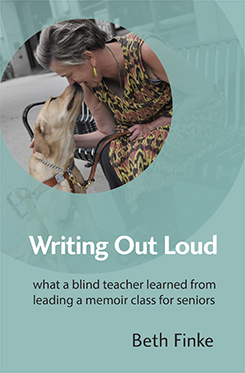
I wish I’d digested the dictionary definition of “somatic” before attending a community poetry writing workshop at Access Living. The non-profit organization advocates for an inclusive Chicago that enables people with disabilities “to live fully–engaged and self–directed lives”. Part of their mission is to generate programs that give voice to creatives with disabilities. I met my writing teacher, Beth Finke and her guide dog Whitney, at the door of the poetry workshop one evening in early June. 

When we entered the room, someone shouted, “Hi Beth!” and it became obvious the greeter attended one of Beth’s writing classes. I can’t go anywhere these days where I don’t run into a current or former student of Beth Finke’s. We sat on either side of a BethFinke-WritingOutLoud-525x8-CoverDesign-245x373young woman artfully made up with dark eyebrows, eyelashes and exquisite dark purple lipstick. Stephanie, her name tag read, had a white cane leaning on her chair.


Stephanie turned to me, asked in a low voice, “Is she the author of Writing Out Loud”?

“Yes, she is. Have you read it?” 

“I’m listening to it now.” 

Our blue-jeaned leader identified himself as Matt, a poet and artist with an intellectual disability, schizophrenia. Invisible disabilities are covered under the Americans with Disabilities Act and spoken of freely at Access Living. They include conditions like chronic pain, chronic fatigue, intellectual and psychiatric disabilities and chronic dizziness. I belong.

Matt tried to describe somatic poetry, using the work of poet CAConrad. He said writing somatic poetry is a bodily experience. All his words following that beginning were Greek to me. They bunched up together, slipped and slid all over each other like a fast-forwarded recording. I mulled my exit strategy. 

CAConrad invented soma(tic) poetics. It involves writing “rituals” like this:         (SOMA)TIC POETRY EXERCISE (abbreviated)                                                                         Wash a penny, rinse it, slip it under your tongue and walk out the door…get your pen and paper and write about POVERTY…”

1A CAConrad photo by Jason Dodge
Poet CAConrad

Conrad describes himself as “the son of white trash asphyxiation whose childhood included selling cut flowers along the highway for his mother and helping her shoplift.” I can, more or less, relate to this life, but not to his writing.

Matt instructed us to write a “ritual” or a somatic poetry exercise, like CAConrad’s. I choked out a few deep breaths and copied the style of the CAConrad ritual. We  ended by reading a few of our rituals aloud. One woman, who sat in front of the signer, described what she was hearing. Stephanie, the dark-haired beauty with the white cane, wrote about throwing her glasses out the window then frantically digging through the dirt to find them. I wrote about the best way to die.

Soma(tic) Ritual. Here & Now.  Find a small bible on your shelf. Look up passages on the best way to die. Read one out loud in the elevator as you descend to the lobby. Announce to the doorman that you are a preacher now. Consecrate him and circle out. Recite passage after passage walking down the street to the birds and the bees. Ask the guy sitting on his steps to read a passage to his big black dog. Go to the park and tell the mother with her stroller you are practicing the best way to die. Read a passage to her baby. Assume the position of one who is reducing the weight of the here and now. Make your voice move words into the trees so they know the best way to die too.

Later, when I couldn’t sleep, I clicked on “somatic”: relating to the body, especially as distinct from the mind. Ahh. We came together with distinct bodies using our distinct voices—diverse souls creating our own flash community. A perfect grace note to Access Living’s mission.


The Americans with Disabilities Act (ADA) was signed into law on July 26, 1990. Special thanks to Marca Bristo, founder, president, and CEO of Access Living who worked tirelessly to draft and win passage of the ADA.

It Pays To Know The Right People

It Pays To Know The Right People

Inauguration of Mayor Lori Lightfoot 2019

I hopped on the number three bus at Chicago and Michigan Avenues having no clue when to pull the cord for the Wintrust Arena. It was 7:30 A.M., too early for rush hour but people dressed in their finest stepped up at every stop as we moved on down the avenue. There was no mistaking the Wintrust bus stop. The cross streets swarmed with jaywalkers, Uber poolers, truants, bus trippers, policemen, VIPs and parkers from the garages. Parades of citizens streamed toward the entrances lining up for the eight o’clock opening. Volunteers in blue “Bring In The Light” t-shirts hoisted colossal signs pointing to the ADA entrances.

“What’s going on?” asked the bus driver.

“Lori Lightfoot’s Inauguration,” I said.

“Oh! The new mayor!” he said. “Great day. End of the Machine.”

Inside the Arena, old friends who’ve fought entrenched politicians for decades worked the event. Hi, Regan! Hi! Hi! I heard victorious voices all around helping me and other revelers find our way. They directed me to two seats, eight rows from the stage. The personification of old-style politics, the Daley clan, took their seats behind me. Even they couldn’t stop the trickle of joy dripping from their upended well-oiled machine.

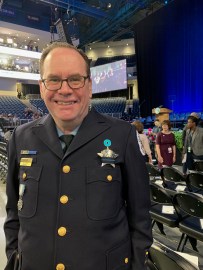
A Chicago policeman came running over to say hello. Matt Baio and I have known each other since we both worked for Speaker Michael Madigan in the late 1980s. Matt’s official post is guarding the inside entrance of City Hall. We’ve seen each other every time I’ve marched into that building protesting the previous mayor, or bought a dog license, or renewed my senior bus pass. I greeted him laughing, anticipating he’d be tickled about the new mayor.

“Matt, I just finished writing a book and you’re in it,” I said.

“What? No way! When’s it coming out?” 

“Early 2020. But I changed your name to protect you.”

“Is it about the time you asked me to be Bill Clinton’s driver?”

Yes, it is. And we had a riot reliving the story of what Matt, the silent navigator, overheard at the wheel in March 1992 during Illinois’ presidential primary.*

“Is it too late to use my name? It won’t hurt me. I’ve never been in a book. I’d be proud. Use Matthew Baio. I’ll buy a bunch and pass them out at City Hall. I gotta go tell my daughters. I’ll be over there by the stage if you need anything.”

My friend Peter arrived via train and bus from the far southwest side of the city. A security guard said he was ticketed for the bleachers and prevented him from joining me. As it turned out, I was also ticketed for the bleachers. I had been inadvertently led to the VIP seats. I eyeballed Officer Baio through crowd. After a brief kerfuffle including murmurs on the security guard’s walkie-talkie, Peter and I secured our prized seats. Reverend Jesse Jackson’s bodyguard sat down next to us keeping eyes on The Reverend in the row ahead.

img_0177.jpeg
Reverend Jesse Jackson and Peter Feldman

After the elected officials paraded onto the stage and took their seats, the diminutive powerhouse, Lori Lightfoot, was sworn in and came to the microphone. The articulation of her vision for Chicago hit every issue. And right smack in the middle of her speech she highlighted a fear I’d expressed to her during a meet-and-greet in a friend’s condo at the beginning of her campaign. 

“I’m looking ahead to a city where people want to grow old and not flee. A city that is affordable for families and seniors,” she said.

Was it because we were so close that Peter and I felt as if our new mayor was talking directly to us? Would we have sighed with relief feeling she actually cared about us if we’d been in the bleachers? I don’t know. But I do know that it still pays to be friends with the right people in Chicago.

_______________________________

IMG_0171
Officer Matthew Baio Lori Lightfoot Inauguration May 20, 2019


*To find out what Matt overheard, go to City Hall and ask him. Or, even better, read my book I Want To Be In That Number, due in early 2020.

Hurricane Whatever by Dorothy Pirovano

By Dorothy Pirovano

Floridians are pretty blasé about hurricanes. The season, now just underway, starts. Threatening warnings. Storms grow in intensity and velocity. Evacuations are suggested, then recommended, then insisted upon and… poof… Charlie or Irma or Michael or Matthew changes course and annoyed residents turn their cars around to return home.

How could I take the hurricane warning seriously in 1992 since it seemed no one else was? I was finishing up at the Chicago White Sox spring training camp in Sarasota, had my little compact white rental car and needed to get out of town to see my Dad an hour-and-a half north in Seminole. I was going to spend a couple days there – just him and me since Mom passed away. He said he’d planned a “fun day” for the two of us – mimicking the fun days I always planned when they came north for six weeks each summer. Mom was always ready for any adventure. Dad would seemingly grumble at being dragged to a museum, the zoo or a tour of the Joliet or Chicago neighborhoods where he grew up, but I knew he enjoyed the outings, especially if they brought back lost memories. Him planning and calling it a fun day confirmed it.

Getting across the parking lot to my car was an unexpected hurdle. It took all my strength to drag my little suitcase through the parking lot against the wind. I was soaked in seconds. But in the car I felt insulated from danger and the radio seemed to confirm that while this hurricane had potential, its course was undecided and evacuation not necessary – at least for the moment.

I knew the route, having taken it for the past several years when my assignment at the training camp concluded and I could go see my folks. A simple straight shot down I-275 almost all the way. Easy except for the Sunshine bridge – two bridges actually. The small one gave me butterflies, having had an irrational lifelong fear of bridges. I had to hold my breath and not look anywhere but forward crossing the big one – more than four miles long and soaring 430 feet into the air before it descended steeply back to earth. It was spectacularly terrifying butalternative routes would take two to three times as long making this the best way to get from here to there. Let’s go girl. Just do it.

The radio was warning about this and that being closed but since I had no idea where this or that were, I decided to plow on, reasoning they wouldn’t allow me to cross the hated bridge if it were dangerous. The lady at the toll booth took my money and suggested I do two things – hug the right shoulder of the bridge and keep the accelerator to the floor the entire time. Obedient and reinforced by the fact that she waved me on, I ventured out, noticing that I seemed to be the only car on the road – at least the only one I could see through the deluge. Thirty minutes later I’d managed the first two miles and was at the peak of the swaying suspension bridge, my car rattling, my teeth clenched in disbelief, too afraid to hesitate, to stop, to cry, so close to the right side I was afraid a gust would blow me up and over. The sharks were likely circling. The descent was no better. What normally took a few minutes was another half hour, accelerator to the floor, hands frozen on the wheel, my recitation of the 23rd Psalm drowning out radio warnings.

The man in the toll booth at the end of the bridge came out of his little house, stared at me and yelled something unintelligible into the wind as I crept by, shaking, breathing deeply, trying to regain control after what was seemingly a near-death experience. The ride to Dad’s was comparatively uneventful – some downed trees, blocked and flooded streets, lightning flashing through the pitch dark mid-day sky.

Dad was anxiously looking out the window when I pulled into the driveway,  braving the storm to retrieve me, both of us dripping from the 20-foot race into the house. A vision of calm and serenity, I smiled brightly, hugged tightly and agreed with him that it would have been absurd – suicidal even – to take that fool bridge here. Who on earth would even think about it?