|
|

|
|
|
|

A doctor I’d never seen peeked around the curtain of my Emergency Room cubby hole and softly announced I have clots in my lungs.
My entire joyless face broke into an involuntary smile.
“That’s great news,” I said.
The doctor pulled his head back, turtle-like, as if he’d delivered the news to the wrong patient.
“There’s a simple solution, right? No surgery? Just pills?”
“That’s right,” he said.
In the thirty-six hours I’d been in the E.R. I’d learned a few things.
First of all, most hospital employees say “E.D.”, as in emergency department, rather then E.R. I was in the E.R. because I couldn’t catch my breath. A few hours of oxygen fixed that. Nurses and doctors kept saying, “it’s good you came to the “E.D.” Everytime I heard it, I thought of those commercials for little blue pills. On the other hand, when I hear E.R., I think of George Clooney.
Second, a nurse asked me if I wanted to be admitted. Was that my decision? My friend Kristina, who came to rescue me from fear and confusion reminded me that we have to say “I want to be admitted”, to satisfy Medicare. If you hesitate in making that declaration, you’ll be farther down on the waitlist for a bed upstairs. And let’s face it, if you’re seventy-five years old and find yourself in the E.R. with tubes in your nose, you’re going to end up admitted upstairs.
Three: There are no beds, no blankets and no extra pillows. The board you lie on is a padded gurney. The E.R. is a whistle-stop on the way either back home or upstairs. No need for frills.
Four: The E.R .does not have food service. You may find out about the secret stash of turkey sandwiches, graham crackers and apple juice. But no one’s in a hurry to get you food. If you toss it, well, there’s the clean-up.
Five: The call button for the nurse is like an emotional support dog. It’s a comfort lying next to you, but won’t answer your call for help if you need to drag your tubes and drips to the bathroom down the hall.
Six: The E.R. has all the equipment for all the tests. It’s designed to get results fast. When someone says, “you can have a CAT scan here or you can have it upstairs”, get it done in the E.R. The upstairs equipment is for the entire hospital and there is a long wait, even for someone with clots in the lungs.
Seven: Watch for clues. When a doctor says we want you to take Eliquis but it’s expensive, that’s your clue to call your friend and find out what online Canadian pharmacy she uses. And yes, buying drugs from Canada is legal.
Eight: There are a lot of doctors, nurses and technicians coming and going using words you’ve rarely heard. Call in a savvy friend like Kristina, to rehash the diagnosis and the prognosis.
Most important of all: take a breath and let them take care of you.
In the past few years, whenever Ian would visit Chicago, he’d hole up in his hotel for hours working on some project for his job. I’d see him only at our favorite restaurants at mealtime. But this past Labor Day weekend, Ian came to Chicago freed from an old job, celebrating a new.
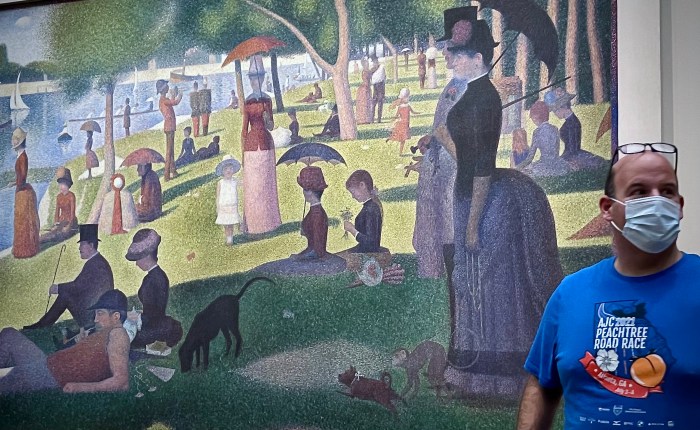
Our first night at a cherished outdoor restaurant was full of laughs about the ins and outs of “onboarding” the new job and the logistics of moving to Washington, where he hadn’t lived for twenty years. On Saturday afternoon I caught up with him in the lobby of his hotel. We walked a few blocks to the Art Institute for the last of the Bisa Butler exhibit next to the popular Impressionists gallery.
Early Saturday morning Ian had run a 5k in Chicago’s Beverly neighborhood. To get to the southwest side he’d taken the CTA train to 95th Street, then hopped a bus. Throughout our walk to and within the Art Institute, he reported his experiences on the Red Line.
“Are people living on the Red Line?” he asked while studying Georges Seurat’s Sunday in the Park. He’d entered the train under Grand Avenue at 6:00 a.m. and had trouble finding a seat for all the passengers and their belongings. A woman in a work uniform demanded a scofflaw in the corner stop smoking. An argument broke out among all the passengers at that end. “Leave him alone! He deserves to have a smoke whenever he wants,” a burly agitator shouted.
“You have libertarians in Chicago?” Ian asked.

In the Paul Gaughin gallery, Ian elaborated on how, at every stop beginning at Roosevelt Road, a young hustler stood in the doorway with his arms stretched out to keep the doors from closing.
“Gimme money! I’m not letting the doors go til y’all gimme some money,” he yelled to no one in particular until an exasperated hostage would give in. After a few stops Ian fled that car and ran onto another. When he finally disembarked at 95th, a policeman asked him why he was on the Red Line. Like he should know better.
Ambling among Claude Monet’s Water Lilies, I heard why he’d moved from his Michigan Avenue hotel after his return from the morning 5K in Beverly. The hotel was trashy—meaning real trash. There were food containers and empty Starbucks cups all over the lobby. The trash bins were overflowing. No sign of the maintenance crew. Boisterous tourists and children occupied every available lobby seat.
By the time we reached Georgia O’Keefe’s Sky Above Clouds IV, I looked back at the packed galleries. I hadn’t been in a crowded indoor space since before the pandemic. Suddenly my throat closed and my legs wobbled.
“I gotta get outta here,” I half-whispered to Ian. We darted through the less-crowded Modern Wing, out to late-summer Monroe Street and tender-loving Lake Michigan.

Excerpted from “In That Number”. Regan Burke. Tortoise Books. 2020
Fellow campaign staffers and I met Adlai Stevenson III at Chicago’s historic downtown restaurant, The Berghoff. It was 1986, Adlai’s second run for Illinois governor. We met to brief him on his speech that night before the Illinois AFL-CIO convention. He was already seated with a martini.
The AFL-CIO endorsed Adlai four years earlier during his losing campaign against Jim Thompson. As governor, Thompson legalized collective bargaining for the state employee union, a major victory for the union and state workers. By the time Thompson’s reelection rolled around, unions had broken their traditional bond with Democrats and endorsed the Republican governor.
Adlai formed the Solidarity Party that spring because right-wing followers of Lyndon LaRouche won two spots on the Democratic ballot in the March primary. Adlai, repulsed by the LaRouchies’ conspiracy-ridden statements, refused to be on the Democratic ticket with “those neo-Nazis”. The campaign desperately needed labor union members to fan out around the state and educate confused Democratic voters on how to vote for the Solidarity Party.
On this September evening Adlai would present his labor union bona fides and make the unusual plea to the rank-and-file audience to vote for him even though their leaders had endorsed his opponent.
Adlai kept his busy daily law practice while campaigning for governor; we were accustomed to briefing him either in his office at lunchtime, at the end of the workday, or in the car on the way to his evening campaign events. Once in a while we’d meet up with him at Berghoff’s, his favorite Loop restaurant.
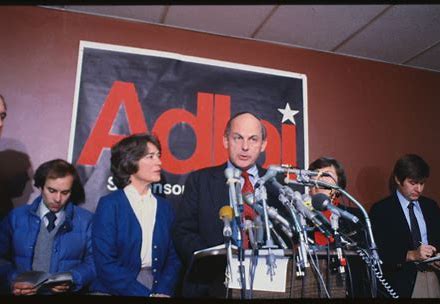 Adlai ordered another martini, a steak, baked potato and a salad. We ordered nothing. We had a lot of ground to cover, and food and drink would be in the way. When the second martini arrived, Adlai asked for beer with dinner.
The campaign’s fast-talking policy director, David Oskandy, laid out elements of the speech he’d written, emphasizing important transitions, including the obligatory laugh lines (which didn’t seem so funny to me). The press secretary, Bob Benjamin, presented the anticipated media questions Adlai might be facing after the speech—especially those having to do with Adlai’s recent off-the-cuff remarks where he’d mused about replacing union highway workers with unpaid prison inmates. My part, as the campaign scheduler, was to familiarize Adlai with last minute changes to the schedule, review the personalities and politicians who’d be at the event, and give him an estimate of how many Stevenson supporters (holding “Labor for Adlai” signs) would be in the audience.
Adlai listened as he ate his dinner. He ordered another beer. The three of us interrupted and contradicted each other, talked frantically fast, repeated ourselves, and got louder and louder—we acted like we were racing against the clock, although there was plenty of time before the evening’s event.
After dinner Adlai ordered a brandy, sat back in his seat, as if he’d pulled the car over to quiet squabbling children. He asked questions of each of us. And as informed as we all were in our roles, we had no answers to his questions. He proved to us, as he always did, that he had an unmatched deep intelligence, housed in a mind that absorbed information, clicked through and organized it, then rolled out high-caliber ideas sprinkled with vocabulary few understood.
He savored Irish coffee as he held forth on the history of labor unions in Illinois, and the Stevenson family’s complicated legacy with them.
The press secretary gave the signal that it was time to hit the road. Adlai stumbled to his feet and muddled through thank-yous and goodbyes. David and I locked eyes in terror.
We slumped on the table. Finally, David ordered his own martini and said, “Oh well. No one ever understands what he’s saying anyway.”

Point Pleasant Nursing Home was a popular employer for minimum wage teenage workers.
The Jersey Shore’s borough of Point Pleasant straddles an expanded spit of land on the Atlantic Ocean between the Manasquan and Metedeconk Rivers. The 25,000 year-round residents reluctantly provide an oceanfront haven for summer visitors. Evelyn Adams, two-time winner of the New Jersey Lottery, is Point Pleasant’s most famous citizen.
An old colonial institution, Point Pleasant Nursing Home sat on the highway a mile away from the mainstreet town of shops and restaurants. Shoppers at the Brave New World Surf Shop across the road supplied a low level hum of traffic.
At my interview for the job, a clear dress code was laid out: wear a uniform, no flip flops, no make-up and no jewelry. My waitress uniforms from two previous jobs at the Asbury Park boardwalk and the Olde Mill Inn were acceptable.
New employees trained on the night shift. On my first night I clocked in at 11:00 pm. A seasoned attendant showed me the ropes. Direct patient care, other than help feeding those who needed it, was the responsibility of the nurses. We were helpers.
Some residents were roaming the halls though it was way past lights out. We left them alone so they wouldn’t get too agitated and scream at us, which would have cascaded into waking others. Eventually they would go to their rooms, but we had to keep an eye on them lest they fall asleep in the hallway and keel over. There’s a certain knack, instinct maybe, to knowing just the right point to steer people into bed. It might be droopy eyelids, slower walking, leaning against the walls; every patient’s body gave off a different signal. My trainer told me not to worry, that I’d pick it up fast.

When all were safely tucked into bed, we began straightening up the day room while listening for disturbances from the sleeping patients. My job was to put games like Monopoly, bingo and chess in their respective boxes and wiggle them into overstuffed cabinets. I wrote down pieces of each game that were missing so the next shift could look for them in patients’ hiding spots—pockets, drawers, purses.
A completed jigsaw puzzle of an Impressionist painting lay on its box cover under a window. I put the pieces back in the box and stuffed it into the cabinet along with art supplies, books and magazines. The maintenance crew cleaned and swept.
I was instructed to offer a simple greeting to each awakening patient before my shift ended at 7:00. One woman wandered toward the day room. I followed her. She stopped at the space where the completed jigsaw had been and looked at me panic-stricken. In a flash she grabbed my hair, shrieked I stole her art, and smacked me in the face. By the time the nurse reached us we were both screaming.
And that was the end of that job.
Twenty-five years later my mother was moved to Point Pleasant Nursing Home after assisted living facilities could no longer care for her. By that time all the people with Alzheimer’s disease and other dementias lived in dormitory settings on the first floor. My mother spent her time taking clothes and jewelry from others and hiding them in her closet. The nurses kept a watchful eye but said nothing. They were as relaxed with her as they were years prior when people roamed the halls until they tired out.
Until the last, my mother did what she always loved: broke the rules.
A couple of weeks ago hundreds of email addresses in my contact list found the following message in their early morning inboxes:
When I retired a few years ago, I weaned myself from compulsively opening emails before wiping sleep from my eyes. So when I entered a busy common area in my building headed out to walk the dog, I was surprised to be greeted by fellow residents calling out, ‘Are you ok? What do you need?’ Even the doorman caught up to me to hand over a note from the building manager, “Change your password. Your email was hacked.”
One incoming neighbor bogged down with groceries said he knew the strange email wasn’t me because the grammar was so bad. That’s nice. To be known as a good writer.
But when email responses to the hacker started hitting my inbox, my equilibrium wobbled off its tracks. Acquaintances I hadn’t been connected to in years started questioning my need:
Regan, I’m sorry, I can’t do that today. I could get one tomorrow late afternoon and drop it off. Would that work? If so, where do you live?
The next few hours, days, and, weeks (!), were a fast and furious miasma of Google searches and You Tube queries on how to fix a hacked email. Change the password in your computer and your phone. Forward all incoming to your other email account (unused result of long ago clickbait about security). Change email addresses and passwords at banks, doctor’s offices, the pension office, Amazon, Etsy, Social Security—get the picture?
Well into the Fix, an email appeared from Microsoft announcing unusual sign-in activity from Nigeria. Nigeria? Too much of a cliche. I ignored it. By the time I sought online help from Microsoft I was 50% into the Fix and wasted an hour in Microsoft Chat. The Chat used the same bad grammar as the email that triggered my friends to alert me. Was this the hacker?
The curiosity demon woke me at 3:00 a.m. and goaded me into googling Nigerian Hackers. The headlines alone scared me into the kitchen in search of chocolate comfort.
When I finally got to my voicemails, expecting soothing sympathetic concern, I heard: “Regan. This is Inez. I got a message from you asking for help. I want you to know I would never help you because, well, I don’t like you. You need to call me back.”
I didn’t.

Adele pulled herself out of alcoholism, made a small fortune in real estate and provided shelter and security for her four children and husband. I met the whole family at an evangelical christian church in the early 1970s. As my role model for a brief time, she showed me how to survive in the extremist Christian cult. Neither of us belonged. We tripped over the threshold searching for a deeper understanding of the word “God”, and got sucked in.
She rejected the White male elders’ biblical interpretation that wives should not work, that the man is the head of the hosehold. I trusted her. She was on her third marriage; she convinced me that financial independence was the first step to freedom if I wanted to get out of my violent second marriage.
The ease of Adele’s sales skills to prospective homebuyers enthralled me. I wanted to be like her. I studied and finally earned my own real estate license while working as an unpaid apprentice to Adele in a planned development. Month after month with no salary and no prospects, I persevered, supported by my husband’s income and buoyed by Adele’s words: “You only need one sale.”
One day a couple in a splendid new car parked in front of the office. I ran out to greet them, showed them the model, obtained qualifying information, and walked them around the grounds to view the plots. The couple, Princeton University professors, picked out their dream house-to-be, and I called the owner of the development announcing my first sale. The owner arrived with a blank contract as the couple discussed their choice of bathroom tiles. I envisioned thousands of dollars exploding in my mailbox.
Since high school, I’d been politically active, and at age twenty-seven, I had no evidence to suggest that America wasn’t heeding the call to social and racial change espoused by John and Robert Kennedy and Martin Luther King, Jr. It never occurred to me that people thought any other way.
The owner hemmed and hawed, saying he wasn’t sure he could provide the couple their tile choice, or carpet, or kitchen cabinets. Still, nothing about his interaction with this couple seemed unusually negative, at least not to me. They signed a contract contingent on later negotiations for the decor.
The whole project slowed, then halted. Adele claimed the money ran out, thanked me for my sweat equity, and found me a part-time job making stained-glass lamps.
A few months later, I stood at my mailbox reading a legal notice naming me and the owner in a civil rights lawsuit for discrimination against the Black couple from Princeton. Adele brought me a news article saying the NAACP was testing the efficacy of the Fair Housing Act of 1968 by sending Black couples to White neighborhoods to purchase homes.
“See?” Adele said. “They were shills.”
It never went to court. I crawled away from my adulation of Adele. And left the real estate business.

The doctor mouths “four to six” in answer to my question. Her eyes say more: I’m sorry, there’s no fixing this.
“Four to six weeks?” I whisper back.
“I’m ordering physical therapy and pain management at the Shirley Ryan Ability Lab.”
I tell her I hate that place. The truth is I’ve never been there. The MRI shows a tear in the muscle connecting my thigh to my groin, the gluteus mimimus. Oh, and attendant flexor tendonitis. It feels like all the knives in the drawer have been thrown at my right leg. I look for hope in the word “inflamed” as if it’s a fire to be extinguished. The doctor assures me steroids reduce inflammation, but pain remains until the muscle heals. She arranges for a wheelchair to fetch me.
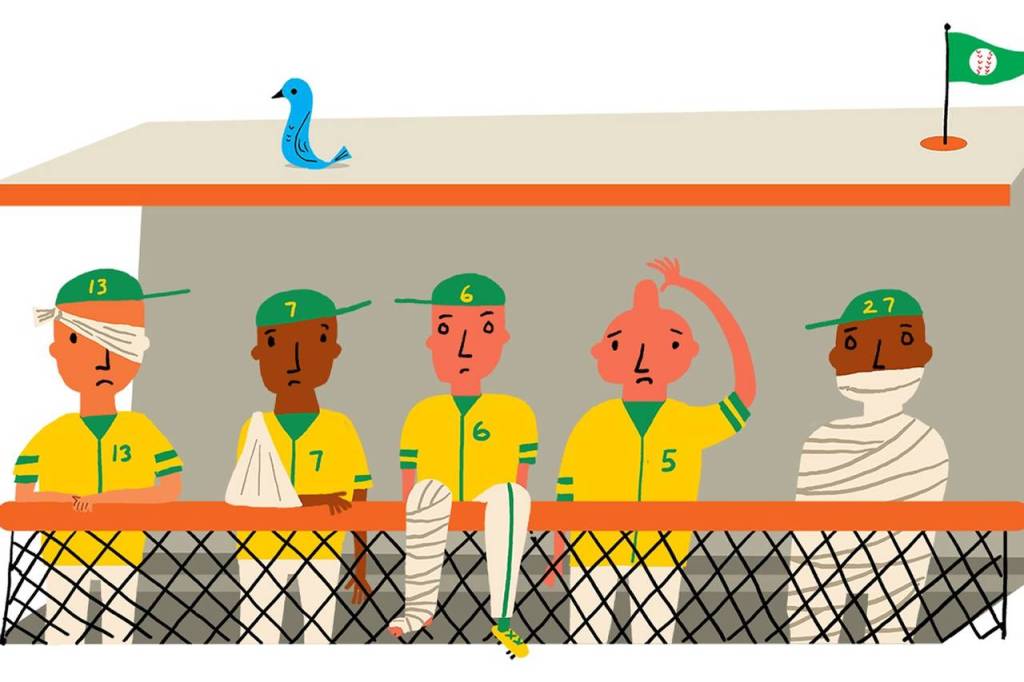
“Is this what puts baseball players on the Injured List?”
“Yeah. This kind of injury puts them out for the season.”
Major League Baseball has two Injured Lists: the 10-day IL and the 60-day IL. Players move off the active roster and onto the IL depending on the prescribed recovery time of the injury. NY Mets pitcher Jacob DeGrom spends a lot of time on the 10-day IL. He says he doesn’t know what he does to cause the tightness, tendonitis, and soreness in his various body parts. Well, I know! He’s throwing, running, reaching, stretching, swinging.
Not me.
All I do is walk the dog and water the geraniums.
This is the summer we all break out of our pandemic packaging, swing our arms around the human race and make big, unmasked plans. As soon as we notice our freedom shoes under the bed, we meet the day like it’s Christmas morning. After spending fifteen sheltered months behind closed doors humped over Zoom squares, curled around books and squinting at TV subtitles we’re ready for the party.
I’m supposed to be riding my bicycle to newly reopened lakeside hot dog stands and hip new coffee shops. Instead, the IL calls for friends to share their leftovers and homemade cookies at my table.
I’m eager to get out and do what I did 18 months ago. I ignored the caution to start slow and go slow in reinvigorating muscles that weakened during the shutdown. Kaiser Health News published a lengthy article about “older Americans struggling with physical, emotional and cognitive challenges following a year of being cooped up inside.” Nina DePaola, Northwell Health in New York, warned that getting back in shape may take time. “Pace yourself. Listen to your body. Don’t do anything that causes discomfort or pain. Introduce yourself to new environments in a thoughtful and measured fashion,” she said.
Thoughtful and measured pacing eluded me as the city gardens came into full bloom. I walked farther and faster. I did nothing to injure myself. Neighbors who see me now with a walker offer a simple hello. If anyone asks I say I slid into third.
Now each painful step is involuntarily thoughtful and measured. I shelter in place dreaming of freedom.
Secretary of Defense Donald Rumsfeld, whom Richard Nixon once called “a ruthless little bastard,” had been a key architect of the invasion of Afghanistan and the Iraq war after the attacks on New York’s World Trade Center on 9/11/2001. By the end of 2006, he’d resigned, battered by controversy over the torture of enemy combatants. He was accused even by his generals and officers in Iraq of poor military planning and strategic incompetence.
Then one Sunday he showed up at my church.
In the early 1980s I’d been on the big search for a church where God shared an unbuttoned space with the intellect. I had exhausted myself in eastern religiosity, women’s Bible studies, spiritual communities of light and love, and the emotional squeeze of evangelical Christianity. And then my friend Paul Galloway told me I’d like Pastor Elam Davies at Fourth Presbyterian Church on Michigan Avenue. “He’s a great orator,” Paul said. Davies’ exegeted sermons, intellectually agile, always distilled into one message: love God, love your neighbor. I became a Presbyterian.
And now Donald Rumsfeld, a fellow Chicagoan, a neighbor, was sitting alone in the pew in front of me under the pulpit.
I had never seen him in church before, but I knew he was a member. Everybody knew. Church people had wanted him thrown off the rolls, banned, shunned. Pastor John Buchanan, a true statesman who had denounced the Iraq war in every sermon, once had to announce to the congregation, “Donald Rumsfeld is a member of this church, and that’s all I’m going to say about it.”
All through the service that Sunday I stared at the wisps of white hair on the back of his neck, formulating what I would say to Rumsfeld after the closing benediction. Perhaps I’d ask him if he regretted what he did, or perhaps I’d ask how many civilian deaths he was responsible for. I settled for one word which I intended to deliver with samurai precision, swift and deadly.

Pastor Buchanan, who knew about my activism against the war, jumped down from the pulpit as the service came to a close. He didn’t stand at the center to recite his usual benediction. He walked swiftly over to Rumsfeld instead, greeted him with a handshake, and quickly escorted him towards the side exit.
I lunged forward from my seat intending to chase after Rumsfeld with a clenched fist, sputtering: “Murderer!” But he got away.
The church places a white rose at the podium whenever a member dies, and lists the decedent in the bulletin. This week the bulletin read: “The white rose in the chancel signifies a change in the life of our congregation. Donald Rumsfeld died on June 30th 2021. We give thanks to God for the promise of eternal life.”
And I give thanks to the church for continuing to teach me about love.
Excerpted from “In That Number”. Chicago: Tortoise Press (2020)
 Ageism and age discrimination are different. Age discrimination raises its ugly head in institutions, corporations and housing. Experts often refer to ageism as complex and subtle. It is subtle, but not that complex. When someone addresses us as “young lady”, the implication is that young is good, old is bad. If we act flattered, we’re perpetuating the stigma. The expression “senior moment” aims to joke about aging memory loss as if it is an embarrassment rather than a normal part of getting old. One of our neighbors is often called “young at heart”. She’s an eighty year old woke grandmother who likes Chance the Rapper and marches in anti-racism demonstrations. “Young at heart” diminishes the lifelong experiences that have brought her to her own reckonings. Yes, ageism is subtle, but really, it’s not so complicated.
 Regan Burke