Early in my sobriety, a therapist told me to volunteer in order to get out of my depression. I almost went for her throat.
“That’s your advice? How can I help anyone when I can hardly get out of bed?”
In Alcoholics Anonymous, we’re told self-centeredness is a common trait that leads to drunkenness; it’s suggested that serving others will help keep us sober.
“It’s a spiritual principle. Don’t overthink it. Just go help someone.” An AA meeting-goer told me when I was whining about the blues one January.
After years of campaigning by activists, members of Congress, and Coretta Scott King, President Ronald Reagan finally signed a bill creating a federal holiday in honor of Dr. Martin Luther King, Jr. Observed on the third Monday of January, dear Martin was first celebrated in 1986.
“You don’t have to have a college degree to serve. You don’t have to make your subject and verb agree to serve. You only need a heart full of grace. A soul generated by love.” MLK told us.
Grace is an indulgent gift from the cosmos. A heart full of love sounds too godly for my rebellious nature. For some, it comes naturally. Not for me. I meet many people I don’t want to love or serve. I balk. This is why I must be told to commit to love, commit to serve. Every day, I’m reminded of the promised rewards: freedom from melancholy and self-pity. The promise is appealing—and attainable.
During the month of January, organizations, politicians, GenXers, and citizen elders all celebrate MLK through service to others. Rush University Medical Center in Chicago offers a few easy opportunities.
Celebrate at a hybrid event: “A Lesson from Dr. King: Health Equity is Everyone’s Business,” on Wednesday, January 17, from 1:00 -2:00 pm. Experts share how to work towards ensuring everyone has access to their highest level of health. Click here if you’d like more information.
Volunteer in person in Chicagodistributing 300 meals on Friday, January 19, from 10:30 am to 12:30 pm. Multiple volunteer roles are available (preparers, packers, and drivers). Want to help? Click here for more info.
Mentor with the Community Health Mentor Program. Teach first-year graduate students about living with chronic conditions (high blood pressure, diabetes, alcoholism), as well as guide them in becoming patient-centered practitioners. All Community Health Mentor meetings will be on Zoom. Mentors receive up to sixty dollars in gift cards for participating in the training and all three meetings. The meeting dates are Wednesdays, January 24, February 14, and March 20, between 1 pm -6 pm for 60-90 minutes. Click here for more info or email Hannah Weitzman, Program Coordinator, at hannah_weitzman@rush.edu.
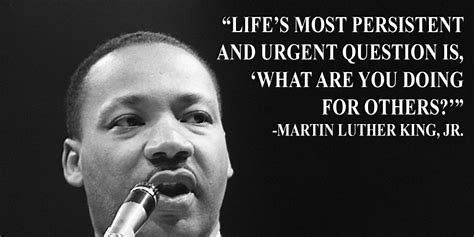
Dispelling my preoccupation with self is a lifelong endeavor. It’s comforting that MLK recognized this is true for many, which is why he gave us all the big quote:
“Life’s most persistent and urgent question is, ‘What are you doing for others?”
The first movie I saw on Christmas Day was To Kill A Mockingbird in 1962. Since I suffered from an endless holiday hangover, little of the story stuck in my saturated brain. As a high school freshman, when I was still afraid to fail, I’d read and reported on To Kill A Mockingbird. Until Mockingbird, I hadn’t seen a movie created from a book I’d read. Fortunately, the film is still so popular it’s come and gone enough times on TV for me to watch it again. And again.
A Christmas Day movie-going tradition began, sometimes with friends, sometimes alone. At first December 25th movie releases offered an escape from uncomfortable family time. Before I got sober in 1976, mandatory holiday gatherings handed out one big gift-wrapped box of shame. Movie people count on family escapees, I suppose. Some of the best movies have been released on Christmas Day: The Sting, Catch Me If You Can, Broadcast News, Sherlock Holmes, and Tombstone.
Every Sunday when my son was a toddler, he’d nap as his father studied, and I’d go to the movies. When he was old enough, we went to the movies together, especially on Christmas Day after the divorces, when it was just the two of us. When he was seventeen, he convinced me to see Talking Heads’ 1984 concert film, “Stop Making Sense.”
“I don’t like punk rock,” I said.
“It’s not punk. It’s different. You’ll like it,” he convinced me.
He had his own band at the time and knew his music, so I trusted him. He was right. I blasted the “Stop Making Sense” cassette on my car radio until the tape wore thin.
When movie buddy Marca Bristo was alive and in town, we couldn’t wait to get to the first showing of the Christmas Day releases before she returned home to her family dinner. We’d usually discuss the movie over after-theater coffee, but on Christmas Day, coffee shops closed, so we’d sit in the quiet theater afterward, mulling the pros and cons. Marca died in September 2019. The Christmas releases that year included Little Women, 1917, and It’s a Beautiful Day in theNeighborhood. I chose Just Mercy, which tells the true story of defense attorney Bryan Stevenson and his client, a black man falsely accused of murder. A powerful advocate for people with disabilities, Marca would have chosen the same.
Movie theaters closed for a while at the beginning of the Covid pandemic in 2020. I’m so wary of catching Covid and all manner of infectious diseases that I’ve not been in a movie theater since Christmas 2019. It’s tempting to see the re-make of The Color Purple, which will open this year on December 25. But every time I’m in a coffee shop or at a public event and someone sneezes or blows their nose, low-level panic attacks. Reclining in a multi-plex next to strangers for two or three hours’ worth of entertainment is out of the question.
The 2019 Polar Vortex slid down from the North Pole, threatening to lock Chicago into subzero stillness. I prepared for the warring cold by teeing up the entire 18-hour series of The Marvelous Mrs. Mazel. Then I threw stale bread crumbs onto my balcony to nourish the house sparrows, finches, and chickadees before they huddled together in eaves and cracked soffits to wait it out. I shuttered in and Dapped all the little crevices around the balcony door that were spritzing air into my not-so-insulated living room. That was the extent of my preparation for the coldest two days ever recorded in Chicago.
Day one brought minus 23 degrees. I woke to a thick film of silver ice covering all the windows. The ice curtain obscured the humanity moving around behind the windows across the street and any fool pedestrian walking in the feels-like-minus 40.
My binge-watching was interrupted mid-morning by a thrashing whomp, whomp whomp on the concealed balcony. I inched toward a clearing in the frosty glass.
A murder of crows had come to forage.
The much-studied American Black Crow might be the most intelligent animal other than primates. They hide their food and come back for it. If a crow looks you in the eye, she will remember you, follow you down the street, and caw at you for attention like a wild pet.
On day two, the temperature was 21 degrees below. The ice wall on my windows melted enough for a small lookout. I abandoned Mrs. Mazel and placed a chair well away from the clearing to observe the crows without startling them. They first landed in late morning. A mighty set of black wings fluttered a plumped-up body onto the balcony railing, and the rest followed—a family of five dipping to the balcony floor for leftovers. They flew off and came back. Again. And again. And again. I remained still throughout, trying to lock eyes with the birds. In the afternoon, the weather broke and allowed the dog and me to walk outside—under the watchful eyes of noisy new friends.
The first cold days of 2023 were predicted for the weekend after Thanksgiving. Though nowhere near the 2019 plunge, 30-degree temperatures heightened awareness of asylum-seeking families living on cardboard slabs outside police stations. I sought diversion through another favorite TV series, Julia.
The TV automatically tuned in CNN, though, where there was live coverage of the hostages being released from Gaza. A mysterious and curious need for every scrap of information gripped me. Who are they? What are their stories? Where are they going? I saw six women over the age of 70. One 85-year-old was helped onto a bus. I winced, feeling my own arthritic pain. Four children appeared—ages 2, 4, 5, and 9. I squinted to see if they were clutching teddy bears.
After watching for two tearful days, unrelenting shivers overcame me. And when I took the dog for a walk, that murder of crows cawed to us from the barren trees.
Some years ago, Cappi Quigley fetched me at the Nashville Airport to spend Thanksgiving weekend with her daughters and their families. She wore black to offset one of her imaginative, color-drenched, wow necklaces.
“Before we go to the house, we must stop at an art gallery downtown,” she said.
That was Cappi. She loved sharing our mutual folk art obsession.
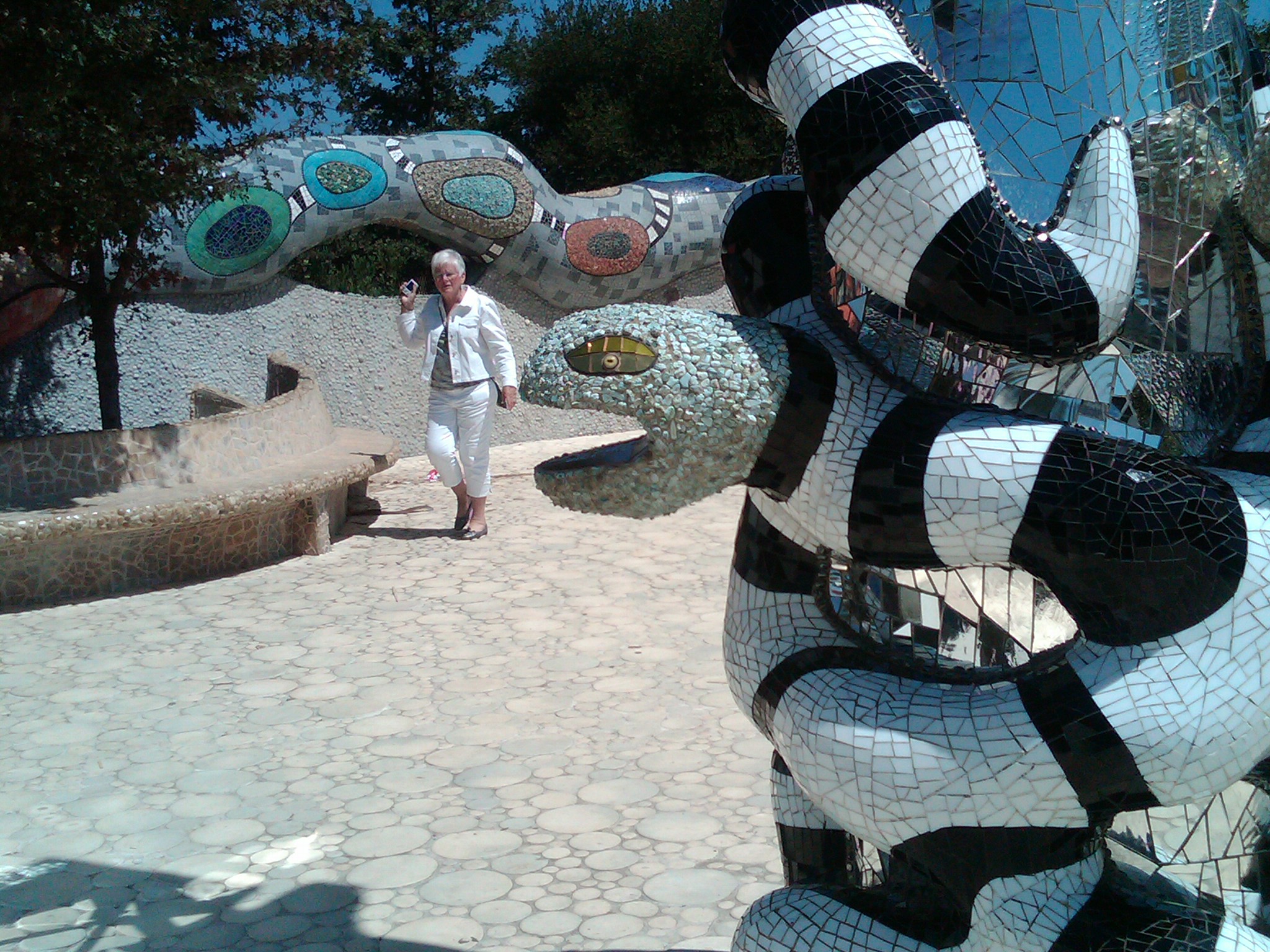
Cappi was visiting me in Chicago when feminist artist Niki de Saint Phalle’s whimsical, large-scale kaleidoscope animals, monsters, and figures were exhibited outside the Garfield Park Conservatory. She made her way to the west side on her own to see “the Niki.” And then couldn’t wait to take me there on the green line.
Cappi Quigley, 2011, at Queen Califia’s Magical Circle, Escondido, CA
We had similar tastes in most everything. Whenever I visited her in California, we ate from the ripened fields around San Luis Obispo. On one visit, we dined for a week on nothing but fresh-picked strawberries and avocadoes.
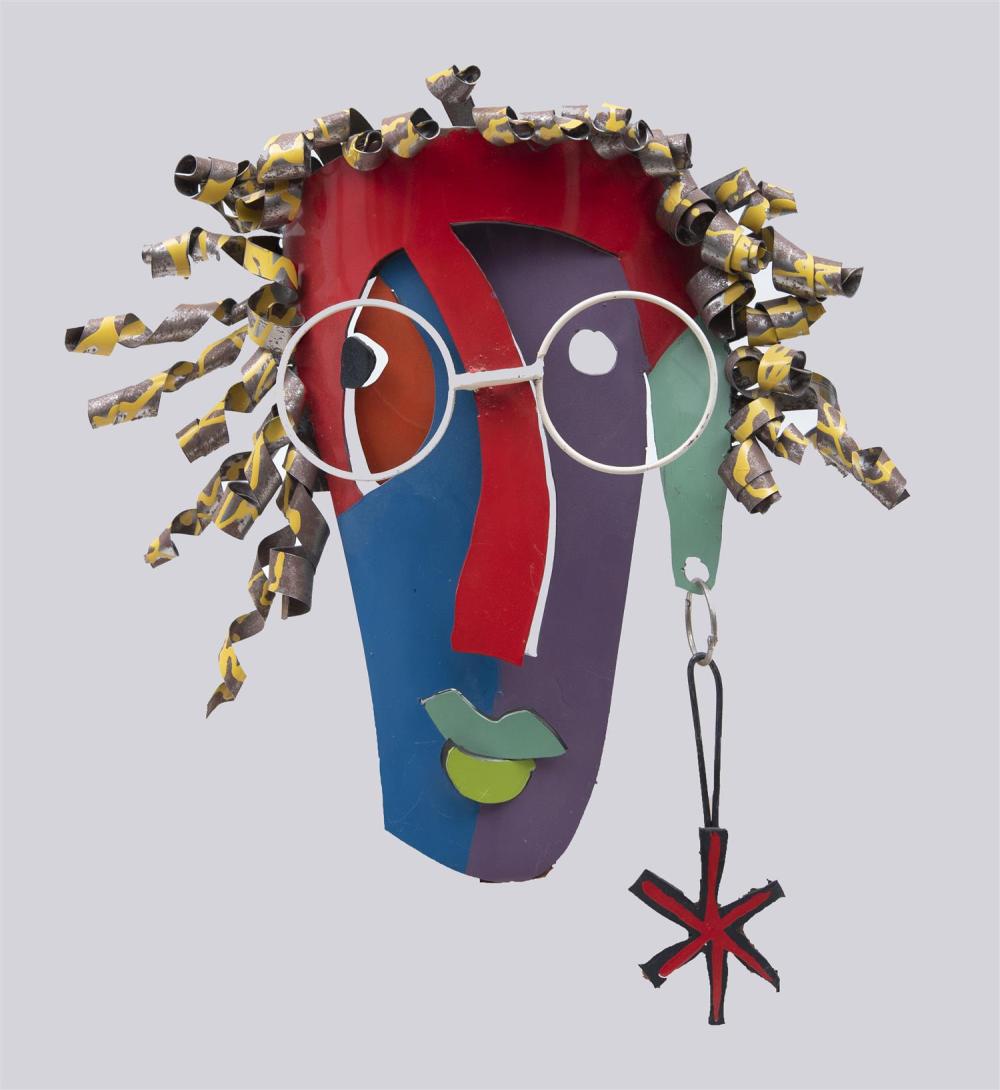
Cappi hurried me through the large, tantalizing rooms at the Nashville Arts Company to the attached warehouse in the back. The floor and walls were full of metal sculptures of every size and dimension. Each one painted in rainbow colors. There were playful metal masks with flowers springing off their hats, some waving flags, some with large eyeglasses, and some holding birds. One wall was filled with life-size avant-garde metal guitars. On the floor, an arrangement of Picasso-type chairs sat around a mesmerizing metal table.
The Arts Company in Nashville represented Brother Mel Meyer, a Marionist monk from St. Louis. Some of each of his creations were on display: metal sculptures, watercolors, stained glass, acrylic on canvas, handmade paper, and textiles. I cherish my Brother Mel metal wall sculpture of a woman with big red glasses, which I bought on the spot. Cappi and I bonded anew over our love and awe for Brother Mel. She subsequently visited his gallery and workshop in St. Louis. Brother Mel was well represented in her Central Coast home.
Brother Mel Meyer, St. Louis 20th Century
We got on the road in a state of hyperconsciousness. Tennessee red maples and golden ginkgoes illumined our spirits. Fireplace pine spritzed the air. Aware of the weekend schedule, we quickened our pace down West End Avenue. Out of nowhere and without warning, an ancient oak tree silently uprooted, toppled over, and bounced down, laying itself out across the road in front of us. The front of the car rested in leafy branches.
I’m not sure how many times we screamed, ‘Oh my god,’ or when we stopped shaking. Without words, we exchanged seats. I backed up, turned around, and drove home. Throughout the weekend, we failed to get an attentive audience for the story of our near miss. Only Cappi and I could know we’d been spirited into a new dimension of living.
Niki de Saint Phalle died in 2002, around the time Cappi and I swooned over her work. We mourned for Brother Mel Meyer in 2013. Cappi Quigley joined them in September 2023. They all left us their own technicolor visions of Paradise.
As a veteran churchgoer, I’ve logged about 3,650 hours in the Sunday pew. My childhood church clocked in at one hour a week for Catholic Mass. When I came to my senses at eighteen, I abandoned churchgoing. After a long period of barstool arguments on the God-is-dead theme, I started up churchgoing again at the Metaphysical Center, where I received a “reading” from a medium. The two-hour-long talk between the spiritualist and his dead interlocutor revealed that I had been Harriet Beecher Stowe in a former life.
I like that. Harriet Beecher Stowe, one of the world’s most famous abolitionists, wrote Uncle Tom’s Cabin after receiving a vision during a church service. Church is indeed a good place for visions. Clare of Assisi, Joan of Arc, and Theresa of Avila are famous Christian visionaries. And, of course, there’s the fearless Miss Harriet Tubman herself, who led enslaved people through the Underground Railroad at night, led by her visions.
After I learned as much as my addled brain could absorb in metaphysical spiritualism, I sobered up and joined a Christian fundamentalist cult. It was so extreme that the elders admonished me for making friends at Little League games with parents who were not our kind of Christian. To extricate myself from that legalistic life, I spent a year drinking jugs of vodka in my basement. Turning again to Alcoholics Anonymous, I sobered up through the holy love of AA veterans.
Since 1979, I’ve been attending a Presbyterian church in downtown Chicago. Yet, I never call myself a Presbyterian. Why? I’m not too sure. Perhaps the residual PTSD from the Christian cult or, Catholicism or, spiritualism protects me from assigning myself religious labels. More likely, I’m not altogether sure I believe what they believe.
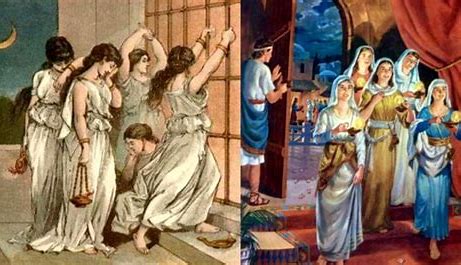
Last Sunday, churchgoers throughout the land heard the parable of the ten virgins, or bridesmaids as they say in today’s lingo. The seven-day wedding feast in ancient times couldn’t begin until the bridegroom arrived. In the story, five wise bridesmaids had working oil lamps when the groom arrived late at night, and they all entered the gate to the feast. The other five foolish bridesmaids were out buying lamp oil and got locked out of the party. In previous preachings, I’d heard Jesus’ explanation of his parable is that we must always be ready, have our lamps lit, awaiting his coming (or was it his second coming?). No wonder I’ve been a nervous wreck my whole life, constantly failing to be ready for Jesus. I really hate parables.
The church’s new pastor spun the story as a lesson in patience. Be patient because we never know when God will present a reason to throw a party. I had to listen again to him on YouTube because I swear I heard that ominous “Jesus is coming” sermon. This is one of the blessings and curses of old age. My brain holds years-old information, which is a blessing. But that information is a curse when it doesn’t make room for new ideas.
The Day of the Dead Mexican holiday, observed on November 1st celebrates the deceased with ofrendas (home altars) and festive gravesite visits. Tombstone gatherings include offerings of the deceased’s favorite food, drink, and music.
When I learned about my sister Mara’s death last spring, I reflected on our estranged relationship in a blog post. Since then, I’ve received a slew of messages from her friends that piece together a life I never knew, stories that give life to the dead.
Borrowing from the Mexican tradition, I offer an ofrenda to my older sister Mara Burke, with a sampling of those messages.
…we double-dated, attended formals at The Peddie School, and listened to music we loved. Her shop, where she helped us look stunning, but never as stunning as she looked, was where she generously gave us all our first credit cards! The slim silver bracelet she gave me many years ago is still my favorite, the many articles she sent knowing I loved cooking and gardening, and the tiny blue and white dish on my nightstand are fond remembrances of herlove.
…I met Mara at the Catholic Home for Unwed Mothers.
…I interviewed Mara for a job a few years after her store closed in the early 90s. She was a talented clothier, but she showed up smelling of booze.
…Mara was on my mind,i Googled her, saddened by the news i now read. I am happy to say that even though Mara and I were not close, we shared plenty of sobriety, laughter, and lots of very good coffee and pastry over the past 33 years.
… I met her in the 90s. We did a lot of meetings and healing through friendship with other recovering folks. She moved from Florida, and we lost touch.
…Mara came to care for me when I lost my mother years ago in a horrific accident. She has been through much with me and was selfless in her caring when my son died suddenly. My pain was her pain, and it was real.
…she always showed up for work even when she couldn’t stand up straight because of that hump on her back. She’s the best salesperson I’ve ever had.
… she was my neighbor for seven years. I set her up on a senior dating site. We laughed about all her dates. She never drank anything but coffee & ice water, attended Mass down the street and knew the priest. She said many times she wanted her ashes spread around her mother’s grave.
…she had that beautiful speaking voice.
… we had a beautiful day to carry out Mara’s wishes. We buried a small crystal heart dish Mara had given me with her ashes. We planted daffodil bulbs to bloom in the spring, said a prayer, and sprinkled her ashes over her mother’s grave.
Mara moved from Florida to Virginia for inexplicable reasons. Two weeks passed before her body was found on the floor of her apartment, and another week before I was called. The death certificate says she died of natural causes complicated by dementia and follicular lymphoma.
RIP, Mara Burke. Born February 14, 1945, died March 13, 2023.
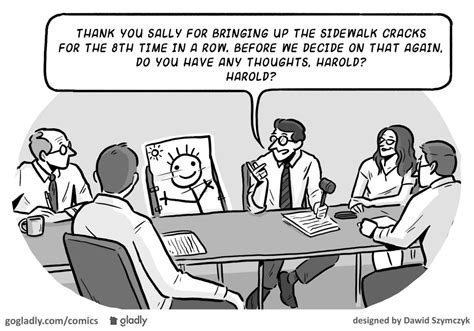
Alex Lubischer, a playwriting teacher at Chicago’s Goodman Theater, taught my beginning playwriting class that every play has its own interior logic that doesn’t have to be bound to reality. I’ve seen plenty of those, good and bad. He prompted us to write a short “bad” play that included a fire escape, a talking animal, a fur coat and a Venmo payment. I can’t guarantee my bad play, The Condo Board, has any interior logic, but it is definitely not bound to reality. The characters and their dialogs are fictional. However, you may see a similarity or two if you’ve ever been to a condo board meeting.
The Condo Board
SET: COURTYARD—48 UNIT FOUR-STORY BRICK BUILDING-EVENING
WE OPEN in a three-sided courtyard. It’s the end of summer. Onlookers sit in their open windows around the courtyard, on the lumpy grass, or lean against the building, waiting for the condo board meeting to start. In a 4th-floor window, a well-dressed, emaciated man with a straw fedora is stretched out on the windowsill. He’s drinking from a whiskey bottle and smoking.
Board members sit in a circle of mismatched folding chairs. Fire escapes are fixed to all three walls. Potted red geraniums fill the 3rd-floor landing of one. A bicycle is locked to the 2nd-floor railing of another. An old rag rug lays over the 4th-floor railing of another. In the center of the building, a cement sidewalk leads from the back door to the grassy courtyard’s edge.
(PAUL, 49, the Condo Board President, balances a spiral notebook and some loose papers on his lap. The sleeves of his white dress shirt are rolled up. He’s wearing khakis and fancy sneakers and holding a pen.)
PAUL. The meeting will come to order. Do we have a quorum?
(BIANCA, 35, building manager, sits next to PAULwith a clipboard stuffed with papers. She’s slight and perky, long dark ponytail, wearing an ill-fitting grey suit.)
BIANCA. No.
(NORA, 50, board member, sitting next to BIANCA. Blonde bob, 1950s flowered fitted dress, pearls, shiny barrette, round wire-rim eyeglasses, white socks, classic white Keds.)
NORA. I talked to Barry an hour ago. He said he’s coming. He agrees to paint the meeting room aqua.
(BARRY, 45, board member, paraclimbs down the fire escape from the 4th floor like a chimpanzee, stopping to do chin-ups on the metal bars. Fit, athletic, Margaritaville T-shirt, shorts, black sneakers.)
BARRY. I’m coming! I’m coming!
PAUL. (Strains his neck to see BARRY.)
What are you doing on the fire escape?
BARRY. (Lands on the ground and walks to a chair next to NORA. NORA perks up.)
Since we’re meeting in the courtyard, I thought I’d get a workout on my way down. It’s faster than that rickety old elevator.
NORA. (Shouts at no one in particular.)
When will the meeting room be finished? It’s gonna be too cold out here next month. Can we paint it aqua?
PAUL. (Looks at BIANCA.)
Do we have a quorum?
BIANCA. Yes.
PAUL. Did everyone read the minutes from the last meeting?
(The emaciated man, hugging his bottle, falls out of his 4th-floor window into the bushes below. His hat flies off in the direction of the meeting. No one notices.)
BARRY. My name is spelled wrong.
(SUSAN, 55, board member, next to BARRY, bleach blonde straightened long hair, fake diamond ring, tight white t-shirt, blue jean jacket, tie-dyed tights, ankle bracelet, oversized pink sneakers.)
SUSAN. I didn’t get the minutes.
BIANCA. Minutes are in everyone’s board pack.
SUSAN. Not mine.
PAUL. Do we have a motion to approve the minutes with the correction of BARRY’s name?
(CARMEN, 45, board member, next to PAUL, black unruly hair, thick eye makeup, red lips, hoop earrings, head scarf, bangle bracelets, ruffle blouse, stuffed into blue jeans.)
CARMEN. (Signals a silent thumbs-up motion)
PAUL. All in favor?
SUSAN. Don’t we need a second?
PAUL. What?
SUSAN. A second, someone to second the motion.
PAUL. How about you?
SUSAN. (Shaking her head)
Oh no, I’m not gonna have my name in no minutes.
(MARCO, 33, board member next to Carmen, tall, black slicked back hair, goatee, sleeveless t-shirt, tattoos, tight jeans, pointed tie shoes, aviator sunglasses.)
MARCO. I second.
PAUL. All in favor?
NORA. When will the meeting room be finished? Does everyone like aqua?
PAUL. Can we have the Treasurer’s report?
BIANCA. The Treasurer isn’t here.
PAUL. That’s Mark. Did he sell his unit?
(Pause. No one answers.)
BIANCA. Tsk. I’ll do the Treasurer’s Report. We have 239,241 dollars in operating.
PAUL. Motion to approve the Treasurer’s Report?
BARRY. I move to approve the Treasurer’s Report.
PAUL. (Gives Susan the evil eye.)
All in favor?
ALL. Ay
MARCO. I’ll volunteer to take over the Treasurer spot.
PAUL. Ok. Let’s table that ’til next meeting.
NORA. Wait. Hear that? Someone’s playing rap music. I hate rap music. When will the aqua board room be painted?
CARMEN. I’ll be right back.
(she stands and walks off, shouting over her shoulder).
I have to get my fur coat. It’s too cold out here. (voice fades)
(BOARD members talk all at the same time about nothing in particular)
PAUL. Order, please. BIANCA, let’s have the Manager’s Report.
NORA. (curled over, swinging her legs, muttering toward the audience)
Finally. The meeting room.
(GREG 35, board member, next to MARCO, sandy hair, Rolling Stones t-shirt, blue jeans, Converse sneakers, skateboard at his feet)
GREG. Carmen! Carmen! Your parrot got out!
BARRY. I’ll get him.
(BARRY paraclimbs up and around the fire escapes, trying to capture the PARROT.)
(PARROT, played by a child, green & red feathered costume, yellow beaked mask, hooked up to circus wires from the ceiling, flies up and perches on a fire escape railing.)
PARROT. Squawk! Squawk! Squawk!
BARRY. (mutters toward PARROT.)
Yeah, we’re writing you out of the building, Buddy.
(Various Board members and onlookers simultaneously try to catch the PARROT and shoo him back into CARMEN’s open window. The PARROT flies around squawking and settles on CARMEN’s window ledge.)
PAUL. Order! Leave the PARROT. BIANCA! Please. The Manager’s Report? Order everyone!
(BARRY swings back down from the fire escape and returns to his seat.)
BIANCA. First up, Owners are complaining about the PARROT squawking.
CARMEN. (arriving back in the courtyard with her fake fur coat) Aw, C’mon. He’s not that loud.
(She blows a kiss up at the PARROT.)
Are you sweet boy?
PARROT. (PARROT bounces onto the fire escape.)
Squawk! Squawk! Squawk!
SUSAN. I move we prohibit parrots from living in the building.
(PARROT flies around squawking and dive-bombing members of the board.)
PAUL. Is there a second?
SUSAN. Now you ask for a second?
PAUL. Do I hear a second?
CARMEN. My PARROT is an Emotional Support Animal protected by the government.
(To the PARROT)
C’mere baby.
(PARROT sits on Carmen’s shoulder.)
GREG. Carmen, you must recuse yourself from this discussion as a board member.
CARMEN. Ok, but my PARROT is an Emotional Support Animal.
(BARRY rolls his eyes. Greg and Marco stare at their phones.)
NORA. Can we talk about the meeting room? Painting it aqua? How about teal?
PAUL. (Ignores NORA.)
There’s a motion on the table.
MARCO. What motion?
GREG. (elbows MARCO)
The motion to kick the parrot out of the building.
(Whispers to MARCO)
Did you get the 50k? I Venmoed to you just before the meeting.
NORA. (Crosses her arms and legs, turns away, looks toward the audience)
I thought the motion was to paint the meeting room turquoise. Or was it aqua?
MARCO. (whispers to GREG)
Thanks, man. That new casino already wiped me out.
PAUL. (Looking around at the board members).
Is there a second to the motion about the PARROT?
(No response. Everyone looks around but not at PAUL or each other, then look at their phones)
PAUL. Hearing none, the motion fails.
PARROT. Squawk! Squawk! Squawk!
SUSAN. (Jumps up)
Wait a minute, we didn’t even discuss it!
BARRY. The motion failed. End of. Let’s move on.
(Winks to CARMEN. Talks loud so the whole building can hear.)
This is not going away, sister. We all hate that thing.
CARMEN. That’s not true.
(Looking around the building)
Who hates the PARROT?
ALL. (muttering) Not Me. Not Me.
BARRY. Let’s move on.
PAUL. Next item on the Agenda is recycling. BIANCA?
BIANCA. Okay, everyone wants recycling. We pay a recycling company $12,000 a year to come every Tuesday to pick up, and the blue bin is always empty. I propose we end the contract.
SUSAN. NO! I recycle all the time.
ALL. So do I! So do I!
BIANCA. Well, if everyone is recycling, why is the bin always empty?
BARRY. It’s that homeless guy who lives in the alley. He takes them plastic bottles and sells ‘em.
NORA. (Looking at Barry.) Are we going to paint the meeting room turquoise or what?
(BARRY puts his arm around NORA and whispers in her ear. NORA blushes and looks at her phone.)
PAUL. Is there a motion to end the recycling contract?
GREG. I move to end the contract.
(GREG nudges MARCO)
MARCO. I second.
PAUL. All in favor?
ALL. Ay.
PARROT. Squawk! Squawk! Squawk!
CARMEN. I move we adjourn.
BARRY. (Standing in front of his chair, stretching, and doing squats.)
What did we just vote on?
PAUL. We still have items on the agenda — the cable company upgrade, fixing the front sidewalk, and security cameras.
CARMEN. I still move to adjourn.
BARRY. I second.
(Winks at Carmen)
Let’s go to your place and watch the game.
NORA. (Smiling, Looks up from her phone.)
Did we vote to paint the meeting room yet?
PAUL. All in favor to adjourn?
ALL. Ay. Ay. Ay.
PARROT (On CARMEN’s shoulder as she walks off with BARRY)
Squawk
(NORA walks off, smiling, staring at a fire escape.)
GREG. (Huddles with PAUL and MARCO, looks at PAUL) Let’s go to yours and decide on the rest of these contracts. My brother-in-law has a security company we can use for those cameras.
MARCO. My girlfriend is the bookkeeper at a cement company. I know the boss. They do sidewalks.
BIANCA. (Overhears and walks over)
My dad can get us a deal from Comcast.
PAUL. Ok. Ok. Might as well. We’ll never get anywhere otherwise. (All four walk off together, chattering.)
(Onlookers in the courtyard amble off. Others linger in their windows, some smoking and looking at the sky. Someone waters a geranium and then stares at the sky. The man who fell into the bushes scrambles out of the branches and wobbles over to one of the chairs, hugging his bottle).
(NORA appears in the courtyard wearing a painter’s shirt with a bucket of aqua paint. She picks up the man’s hat and puts it on his head. He nods and takes a swig. She begins painting a fire escape as she hums “Blue Skies.” Onlookers look down at her and blissfully return to staring into the dark blue sky, humming along.)
Candles, Israel-Gaza, and a World We Don’t Have Yet
Jonathan and Sandy Miller founded “Sounds Good” choirs for older Chicago adults in 2016. Two years later, they added “Good Memories” choirs for those with dementia and early-stage Alzheimer’s. Having no background in singing and an inability to carry a tune or read music, I hesitated to volunteer to help people with following their sheet music. But Sandy and Jonathan said a fuller group would give people a better choir experience. So I joined.
I’d been worried that I had slid into a period of ever-increasing cognitive decline myself. In researching what was happening to me, I’d read that singing, particularly choir singing, could help stitch together busted nerve endings in the brain. It has. Learning to match the notes to the words, concentrating on reading the music, and trying to vocalize it seems to replenish bits of lost grey matter. Choir singing enlarges my world by healing the brain.
Sandy & Jonathan Miller, Founders of Sounds Good/Good Memories Choirs
Little did I know that the world of Jonathan and Sandy Miller is a body, mind, and soul experience. The following essay was posted on the Sounds Good website. Jonathan Miller doesn’t “preach’” as our choirmaster. But he and Sandy exemplify every good quality expressed here.
Come hear the fruits of these labors at our concert in Chicago on Dec. 21, 2:00 pm, 4th Presbyterian Church, 880 N. Michigan Ave.
Candles, Israel-Gaza, and a World We Don’t Have Yet
by Jonathan Miller
We have been rehearsing “Light One Candle” in all of the Sounds Good Choirs for many weeks. When Linda Powell and I picked the song for this fall’s concerts, we had no idea how timely it would seem now—almost prophetic. It suddenly feels deeply relevant, especially when seen in the context of events unfolding in Israel and Gaza. What is happening there horrifies me as a Jew and breaks my heart as a human being. My heart cries out at the suffering that has taken place and is bracing for yet more suffering to come.
Look anywhere in your news feed for thirty seconds, and you’ll see it: we have not learned how to live together. A song, therefore, that acknowledges pain and suffering is a good thing right now. A song about “the terrible sacrifice justice and freedom demand” is a wise and timely song.
Light one candle for the Maccabee children With thanks that their light didn’t die Light one candle for the pain they endured When their right to exist was denied
Peter Yarrow wrote “Light One Candle” in 1982 when war broke out between Lebanon and Israel; he said that he hoped the song would take hold in people’s hearts like “Blowin’ in the Wind” had captured American hearts during the Vietnam War. The song holds up the example of the “Maccabee children”—those Jews who stood up for themselves when the Romans took over the Temple in Jerusalem around 165 BCE—as a source of inspiration, resistance, and courage.
History gives us many such role models of courage. Sandy and I recently went to a fundraiser for the nonprofit “Facing History and Ourselves.” Facing History equips middle- and high-school teachers and administrators to embrace a thoughtful, rigorous approach to history to promote civic engagement, a sense of empowerment, and the investigative rigor to understand how injustice happens—so we don’t have to repeat past mistakes. Their training and curriculum resources encourage deep inquiry. They show students how to ask the tough questions. They foster in an entire school (not just a social studies classroom, which is super cool) an orientation toward challenging entrenched attitudes about race, bullying, homophobia, and other volatile topics. A young woman spoke at the fundraiser; she had studied with Facing History in high school and had just graduated from college. Her words were an inspiring lesson in honesty and bravery. She said her college “worked hard to get Latinx students there, but they didn’t make us feel welcome when we arrived.” She spoke of fighting to raise awareness of the issue, to help create safe spaces for Latinx students at her college, and of her vision to shape a career that combines her passion for reproductive rights with her concern for immigrant women.
Light one candle for the strength that we need To never become our own foe And light one candle for those who are suffering Pain we learned so long ago
The event concluded with a conversation between Jonathan Eig, whose recent biography of Dr. Martin Luther King, Jr. has met with critical acclaim, and Adam Green of the University of Chicago, whose scholarly work includes post-emancipation African-American history, cultural studies, and urban studies. The conversation was about Dr. King’s legacy for us in our time; it was fascinating, and I felt stretched in a wonderful way afterward. The conversation took a deep dive into, among other things, our tendency to put leaders on pedestals; the seminal influences on King’s life and thinking, including Coretta Scott King and Rosa Parks; and King’s own way of stretching himself to take on bigger and bigger problems, even when it was very difficult, and of continuing to find and engage with people whose views differed widely from his own, including Stokely Carmichael and the toughest Vice Lords gang leaders in Chicago.
Light one candle for the terrible sacrifice Justice and freedom demand
Toward the end of the conversation, Adam Green reminded the audience about Howard Thurman’s 1948 book, “Jesus and the Disinherited,” one of my favorite books. A mentor to Dr. King, Howard Thurman was dean of the chapel at Boston University and one of the most influential theologians of the 20th century. In this book, Thurman speaks to the downtrodden of the time: Americans of African descent, against whom Jim Crow relentlessly hurled insult upon humiliation upon pain upon injustice. However, rather than encouraging African Americans to succumb to rage, violence, hate, or disconnection, Thurman exhorted just the opposite: moral courage, a conviction that their own basic goodness, in concert with others, could turn the tide, and a sense, using Christian language, of “committing myself to the redemption of everyone.”
Echoing Gandhi, who said, “Nonviolence requires more courage than violence,” Dr. King said, “We will meet suffering with soul force.” When we do not follow the crowd by succumbing to fear or fearmongering, we can look our situation squarely in the eye and begin to tell the truth of the situation. Following this example, we must insist on goodness and truth-telling from ourselves first, holding ourselves to a higher standard rooted in compassion, what Abraham Joshua Heschel calls “moral grandeur and spiritual audacity.” This, in turn, creates a virtuous cycle of people committed to making the entire situation work for all concerned. I especially like how Buddhist nun Pema Chödrön describes King’s mindset: “For me to be healed, everyone has to be healed.” If my life gets better, but you are left in the dust, does that really work in the long run?
Light one candle for all we believe in That anger not tear us apart And light one candle to find us together With peace as the song in our hearts
A worldview where we all mattered… what would our planet look like if that’s what we all strove for? How would we have to enlarge our sense of who “we” are if we wanted that sort of society? Can we challenge ourselves, individually and collectively, to do that? I’d like to find out. I’m not sure we can survive as a species if we don’t.
What all these wise people are pointing to is not conventional thinking, and I don’t claim to be good at it. If it were easy to create a bigger box that could hold us all, what King called “a revolution of values,” we would have done it by now. But I want that world: an America, for example, where I don’t have to choose between health insurance and food or between living in my car and paying rent and where I don’t have to endure ridicule for wanting that. I want a world where my character and skills matter more than my skin color. I want a world where caring for my children or parents doesn’t mean I have to quit my job. I want to be able to love whom I choose, make choices about my own body, and live with dignity in a place that I can afford. And of course, I want a world where the gifts and experiences of older adults are celebrated. It may take us still more centuries to “light one candle to find us together with peace as the song in our hearts,” but it’s the right direction. Let’s go there.
Don’t let the light go out! It’s lasted for so many years! Don’t let the light go out! Let it shine through our hope and our tears.
The morning after my last colonoscopy, I stood in line at Starbucks to satisfy a sudden obsession for a flat white, not my usual coffee drink. A familiar tune came through the surround sound subwoofers. My toes began tapping involuntarily until the song’s words remembered my voice from long, long ago and softly fell freely from my lips.
Thunder only happens when it’s raining
Players only love you when they’re playing.
Dreams. Stevie Nicks. I imagined myself wiggling my hips and flailing my arms—an unwise move for a not-so-sure-footed roly-poly 77-year-old.
Feldenkrais teacher Deborah Darr says, “Imagine you’re doing the movements you can’t physically do.” She taught me that imagination can so deeply engage the mind that the body feels like it’s moving when it’s not. So, on my way home from Starbucks, I imagined myself line-dancing down the street humming Dreams.
By the time I got home, I was physically exhausted. I clicked into a meeting of Alcoholics Anonymous on Zoom. I’ve been attending AA meetings for over 50 years and often ho-hum to myself, “I’ve heard this story already…nothing new,” even if I’ve never seen the speaker before in my life. On this day, I zeroed in on the story so wholly that I felt every cheap drink, every disgusting hangover, every regrettable hook-up, and every sickening word of his drunken story. When he talked about getting sober, my stomach balled up, remembering the agony of those early days of sobriety with uncontrollable sweaty shakes and tears. The love he felt from fellow sober alcoholics and for his family sticking with him filled me, too. Love and gratitude seeped into my every pore.
The growing ball in my stomach erupted at the emotional and physical powerlessness, and I ran to the bathroom and puked.
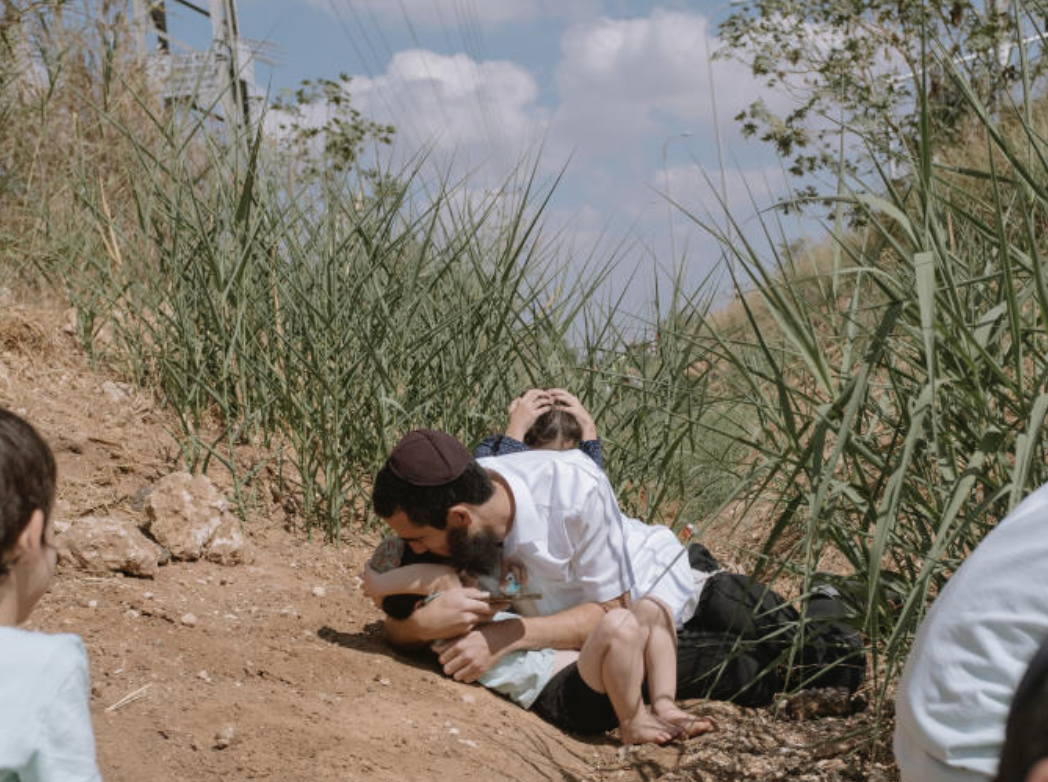
(AP Photo/Dor Kedmi)ASSOCIATED PRESS
Seeking distraction, I turned on the TV. Hamas terrorists had tunneled under the Gaza-Israel border a few days before and riddled Jewish babies with bullets. News outlets had taken a few days to get the images to us. I wept watching the photos and videos, hearing children crying out for their mothers, watching helpless fathers, and reporters describing families on the move. Displaced. Terrified. Confused. Grieving.
I reached in my purse for the forgotten mound of papers handed to me as I left the “colonoscopy suite.” Was I supposed to read them sooner? I don’t know. But I saw why I was so giddy, twirly, and happy in the morning and so emotionally flattened later. Fentanyl. The doctor shot fentanyl in my arm before snipping a bit of chitterling from my innards. Fentanyl is so powerful that I forgot biopsy results were coming my way.
The doctor sent me a note within a few days. “All clear,” he wrote.
Just one veinful of fentanyl laid down a new neuro path in my brain, allowing the deepest of joys and sorrows. Since then, if I’m tuned in, boundless joy arises from the hope of alcoholic stories—and bottomless sorrow from images of bloodied children being carried to unsafe safety.
At the Convent of the Sacred Heart in 1958, Mother Cleary announced at the weekly school assembly the name of the annual school play. She was uncharacteristically gleeful.
“Gilbert & Sullivan’s The Mikado will be this year’s play. We’ll start auditions next week. The entire school will take part. It will be a real pageant!”
The “convent” was a community of nuns and a Catholic girls’ school for grades five through twelve in a pastoral Chicago suburb. The nun’s surnames Riley, Doyle, O’Brien, and McCarthy would lead outsiders to think the order of the Religious of the Sacred Heart of Mary has its roots in Ireland. Not so. The order originated in France. Wealthy Irish families paid to have their well-educated daughters live and teach as “Madams” of the Sacred Heart, as they were known colloquially.
On hearing the news of The Mikado, we in the lower grades looked at each other with a shrugged Huh? The high schoolers cheered. Full of musicians, music lovers, budding drama queens, or future dramatists, the upper grades knew their Gilbert & Sullivan.
Gilbert & Sullivan wrote their 1885 comic opera as a satire on Victorian mores, culture, and government. The plot of The Mikado is the operatic old stand-by of an adolescent boy and girl trapped in forbidden love. The forbidden in this opera is a law against flirting. Some like to think Gilbert & Sullivan used the ridiculous plot to mock England’s law against homosexuality.
The late 1880s British society, the Victorian era, is known for its sexual prudishness. As an eighth-grader in the 1950s, I doubt I knew the word “Victorian” was synonymous with hypocritical sexual repression. Do you suppose those crafty Sacred Heart nuns were trying to get some subliminal point across to their mostly virginal students?
Those in the know at school aroused curious excitement about the play, the music, the staging, and the costumes. Oh, the costumes. The Mikado is a fake Japanese story, and the buzz about the songs, the kimonos, the make-up, and those hairdos filled my dreams with whirling color.
In Catholic schools, everyone sings in the choir throughout the year’s many feast days. When it came to my turn to audition, I had high hopes of landing a dramatic singing part. I had no idea I couldn’t carry a tune. My seventh-grade sister and I were called together to audition with Mother Cleary.
“Oh, girls, we have the perfect parts for you! You will be dressed as mackerels and stand as sentries on either side of the stage for the entire play! Isn’t that exciting? You’ll be visible the whole time!”
“Mackerels? You mean fish?” I asked.
“Yes, yes, yes! Don’t worry; you aren’t required to attend all the rehearsals—just the last few. Mother O’Brien will contact you about your costumes.”
“I won’t be singing?”
“Oh no, dear. That isn’t a part for you.”
“Thank you, Mother.” No matter how dispirited I felt, I knew manners were required. Pretending to be grateful was more virtuous than expressing true feelings.
Our costumes were colorful green felt tunics with blue and grey scales stitched in rows around the entire body. A fin and fishtail were sewn to the back, not that it mattered since only the front was visible on stage. I loved my costume. Mother O’Brien fitted it just right. But the fish head? It was a gigantic papier-mâché exaggeration of a mackerel head with slits for us to look out. We had to wiggle into our heads in the wings and be led to our spots at each edge of the stage. The smell of fresh white paste never dissipated inside the mackerel head.
We held silver staffs fastened to oversized cardboard hatchets. The mackerels were also executioners.
As executioner mackerels, we stood sentry throughout the play — a constant reminder to the audience that The Mikado is about death. Self-decapitation, being buried alive, and boiling in oil are all described in The Mikado as humorous ways to die if caught flirting. Death is funny.
I suppose for nuns cloistered in their habits, satire about death allowed them a fun escape from the reality of staring at a bleeding dead man on the cross at daily matins. My thoughts have turned to death every day before and since The Mikado because of that same bleeding dead man on the cross. But the play permitted me to laugh at death, and myself, for that matter.
As for Gilbert & Sullivan, I feel nauseous whenever I hear The Mikado’s “Pretty Little Maidens.” I suffer from a subconscious sixty-five-year-old humiliation that I buried while standing on that stage for hours, holding a weapon meant to decapitate.









 History gives us many such role models of courage. Sandy and I recently went to a fundraiser for the nonprofit “Facing History and Ourselves.” Facing History equips middle- and high-school teachers and administrators to embrace a thoughtful, rigorous approach to history to promote civic engagement, a sense of empowerment, and the investigative rigor to understand how injustice happens—so we don’t have to repeat past mistakes. Their training and curriculum resources encourage deep inquiry. They show students how to ask the tough questions. They foster in an entire school (not just a social studies classroom, which is super cool) an orientation toward challenging entrenched attitudes about race, bullying, homophobia, and other volatile topics. A young woman spoke at the fundraiser; she had studied with Facing History in high school and had just graduated from college. Her words were an inspiring lesson in honesty and bravery. She said her college “worked hard to get Latinx students there, but they didn’t make us feel welcome when we arrived.” She spoke of fighting to raise awareness of the issue, to help create safe spaces for Latinx students at her college, and of her vision to shape a career that combines her passion for reproductive rights with her concern for immigrant women.


 Regan Burke