The Race Midpoint That Never Ends by Dave Schanding

The sign reads 35th St exit 1 mile.  Southbound Lake Shore Drive has been closed to allow for the Soldier Field 10-mile run to use this novel running surface.  The runners have navigated through this turn-around point.  Now we walkers are approaching the half-way point of the race.

In Spring, 2011, Kevin and Dave decided to improve their stamina.  They set their initial sites on the Hot Chocolate Run, 9.3 miles from Grant Park to the United Center and back.  After its successful completion, they sign up for the Soldier Field 10-mile run.  The novelty of this race is completing the run on the 50-yard line at Soldier Field.  What Bear fan could pass up this opportunity?

Dave has discovered that walking in a race is a bit different than sauntering down Michigan Av.  Participants are required to average 4mph, or a 15-minute mile.  Most of us typically walk 2.5-3mph.  As Dave nears the turn-around point, his son, Kevin, waves from the northbound path.  Kevin has done a combination of jogging and walking.  Dave checks his left knee with its titanium insert—no more running after the knee replacement the prior year.

In Dave’s driving mind, 1 mile to the exit at 35th Street should be reached in a minute.  When one is on an expressway, a mile takes a minute.  After that minute, Dave doesn’t feel any closer to the exit.  His body reminds him that he’s not driving today.  Dave looks around and sees ‘the bus.’  Race organizers have paid a pretty penny to have the city shut down Lake Shore Drive, and they are strictly enforcing the 15-minute mile race standard.  ‘The bus’ picks up stragglers and returns them to the starting line, without accolades and without the race medal.  Fortunately, the bus is a good half-mile away—Dave is a little ahead of schedule thus far.

He notices the next 1/10-mile marker.  Each marker should be passed every 6 seconds—10 markers per mile, one minute per mile.  That 5/10-mile marker remains annoyingly fixed in Dave’s sights.

Dave maintains a steady pace, staying a little ahead of the 15-minute-per-mile.  He is joined by many weekend warriors.  There are folks of all ages that seem to think they can run 10 miles but instead have to make frequent stops.  It’s the tortoise and the hare all over again. Some folks are actually wearing dress shoes or flip-flops.  Dave’s feet ache just thinking about going 10 miles in that footwear.

5 minutes have gone by and that 35th St exit sign looms just as far in the distance as it did 5 minutes ago.  Not really, but it feels like it.

After 15 minutes, the crowd reaches the exit ramp.  Another revelation.  Dave’s mind is in driving mode again.  One zips down an exit ramp only worrying about whether to turn left or right at the end.  But Dave is still walking.  He wonders if he will have to move into the left-turn lane to legally stay in the race. The exit ramp is interminable.  He’ll have plenty of time to figure out which lane to get into.

Dave finishes the race a couple of minutes before the 2 ½ hour time limit.  He goes into sprint mode for the final 200 yards, including that magical run on soldier field.  His sprinting self-image is dashed as he reviews the photo-for-purchase that shows a lumbering 60+ y/o fellow rather than an athletic 30 y/o.  Kevin finished 15 minutes earlier and the father and son team take a couple of pictures of themselves on the field.  They proudly wear their medals through the park and cab ride home.  They are feeling every mile, but they’ve made it.

D&K finish at soldier field 05262012

The Power of WE by Dave Schanding

A bit over seven years ago, my friend, Mike, asked me to join a history book club. He described how he had felt his brain thirsting for something challenging, and reading and discussing history books was his prescription.

I had hated history in school.  It consisted mainly of memorization of dates, which I did not excel at, nor did I find it particularly interesting.  I also hate sound-bites.  Life and its challenges are almost always more complex than a 30-second segment I hear on the news.  I thought that a history discussion could provide an opportunity to look at events in detail and to begin to understand them in context.  I readily joined.

Our discussion group is an eclectic bunch.  Mike works in human resources.  Bob and John are attorneys.  Another Dave is a handy man and Bill a teacher.  A second Mike works in commercial real estate.  Peter was in pharmaceutical sales.  I worked in mental health and drug abuse treatment.  It’s always been a men-only group.  The ground rules of the group are pretty simple.  We meet every other month to discuss a book.  We take turns picking the book and hosting the meeting.  The books can be about anything historical, with preference for actual history rather than historical novels.  We are to remain respectful of one another’s opinions.  We can agree or disagree, and we oftentimes do plenty of both.  Some clearly have deeper knowledge of history, and we appreciate their perspectives.  But no one seems reticent to speak.  Our membership spans the traditional conservative-moderate-liberal scope of opinions.

As of the summer of 2017, the group has discussed something over 40 books. It has been eye-opening for all of us.  Mike chose two sociological studies.  Why is the Dominican Republic thriving while Haiti is not, despite the fact that they share the same island?  We learned that, at some point, the ruler in Haiti wanted a massive palace made of wood.  Haiti’s forests were leveled.  Topsoil no longer had roots to hold it into place and much of the topsoil blew into the sea.  No top soil, no food.  No food, poor economy.  A similar event occurred in several South Pacific islands.

John tossed in a book about epidemics and governmental responses to disease outbreaks.  I felt pretty smart that meeting, as I’d worked at a health department.  I could describe the system we had in place to assure rapid distribution of prophylactic antibiotic medications. The group was comforted to know that someone was thinking and planning to handle large disease outbreaks.

Mike had us read a book about George Washington’s revolutionary war spy ring.  Six individuals in New England spied in plain sight against the British and helped turn that portion of the war.  Most of us had no clue of this phase of the American Revolutionary War.

I believe that most of us think of Prohibition as a puritanical movement against the evils of alcohol.  While there certainly was some of that, the reality at the turn of the century was that beer was served routinely in factories starting in the late morning—a recipe for disaster.  There were no safety standards for what we typically call ‘hard liquor,’ leaving many poisoned or dead after consumption of bad batches of brew.  Per capita consumption of alcohol was 2-3 times today’s rate.  Something had to be done—Prohibition makes much more sense in this context.

Bill, our resident historian, tossed in a book on the portion of history where Great Britain controlled India.  At one point, it used India as a wedge to battle against Russia.  Most of my school-based history only discussed foreign life as it related to U.S. history.  Looking at history from the perspectives of Britain, India and Russia was an eye-opener.  Dave, the handy man, selected General George Rommel, the German ‘desert fox’ who was initially very successful in northern Africa during World War II.  He also brought us Hannibal’s battles against imperial Rome.

Did you know that British tea was essentially stolen from China?  The Brits actually sent a botanist secretly to China to steal hundreds of seedlings.  Charles Lindbergh was an amazing pilot and inventor, but had many shortfalls as husband and father.  Ty had us read about the U.S.-led overthrow of the democratically elected government in Iran in the 1950’s.  In our sound-bite world, we wonder why Iran hates us wonderful democracy-focused Americans.  It has only been with the recent declassification of CIA documents that we learn why we’re not on their Christmas card list.

It has been interesting to learn that U.S. presidents assist one another in what one author called ‘the presidents’ club,’ and party affiliation is largely irrelevant. Sometimes this has meant that former presidents assist in diplomatic travels representing the country; sometimes it has meant calling for public support and financial donations related to humanitarian needs; and sometimes it has simply been a phone call or visit. Regardless of the expertise of staff in each White House administration, there’s nothing like talking through a difficult issue with someone that has faced it previously.

Two books I brought to the group discussed the Civil War Battle of Gettysburg and the building of the Panama Canal.  In both instances, I’d visited the locations shortly before the gatherings, and so I was able to add pictures and video to the discussion.  This helped get a more complete understanding of the stories behind the history.  Gettysburg lasted just three days, and primarily a foolish decision by Southern generals to charge through open fields against the North turned the tide.  The Panama Canal was started by the French, who unfortunately had more political than engineering knowledge.  A large sale of stock meant that a large number of French citizens had supported the unsuccessful effort to build the canal.  Fortunately, the U.S. Army Corps of Engineers was more successful.

Our group membership seems to remain at between 8-12 members, although the make-up of the group changes over time.  And while we’ve covered a hodge-podge of stories, we can see that we’ve filled in many blanks on our historical journey.  I have found the history discussion a personally enriching experience.  History is no longer dry and dusty and filled with dates.  It has complexity and challenge—things I always guessed were present all of the time.  And while our membership comes with a wide range of knowledge and background, I believe that our collective wisdom has made us all smarter historians.

A People’s History of Chicago

kevin-coval-peoples-history-chicago

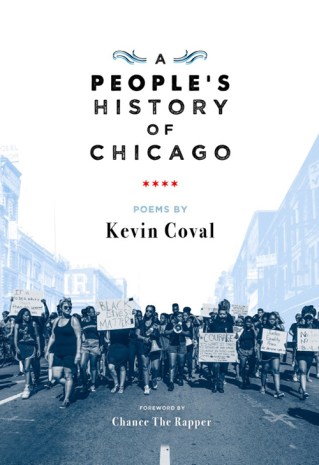
Chicago poet Kevin Coval came to a luncheon of forty older adults in the Gold Coast to read from his new book, A People’s History of Chicago. This was not Kevin’s usual audience, which is young, disaffected and enlightened high school kids from the neighborhoods. After his reading, he passed out small notebooks and pencils and asked us to write a list of what you see when you walk out your front door. Then he gave us 8 minutes to write a poem.

Kevin is the Artistic Director at Young Chicago Authors, an ongoing free workshop that meets every Saturday at Milwaukee and Division. He invited all of us to the workshop, saying “we need you.”

And so the next Saturday I climbed to the 2nd floor high-ceilinged room of bare brick walls and planked floors. Twenty chairs were arranged in a circle in the middle of the room and loose, unlined sheets of paper and pencils were in a box in the middle of the circle. This is not just organization, it’s respect.

Poet-teacher Jose Guadalupe Oliverez sat on a chair in the circle and as people emerged from the staircase, he motioned to them to join him. He asked us to state our first names, age and our high schools. A group of 16-year-olds from Crane High School and their spoken-word coach, a 19 yr old poet from Calumet City, a 16 year old Lincoln Parker home from boarding school and a 20 year old jewelry maker made up the group. I apologized, “I’m Regan and I’m old. Thank you for letting me sit in.” Jose prompted us to write lists, reading various poems for inspiration about truth and lying. He gave us 8 minutes to write. At the end, each of us recited one poem.
_____________
Lying

I get on the bus
See a cohort
Where you goin?
To the March at Trump.

You go girl, he says
thinking I’m alive in pursuit of justice

Am I? I dress for the day
with buttons and banners
Tell others I’ll see you there!
Notify on Twitter and FaceBook

Then go downtown and what?
I tell others it works
to be in the number, to yell
This is What Democracy Looks Like

I write letters, make calls, send emails
Proclaiming the what and why
but then in silent spaces
I doubt.

Does my voice matter?
I tell others theirs does, mine does.

I doubt.
Will it get better?
for me
or you
or them
or us

Am I acting, lying?
What about the rest of ‘em?
Are we all just hoping, acting, lying?
_______________

Hot and weak at the bus stop I was thinking about the racism-felt poems I’d just heard from the young poets. A woman in a McDonald’s uniform came along complaining, “Where the fuck is the bus?” She asked if I had been to the new Division Street Target and before I answered, she added, “I can’t go there. They tore down my home to build it.”

I beseeched God, “when will it ever end?”

People Say They Did the Best They Could

What My Parents Believed

No One Ever Said We Were Democrats. Neither of my parents campaigned nor wore political buttons nor wrote thoughtful letters to politicians. They were Catholics, went to Catholic schools, Catholic colleges, married in the Catholic church. They took on the mantle of Irish Catholicism as if it were a physical birthmark, a once-a-Catholic-always-a-Catholic mental tattoo unaccompanied by belief in God or Jesus. They took advantage of the culture of the sacraments— Holy Communion, Marriage, Baptism—to display how beautiful we all were in our expensive clothes, polished shoes, fashionable hair styles.

They argued. About money mostly. And other women, other men. They agreed on important things. Pope Pius XII was a backwater imbecile for invoking papal infallibility in 1950 when he proclaimed all Catholics must believe Mary didn’t suffer physical death and was assumed into heaven. This new doctrine, along with the Pope’s insisting the Church of Rome stay neutral during the Holocaust, put a stake in their religiousity.

They hated right-wing bullies like Senator Joseph McCarthy and J. Edgar Hoover. McCarthy was a reckless demagogue who ruined lives with public witch hunts and unsubstantiated accusations against communist sympathizers. FBI Director Hoover amassed power by steering favorable press and policy his way using his secret files to blackmail Congress and Presidents alike. Throughout their lives my parents derided the Red Cross for raising money for war-time troops then charging soldiers and sailors for their so-called giveaways like toothpaste, coffee and donuts. My mother eagerly showed how smart she was in these matters. After all, my parents attended college in the nation’s capitol in the years leading up to World War II. She gossiped about under-informed conversationalists, “What do you expect, they don’t even read the New York Times.”

During the war, they lived in housing provided by the Navy in Key West. With no children to mind, they spent evenings in the Officer’s Club chattering about the day’s news, forming opinions and cooling off with rum smuggled in from Cuba. The men were Navy pilots and Naval intelligence officers. Some worked in the newly-formed CIA. Anyone who didn’t drink was not to be trusted. They never went to a restaurant, nor any gathering, party, picnic, or church function unless they knew alcohol would be served.

Any friend or relative who stopped drinking was derided as a reformed drinker, as if that were a dirty word. My father eventually stopped drinking and went to Alcoholics Anonymous, but he still steered clear of social events and restaurants where there was no alcohol. With all their strong opinions about religion and politics, the foundational belief of my parents was that life without alcohol was as unsophisticated and tasteless as a Greek diner.

My father, divorced from my mother, helped me get sober in 1979. When I told my family I was in AA, my older sister, glass of wine in hand, said, “Well. Just because you’re an alcoholic, doesn’t mean everyone is.”


If You Can’t Stand the Heat, Don’t Come to My Place

When friends from out of town ask to visit, they know they’ll be sleeping on a pull-out couch. No one seems to mind. But in the summertime, when I inform them I have no air conditioning and no screens, few believe me. The original in-the-wall air conditioner in my 1959 condo conked out in 2006. Replacing it would require ripping up and rewiringth-1 the wall and I’ve never had the inclination to do so. Neither can I bring myself to replace the broken dishwasher or stove.

Hot spells can be oppressive, even claustrophobic. When heat envelops me, I sweat, swell up, get dizzy. At times I feel like I’m going to faint. The failure of my body to adjust disrupts my circadian rhythm and agitates my sleep cycle. To cool off, I sleep with my windows open for the nighttime breeze from Lake Michigan which means on weekends I hear 2:00 am passersby mixing it up from the bars down the street and cars and motorcycles gunning it on my corner. North Lake Shore Drive makes an “S” curve at Oak Street Beach right outside my building and the occasional emergency siren wakes me as it hones in on late night crashes.

Summer sleep can be exasperating. I rise with the sun at dawn because my blinds are open all the time to catch the changing light and moving clouds. Oh, there are some — I’ve run out of wall space, so I hang paintings and dangle sculptures from drapery rods in front of partially closed blinds.

When I was about 10 years old, I occasionally slept outside in the summer on a porch with no screens. Mosquitoes didn’t bother me there. But when I slept inside, the bloodsuckers buzzed my ears until they found a juicy spot to prick my skin. I figured this was because mosquitoes come inside through the screens and can’t get out. I vowed to get rid of all the screens as soon as I had control over my own surroundings. And so I did. th-3Some visitors are afraid of the mosquito-borne West Nile Virus so they spray gobs of poisonous DEET all over themselves. I’m as afraid of West Nile as I am of getting hit by a bus. Bugs fly in. Bugs fly out. Mosquitoes, moths, flies, bees, wasps — they come in, take a look around and go out.

An occasional sparrow or pigeon may fly in too, but they find their way out once Ozzy the dog wakes up and gets wind of them. City life with all the windows open, nature buzzing around, birds chirping, cars honking, buses burping, lake breezes, the sound of rain on the trees – all of it fills me with joie de vivre. I wouldn’t live any other way.

So, if you’re nostalgic for life before air conditioning, come to my place. You’ll be cooled and calmed by slow-whirring fans and iced lemonade.


Suffering the Consequences

Suffering the Consequences

In late summer 1962, I ran away from home; away from my mother, away from my three sisters, and away from our year-round Jersey Shore beach house. My mother had left my father a few years before, after we were evicted from a mid-century-modern in the Chicago suburbs.

I loved moving close to the Atlantic Ocean but not even the beloved beach down the block could keep me from escaping from my mother’s uncontrollable, screeching, violent rampages. I fled to my father, two hours away in Manhattan. He’d moved there to be close to us and to try, once again, to stay sober. My mother suspended her hatred long enough to allow a few visits between us, but when he moved into a new girlfriend’s suite in the Delmonico Hotel on Park Avenue, my mother cut off all communication with him.

When I arrived, he checked me into my own hotel room, across the hall from his and the girlfriend’s suite. I enrolled in the sophomore class at Marymount Fifth Avenue Catholic girls school, where I became fast friends with another girl who lived in a hotel—her father managed the Waldorf-Astoria. I was no stranger to hotel living. My family had lived in the Meridian Hotel in Indianapolis for a year when my parents were drinking round-the-clock and couldn’t pull it together to find a family home. At 8-years-old, I had learned to run a tab for grilled cheese sandwiches and Coca-Colas in the hotel coffee shop. I relied on the doorman to report my whereabouts to my parents when I went out to play, since they weren’t always available to ask permission. I loved that part.

In early December at the Delmonico, I woke to a fiery, closed throat and vice-gripping headache. I went by ambulance to the emergency room of New York Presbyterian Hospital and was diagnosed with mononucleosis, hepatitis and migraine. The doctor explained that mononucleosis is called the kissing disease because it’s transmitted by mouth. Oh shit. Shame ran in my veins alongside the debilitating virus. I was afraid everyone would find out I was kissing a lot of boys and having sex.

Treatment included nausea-producing morphine injections and steroids. To heal my inflamed liver I lay flat on my back for 30 days— through Christmas and New Year’s. Classmates from Marymount brought homework; friends from the Jersey Shore sneaked in beer; my Boston boyfriend came with a stuffed Wiley Coyote; a case of Reese’s Peanut Butter Cups showed up from my cousin,Therese. My mother never visited nor called.

Central-Park-New-York-city-NY-6While I was in  the hospital my father rented a furnished 3-bedroom apartment
overlooking the Wollman Skating Rink in Central Park. Prolonged bedrest in the new home led to my recovery. The compulsory homework necessary for me to move on to my junior year slipped from my hands and onto the floor as I slept off my diseases. I returned to school after four months and failed that year with a final average grade of a humiliating 34.

The Tragedy of 11/9

Calling All Predators

Zoophagous and silver spooned.
Queens street smart.
Boys school ass-slapping
name-calling. Winning

at all costs no
matter how you get there. Win

Win. Win. High school lying and cheating
to win doesn’t count in the real

world but forms and shapes
the real man. Get away with it to
win. Say anything to
win. Break laws to
win. Make money to break
laws to buy lawyers and courts not

to prove but to
win.

Won and now
What?

Win more. My way.
My family. My hair. My plane.
My gold faucets. My servants. My
Mine. Yours?

Not so fast. I get mine. You
get yours. You say I need.
I say you get
it
yourself.

You cheat. You lie. You break laws.
You don’t play that way? Then
you are a loser. You lose.
You will
lose.
Again.

Weak Women care about
others. Take care of
others. Spend money on
others. Help
others.
Church. Soup kitchens. Volunteer. Weak. Soft. Losers.
I’ll keep them

that way. Don’t you
worry.

I’ll make
the world smaller. Our women. Our world. Our goods. Our military.

They will ask and ask and ask. No more mercy. No more
giveaways. Humanitarianism
– over. Negotiation is now. What do I
get for what I’m giving? Strength.

Boys. Men. White. This is your
world. What you want

I know. Have always
known. Since Queens.

A long sentence about a ride down memory lane

My my wife, Kath, and I have our schedule, dutifully returning to downtown Chicago on Sunday afternoons, hoping we’ve left early enough to avoid the heavy traffic that invariably heads downtown and hoping against hope that we can catch the express lanes, but today after smooth sailing through the incessant freight train tracks of Des Plaines, we’re slowed at the River Road toll booth, giving us a chance for a five miles-per-hour ‘up close and personal’ encounter with our fellow travelers, but fortunately we have good air conditioning and a radio to help us pass the time of day as we hum along to some of my favorite songs, when, with little warning, both of us break into song with ‘Taking Care of Business’ by Bachmann Turner Overdrive (BTO), reminding me of my days in summer camp in southwest Ohio, probably the first crank-it-up-real-loud-and-roll-down-the-windows song that I remember,

“You get up every morning From your ‘larm clock’s warning

Take the 8:15 into the city

There’s a whistle up above And people pushin’, people shovin’

And the girls who try to look pretty”

and I feel younger again even as I feel like my grey hair is growing faster than my progress on the Kennedy Expressway, and Kath remembers all the words to the song, adding that she remembers hanging with friends in Evanston when BTO was big, and that our lives were nothing like the song where the band never adheres to a regimented work schedule like we have because they “can love to work at nothing all day” while both Kath and I have managed work and family, but our nostalgia is broken a bit when we hear that we can ‘save big money at Menards’ with their big spring garden sale, and out-of-the-blue I experience the exhilaration of my Camry hitting 25 mph as we near Foster Av and I wonder about hearing loss in the driver next to me whose base is making his car vibrate, but my thought of complaining about it is sidetracked as Simon and Garfunkel begin to sing, reminding me of my tumultuous late teen years, when their Bridge over Troubled Waters was popular, and we again join in, “When you’re weary, feeling small” and I recall that the mood of many of my friends whose emotions vacillated from day to day and sometimes minute to minute, and how we all felt we could save one another as we belted out “if you need a friend, I’m sailing right behind,” loving a song with some depth to it at a time when so many songs were about unrequited love and drug experimentation, and I don’t even care if the folks in the cars next to me think I have a screw loose as I belt out “like a bridge over troubled water, I will ease your mind,” as now, at long last, we creep through the Edens-Kennedy merge at Montrose, but then, commercials seem to have taken over the airwaves until, on the eighth radio button, I run across the Clancy Brothers and I again join in song,

“A gypsy rover came over the hill,

Down through the valley so shady,

He whistled and he sang ’til the green woods rang ,

And he won the heart of a lady”,


and Kath asks how I know an Irish drinking song since I’m of German extract, knowing full well that she and the girl I’d dated before her, both ladies of my dreams (sequentially, not concurrently!) are Irish, and that I’d become acquainted with the Clancy Brothers through trips with each to the ‘Emerald Isle’ which was somewhere downtown, and that over the years I’d been well indoctrinated into being an honorary Chicago Irishman, and as the song concludes,  Tommy Makem encourages us to sing the chorus along with the band, and I oblige,

“Ah-dee-doo-ah-dee-doo-dah-day,
Ah-dee-doo-ah-dee-day-dee, 
He whistled and he sang ’til the green woods rang
And he won the heart of a lady, “

while at last I find myself at the Ohio Street exit ramp and progress at moderate pace across Ohio toward our downtown home, continuing to punch buttons and settle on one of my favorite karaoke songs, one with some good advice from Kenny Rogers and The Gambler,

You’ve got to know when to hold ‘em,

know when to fold ‘em,

know when to walk away,

and know when to run.

You never count your money
When you’re sittin’ at the table
There’ll be time enough for countin’
When the dealin’s done,

As our building’s garageman smiles seeing us belt out along with Kenny, grateful that what should have been a 40-minute trip downtown only took 90 minutes on this warm Sunday afternoon, and grateful that we’ve enjoyed a trip down memory lane as we traversed once again between the suburbs and our home downtown.

______________________________________

And in case you’re wondering:

Takin’ Care of Business” is a song written by Randy Bachman and first recorded by Canadian rock group Bachman–Turner Overdrive (BTO) for their 1973 album Bachman–Turner Overdrive II.

Bridge over Troubled Water is from an album of the same name, the fifth and final studio album by American duo Simon & Garfunkel, released in January 1970 on Columbia Records.

The Gypsy Rover, is a ballad composed and copyrighted by Dublin songwriter Leo Maguire in the 1950s.

The Gambler is from an album of the same name, the sixth studio album by Kenny Rogers, released by United Artists in 1978

Where ARE You, Mary Riley? by Regan Burke

Where ARE You, Mary Riley? by Regan Burke

Vehicles on Ridge Road held landowners and families, deliverymen, trash collectors, handymen, maids, sheep and no others because the country road rolling along the distant end of our north shore Chicago suburb past big old generational homes like yours, one modern (mine) and one sheep farm disinvited disturbances to the quiet outside while inside Meet the Press murmured on Sunday mornings before Mass and the nightly news narrated the evenings before dinner, but you, Mary Riley, clomped 5 miles down Ridge Road on your horse and brought another to me so we could trailblaze in the sheep fields and eat wild raspberries in season then ride through the back brush to your barn spying on your mysterious brothers and their polo ponies, making the best of memories in a time that held the worst for me inside my family’s rented mid-century modern that reeked of cigarettes, Scotch and Budweiser—outside, chlorine rose from the pool my mother cleaned for us so we could swim after horseback riding in the summer—then in the fall Sacred Heart Academy took us in navy blue blazers for French and Religion, The Mikado and recess and lunch with the nuns and Cuban girls from the revolution; after school I avoided the shame of the empty ice box and food cabinets and met you on Ridge Road to ride our bikes with my baby sister Stacy on the handle bars past the sheep farm to the seven-kid Burns family compound for softball and ping pong, joking around and drinking cokes in the Burns family kitchen watching horses in the fields and chickens in the coop, a respite from my house down the road where talking was dangerous and lies took over and my father was absent for long stretches, commuting to the city and flying to Mexico on extended business trips, and my mother drank all day and night and I wondered if she was still alive in the morning because she didn’t wake to wrap peanut butter and jelly sandwiches in wax paper and boil soft eggs— what about yours? she had something wrong with her, did she drink too? was she sick?— then learning to drive on the macadam driveway in the white station wagon when my little sister Erin ran over her kitten, splat! hysterics all around except me—I went numb, wise to parents not giving a damn behind the flat walnut door to the Mies-like architecture where danger lurked and drunks stumbled but where, once, pointing out the bathroom window at eye-level with a tree limb, my mother showed me a robin’s nest holding blue eggs, and when I told you, you said, my father told me your phone is disconnected because you didn’t pay the bill, and Boom! that was the end of our friendship, right there at the lunch table in front of the muchachas who didn’t speak English and the Cuban girls who did and the French nuns Mon Dieu! alarmed but inept at how to reprimand you, you double-crossing rat bastard—whatever happened to you?

Thank you, Kevin Coval, for the brief but spectacular teaching.

I Love Lucy: Meditation on Funny

I Love Lucy: Meditation on Funny

I Love Lucy. The weekly television show from October 1951 to May 1957 starred Lucille Ball as Lucy and her husband, Desi Arnaz as Ricky Ricardo. The naïve, curious, ambitious th-3and untalented I-Love-Lucy sought love and approval through show business and schemed her way into hapless situations that led to trouble for the couple and their friends, Fred and Ethel Mertz. At the end of each half-hour black-and-white show, I-Love-Lucy was forgiven and everyone hugged. From the age of five through eleven I never missed an episode.


F    U    N    N    Y


amily. Imperfections aside, I-Love-Lucy had everything I wished for my mother – vitality, ambition, curiosity, best friends, fun costumes and love for her family. In 1954 my mother drove past the 1600-seat Indiana Theater on Wabash Avenue in Terre Haute with my 8-year-old eyes peering out the open window from the backseat. Parked curbside, an oversized flamingo-pink tractor trailer emblazoned with the words, Long, Long Trailer promoted the new Lucille Ball-Desni Arnaz movie. “No, you are NOT going to that movie.” My mother and her sister insisted it was not their job to provide entertainment for their children.

nyielding. My mother’s sister, Jean Renehan, was the exact opposite of I-Love-Lucy. Whip-smart, well-informed and organized, her only ambition—to connect to Jersey Shore high society—led her to marry a charming, well-turned-out blue blood alcoholic with a dowry. Always the strongest, most graceful and best-dressed woman in the room, she wasn’t prone to bumbling mishaps—until each cocktail hour separated her from grace. She laughed with others but the only lines she delivered herself were opinionated sarcastic put-downs of those who didn’t meet her standards.

onsense. Rick Steves has recorded three different videos of the Iberian Peninsula’s Rock of Gibraltar with its infamous native monkeys. Like I-Love-Lucy, the monkeys’ obsessions get them in trouble and make people laugh. Tourists move in to pet the comical wild animals and in the blink of an eye the monkeys snatch hats, purses, lunch, keys – anything to engage the unsuspecting humans in a game of hide and seek.

incompoop. Donald Trump is the I-Love-Lucy of American politics. He announces thpreposterous schemes, gets himself in trouble and we create punch lines to make ourselves laugh. When TrumpCare passed the House of Representatives, he tweeted, “ObamaCare is dead,” and threw a victory party at the White House. It looked like he actually believed the nascent bill became law. Late-night comics played Schoolhouse
Rock’s “Just a Bill” to show the fabulist President how a bill becomes law. Unlike I Love Lucy, this is not a TV series we can turn off.

uck. The sloth is named after the human vice because it is the very definition of inactive and lethargic, two characteristics totally foreign to I-Love-Lucy. Sloths spendUnknown-2 most of their lives hanging upside down in trees. Their fur houses moths, beetles, cockroaches, fungi and algae. I recently heard about a service that will deliver a sloth to people who want to hug them. Eww. Do they know about the fur? God bless the sloth-huggers who embrace these imperfect funny creatures as I did with I-Love-Lucy.