City Creatures Blog: Break Out the Border Collies

City Creatures Blog: Break Out the Border Collies

CITY CREATURES BLOG is a storytelling community, sharing reflections on how cities can offer opportunities for transformation, intimacy, and connection with other species and one another. Follow @City_Creatures  and its parent https://www.humansandnature.org/blog for more stories on humans intersecting with nature.

Gavin Van Horn, editor of City Creatures and author of “Way of Coyote ” published my essay on fecal matter in Lake Michigan on August 27, 2019. I’m honored to be among his chosen writers. You may have read this story already but if you swim or wade in Lake Michigan, its good to be reminded of what you’re getting into.

Break Out The Border Collies

Nature immersion was about to be my off-ramp from a years-long highway of depression.

Before light bulbs, blinds, or a new shower curtain, I bought clay pots and flowering plants for the balcony of my newly purchased, third-story condo. I had the screen door removed so I’d have no obstruction to the outdoors from the living room. I imagined young, lime-green sweet potato vines and purple morning glories growing up hugging each other, curling around the railings, stretching toward the sun, competing for space on the top rail, then spilling over, and finally hanging down in a cascade of tangled color. I filled the pots with soil and placed them on the balcony to cure overnight before planting, leaving the door open—inviting night breezes to induce a soft sleep. 

In the morning, I shuffled into the living room to find dirt tracked all over the white carpet. 

Usher, a one-year old Scottish Terrier lay with his legs splayed on the balcony floor. He held his head high, eyes half-closed, basking in the light wind, proudly displaying his muddy nose and dirty paws. What do you suppose dogs think? Was he grateful I gave him the opportunity to dig up our new backyard?

Off to Home Depot, I went for another bag of soil and over-the-railing brackets to hold the pots up and away from those ancient digger instincts. I planted and watered. 

My north-facing building juts out on just enough of a curve of Chicago’s North Lake Shore Drive to have a tree-filled view of Lake Michigan. Only those trees along Lake Shore Drive stand between my balcony and the North Pole—no buildings, no mountain ranges, not much to break the full force of the north winds barreling down the Great Lakes, slamming into my balcony and battering the sweet potato vines and morning glories. They didn’t last the week.

For three years, I potted a cornucopia of perennials and annuals, praying for wind resistance. The master gardeners at Gethsemane Garden Center finally told me I was in a losing battle. 

Abandoning the outdoor garden, I’ve settled for the delight of a tree-filled, panoramic view full of sparrows, chickadees, and starlings. Occasionally I spot a cardinal, an oriole, or a woodpecker hopping through the leaves. One year a crow built a nest in the crook of two high limbs. A lone squirrel used to sit on a branch parallel to my balcony, squeaking and shaking his tail, tormenting young Usher. Across Lake Shore Drive, gulls mind their territory, gathering on the wing above Lake Michigan.

On cloudless summer Saturdays in the early aughts, I sloughed off my dead weekend chores—grocery shopping, haircut, the laundry. I chose the beach. I filled my backpack-chair with a bottle of water, mosquito spray, dog treats, a beach umbrella, Vanity Fair, cell phone, and a small purse.

Walking intrepid Usher at the lakefront

I strapped the chair to my back, gripped Usher’s leash, and walked across Lake Shore Drive through the bee-buzzing garden leading to the Oak Street Beach underpass. I hurried past the watery underground restrooms, holding Usher tight to keep his nose off the ground. We climbed the cracked cement stairs, landing on the maniacal paved bike path that grips the edge of the beach.

During mid-week Junes, Chicago Park District beach workers spend early morning hours bulldozing clean sand over the previous winter detritus. Gulls argue over the gleanings, anticipating the arrival of their human garbage dumpers.  

“Smile, you are on Camera” by bboylanky (CC BY-ND 2.0)

Usher and I would dodge the slipstream cyclists and jump down into the sand that swallowed up the sound and stench of cars on the Drive. We’d set up shop at the shoreline. I faced my chair away from the sun to protect my ultra-violated skin, screwed the umbrella to the armchair, and settled in with my magazine. Usher dug into the cool sand under my seat and rested. As the beach turned to follow the sun, I’d stretch, take Usher for a swim, and reposition the chair. 

Nearly every week, I’d have lunch with a friend on the shady deck of the Beachstro Cafe. The hamburgers were lousy. But we sat with our backs to the skyscraping neighborhood, at the water’s edge, hearing nothing but the lake licking the sand and gulls singing over the water. We might as well have been on a Bahamian island.

One day the lifeguard rushed over to me on the beach. “Get your dog out of the water! Didn’t you see the yellow flag? No swimming. E. coli. It’ll make your dog sick.” 

Escherichia coli, E. coli, a nasty bacteria that causes stomach disorders, indicates a high fecal presence in the water. The last thing a dog owner wants for their little housemate is to have intestinal distress. I packed up immediately, ran home, and gave the poor guy a thorough bath.

Chicago beaches are tested for E. coli every day in the summer. In the early 2000s, high concentrations showed up regularly, indicating a saturation of fecal matter. DNA studies showed the E. coli landed on the beaches from gulls and washed into the lake.  

Huh? It was in the sand, too?

The press reported there was a twenty-four-hour delay in test results, so at that time, when a beach closed due to water contamination, it meant we had been exposed the day before. The Chicago Park District tamped down outcries from the public by piloting an EPA grant to use Border Collies to chase gulls off the beach. 

Photo credit: “Jock, the Smiling Collie” by jammach_uk (CC BY-ND 2.0)

Oh, the Border Collie! The smartest worker in dogdom. She doesn’t just chase the gulls. She crouches down and makes eye contact as she creeps toward her charge. This terrifies the gulls and they fly off. When the birds try returning to the sand they face the same evil eye because from dawn to dusk, the collies never tire of their rigorous jobs. By instinct, these dogs won’t catch the birds, an important point since gulls are still protected under the Migratory Bird Treaty, even from the collies.

My beach days with Usher were over however. I welcomed the collies but was too creeped out by the constant reminder of bacteriological threats. People were reporting getting sick just from breathing in sand dust while laying out.          

Usher is long gone but I recently acquired Henry, another lovely old terrier. I thought I’d introduce the former farm boy to the delights of the beach since I hadn’t heard about beach closings for years. I wondered if the Border Collies were still shooing gulls from the sand. I couldn’t get an answer from the Chicago Park District so I sent a query to “Curious City,” a program on Chicago’s local National Public Radio affiliate WBEZ. Does the city still use Border Collies to chase gulls off the beaches? Are the beaches safe from E. coli?
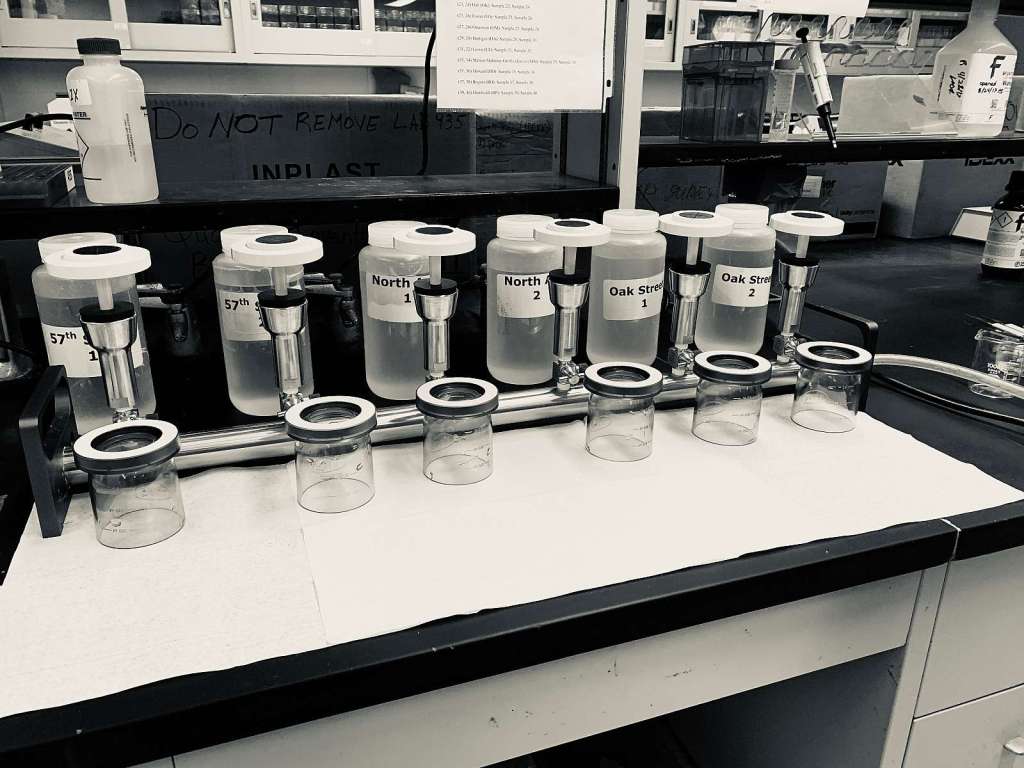
Beach water getting tested at the lab

When WBEZ reporter Monica Eng called to say she’d been investigating my query, she invited me to join her at the University of Illinois at Chicago lab where the beach water is tested. We watched delivery of the water samples and observed the scientists take them through the paces. The daily results are released to the lifeguards by 1:30 pm. If there’s a high concentration of fecal matter, the lifeguards are supposed to raise a yellow flag which signals to the beachgoers the water quality might make them sick. The Chicago Park District stopped alerting the media about high levels of fecal contaminants and stopped closing the beaches in 2011, opting for the Swim-at-Your-Own-Risk flag system. 

And the Border Collies? The UIC scientists pointed to studies that show gulls are the main culprit of contaminated water (and sand) and the most effective way to manage them is to use Border Collies. At a Chicago Park District Board meeting in July, I asked, 1) why don’t they use dogs now? and 2) why don’t they close beaches that test for high levels of fecal matter?

The Park District CEO answered that they don’t use dogs anymore because they were rejected for the EPA grants that funded them. And they don’t ban swimming for super high feces anymore because people like to swim, and the health department hasn’t heard about any E. coli infections from beaches recently. These answers didn’t restore my confidence in the Park District’s understanding of public health policy. But they did cement my resolve to never take Henry to the beach. We’ve settled for the view from the maniacal bike path. 

And contaminated or not, the blue serenity of Lake Michigan is its own anti-depressant. No medication can substitute for the mood-altering calm of her reflected beauty. I’m grateful to have her.

*     *     *    * 

Read more about poop data in Curious City’s “Scoop on Poop on Chicago’s Beaches.” The nine-minute audio story has even more information. Listen here.
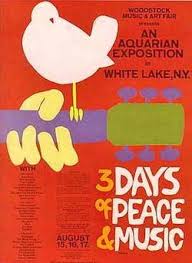
Remembering Woodstock

Remembering Woodstock

My estranged husband dropped by my friend’s place at the Jersey Shore on Thursday afternoon, August 14, 1969 to fetch our child for the weekend. I lay in bed smoking pot with my sister’s boyfriend next to the crib where the two-year old slept. The three of us had a grand argument. Grabbing his toddler son, my husband screamed I would never see either of them again as he bolted from sight.

The next morning, I hopped in a station wagon headed for Three Days of Peace and Music in Woodstock, New York, with my sister, the boyfriend and a few merry-making hippie wannabes. The car roof was overloaded with tents, sleeping bags and cases of Rolling Rock. We squeezed a change of clothes, toiletries, hallucinogens and festival tickets into our Army surplus backpacks.

Turning off the New York state highway onto the country road leading to Bethel, we fell in line with a flotilla of vehicles undulating in three lanes up a two-lane road. We shared joints and beer with new friends and danced alongside cars with tunes blaring from their radios. After a few hours we pulled into a roadside clearing and set up camp with other squatters.

Concealing our festival tickets for fear someone would pickpocket them, we stepped into the twenty-minute march to the festival. We came up over a rise to the clear acoustic sound of “Freedom”. There were no ticket takers, no souvenir stands, no fences, no security guards. All of life gently moved downhill toward the music, each group plopping down on each perfect spot with Richie Havens in sight.

Wavy Gravy announced 500,000 people, don’t eat the brown acid and free food in the Hog Farm tent. A lone helicopter whirled in and out of a landing spot near the stage. Cardboard crates full of donated ice cream sandwiches, oranges and apples were arriving on the helicopters and getting passed overhead one to another. 

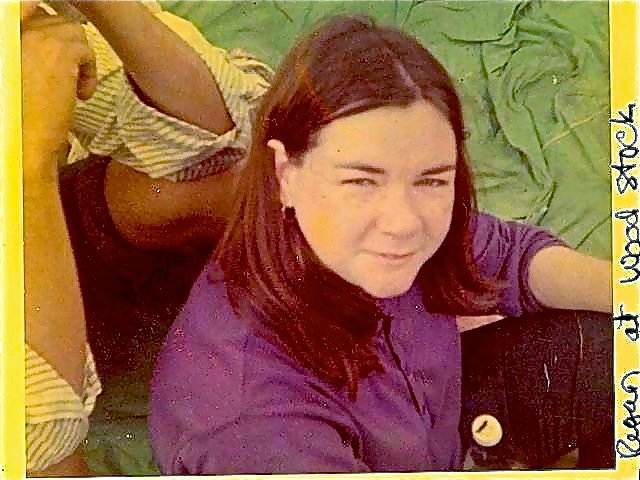
Paranoia ignited my companions who returned to camp one by one. They believed the government had gathered all the hippies in one place to drop bombs on us. I 184629_133318706737279_100001774502093_210241_2876134_nremained. Rain fell sometime in the night and the day. I crawled under a stranger’s tarp slept off and on, waking for Santana, Canned Heat, The Grateful Dead, Creedence Clearwater Revival and then that Texas twang from my hero …take another little piece of my heart.. Janis Joplin. Sly and the Family Stone rocked the muddy land as I wandered through the thinning crowd.


On Sunday morning I found myself among a group of tattooed bikers. I thought I should be afraid but they shared their drugs, food and drink. We were at perfect peace as Jimi Hendrix and his band, Gypsy Sun & Rainbows came to the stage, nine hours later than scheduled. He lifted us all into the fifth dimension throwing down his crazy electric Star Spangled Banner. We claimed Hendrix’s version for our ourselves–our own national anthem because we loved America too.

The party was over. I stood alone on a muddy, garbage-strewn hill. A friend appeared who had stranded his car on the festival road. We laughed and cried moseying along the road with other stragglers searching for their rides. Squinting through the sunny Monday, we drove down New Jersey’s Garden State Parkway landing in the sobering net of the state police. I gulped down a stash of opium saving us from legal harm.

Down from heaven to home, I faced the consequences of my humanity, vowing to clean up my act.


Am I Having a Panic Attack?

Am I Having a Panic Attack?

Waiting in examination room #5 for the skin doctor, I suddenly felt separated from the real world. Where was everyone? Was I in the right place? The right day? The right office? Where was I? Space stretched thin like over-rolled pie crust. I focused on deep breathing but knew I had to get out of there fast.

There’s nothing wrong with my skin. My mother called it “cheap Irish skin” because the sun burns it bright red, never a gold-plated tan. Splotches of actinic keratosis or “AK” from years of sun exposure periodically scale up on my face. The dermatologist unholsters an aerosol can from her belt and shoots liquid nitrogen on my AKs during twice-yearly visits. It creates instant frostbite on the dead cells, freezing the AKs in place. It doesn’t hurt. There’s no downside, no need for alarm and certainly no reason to have a panic attack.

“Anything else I need to look at?” the dermatologist asked.

No. This wasn’t the time for new concerns about my skin. I was on the verge of collapse.

By the time I got down the elevator into a lobby chair, hyperventilation was threatening to kill me. I thought I’d been in exam room #5 for a few hours but when I checked the time only thirty minutes had passed. Why were my legs so weak? I focused on my breathing until I recovered.

Looking for understanding, I later mentioned the discomfort to a friend, who happens to be a doctor.

“What did they do for you?”

“Nothing. I didn’t tell them.”

“What? Are you crazy? If your blood pressure spiked you could’ve had a heart attack.”

She didn’t understand. It was impossible for me to report my condition at the time. The pinched air sucked the words from my mouth. I couldn’t talk. I thought I was going crazy.

Panic attacks started in earnest a few years ago without any warning (not that I’d have recognized the warnings). I visited an old friend in the hamlet of Baltimore, a sailing community on the rugged southwest Irish coast. Vivienne and her friends were boarding a rubber inflatable one day for transport to a sailboat moored in Roaring Water Bay. She shouted “Get in!” as she crawled into the idling dinghy.images-3

“I can’t!”

“Yes you can. Get in! Get in!”

“I can’t! I can’t!”

I yelled at her over the roar and hum of end-of-summer harbor noise.

“Go without me!”

I ran to the bait shop restroom, then dragged myself to a wind-slapped bench and recuperated under the shade of a wild fuchsia hedgerow.

Later Vivienne joined me on the deck of the waterfront cafe. “I panicked,” I said. She understood. Convenient word, panic. 

Last year I panicked at different times in several US airports. There’s a simple solution to that—stay out of them. Now I face the unpredictability of panic striking at any moment and for no reason. I’ve considered revealing this malady to my friends in case I’m in their company if it happens again. I wouldn’t want anyone rushing me off to the emergency room because they don’t understand. But whenever I mentally rehearse the words, the room sways. I can hear the questions, “what are you afraid of?” and “why do you think this happens?”. 

The difference between me and Henry the dog is that as the human animal, I’m able to understand my psychology and articulate that understanding to others. But the stigma of perceived weakness stills me into secrecy. 

How would I know if Henry, the non-human animal, encounters panic attacks?

Tale of Two Friends

Tale of Two Friends

When the Vietnam war was over, there were no patriotic homecomings for returning veterans—no sympathetic bystanders thanking soldiers for their service. The American public shunned them. The same politicians who sent them to die for no good reason

denied their health care for post-traumatic stress and any cancerous effects of the US-deployed Agent Orange.

I’d been working on Adlai Stevenson’s campaign for Governor in June, 1986, when Chicago held a long overdue welcome home parade for her Vietnam War Veterans. One of Adlai’s supporters, Kitty Kurth, asked if I would round up some volunteers to help organize the march with the vets.

When I asked my unemployed friend, Alice, to join me in the march, she asked, “How much will I get paid?”

“Nothing,” I answered, “it’s volunteering.”

“You want me to walk for four hours with people I don’t know, for nothing?”

My acceptance of the call to volunteer with the parade, forced me to confront my shameful scorn in the sixties and seventies for returning Vietnam vets. As I slow-walked with 200,000 battle-scarred military men and women in silence through downtown Chicago, a redemptive veil flittered around me. I felt honored to be among them.

I can’t remember the first time I ever volunteered for anything. My family considered volunteering beneath them. They ridiculed me as a a naive idealist at best, a do-gooding loser at worst. Perhaps I started volunteering as a show of rebellion. Perhaps I sought refuge in something meaningful. I’ve abandoned friends, family and many living-wage jobs to work on political campaigns, for no money, surviving on unemployment benefits or credit cards. By the time my volunteering spawned a paid position for work I love, I’d racked up a lot of experience and a lot of financial distress.

Kitty and I kept in touch. We saw each other at various political events and campaigns. Then in July 1991, she asked me to volunteer with Comic Relief at the Chicago Theater, a star studded Tribute to Michael Jordan to raise money for homelessness. Assigned to greet Jane Curtin at O’Hare Airport, I escorted her downtown in a limousine, led her to the dressing room and kept her on time for her performance. All the volunteers hung out backstage and met Billy Crystal (a real jerk), Patty LaBelle (the nicest person in the world), George Wendt (another jerk) and Siskel and Ebert. Roger Ebert asked me every detail of my car ride with Jane Curtin. He greeted her by quoting some of her lines from3cb4ef3277b51b27070c9f70f7c10864 the Saturday Night Live Coneheads skit. He was as starstruck as I was.

At intermission, Michael Jordan appeared backstage to meet and take photos with the volunteers.

When I later bragged to Alice about Comic Relief, she was furious I didn’t include her.

“Well, you have to pay your dues,” I said.

“What’s that mean?” she asked.

Kitty has a lively communications firm and invites me to events she knows I’ll enjoy. Alice, like my family, derided me as a naive idealist. But I discovered life is more meaningful and a lot more entertaining when I just say yes. I’m not ready to give that up. Not yet.

Irish Buffet

Irish Buffet

A Hero’s Kitchen

I have no memory of my mother’s cooking before she left my father. After their Midwest life of drunken brawls, evictions and midnight moves, she relocated my sisters and me to the unfamiliar Jersey Shore as we approached adolescence.

The kitchen appeared to be an afterthought in our new four bedroom stucco: four corner doors led to the living room, the backyard, the driveway and the dining room. The backyard door swung open and shut on one side of the stove. The fridge sat on the other side, leaving no wiggle room between it and the stove, it and the living room door. It’s as if no one was expected to cook in there.

In an attempt to provide a semblance of order in her new-found single motherdom, Agnes sat her four daughters down to a gourmet dinner every night. Chopping and mixing occurred on the space between the stovetop burners or on the drain area of the sink opposite the stove. An unspoken rule kept food preparation away from the dining room table.

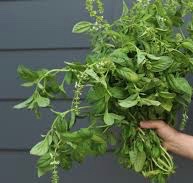
Agnes insisted my sisters and I learn to use the pressure cooker she’d acquired to whip up potato salad in the summer and mashed potatoes in the winter. After the lid blew off and the contents hit the ceiling, I never went near it again. Her recipe for pressure cooker spaghetti sauce required bunches of fresh basil, and Agnes could only find that at the summer farm stand. I don’t know how much the recipe called for, but she dropped so images-1 2much of it into the tomato sauce it came out like basil stew, delicious over spaghetti but awkward to twirl around a fork.

She thought gourmet cooking meant stirring wine into every dish, usually at the last minute. That way the alcohol wouldn’t cook off. She added wine to chile con carne, shrimp newburg, chicken a la king, beef stroganoff and all au jus sauces. My sisters and I exchanged glances when dinner guests remarked on the richness of the sauce. We’d dare not say anything about Agnes’ cuisine, especially the wine additive, for fear of her embarrassing reprisals like, “what do you know about cooking?”

Agnes cherished continental dining. We sat down to dinner around 8:30 depending on how long she stretched the cocktail hour. My sisters and I fought every night about whose turn it was to clean up. We were so tired by the end of dinner we often left dirty dishes piled in the sink. No one ever took the garbage out. Two or three grocery bags full of empty beer cans continually took up precious kitchen floor space. A friend once referred to the sight of it as an “Irish buffet” which Agnes thought hilarious.

As her alcoholism progressed, Agnes’ dinner-table attempt at a normal life fell by the wayside. But for a few brief years, in that tiny trashy kitchen, Agnes was a culinary hero.