When The Saints Came Marching In


I hear some people say they knew this or that at age 5, 6, 7 or 8. They knew there was no Santa Claus or they knew their father was having an affair with the neighbor. Not me. Throughout grade school, with all evidence to the contrary, I trusted that the adults in my life knew what they were doing, didn’t lie to me and moved our family around for good reasons like better neighborhoods or better schools. Then my mother yanked us from our midwestern roots, away from my absentee father and took us to the East Coast. My sister Erin and I landed at the doorstep of my mother’s sister, Aunt Joanne, in Upper Marlboro, Maryland, with her husband Bill Dorsey and their seven children. It was Christ-Rohrmid-May when we entered St. Mary of the Assumption School where the nuns “sought to imitate Jesus Christ.”  In 1959, St. Mary’s was still segregated except on the playground where I joined girls and boys, blacks and whites defiantly playing baseball all together.
The eighth grade class at St. Mary’s had spent the entire year before I got there memorizing one poem a month. In order to graduate, I had to memorize all nine poems. Not only did I rebel against this arbitrary standard, I became hysterical over it. My mother had taken two of my sisters to New Jersey to live with other family members and for the first time in my life I absolutely knew that she had gotten it wrong. I needed her with me, to defend me against the injustice of those nuns. I had sacrificed a lot for her and it was time she helped me.
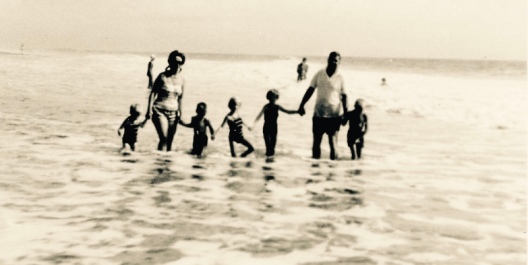
img021
The Dorseys at Bethany Beach, Delaware

Uncle Bill had a different idea. He told me I could do it, that we’d do it together. Never before had anyone sat me down and given me a pep talk. Every night after dinner for four weeks he helped me learn those lines. Poems like “Annabel Lee” by Edgar Allan Poe, “The Tyger” by William Blake, “O Captain! My Captain!” by Walt Whitman and my all-time favorite, “The Chambered Nautilus” by Oliver Wendell Holmes. Uncle Bill’s love flowed through me and poured out onto the paper, lighting up the poetry. He gave those words to me. And now, when I hear or see them, my heart pounds with a thunder of love for his eternal soul.

The Dorseys threw a party on my 13th birthday just before I graduated. They invited all their friends and children. My mother arrived from New Jersey with my baby sister. The backyard ballooned with streamers and bunting, barbecue, birthday cake, and something I’d never seen before – a keg of Budweiser. Uncle Bill gave me the first draw of the tap. I gulped it down without tasting it. My first beer. Then I had another. And another. And suddenly I loved everything around me. I knew I belonged, in that family, at that party, with those saints.

The St. Mary nuns blundered in their seeking to imitate the Christ. But Uncle Bill Dorsey? He was the real deal.
Journey to Paradise

JFK was still alive the September I drove with my father in his white Cadillac Eldorado down the pike from our temporary home in Washington, DC to boarding school in Williamsburg, Virginia. My head overflowed with questions. Will they have a television? What will I do after school? How will I wash my clothes? I dared not ask my father for fear he’d mock my questioning of such mundane matters. In his silence I could hear him say, “They’re nuns. They take care of people. Stop worrying.” I wasn’t worrying, just wondering. In spoken language between us, different words seemed to have the same meaning—wonder and worry, driving and speeding, drinking and drunk.

Unfamiliar signs became our talking points.

“Look there’s Fredericksburg. Did something historic happen there?”

He told me it’s a Civil War town. 10,000 slaves ran away from the plantations there and joined the Union Army.

Slaves? I had never been in a place where slaves had lived. Monticello. Is that Jefferson’s home?

I’m not sure how much I knew of Civil War history or American history as I was entering my junior year in high school, but clearly the road signs along the highways in Virginia had awakened some schooling. Petersburg and Appomattox. My premature view of life misinformed me that places I read about in history books, like these, no longer existed.

Until then, I had lived my whole life at sea level—the flatlands at northeastern Illinois’ Lake Michigan and the New Jersey seashore. The Virginia road climbed up and down between wavelengths of blue and green, tree-lined hills with wide verdant medians. My mother used to call me a nature-lover. I guess she was right. The scenery captivated me, as if we were driving through the Garden of Eden. I imagined Paradise at the end of our journey.

“What’s the Blue Ridge Parkway?”

My father loved to drive and he’d already been on Skyline Drive, the main road through Shenandoah National Park on the Blue Ridge Parkway. Our route to Williamsburg didn’t bring us near there. Thirty years later, remembering my father’s description of the misty Blue Ridge Mountains and the hills rolling down to the Shanandoah River, I drove there myself.

At Richmond we turned southeast toward the Norfolk Naval Base, Hampton Roads and Williamsburg. I was leaving no one behind. My mother, sisters, cousins and friends lived in another place, another time with their wild summers and grey winters. A vagabond life brought me to live at Walsingham Academy run by the Sisters of Mercy, the school that housed girls from mothers who didn’t mother and fathers who didn’t father—girls who had ulcers and girls who dyed their hair.

We turned onto Jamestown Road toward my new assignment. Fear tightened my grip on reality. Had he told the Mother Superior I had mononucleosis? Got drunk? Swore? Didn’t believe in God? Had an ectopic pregnancy? Did he even know I was tired all the time, and lost? I feared and I hoped they’d care for my soul.

Dearest Jean, Key West, 1943

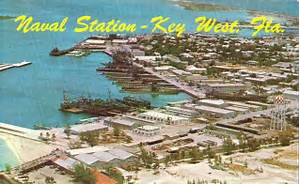
My cousin Therese cleaned out the old dresser in the basement next to the washer and dryer after her mother died in 2001. She found a letter my mother had written in 1943 from Key West. My mother was 22 years old, married to my father, a Navy pilot.th-2

The letter begins with sisterly reasoning about why she isn’t using her best writing paper. “As long as you’ve seen my good stationery, I’ve decided to use this stuff.”  She makes no apology about why she hasn’t written sooner: “Laziness accounts for all the weeks I haven’t written.”

My mother, Agnes, and her sister, Jean, were a year apart. They lived for a time at Georgetown Visitation College, an all-women convent school on the grounds of Georgetown University, where they met their husbands. In my mother’s letter to Jean, she gossips about former classmates. Dorothy Castle’s husband Ed was in the Navy’s “Sound School”, training to detect enemy submarines, and would soon be commanding a “sub chaser”. “Water Wings Haley, up in Miami, was waiting for a ship to get outfitted that he would command.”

She mentions that my father “will jump from Ensign to full Lt. if the Air Corps ever gets tharound to promotions.” And then she writes, “I personally don’t give a damn, but that’s all anyone talks about.”

Ah-ha! There’s the mother I knew, not giving a damn. And judging people who do–give a damn, that is.

She then reveals that my father’s mission, patrolling the Florida Straits between Key West and Cuba looking for German submarines, is a military secret. On liberty in Cuba, he and his fellow pilots acquire contraband —English gabardine, cigars and liquor. “We’ve become quite the rum and scotch ring. I’ve had to acquire a taste for Daiquiri’s because of the lack of gin,” she writes.

Next we read about her new bathing suit, her tan, the new officers’ club where “we have to bring in our own liquor because it’s on an Army Reservation.”

I have no idea how or when criminal activity became just another part of life to my mother, like clothes shopping or mixing a martini. Until I read her letter, I thought my father had influenced her. Her nonchalance on smuggling reminds me that she seamlessly taught me to shoplift from the A&P as a child and that she stole from her employers.

The second child of seven, she grew up in one house in Westfield, NJ where the children revered their successful father and adoring mother. Yet, like my father, she wasn’t governed by her conscience. My parents didn’t pay bills, cheated their friends and families and relied on midnight moves to escape rent-collecting landlords and hotel managers. They left me with a lifelong struggle “to give a damn.”

The day she died, I visited her last residence, a nursing home in Point Pleasant, NJ. Her closet overflowed with clothes she stole from other residents. The nurses said my mother expressed a lot of emotions in her dementia but guilt and shame were not among them.