Chicagoans: People of the Water

FeaturedChicagoans: People of the Water

Chicago is a water town. Lake Michigan and the sky above are our watermarks, the invisible identifier embedded in the soul of anyone who lives here for more than a year, or so. We are built around the lakeshore, the river banks, the canals, the bridges. Oh those bridges! For the next two to three years, three downtown bridges over the Chicago River are closed for repair. I know the river. I know those bridges. Whenever I’m a passenger in a car headed toward the Chicago River, I, a non-driver, turn into a navigational virtuoso.

“Turn left on La Salle Street! Now! Go to Jackson and make a right. Yes, Jackson.”

I’m insufferable. And always right.

Once you’ve lived anywhere in Chicago with even the thinnest view of the lake or the river, you can never go back, never not have water in your sights. Magical is an inadequate adjective. It’s cellular. What must it have been like for those who settled this land we call Chicago? Did a wild black and blue sky moving over Lake Michigan shout danger to our native ancestors? On windy days, did the lake and river together kick up such a fuss that the confluence was unnavigable? Were their beliefs tied to a cellular connection between the water, the land, the ancestors? Dare we imagine that those first peoples inseminated future generations, yes us, with a cellular connection to the water? 

My favorite visitors are those whose excitement about the Chicago Harbor Lock exceeds mine. The Lock is at the confluence of the Chicago River and Lake Michigan. It is part of multiple locks and dams that allow water from Lake Michigan to flow inland, toward the mighty Mississippi. Chicago devised reversing the flow of the river in the 1900s to send our sewage downstream, away from our beloved lake. Lucky for us. Unlucky for St. Louis. 

Boats and cargo ships moving from the river to the lake first enter the lock and tie up. Like a water elevator, the water raises or lowers to meet the level of the lake. I’ve been on tourist boats waiting in line on either side for tankers and cargo boats to get through the Lock. Thousands of Chicagoans live in high-rises with floor to ceiling windows where they can pull up their work desk and chair and watch the Lock all day long as they work from home. What a great city. This water town.

In mid-September, Customs and Border Patrol (CBP) agents were dispatched to Chicago as part of the Trump Administration’s ICE operation to arrest illegal immigrants with criminal records. They announced themselves by cruising up and down our cherished Chicago River, in and out of tour boats and kayaks. Some were masked. All were uniformed. All were armed with semi-automatic long guns. How did such an invasion get through the Lock?

Since that absurd melodramatic entrance into our city, the CBP has cruised into neighborhoods in military vehicles, springing into action to terrorize Chicagoans, citizens and non-citizens. 

Chicago responded with multiple layers of volunteer rapid response teams covering every scenario of civic and private life. New and old activists carry whistles to alert neighbors of CPD/ICE presence on our streets. Neighborhood school patrols walk children to school.

The Customs and Border Patrol floated into Chicago with 250 agents. There’s reason to believe that number is reduced to 100 for the winter. One of their most horrific tools, tear gas, doesn’t work in cold weather. They’ve gone off to warmer climes for training — to figure out how to deal with the likes of Chicagoans. Reportedly they will be back a thousand fold in the spring.

Oh these blue-minded Chicagoans.

These people of the water.

Will be ready.
______________
“Yet once you’ve come to be part of this particular patch, you’ll never love another. Like loving a woman with a broken nose, you may well find lovelier lovelies. But never a lovely so real.”― Nelson Algren

Magpie Wedding Guests

Magpie Wedding Guests

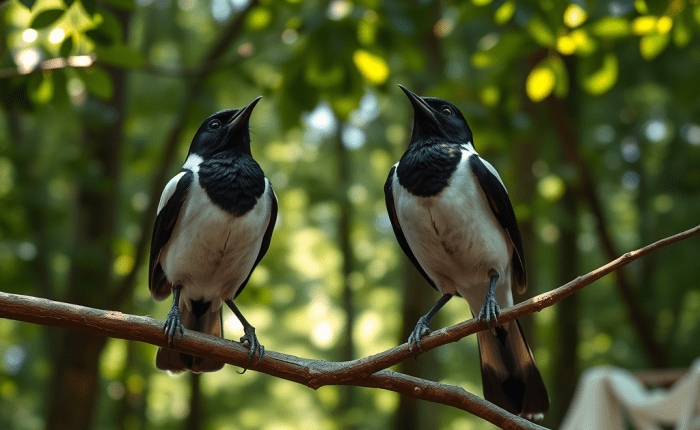
The Merlin app in my iPhone reported two singing Magpies above the deck built into the trees surrounding the wedding. Standing at the rail with my 19-year old grandson, we looked to the sounds — to one side of the dense forest, then to the other.

“We should be able to see them,” I said. “They’re the size of a crow, with white bellies and flashy black wings.” 

The Merlin Bird-ID developed by the Cornell Lab of Ornithology, identifies birds by their song. It works like this: I open the app, Merlin tells me the name of the bird it hears, and I look for that bird. I’m satisfied, thrilled actually, with knowing who they are even if I don’t spot them.

We were in Salt Lake City for Kirby and Nate Green’s wedding. My granddaughter. I had walked around my hotel neighborhood earlier looking for birds. Many North American birds, like the Magpie, never come over to my side of the Mississippi River in Chicago. They stay out West. On my morning walk, I spotted only the ubiquitous house sparrow.

Magpies! Known as the world’s most intelligent animal, they are in the equally-smart crow family. Magpies have even been observed mimicking human speech. Trying to spot the Magpies on the on the deck, I thought of a time I visited Los Olivos, California. 

In the garden of a gift shop, I noticed a gregarious Magpie couple roosting on a shed.

“Look them in the eye!” 

The proprietor instructed me to interact with the birds because of my exaggerated curiosity. My friend, Cappi Quigley, tried unsuccessfully to lure me away to the California artists’ original wares displayed around the garden.

“They are wild pets,” the owner explained. “They’ll follow you, protect you. Lock onto their eyes and you will not be forgotten.”

We drove out of Los Olivos five miles up Figueroa Mountain Road to Michael Jackson’s Neverland Ranch for a look-see. MJ had been dead for about two years then. We managed to snap each other’s photos in front of Neverland’s iron gates, just as the guard shooed us away.

Two Magpies yacked and magged at us the whole time from low hanging olive trees. They had followed us up from Los Olivos and all the way back to town, swooping down on the car and yelling, as if they were warning us away from Michael Jackson’s ranch.

Folklorists report that Native Americans believe the sight of a single Magpie brings bad luck. But a pair of Magpies, as heard in the trees above the wedding, brings joy. I heard the Magpies again as Kirby and Nate exchanged their vows. There is a world where we might believe that those two Magpies have found their way from the trees above the wedding to Kirby and Nate’s backyard. And that the Magpies will roost on the shed, bringing joy to Kirby and Nate’s lives together as long as they live. 

Cold Wars

Cold Wars

The 2019 Polar Vortex slid down from the North Pole, threatening to lock Chicago into subzero stillness. I prepared for the warring cold by teeing up the entire 18-hour series of The Marvelous Mrs. Mazel. Then I threw stale bread crumbs onto my balcony to nourish the house sparrows, finches, and chickadees before they huddled together in eaves and cracked soffits to wait it out. I shuttered in and Dapped all the little crevices around the balcony door that were spritzing air into my not-so-insulated living room. That was the extent of my preparation for the coldest two days ever recorded in Chicago.

Day one brought minus 23 degrees. I woke to a thick film of silver ice covering all the windows. The ice curtain obscured the humanity moving around behind the windows across the street and any fool pedestrian walking in the feels-like-minus 40.

My binge-watching was interrupted mid-morning by a thrashing whomp, whomp whomp on the concealed balcony. I inched toward a clearing in the frosty glass.

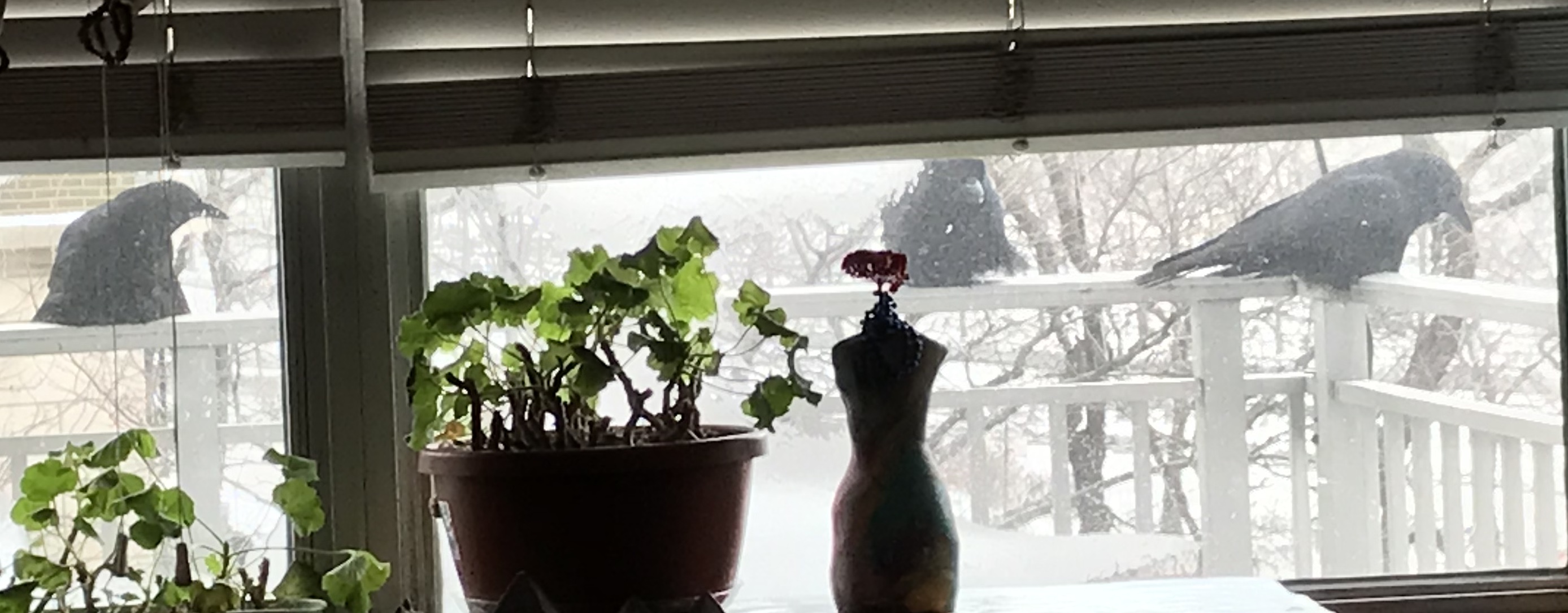
A murder of crows had come to forage.

The much-studied American Black Crow might be the most intelligent animal other than primates. They hide their food and come back for it. If a crow looks you in the eye, she will remember you, follow you down the street, and caw at you for attention like a wild pet. 

On day two, the temperature was 21 degrees below. The ice wall on my windows melted enough for a small lookout. I abandoned Mrs. Mazel and placed a chair well away from the clearing to observe the crows without startling them. They first landed in late morning. A mighty set of black wings fluttered a plumped-up body onto the balcony railing, and the rest followed—a family of five dipping to the balcony floor for leftovers. They flew off and came back. Again. And again. And again. I remained still throughout, trying to lock eyes with the birds. In the afternoon, the weather broke and allowed the dog and me to walk outside—under the watchful eyes of noisy new friends.

The first cold days of 2023 were predicted for the weekend after Thanksgiving. Though nowhere near the 2019 plunge, 30-degree temperatures heightened awareness of asylum-seeking families living on cardboard slabs outside police stations. I sought diversion through another favorite TV series, Julia.

The TV automatically tuned in CNN, though, where there was live coverage of the hostages being released from Gaza. A mysterious and curious need for every scrap of information gripped me. Who are they? What are their stories? Where are they going? I saw six women over the age of 70. One 85-year-old was helped onto a bus. I winced, feeling my own arthritic pain. Four children appeared—ages 2, 4, 5, and 9. I squinted to see if they were clutching teddy bears.

After watching for two tearful days, unrelenting shivers overcame me. And when I took the dog for a walk, that murder of crows cawed to us from the barren trees.

Shallow, I’m Into The Sha-la-la-low Now

When the attendant told me I was at the wrong gate, I froze. I’d been at Midway Airport for two hours waiting to fly to Salt Lake City for my granddaughter’s 2018 graduate school graduation. My vision blurred, my legs shook and I gaped at him without speaking. I actually couldn’t hear him. Someone grabbed my arm and raced me over to the correct gate just before the jetway closed. Inside the plane, I was escorted to Row A
where they keep an eye on people. th-4

I traveled twice more that summer. Once I was in the wrong TSA line, so confused that a stranger brought me to where I needed to go, again. I’ve since developed a phobia, thanks to nightmarish remembrances of Tom Hanks in the movie Terminal—about a man who lives in the airport after he is denied entry into the US.

A friend who works for O’Hare tells me airport workers regularly experience confused old people wandering around lost and panicked. I’ve traveled a lot in my life but familiarity with airport commotion holds no weight now.

When I first retired, I was unsympathetic to people with cognitive disorders. I joined the morning exercise classes at church but not to make friends. I told myself I wasn’t like those old people. Well, those old people have subsequently shown me how to be old, have compassion for those who talk slower than I do, who will never remember my name nor I theirs, nor the title of the book we just read or the movie we all saw. Our get-th-7togethers are often hilarious games of 20 Questions where we all guess what someone is trying to remember.

There’s just not enough room for all the bits lodged in my aging brain. A mysterious natural phenomena controls the shedding and changing of my grey matter, like menstruation and menopause in my body. Trouble is, the shedding seems to be more active these days. Oh sure, curiosity fills my brain with new information but its cells refuse to let those memories form and what I learned yesterday is soon forgotten.

One technique I use to block braincell destroyers is to ignore anxiety-producing articles that say cognitive decline slows if I eliminate sugar or learn chess. Perhaps the content is correct, but I’m possessed of my own version of old age, not a researcher’s cookie-cutter version. Similarly, I cast off brain-shrinking agitations delivered by younger friends who tsk me for walking too slow or for asking them to speak up. 

However, I love music so I responded to an article about choir singing strengthening the memory and joined the Good Memories Choir. Singing won’t get me back in airports, but learning music keeps me attached to the real world. In Bradley Cooper’s remake of A Star Is Born, Lady Gaga sings about the love of the two main characters as “far from the shallow now,” as if the brain has no choice but to deepen the couple’s experience. In my case, like the reversed flow of the Chicago River, I have no choice but to spill out of the deep and into the shallow now.

___________________________________________________________

For those who don’t understand my title, I give you, with love, Shallow