
From my window, I can see Lake Shore Drive’s curve at Oak Street, an “S” curve fraught with danger. Some days, as many as five separate car crashes occur from unsuspecting or inexperienced drivers speeding toward the curve and sliding off the road. Heavy gauge ribbed steel barriers prevent errant vehicles from jumping the curb, flying off across a small park, and crashing into the Drake Hotel and vintage apartment buildings on East Lake Shore Drive.
On eclipse day, April 8, 2024, an East Lake Shore Drive building was an arrival point for President Joe Biden’s visit to Chicago. To augment the threat of car bombs speeding down Lake Shore Drive and intentionally barreling off into the building, city salt trucks lined up bumper to bumper on a half-mile stretch of the S curve that hugs the small park on one side and Lake Michigan on the other.
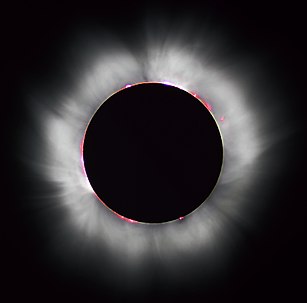
At 2:07 pm, the moon blocked the sun by 94% as I waited in the park with my dog Elsa. A few other dogs tethered to humans stood nearby.
“Is the eclipse happening soon?” I called out to one.
“Yes, right now,” a neighbor announced.
“Here!” He rushed over and handed me his solar glasses so I could see the shadow of the moon crossing the sun.
“Oh, there it is,” I whispered, “I thought the sky would be dark.”
At 94% sunshine, the sky doesn’t turn dark. Even a tiny sliver of the sun is so bright it can light up the sky. I hadn’t been paying much attention to the details of the solar cycle or lunar eclipses. I knew light from that 6% sunshine is so intense it can fry your eyeballs, but I didn’t know that 6% sunshine gives off an intense, vibrant light capable of eliminating shadows.
As I handed the solar glasses back to my neighbor, I looked down at Elsa, standing in the projection of overhead tree limbs. April brought out buds, but still no shady foliage. The images of the boughs, branches, and twigs on the ground were as clear as they were on the trees, like a photo. A perfect mirror image of the deep brown arbor architecture above. Nothing in my memory compared to this. I sensed, though, a deep knowing, as if ancient benevolent familiars had brought me the seeing of a thousand ancestors.

“The sun is about a million times brighter than the full moon,” explains Angela Speck, an astronomer at the University of Texas at San Antonio, “So if 99.9% of the sun is obscured,” she says, “there will still be a thousand times more light than the full moon.
I read that in the days before the eclipse, but it held no meaning and slipped my memory. I still had a preconceived notion that the sky would turn black. Experiencing the solar light on the ground, mine and Elsa’s ground, in the valley between the salt trucks and the highrises, revved up my consciousness.
Now it makes sense.

 tomcat prompting my mother to kick the cats and scream, “You queers! Cut it out!”
 Regan Burke