Featured

Cops at the Door

In Resma Menakem’s book, My Grandmother’s Hands, we learn that racialized trauma lives in the bodies of White Americans. Not Europeans. Not Asians. Not Russians. White Americans. There’s evidence that the DNA of Black African Americans and, in a different way, of White Americans, has changed as the result of enslaving Black Africans within the past four centuries. If you’re a White American, the trauma has been passed down from your White ancestors and will be passed along to your White progeny.

Reading this introduction, I paused. For a long while. Did I want to go this deep in recognizing and ridding myself of my own racism? Not really. I’m exhausted by introspection on racism, which I’ve been drawn to and stuck on since the murder of George Floyd. But my book group is engaged in a six-week study and I like them.

Its unclear whether certain strings of DNA draws generational traumatized people to law enforcement. Or, do we all have the same traits, and then police work brings out reptilian responses managing Black bodies? In White neighborhoods, policemen jump to a heightened state of control and figure out a way (legal or not) to remove Black people, well, really young Black men, especially when they’re sighted walking down the street hooded and slouched.

When the police go to court to defend these arrests, they say, “residents were afraid for their lives.” If they’ve roughed up, maimed or killed a Black defendant during the arrest or in the jail cell, the judge and jury are persuaded it was self defense with the simple words, “I was afraid for my life.”

This chapter in the book, “White-body Supremacy and the Police Body” seemingly had nothing to do with me. As an old White woman, I have little interaction with the police. But during the meditation exercises at the end of the chapter a memory busted out of my subconscious.

In the mid-1990s I answered a knock at the door to two White policemen. They questioned me about an altercation I had that morning with my car and a new BMW. Both of us were squeezing into one lane of an off-ramp and I banged into her car. She rolled down her window, screaming obscenities, yelling at me to pull over. I did not. I sped up, drove straight home, closed all the curtains and dove into a pint of ice cream. The police plainly stated my actions could be a hit and run. My lizard brain impulsively launched into a devious defense.

“Did you see her?”

“Well, you must see how afraid I was? She scared me to death. I was afraid to pull over. What if she had a gun?”

She was Black. The policemen backed up, put away their notebooks.

“We understand. Don’t worry. She doesn’t have your address. We won’t pursue it.”

The book begins with a quote from Charles M. Blow: “One doesn’t have to operate with great malice to do great harm. The absence of empathy and understanding is sufficient.”

MLK Jr teaches this. So does Jesus. And now, reminded of that ugly part of me, I have to learn the practice of empathy and understanding.

Someday.
Race Restrictions: The Chicago Covenants Project

Race Restrictions: The Chicago Covenants Project

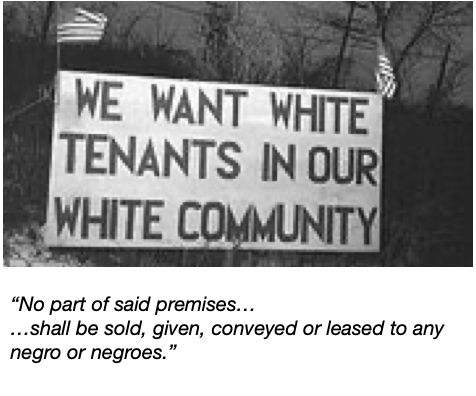
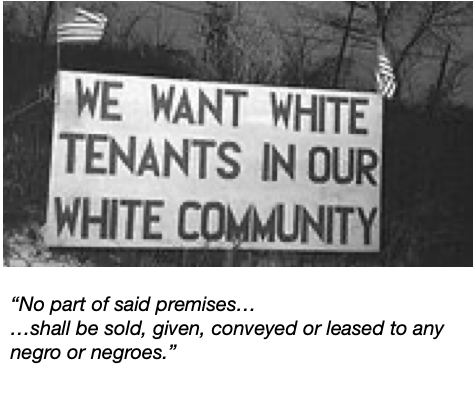
Restrictive covenants, redlining and contract buying were some of the discriminatory housing practices used to segregate Chicago in the first half of the Twentieth Century. Restrictive covenants prevented Black Americans, and sometimes Jewish Americans from buying, renting, or living in houses in white neighborhoods. 

The Chicago Covenants Project, begun in Spring 2021, uncovers deed restrictions officially recorded in Cook County. A team of their researchers and volunteers gather in the Tracts Division in the basement of city hall a few times a month to search land records for racial covenants. 

Finding the Tracts Division of the County Clerk’s Office is the first test of a volunteer’s sleuthing skills. The entrance to the first floor staircase is often obscured by a large easel with a sign listing the prices of birth certificates and marriage licenses—no arrow pointing to “Tracts”. I once worked in the Clerk’s office but I still feel subversive slipping past the sign and the security guard to head downstairs.

The Tracts Division is a football-field sized room organized by rows of old shelves filled with real estate index books. Each book is 2 feet by 4 feet. A Project researcher assigns the books by number. My first assignment was book number 420. I lifted it onto the top of the elbow-high bookshelf and leafed through page by page. Thank God I thought to swallow an allergy pill before I left home.

Every deed recorded in Cook County until 1980 is hand written in an index book. After 1980, the records are digitized. Each page could have deeds recorded from 1910 to 1980. I looked only at deeds recorded up to 1950 since restrictions waned after a 1948 Supreme Court decision declaring racial covenants unconstitutional.

The volunteers in Tracts spread out around the room with their assigned books. Looking for covenants line by line is tedious. There’s a small explosion of joy, “I found one!” when one of us spots a handwritten “rac-restr” notation.

Property ownership has long been the avenue to accumulating family wealth. Restrictive covenants helped deny this possibility to Black Chicago for decades, while walling off the city’s segregated communities and perpetuating generations of racial inequity.

The Chicago Covenants Project has uncovered deed restrictions all over Chicago and the suburbs. Organized neighborhood groups supported by realtor associations once signed up homeowners block by block. Between 1933 and 1937, a mailer was distributed door to door to stoke fears about Blacks moving to Chicago’s North Side, where I’ve always lived. It minced no words: “The Near North Side Property Owners Association proposes to ask every property owner in the district to agree to sell and rent to white people only.” 

Even the renowned Newberry Library has a racial covenant. 

You may be asking, “what’s your point?” 

Well. These buried files prove that racial inequity in Chicago was intentionally created by white people—house by house, block by block, neighborhood by neighborhood. 

A fact that cannot be erased.