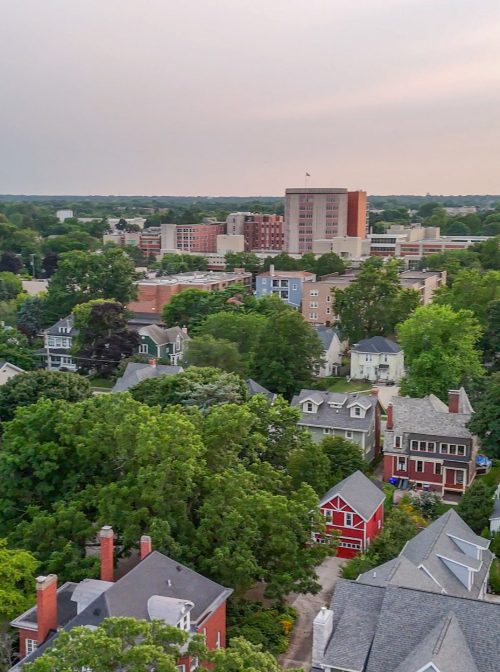
The gardeners in the small neighborhood park I call my own, butchered the beauty out of the spring flowers and attendant bird migration. In their zeal to prune away the dead and diseased tree branches, they yanked out all non-native “invasive” species. This disrupted the seasonal pattern of our expectations. As I wandered through the other day, a neighbor with her spaniel in tow stopped me.
“What happened to our flowers?” She yelled across the boxwood. “The gardeners mulched it all into last years’ compost.” I said. I don’t know her, but here we were joined by a sudden mutual experience. “They went too far! Can’t you do something about it?”
Me? I must have spoken with authority about the Chicago Park District’s program to remove invasive species and introduce native plants. As usual, I imparted knowledge based on next to nothing. Last summer as my allergies exploded, I read an article in the Chicago Tribune about the Park District planting more allergen-producing native plants, like goldenrod. A passing employee of the Chicago Park District once educated me on the park’s introduction of native plants, especially those glorious hibiscus. And a neighbor who is a volunteer gardener at the Lincoln Park Zoo spends her summer eliminating “invasives”. That’s the extent of my knowledge on the subject.
“You can go to the Park District Board meetings and ask about it,” was my know-it-all answer.
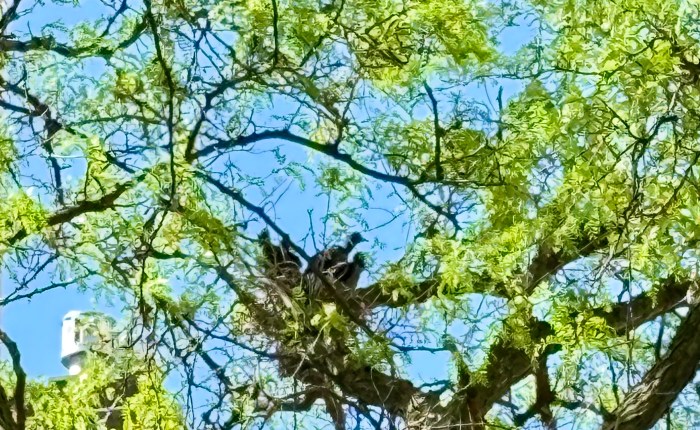
But Nature has once again reigned supreme in my city neighborhood. On my street, there is no human control over the crow’s nest and its four chicks that are flapping around in the branches. I watch them strengthen their young wings to fly out from their birthplace and fend for themselves. Wildlife never needs permission to be. But it does need protection.
The New York Times reported this week on one of Chicago’s best nature stories. The Lakeside Center at McCormick Place applied a treatment on its glass building to deter migrating birds from banging into it. Last year up to 1,000 birds died in one night at McCormick Place. This year, the deaths, due to the widow treatment, were down by 95%. Chicago’s unpopular mayor should take credit. For some of us this fact alone is enough to vote for his reelection.
Unfortunately there’s no treatment we can apply to protect ourselves from bumping up against the current man-made enemy that is called the United States of America. What can protect us from dirty air and water unleashed by industrial, vehicle and power plant toxins?
I envision a doomsday scenario, a post-apocalyptic environment like “the Last of Us.” Will my city’s native species die off and be replaced by invasive, toxic-loving kudzu? The White Christian Nationalists setting ecological policy have abandoned the Bible as their guide. Genesis 2:15, in all versions, clearly states we must tend to God’s creation.
NIV: The Lord God took the man and put him in the Garden of Eden to work it and take care of it.
KJV: And the LORD God took the man, and put him into the garden of Eden to dress it and to keep it.
NLT: The LORD God placed the man in the Garden of Eden to tend and watch over it.
CSB: The LORD God took the man and placed him in the garden of Eden to work it and watch over it.
All over early-morning Chicago, garbage trucks back in and out of alleys using rapid beep-beep-beep signals announcing their hulking presence. Elsa the dog and I are indifferent to this annoyance as we take our morning walk. But in mid-April, we both jumped to attention. We heard what seemed like a hundred garbage trucks backing up. The wildly unfamiliar bellowed from a block down the street.
“What’s going on Elsa?” I shouted down to my agitated Westie on the sidewalk. All of a sudden two honking Sandhill Cranes flew through the center of the street below the treetops. Their wingspan swooped past us from sidewalk to sidewalk as they glided and bellowed toward Lake Michigan.
Elsa flew into a barking rage. I lost my breath. My knees buckled. The Sandhill Crane is an ancient animal whose sole purpose is entertainment.
I love these four-foot high red-headed trumpeting birds. I once traveled to the Platte River on the edge of Nebraska’s Sandhills for their spring migration. My friends and I joined serious birders on the 5:00 am riverbank to view 600,000 roosting Sandhill Cranes. Their summer and winter homes are the northern and southern edges of the Great Plains. They are North Americans, Midwesterners.
Where did this duo come from and where were they going? They were likely in a flock following the Great Lakes Flyway, the migration route to their summer home in the boundary waters between the U.S. and Canada. Perhaps they were lured away by a mischief of rats feasting on the overflowing garbage bins in the alleys of nearby restaurants. Did a garage truck disturb their hunt? Whatever the story, I am deeply grateful they strayed from the flock and flew into my morning fugue.
Fugue? Yes, lately every morning I awake in a seemingly altered state. Oh, I tend a regular household routine, brain-fogged by radio news from the psycho-battleground that is my home country. Any diversion is welcome, particularly wildlife making its way through my city street.
But diversions, like bird spotting, are fleeting. The pluralistic society we’ve known as democracy is under siege. Pluralism, a word as ancient as the Sandhills themselves, one we learned in middle school, has been displaced of late by DEI or Diversity, Equity and Inclusion. DEI was corporate America’s answer to the communal guilt stemming from the sight of George Floyd’s on-air murder. The lofty goal of transforming Human Resource departments into offices of Diversity, Equity and Inclusion crashed and burned on the heels of Donald Trump’s name-calling presidential candidate Kamala Harris a “DEI” hire. Little did we know then, the summer of 2024. The weaponizing of DEI was not a diversion. Instead, it was a tactic in a larger strategy to destroy pluralism and make America White and Christian.
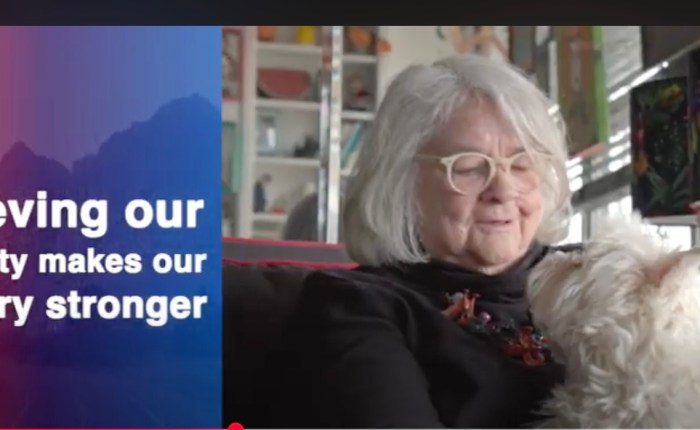
Interfaith America, the nation’s premier interfaith organization, has come to the battlefield now — taking the case for pluralism to the streets. A giant digital billboard in one of the most diverse locations in the country, Times Square, New York City, shows Interfaith America’s devotion to American pluralism. The message: diversity makes our country stronger. I’m in here, proud to represent my cohort, old white ladies with their dogs. Take a look.
At Saturday morning coffee in downtown Chicago, a friend and naturalized citizen joined our small group. They work (or by now, worked) at a federal agency where half the workforce had just been fired.
“Are you next?” I asked.
“I wrote a list of things I can do to make money. Nothing to do with my profession but at least I have options,” they said, “I have EU passport and know some languages. My European colleagues are already strengthening connections between their countries. There’ll be jobs.”
Watching TV on February 28, I was like a six-year old sitting cross-legged in front of a life-size screen expecting it to throw itself at me. The Trump-Vance shakedown of Ukraine President Zelensky in the Oval Office presented TV reporters and viewers with a clear and present danger. The US just changed sides. We would now be the puppet ally of Russia’s Vladimir Putin. The reporting immobilized me. What happened to Putin the mortal enemy? Another historical norm thrown onto the MAGA heap of used-to-be’s. Cafe societies the next day ratcheted up conversations about how to leave the country.
Our President was now our enemy.
How I want to write more about my friend! Their story about growing up behind the Iron Curtain during the Cold War intrigues this nosy Midwesterner. But I fear exposing my friend to gotcha algorithms that worm around the internet. I even write “they/them” so the sex can’t be identified.
They said, “Big difference between here and country of my childhood. Before the breakup of USSR, you’d be killed if you wrote forbidden words.”
Alexander Dugin, a friend of Putin’s, on the day of Trump’s 2024 presidential victory, proclaimed that “traditionalism won. Globalism lost. A victory for Russia.”
Globalism has been the hallmark of the devil infundamentalist Christianity since before Jimmy Carter’s presidency. At my small fundamentalist Christian church in the 1970s, a friend pulled me aside one Sunday during coffee hour. She said Jimmy Carter’s White House Conference on the Family was diabolic. We were both former hippies. We grew cabbage in our back yards. We made our own yogurt. We balanced our immune systems with apple cider vinegar. I thought I knew her.
A Christian convert, she’d been exposed to the idea that Carter would lay out his progressive American family values. Then spread those ideals around the world through programs like USAID.
“Carter is promoting globalism,” she said. “He wants all families to think like him.”
Preposterous? Yeah. I thought so too.
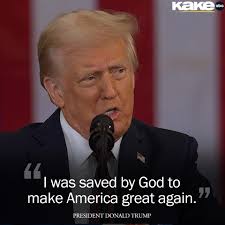
New York Times columnist, David French, is the original Never-Trumper. An evangelical Christian, French teaches history and the constitution. He explains Trumpism from a biblical point of view. Prophesying Christians, Pentecostals and traditionalists believe the Devil is the force behind globalism. Prophesied in the Bible. These Christians tell Trump he’s God’s man to lead America out of the spiritual darkness of globalism, especially because he survived a gunshot to the head. Trump’s leadership in anti-globalism, divvying up the world pie between the four leaders, Vladimir Putin, Xi Jinping, Donald Trump and Benjamin Netanyahu, is victory over the Devil. Oh.Yeah.
Long before Trump, when insecurity and doubt began settling in my young joints, I was desperate for certainty. I fell for these biblical prophesies, these absolutes. I sobered up, married and mothered a boy. I worked in a stain glass factory and had a garden. Despite these, I fell into a years-long fever dreams submitting to charismatic prophesying men. When I woke, a Presbyterian preacher told me doubt was good, certainty wasn’t. Putting church friends behind me, I rejected the prophecies of Christian fundamentalism.
On a podcast about grief, artist Laurie Anderson revealed to Anderson Cooper that she felt sad without being sad when her husband, rocker Lou Reed died in 2013. She came to this awareness at a class on the Tibetan Book of the Dead. The teacher, Bob Thurman, said there is no dead. Dead doesn’t exist. He was referring, in part, to post mortem existence.
Different concepts of the afterlife exist in most religions and philosophies. For atheists who believe nothing happens after death, Thurman, a Tibetan Buddhist, teaches there is no nothing. Dead is not nothing.
I’m about as sure of what happens when the body breathes its last as I am of next week’s weather. Oh, I tacitly agree with those who suggest I’ll see my dead dogs again, the same way I concur it’s going to snow tomorrow. Maybe. Maybe not. Surely, dead is not nothing?
On November 22,1963, my mother called from New Jersey to the Catholic boarding school where I was sent to “shape up” in Williamsburg, Virginia. I picked up the black handle dangling from its stretched out cord in the one allowable phone booth for us wayward boarders.
“Kennedy’s been shot.” She said.
I replied, “I know. He’s dead. It’s on the radio.”
There’s a reason my mother called me. She knew, even at seventeen years old that I’d be upset, more like hysterical. Politics had grabbed me as a pre-teenager watching the Vietnam war on TV. By the time Martin Luther King Jr. was assassinated, I, a twenty-two year old hippie, had been to two marches on Washington and written hundreds of letters to Congress and President Johnson. I was in support of the Civil Rights bill, the Voting Rights bill, banning the bomb and against the Vietnam war. Anytime the morning news stirred an injustice I had to fix, I reached for my stash of pre-stamped postcards to fire off messages to Congress. I harangued my friends—at work, in bars, on the beach, at parties—to think and talk like me. They didn’t. I kept going.
MLK’s admonition, “Our lives begin to end the day we become silent about things that matter,” initially whipped me into a frenzy of activism—more letters, more phone calls, more marches, more recruiting. Then in his “Drum Major Instinct,” speech in 1968 he preached to act as a servant, not a savior. It is noble to help just one person, change one person’s viewpoint, get one person to vote. Gradually, I adhered to King’s spirit and put into practice a daily mindfulness mantra: the worries of the world don’t own me, I don’t own the worries of the world.
DNA has proven dead is not dead. DNA, our physical manifestation of life itself, apparently lives forever. Anyone who has had a DNA test questions their reported trace variants of first peoples like Neanderthal listed in their results, as if our DNA was there at the beginning, or, before? Some religions teach physical immortality, that our dead bodies will rise (or have risen) to live in Paradise. It begs the question: wherever our raised bodies take up residence, will they have our same DNA?
Martin Luther King’s DNA lives in the generative marrow of his words. I always feel sad, without being sad on this day, his birthday, like Laurie Anderson grieving over Lou Reed. His death forever transitions into the endorphins between my dreams and awareness. He lives in that zero-gravity mirage of my inner life that says: serve, get out there, be brave, do it, say it.
As an eighth grader I entered segregated St. Mary’s of the Assumption for two months at the end of the school year. My family had come apart in the Chicago suburbs and one of my sisters and I were sent to live with relatives in Upper Marlboro, Maryland. Whites and Blacks mingled at St.Mary’s only on the playground where I pitched in the integrated baseball games.
On our first Sunday at St. Mary’s Church, my sister and I headed for the back pews. A white man ushered us out of our seats toward the front. Only Blacks sat in the back. The Sunday my mother visited from her temporary home in New Jersey, she pushed the usher aside and sat us all in the back. Her hangovers would not allow suffering through the entire hour of the Mass. She needed a quick exit after the obligatory Eucharist and delighted in integrating the back pew.
One day St. Mary’s eighth grade class was bussed down the way to Andrews Air Force Base to greet President Dwight D. Eisenhower. Blacks in the back of the bus. Whites in the front. Having so little experience with segregation, I was sure it was wrong but had no idea how to take a stand. I wished my mother had come along to integrate the bus. We waved little American flags at President Eisenhower as he deplaned Air Force One, Blacks lined up on one side, whites on the other. It was 1959.
Sixteen years later in a sleepy Jersey Shore borough, I read about Jimmy Carter’s campaign for president in Time Magazine. What caught my attention was Carter, as governor, in a surprise to fellow Georgians had denounced racism and segregation. I sent a note to Jimmy Carter, applauded his positions on race and volunteered on his campaign. He sent me a hand written thank you note.
When we received an invitation to Carter’s Inauguration, there was no question that my then-husband and nine-year old son would head to Washington DC for the January 1977 swearing-in. Sitting high up on bleachers on the shady side of the Capitol, it was as cold as any day I can remember. Twenty-eight degrees with a wind chill to equal fourteen.
My grandchildren, C.J. and Kirby, were 10 and 12, when we flew from Chicago to brave twenty degrees with 1.8 million others for Barack Obama’s 2009 inauguration. We stood for hours on the frozen ground by the Native American Museum on the Mall. Every once in a while I’d ask my shivering grandchildren if they wanted to go inside. No they didn’t! The clutch of strangers that formed in our section treated us like family—retrieving packs of hand warmers from a far-away tent for the inside of our mittens and boots.
It was sunny. Cold. And glorious.
Obama quoted Founding Father Thomas Paine in his in Inaugural address.
”Let it be told to the future world … that in the depth of winter, when nothing but hope and virtue could survive … that the city and the country, alarmed at one common danger, came forth to meet.”
Adlai Stevenson III (1930 – 2021) entered the 1982 race for Illinois governor just as I had become unemployed. My only memory of that forsaken job, like all the others, is my shameful obsequiousness to the forgettable male boss.
A journalist friend, Paul Galloway (1934-2009) interceded on my behalf to the Stevenson campaign for a volunteer position. Yes, that was necessary. And still. The sublime expression, “We don’t want nobody nobody sent,” originated in a Chicago ward campaign office. Campaigns still scrutinize volunteers with more than an eye roll. Because of my juice through the local newspaper, people were cautious about what was said around me.
I floundered around the office of Adlai Stevenson’s wife, Nancy, who was usually out campaigning. One day, I had the great fortune to be tagged to drive her to Oak Park for an event. That fluke set off a campaign-long assignment as Nancy’s driver.
Nancy and I regularly stepped into community rooms where older adults were having lunch through the federal Meals on Wheels program. Older women would clasp Nancy’s wrist, pull her ear close to their lips and whisper messages for her to take back to her husband. The Meals on Wheels crowd assumed Adlai III was his father, Adlai II, the governor when most of them were young. Nancy, who had a gentle and keen understanding of aging, let most of them hold this holy untruth. She displayed genuine kindness in her friendly interactions with old people who were in obvious cognitive decline. This helped me admit my own subconscious bias toward the aging. My ageism has changed overtime, especially now that I’m old and experience age discrimination against myself and my friends.
Meals on Wheels is funded through the Older Americans Act Nutrition Program which was permanently authorized by Congress in 1972. The purpose is three-fold: 1) reduce hunger, food insecurity, and malnutrition; 2) promote socialization; 3) promote health and well-being by preventing health-related diseases. The Program is available to adults age 60 years and older. Priority is given to low-income individuals, racial or ethnic minorities, rural communities, those with limited English proficiency, and/or those at risk of institutionalization.
One of our campaign stops was a community space in the neighborhood of Hegewich. It is located on the far south side of Chicago, known as the perfect workingman’s neighborhood. When Chicago’s steel mills shut down in the 1980s, the Polish immigrants who’d settled in Hegewich lost their jobs. They also lost their pensions. People survived on government subsistence and odd jobs.
As Nancy began her round of shaking hands, bobbing up and down to lean over to hear the messages of the elderly, she announced, “You know, my husband, Ad, voted for Meals-on-Wheels when he was a senator in Washington.”
Before she could get out another word, a large woman in the corner who looked like a George Booth cartoon yelled:
“Yeah? Well, he oughta be here now for the corned beef! ‘Cause it stinks!”
“Well, I’ll be sure to tell Adlai!” Nancy shouted back.
Funding runs out on December 31, 2024 for the Older Americans Act and the Meals on Wheels Program. If Congress doesn’t vote to reauthorize the Act, the Nutrition Program will be at the mercy of Elon Musk and Vivek Ramaswamy’s Department of Government Efficiency (DOGE). And they have vowed to eliminate all programs that have not been reauthorized by Congress.
My guess is neither of them have come to terms with ageism.
Hal Lindsey’s doomsday prophecies in “The Late Great Planet Earth,” stoked the born-again Christian fundamentalists in the cult I surrendered to in the early 1970s. One hundred disparate spiritual seekers in Toms River, New Jersey, accepted Jesus Christ as a personal savior, a necessity for inclusion in the Fellowship.
Churchmen directed every aspect of the lives of their blue-jeaned outcasts. Husbands were the heads of the household, women didn’t work. We lived in separate homes but were discouraged from socializing outside the Fellowship, lest we be influenced by 1970s secular humanist ideas — like having credit cards. The proliferation of credit cards, one of Satan’s tools to create a global economy, was a sign of the end times. We boycotted the Bank of America because the bank sought to legalize interstate branch banking, thereby centralizing all the country’s money into a single entity, another Satanic plan, a.k.a. globalism.
Based on his interpretations of the Book of Revelations in the Christian Bible, Hal Lindsey in “The Late Great Planet Earth” sensationalized end-of-the-world Biblical prophecies. He connected them to current events as proof of the coming Rapture where Christians would be plucked from the earth and taken right to heaven, thus avoiding Armageddon. Satan’s plans to form a one-world government and religion, as prophesied, were triggered by the establishment of the state of Israel and the World Council of Churches — both in 1948. Everywhere I looked in the 1970s, I saw signs of the end times: an increase in the divorce rate, recreational drugs, new technology, the gasoline shortage, religious ecumenism, and the birth of the European Union.
When my son joined Little League in the first grade, I sat away from the other parents in the bleachers. I feared the wrath of God if I talked to anyone outside the Fellowship. Church members accepted my volunteering for Jimmy Carter for President in 1976 only because my husband supported Carter. They doubted his born-again bona fides because of his family policy.
After four years, I extricated myself from the Fellowship, left my abusive husband, and drove my nine-year-old son 800 miles west to a new life in Chicago. A group of Christians at La Salle Street Church who had experienced similar religious cults nursed me back to spiritual and emotional health. The ideas of Hal Lindsey dissipated into the ether of bad dreams. After a few years, I no longer looked for signs of the end times.
Until now.
Donald Trump, in a 2017 speech to the Joint Congress, announced he was not the President of the world. Instead, he stated he was the President of America. These words and those of Trump apologist Steve Bannon announcing a nationalistic government free from links to other countries sent a signal to anti-globalists around the world. Alexander Dugin, a friend of Russian President Vladimir Putin, commented on Trump’s 2024 presidential victory, proclaiming that traditionalism won and globalism lost. Alex Jones uses globalism interchangeably with the New World Order and the Deep State. Are these guys aware they’re heeding Hal Lindsey’s warning to resist Satan’s plans for a global economy and one-world government?
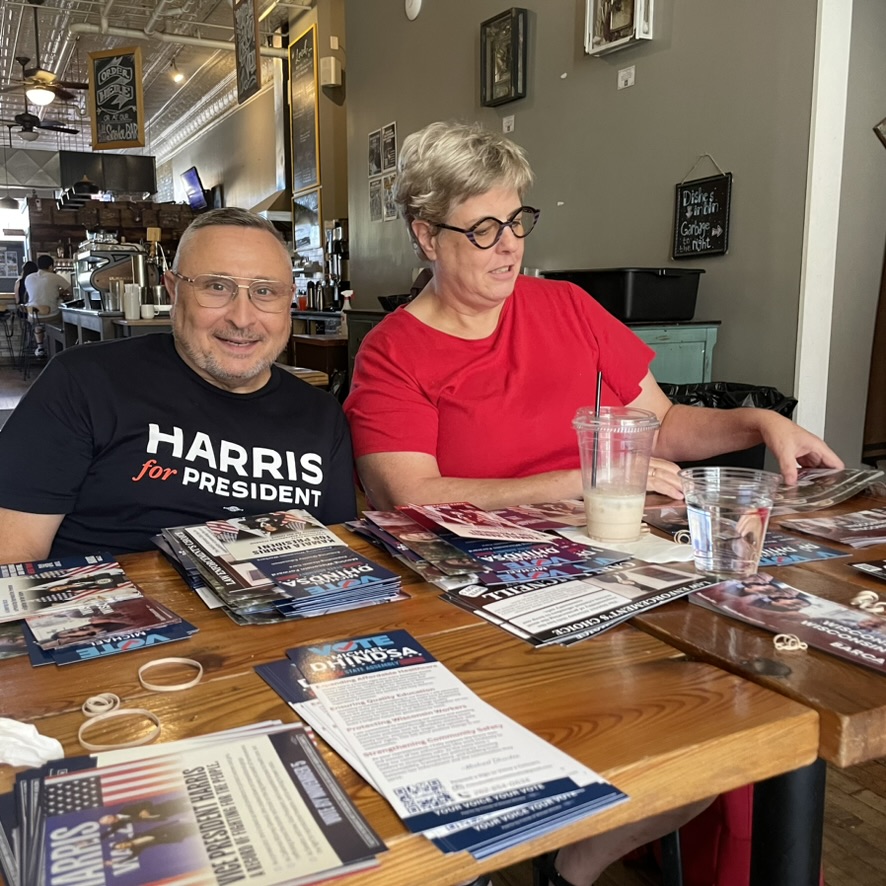
In Kenosha, at the door of a new white house in a new white neighborhood with curvy streets, low trees, and developer-landscaped gardens, I knocked on the storm door, bang, ba-bang, bang. A huge white Old English Bulldog slid around the corner from the kitchen. He ran to the front door and barked as loudly as his docile voice would allow. His owner barely held him back.
I shouted through the door, “I love dogs. It’s ok. Can I pet him?” We all smiled, including the dog. He came out to greet me and gently pushed his massive stubby body against my legs.
‘Hi, I’m with the Kenosha Democrats. Have you voted yet?”
“No, we’re voting tomorrow.”
“What’s his name?”
“Arnold.”
“Arnold? Like Schwarzenegger?”
“Yes.” We both cracked up as Arnold dutifully looked one to the other, pleased to hear his name.
“You know, Schwarzenegger just endorsed Kamala Harris.”
Thus, I established my purpose in knocking on her door on a bright white Saturday afternoon.
“I know!” she said. Then she mouthed the words, “I’m voting for her.”
“Oh great,” I whispered, “Thank you.”
As I crossed the street to my next house, a white SUV suddenly sped out of Arnold’s driveway. It stopped in front of me. She rolled down the window and shouted, “I’m for Kamala! Going to vote right now!”
I thought back to her open door and realized someone else had been rattling around in the kitchen. A husband? She couldn’t let her husband know she was voting for Kamala Harris? Is this a sign of renewed influence of Christian fundamentalism?
Anthropologists say that authoritarianism, old-age anxiety, border disputes, memory disorder, pandemic uncertainty, virtual reality, environmental issues, and gender trouble put society in a self-protective liminal state. We now stand in the doorway between the Biden and Trump administrations. The entire Trump presidency may turn into a self-protective liminal state.
Liminal, from the Latin, “threshold,” puts time and space betwixt and between. On liminal days, we often wander aimlessly, unsure where to go, what to do, stare out the window, quiet down. Hush. The past and the future dangle off the edge of time. Do you feel it?
“Why did God dump Trump on us again?” a friend asked, squirming in her liminal state.
“God didn’t do this,” I said. “We did it.”
It began long ago. The anti-globalist cult surrounding Trump follows bunny trails through the woods of end-times literature, movies and evangelists that we have derided, failed to understand, take seriously, refute or diffuse.
Pastor Tom Are of Fourth Presbyterian Church Chicago says, “The church is not always lost in wonder, love, and praise; sometimes, it’s just lost.”
When we step over the threshold, away from our involuntary liminality, into the perfect, friendly, and loving world created for us, we’ll find the wisdom we need to activate our role in the future. Some will join the opposition party. Some will move to Costa Rica. Some will run for office. Some will hide immigrants. Some will help women. Some will march with the saints. And some will find a no-news thin space to wait it out.
While we wait, we can practice letting go of the obsessive hope that the built world of institutions will save us. It won’t. Let it go. Instead, lean on the unseen, the un-built, and the natural world. Eat and sleep.
In the Hebrew Bible, God said to a self-pitying Elijah, “Get up! Eat something!” And after Elijah spent forty days indulging in self-care, God came back and said, “Why are you still here? Get back to it. You’ve got work to do!”
And so we do.
______________________
Reprinted from Interfaith America Magazine, November 14, 2024
In Kenosha, at the door of a new white house in a new white neighborhood with curvy streets, low trees and developer-landscaped gardens, I knocked on the storm door, bang, ba-bang, bang. A huge white old English bulldog slid around the corner from the kitchen to me, the stranger, barking as hard as his docile voice would allow. His owner appeared looking as if she could barely hold him back.
I shouted through the door, “I love dogs! It’s ok. Can I pet him?” We all smiled, dog included, and he came out to greet me with a gentle push of his massive short body against my legs.
“Hi, I’m with the Kenosha Democrats. Have you voted yet?”
“No, we’re voting tomorrow.”
“What’s his name?”
“Arnold.”
“Arnold? Like Schwarzenegger?”
“Yes.” We both cracked up as Arnold dutifully looked one to the other, pleased to hear his name.
“You know, Schwarzenegger just endorsed Kamala Harris.”
Thus, I established my purpose in knocking on her door on a bright white Saturday afternoon.
“I know!” she said. Then she mouthed the words, “I’m voting for her.”
“Oh great,” I said, “”Thank you.”
Canvassers use a handy cell phone app, Minivan, to record voters’ responses. The drop down menu lists Strong Democrat, Lean Democrat, Undecided, Lean Republican and Strong Republican. Since my voter didn’t give it her all, I decided she was a Lean Democrat, punched it in and moved on to the house across the street.
As I came back to the sidewalk, all of a sudden a white SUV sped out of Arnold’s driveway and stopped in front of me. She rolled down the window and shouted, “I’m for Kamala! Going to vote right now! Good luck!”
I thought back to her open door and realized someone else had been rattling around in the kitchen. A husband? She couldn’t let her husband know she was voting for Kamala Harris?
This gave me hope. I changed her in Minivan to Strong Democrat. Voting Harris.
Perhaps she represented a political ad where Julia Roberts voiced, “in the one place in America where women still have a right to choose, you can vote any way you want, and no one will ever know,” suggesting women can lie to their husbands about their vote. Apparently Fox News went berserk over this ad, as if spouses never lie to each other.
Today, the day before election day, it hit me how different life will soon be. No matter who wins, I’ll have no more reason to hope — for the vote, for my candidates, that the country will be at peace, or that democracy survives. It-is-what-it-is acceptance will necessarily move in to care for me.
Saturday afternoon trips from Chicago to Kenosha, stopping in the bustling Democratic headquarters then out to canvass voters will halt. My calves will never forget the two-step entrances to every house in Kenosha County. But memories of coffee and sandwiches at The Buzz Cafe on Sixth Avenue will fade.
The Buzz Cafe Kenosha Wisconsin
I do have something to hope for.
Incoming texts and emails will be reduced to a trickle.
Transistor radios first appeared on the shelf behind the cashier at Walgreen’s, alongside the cigarettes, in the 1950s. The purchase price was cheap enough for my mother. I can’t imagine what my life would have been had it not been for the radio.
In our teens, we lay on the floor, smoking pot and singing to the Beatles on the radio. A friend once mused, “our lives would be more manageable if it weren’t for the radio.” Every half hour DJs stopped spinning records and announced the news. Radio news. It stirred me up for life.
The radio these days is an Amazon Echo. It is set to turn on NPR at 7:00 am in my house these days. On Sundays, I usually ignore a 7:00 am show called Hidden Brain. A neuroscientist interviews interesting enough people, but I just want to hear the news at 8. Recently I put off walking the dog and making coffee when I heard the voice of Dr. James Pennebaker on Hidden Brain. He talked about how people’s language, written and vocal, signals what’s happening inside their heads.
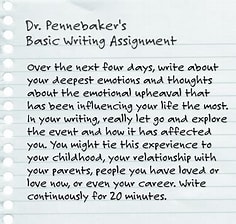
James Pennebaker is a social psychologist at the University of Texas-Austin. He taught me that chronic pain can be healed through expressive writing. His recipe, grounded in scientific research, consists of writing it down. Just write it down. It’s cheap, easy. And it works. My writing teacher Beth Finke and I used to call it bibliotherapy. Pennebaker’s books are sweet old friends. The same goes for Jon Kabat-Zinn’s Full Catastrophe Living, John Sarno’s Healing Back Pain, and Howard Schubiner’s Unlearn Your Pain. Thinking of these now butters my memory with gratitude. I write because these authors taught me words can heal. And, for the most part, they have.
I’m not particularly interested in interpreting the language of my friends. I don’t want to know what’s happening in their noggins as Pennebaker does with his research subjects. No, what’s tasty lately about Pennebaker is what he says about Donald Trump.
He examined Trump interviews from 2015 to 2024 and found a whopping 44% increase in words plated in the past. What’s that mean? Well, usually presidential candidates dish out rhetoric about the future. Pennebaker says Trump whips up such simple words and sentences that he can only be described as “an incredibly simplistic thinker.”
“I can’t tell you how staggering this is,” he told Stat News. “He does not think in a complex way at all.”
I loved hearing this. And there I was again, glomming on to any tidbit that humiliates and demeans Trump. It’s called schadenfreude. I love that word but ashamed how I delight in its meaning: the experience of pleasure, joy, or self-satisfaction that comes from learning of or witnessing the troubles, failures, pain, suffering, or humiliation of another.”
Schadenfreude is one of the delicious habits I metabolized, after using Pennebaker’s and others’ writing exercises to relieve chronic pain. Obviously this is not a vice easily kept at bay. Availing myself of some form of spirituality, like meditation, helps. And the writing, of course.
On day two of the Democratic National Convention, I came face-to-face with a tall, long-haired, familiar beauty outside my local coffee shop in downtown Chicago.
“Hi! Are you Caitlin?”
“I am.”
“You’re at my coffee shop!”
“I love this place; come here every morning,” Caitlin said.
“Oh, gosh, I wish my friends were here to meet you. We’ve all been gathering for coffee in the Ritz Hotel lobby looking for you!”
“I wish I could meet them too!” She said.
“Well, I can’t speak for them, but I love you. My whole family loves you.”
And so went my encounter with Caitlin Collins of CNN. Neighborhood friends and I camped out in various hotel lobbies during Convention week hoping to spot famous people. We’re political junkies, more likely to screech at Mitch Landrieu, former mayor of New Orleans, than Golden Globe winner Greta Gerwig. Oh, there are exceptions. I longed to see Billy Porter. Why him? As soon as President Joe Biden announced he was stepping aside for Vice President Kamala Harris, Billy Porter jumped out of the starting gate to endorse her. Also, I love his outfits.
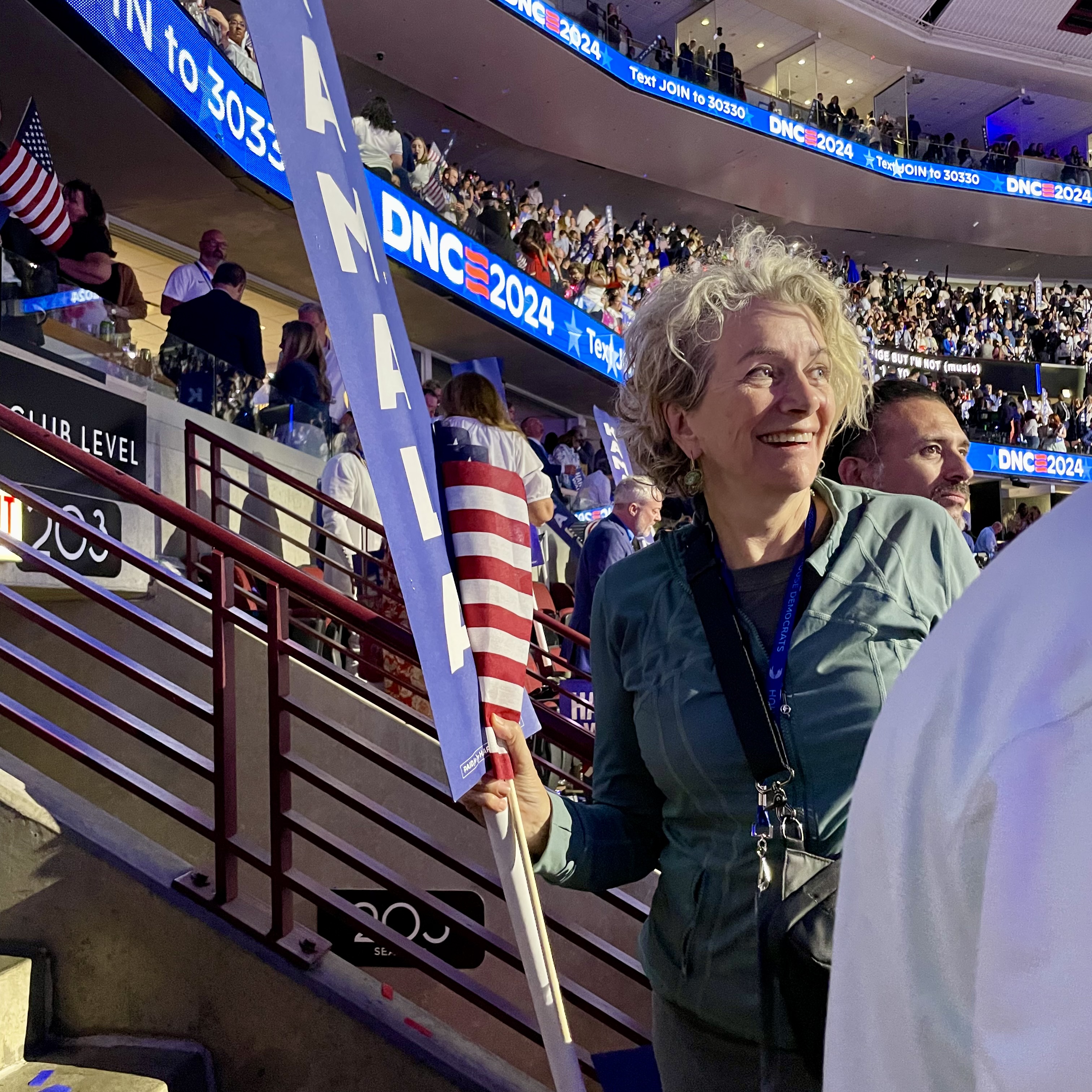
In January 2024, Convention organizers declared they needed 12,000 volunteers. Unenthusiastically, almost reluctantly, some of us registered on the convoluted DNC volunteer website in February, March, April, never receiving acknowledgment or confirmation. My constant refrain to anyone who asked (or didn’t ask) was: sign up—you never know what will happen. When the Biden-Harris Handover came down, the volunteer pool immediately swelled to 30,000, a nascent signal of unabashed support for Kamala Harris for President. Would-be volunteers came from around the country thinking they’d grab a plum “slot” from the AI-driven robot volunteer organizer. A few days before the Convention started, I was called to the basement of the United Center with about 100 others to “unfurl” flags as they rolled in from the loading dock. We were gleeful. Some were called back for various duties at the Convention. Not me. I never did secure a volunteer gig to check credentials, or sort the garbage for recyclables, or greet people at hotels, or direct delegates to buses.
On the afternoon of Convention day four, I received a text, “I’m leaving a pass for you at the desk of my hotel,” from a lovely I’d known thirty years ago in the Clinton Administration. I hiked up my skirt, jumped on my three-wheel ADA electric scooter, and navigated my way through the exterior United Center maze of Secret Service, Chicago Police, Cook County Sheriffs, metal fencing, magnetometers, hawkers, protesters, volunteers, and a mile-long line of faithful ticket-holders. Vivienne from County Cork and Mark from St.Louis in section 202 texted every few minutes with updated instructions on how to squeeze through the crowds and get to the seat they were defending for my grateful butt.
“I just got in a fight,” texted Mark. “Standing firm. I told them you were waiting for the elevator. Viv meeting you.” Finally, from my cherished seat, I texted David, who I passed outside on the pedestrian line. “No seats.”
Vivienne–great craic at Democratic Convention
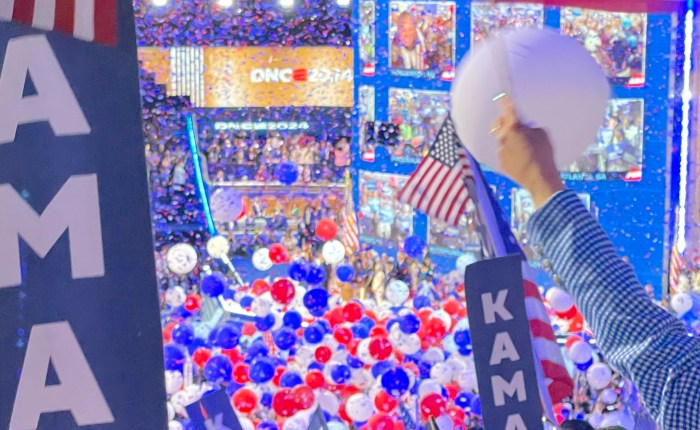
Lucky doesn’t begin to describe how it felt to be in Section 202 of the United Center on August 22, 2024, for Kamala Harris’ acceptance speech—the most blessed hurly-burly hoopla in memory.
Or, in the words of Irish Vivienne, “Best craic a’ me life.”









 Regan Burke