Magpie Wedding Guests

Magpie Wedding Guests

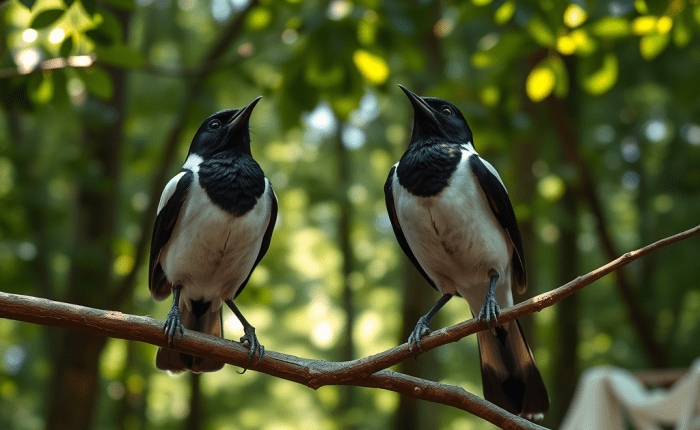
The Merlin app in my iPhone reported two singing Magpies above the deck built into the trees surrounding the wedding. Standing at the rail with my 19-year old grandson, we looked to the sounds — to one side of the dense forest, then to the other.

“We should be able to see them,” I said. “They’re the size of a crow, with white bellies and flashy black wings.” 

The Merlin Bird-ID developed by the Cornell Lab of Ornithology, identifies birds by their song. It works like this: I open the app, Merlin tells me the name of the bird it hears, and I look for that bird. I’m satisfied, thrilled actually, with knowing who they are even if I don’t spot them.

We were in Salt Lake City for Kirby and Nate Green’s wedding. My granddaughter. I had walked around my hotel neighborhood earlier looking for birds. Many North American birds, like the Magpie, never come over to my side of the Mississippi River in Chicago. They stay out West. On my morning walk, I spotted only the ubiquitous house sparrow.

Magpies! Known as the world’s most intelligent animal, they are in the equally-smart crow family. Magpies have even been observed mimicking human speech. Trying to spot the Magpies on the on the deck, I thought of a time I visited Los Olivos, California. 

In the garden of a gift shop, I noticed a gregarious Magpie couple roosting on a shed.

“Look them in the eye!” 

The proprietor instructed me to interact with the birds because of my exaggerated curiosity. My friend, Cappi Quigley, tried unsuccessfully to lure me away to the California artists’ original wares displayed around the garden.

“They are wild pets,” the owner explained. “They’ll follow you, protect you. Lock onto their eyes and you will not be forgotten.”

We drove out of Los Olivos five miles up Figueroa Mountain Road to Michael Jackson’s Neverland Ranch for a look-see. MJ had been dead for about two years then. We managed to snap each other’s photos in front of Neverland’s iron gates, just as the guard shooed us away.

Two Magpies yacked and magged at us the whole time from low hanging olive trees. They had followed us up from Los Olivos and all the way back to town, swooping down on the car and yelling, as if they were warning us away from Michael Jackson’s ranch.

Folklorists report that Native Americans believe the sight of a single Magpie brings bad luck. But a pair of Magpies, as heard in the trees above the wedding, brings joy. I heard the Magpies again as Kirby and Nate exchanged their vows. There is a world where we might believe that those two Magpies have found their way from the trees above the wedding to Kirby and Nate’s backyard. And that the Magpies will roost on the shed, bringing joy to Kirby and Nate’s lives together as long as they live. 
‘There’s a special providence in the fall of a sparrow’

‘There’s a special providence in the fall of a sparrow’
There’s a special providence in the fall of a sparrow.

If it be now, ’tis not to come.

If it be not to come, it will be now.

If it be not now, yet it will come – the readiness is all.

— Hamlet

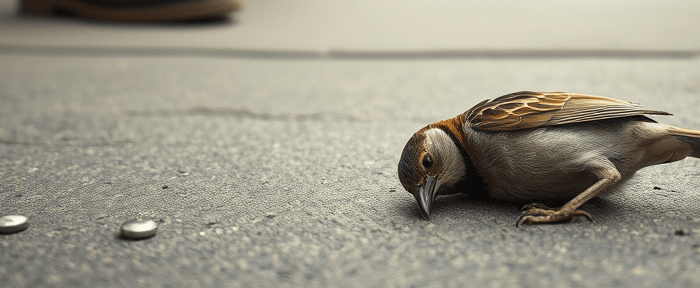
A sparrow fell from the sky and plopped down next to me on a sidewalk corner beside the church as neighbors, shoppers, and tourists bustled to their places.

“Damn! That’s disgusting!” Said a snap-back-hatted young man sidestepping around the splat. Looking the revenant himself as if returning from a dead weekend that probably started out fun on Friday night, he looked up. Was he searching for someone behind the clouds to blame?

“Look at it. So gross!” Looking down now, seemingly blaming the sparrow for its dead ugly existence.

Perhaps because I was headed to church, the sparrow’s lasting legacy in the bible came to mind. Scriptures tell us to look at how God cares for the lowly sparrow as a metaphor for how that same God cares even more for humans. But here I was, staring at a dead bird. Did that God in the bible throw the bird down beside me so I’d know who’s in charge around here? Is it an omen of a bad year ahead? A symbol of immortality? A sign to repent?

There’s a peregrine falcon nest directly east on Lake Michigan in the intake crib of Chicago’s water system. Those tricky raptors attack other birds in mid-air and sometimes miss their prey as they swoop down to catch them. On my dog walks, I’m constantly on the lookout for bird carcasses (sometimes impaled in the bushes) because Elsa will sneak a forbidden lick if I’m not vigilant.  I assumed the unfortunate sparrow was one of these victims.

If God set this complicated natural aerodynamic food chain in motion, so be it. I’ll accept that God. However, no God is going to snap me to attention about the upcoming election or remind me of some regrettable remark I’ve made by throwing foreboding dead birds at me. The same force may have set all the emotions of fear and regret in my DNA, but a god that powerful better not have my same human characteristics. I’m conscious of an impersonal force, something outside of myself, an unexplained presence. I believe there’s a higher power, that I call God. Holding that power out as a relatable, reasoned person that acts as a mean-spirited human, to get my attention is not my idea of a god. At least not today, or, not at this moment.

The ubiquitous house sparrow is not native to the United States, I’ve been told by birders. They chirp most of the US awake in the morning and nest outside our homes’ nooks and crannies. At Chicago’s Navy Pier, if you try to eat McDonald’s fries outside, you’ll be sharing them with sparrows. If you look at your phone outside the Pancake House to catch up on text messages, sparrows will swoop in and pluck at the remnants of your Dutch Baby. This diminutive invasive species is so plentiful that I give it short shrift, ignore it, as if it’s not important.

Until one drops from the sky on my way to church.

____________________________


Smelly Lilacs

Smelly Lilacs

The tulips were showing their last droopy colors. The iris’ were ready to pop for a week or two of runway-like exhibitionism. The trees in the small park were half-dressed, embarrassed by their young fresh leaves, waiting for their green siblings to fill in around them. 

And oh those smelly lilacs. 

Their short-lived incarnation makes me holler 

thank you Jesus. 

And then, the warblers.

Every spring is the same. Year after year. And yet, every single time, I’m shocked out of winter doldrums by the sheer variety of beauty and fragrance in the cultivated and in the wild city gardens. A text or an email or an article from birding organizations will remind me to listen for migrating warblers. They pass through as the tulips fade. I hear them. Never see them. 

Warblers visit Chicago on their way up north from Central and South America. They’re tiny. My old eyes are acclimated to spotting bigger birds—starlings, blackbirds, crows. Even sparrows are larger than warblers. I look, but mistake the warbler for a leaf or a twig, even a large bug.

But the other day, on an unusually seventy-five-degree May morning, I passed under a tree while Elsa sniffed around the ground cover for messages from new and old pals. I heard a symphony of birdsong overhead and looked straight up to see tiny bright-colored warblers flitting from branch to branch, hunting insects. 

I switched on my iPhone, pressed the Merlin bird app, and recorded a Tennessee Warbler, Yellow Warbler, Yellowthroat, and American Redstart all singing their wee hearts out within shouting distance. I suddenly realized I was in a bird “fallout,” a phenomenon that occurs when curious weather slams into migrating songbirds in the air and they descend into the trees below. 

The weather systems predict the number of songbirds that may be migrating over Chicago on spring nights. Attracted to their reflections in the windows of highrises, they accidentally kill themselves by flying into lit buildings.

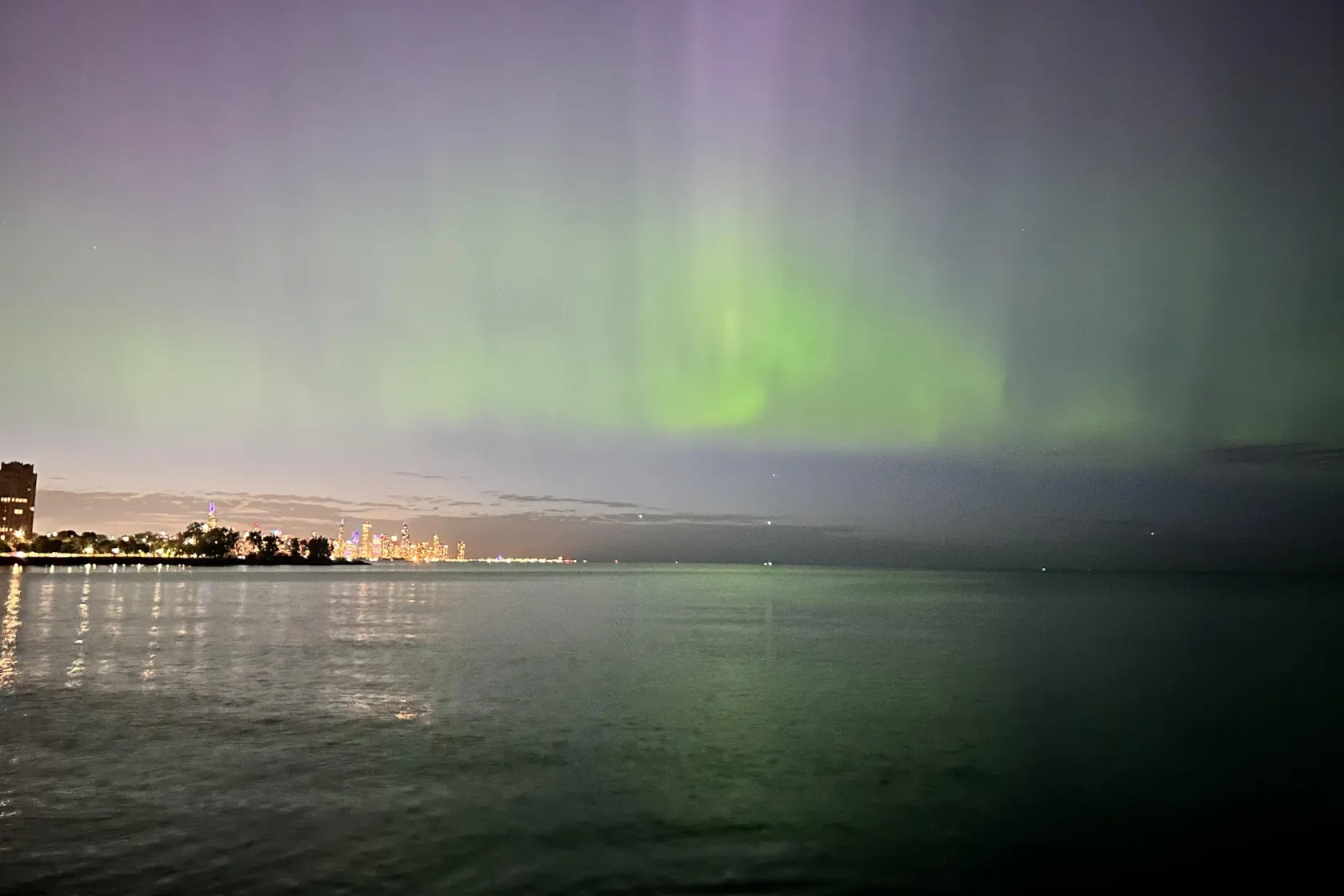
The uncommon migration fallout happened twelve hours after Chicago’s unusual sky-drenching from the northern lights—yes, the northern lights! The aurora borealis: blazing bits shooting out of the sun, hitting the diluting atmosphere with undulating ribbons that lit up the Chicago night. All this only a month after a solar eclipse. 

Hyde Park residents Meghan Hassett and her husband Max Smith captured the northern lights from Promontory Point Friday, May 10, 2024. Provided by Meghan Hassett

In the park, a dog-walking neighbor neared with Zeus, stopped, and looked up. 

“Whatcha lookin at?”

“Warblers.”

“Oh,” and he continued on. He lives in my building and told me a few days before that he’s planning a hiking trip to the Rockies because he “likes nature.”

Me too.

Cold Wars

Cold Wars

The 2019 Polar Vortex slid down from the North Pole, threatening to lock Chicago into subzero stillness. I prepared for the warring cold by teeing up the entire 18-hour series of The Marvelous Mrs. Mazel. Then I threw stale bread crumbs onto my balcony to nourish the house sparrows, finches, and chickadees before they huddled together in eaves and cracked soffits to wait it out. I shuttered in and Dapped all the little crevices around the balcony door that were spritzing air into my not-so-insulated living room. That was the extent of my preparation for the coldest two days ever recorded in Chicago.

Day one brought minus 23 degrees. I woke to a thick film of silver ice covering all the windows. The ice curtain obscured the humanity moving around behind the windows across the street and any fool pedestrian walking in the feels-like-minus 40.

My binge-watching was interrupted mid-morning by a thrashing whomp, whomp whomp on the concealed balcony. I inched toward a clearing in the frosty glass.

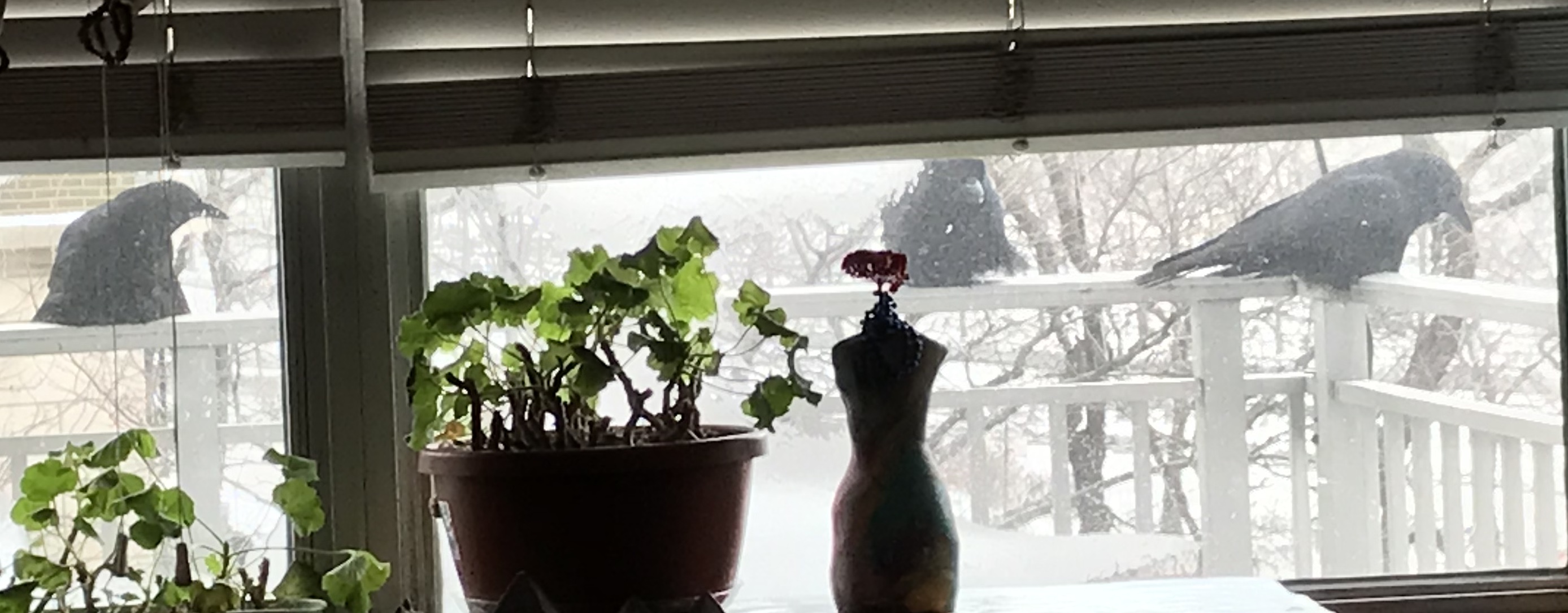
A murder of crows had come to forage.

The much-studied American Black Crow might be the most intelligent animal other than primates. They hide their food and come back for it. If a crow looks you in the eye, she will remember you, follow you down the street, and caw at you for attention like a wild pet. 

On day two, the temperature was 21 degrees below. The ice wall on my windows melted enough for a small lookout. I abandoned Mrs. Mazel and placed a chair well away from the clearing to observe the crows without startling them. They first landed in late morning. A mighty set of black wings fluttered a plumped-up body onto the balcony railing, and the rest followed—a family of five dipping to the balcony floor for leftovers. They flew off and came back. Again. And again. And again. I remained still throughout, trying to lock eyes with the birds. In the afternoon, the weather broke and allowed the dog and me to walk outside—under the watchful eyes of noisy new friends.

The first cold days of 2023 were predicted for the weekend after Thanksgiving. Though nowhere near the 2019 plunge, 30-degree temperatures heightened awareness of asylum-seeking families living on cardboard slabs outside police stations. I sought diversion through another favorite TV series, Julia.

The TV automatically tuned in CNN, though, where there was live coverage of the hostages being released from Gaza. A mysterious and curious need for every scrap of information gripped me. Who are they? What are their stories? Where are they going? I saw six women over the age of 70. One 85-year-old was helped onto a bus. I winced, feeling my own arthritic pain. Four children appeared—ages 2, 4, 5, and 9. I squinted to see if they were clutching teddy bears.

After watching for two tearful days, unrelenting shivers overcame me. And when I took the dog for a walk, that murder of crows cawed to us from the barren trees.