Oh no! Parables

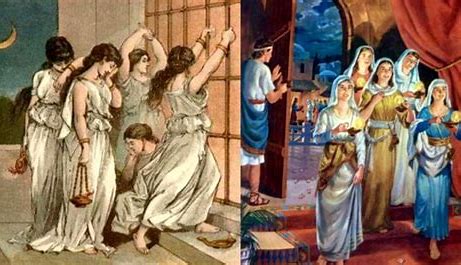
A few months ago, I wrote about a preaching at church on the parable of the ten virgins, or bridesmaids as they say in modern versions of the New Testament. In the story, told by Jesus in the gospel of Matthew, the ten women are waiting for the arrival ceremony outside the gates of the wedding venue. Five of them, known as the wise bridesmaids, came prepared with full oil lamps, greeted the wedding party, and they all entered the gates to the feast. The other five, known as the foolish bridesmaids, were out buying lamp oil, took too much time in the shop, and got locked out of the party. The preacher says the oil is a metaphor for hope. Always have a little hope stored up because you never know when God will present herself with the next great opportunity.

I really hate parables. They’ve always made me feel bad about myself. Oil as a metaphor for hope seems a stretch, but it still makes me cringe. In this and all Bible stories, I relate to the foolish ones, the worst person in the story. I’m never ready, always late, and a failure at time management. 

The question arises: why would Jesus, my earliest-remembered friend, use the parables to traumatize me with such heavy doses of self-blame? No wonder people have stopped attending Christian churches.

At the church I attend, the Sunday bulletin at the end of May included this statement: 

This summer, we will take our messages from the stories that Jesus loved to tell: Parables. 

Oh Jeez. That gives me about thirteen Sundays’ worth of sermons to learn and absorb some wider spiritual truths that have eluded me thus far. I have hope that the preacher is up to the task. In his kick-off to the summer pulpit, he talked about the parable of the Sower. Do you know that one? The farmer throws seeds around willy-nilly throughout the land, giving no thought to where they settle. Some seeds settle on rocks, some on thorns. I’ve always considered myself the thorny soul who has choked off God’s seeds through my own self-will. Another parable evoking self-blame.

When I was younger, I used to buy cheap packets of wildflower seeds at Walgreens and toss them around Lincoln Park on my morning run in places that needed a bit of sprucing up. I never bothered cultivating them; I simply hoped a few would spring to life. It was a labor of rebellious love. 

The preacher reminded me of those long-ago spring days. He interprets the seeds as love, God spreading love around. Sometimes, love takes. Sometimes, it doesn’t. But God keeps throwing it out there, just like I kept throwing out seeds of wildflowers. Love is power, says the preacher,  tender power, vulnerable but power nonetheless, capable of changing people. The sighting of Spring’s first tulips makes me happy, no matter how anti-happy I may be. That’s powerful love.

Perhaps a summer of parables will be ok. 

The Ten Virgins

The Ten Virgins

As a veteran churchgoer, I’ve logged about 3,650 hours in the Sunday pew.  My childhood church clocked in at one hour a week for Catholic Mass. When I came to my senses at eighteen, I abandoned churchgoing. After a long period of barstool arguments on the God-is-dead theme, I started up churchgoing again at the Metaphysical Center, where I received a “reading” from a medium. The two-hour-long talk between the spiritualist and his dead interlocutor revealed that I had been Harriet Beecher Stowe in a former life.

I like that. Harriet Beecher Stowe, one of the world’s most famous abolitionists, wrote Uncle Tom’s Cabin after receiving a vision during a church service. Church is indeed a good place for visions. Clare of Assisi, Joan of Arc, and Theresa of Avila are famous Christian visionaries. And, of course, there’s the fearless Miss Harriet Tubman herself, who led enslaved people through the Underground Railroad at night, led by her visions. 

After I learned as much as my addled brain could absorb in metaphysical spiritualism, I sobered up and joined a Christian fundamentalist cult. It was so extreme that the elders admonished me for making friends at Little League games with parents who were not our kind of Christian. To extricate myself from that legalistic life, I spent a year drinking jugs of vodka in my basement. Turning again to Alcoholics Anonymous, I sobered up through the holy love of AA veterans. 

Since 1979, I’ve been attending a Presbyterian church in downtown Chicago. Yet, I never call myself a Presbyterian. Why? I’m not too sure. Perhaps the residual PTSD from the Christian cult or, Catholicism or, spiritualism protects me from assigning myself religious labels. More likely, I’m not altogether sure I believe what they believe. 

Last Sunday, churchgoers throughout the land heard the parable of the ten virgins, or bridesmaids as they say in today’s lingo. The seven-day wedding feast in ancient times couldn’t begin until the bridegroom arrived. In the story, five wise bridesmaids had working oil lamps when the groom arrived late at night, and they all entered the gate to the feast. The other five foolish bridesmaids were out buying lamp oil and got locked out of the party. In previous preachings, I’d heard Jesus’ explanation of his parable is that we must always be ready, have our lamps lit, awaiting his coming (or was it his second coming?). No wonder I’ve been a nervous wreck my whole life, constantly failing to be ready for Jesus. I really hate parables. 

The church’s new pastor spun the story as a lesson in patience. Be patient because we never know when God will present a reason to throw a party. I had to listen again to him on YouTube because I swear I heard that ominous “Jesus is coming” sermon. This is one of the blessings and curses of old age. My brain holds years-old information, which is a blessing. But that information is a curse when it doesn’t make room for new ideas.

Like with those wily parables.