Sharks and Snakes At the Movies

Sharks and Snakes At the Movies

One summer in the early 1960s, my mother walked the beach near our Sea Girt, New Jersey home. A shark came into the calm shallow of the Atlantic and chomped off the leg of a man wading right in front of her. 

Another that week. And another. Grisly accounts and sightings of man-eating “great whites” all along the central Jersey coast appeared daily in the Asbury Park Press. Lifeguards stood high on their stands and whistled us out of the surf repeatedly at any sign of a dorsal fin. The summer was terrifying. 

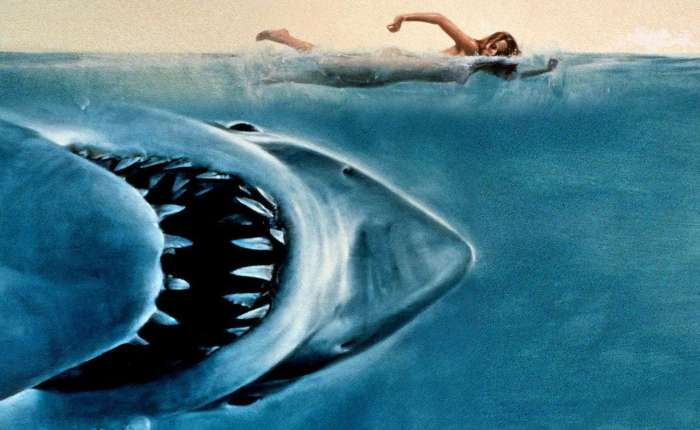
When Peter Benchley’s 1974 novel, Jaws, appeared on the paperback rack, my mother snatched it up, read it, and passed it on. She and everyone else at the Jersey Shore convinced themselves that Benchley, who lived in New Jersey, based the book on our summer shark attacks. 

What a book. After eyeing that famous book cover, my seven-year-old son, Joe, became interested in and eventually obsessed with sharks. Having read in Dr. Spock that I shouldn’t tell my child frightening stories, like the crucifixion of Jesus, I kept the Jaws story from him. 

The movie Jaws was released the following year. I refused to watch it, much less expose it to my eight-year-old. His sleep was already interrupted by nightmares after getting hit with a pitched baseball at Little League. 

At age nine,Joe announced that Jaws was at the neighborhood theater on Dollar Day and begged me to take him. The near-empty theater was spooky. I held both hands over my eyes for most of the show .

“You can open your eyes now,” Joe said.

I did, just as the shark was ripping apart a girl on her raft.

“Oh my god! I’m going to puke! I thought you said it was ok!”

We laughed so hard we could hardly hear the movie. Thus began those funny years when boys learn there’s a big payoff in pranking their parents.

When Raiders of the Lost Ark came out in 1981, we lived in Chicago. 

“Is it about Noah’s Ark?” I asked Joe.

“No. The Ark of the Covenant. You know, where the Ten Commandments are.”

Dragging him to Sunday school all those years had paid off.

We ran to the 1,400-seat Esquire Theater on Oak Street. The only tickets left were upfront. Right there, on the front row, the entire wall before me slithered and hissed as Harrison Ford was lowered into a hypnotic pit of 10,000 snakes. 

I shut my eyes. 

“OK to look now,” Joe whispered.

And again, I got fooled into watching the creepiest part of the movie, where Indiana Jones is staring down a hooded cobra.

Raiders is set in 1936 and follows Indiana Jones vying with Nazi Germans to recover the invaluable long-lost Ark of the Covenant. Some have interpreted it as Steven Spielberg’s creation to slam the Nazis for the Holocaust. But to me, it’s a hilarious, breathless adventure, made memorably funnier by the prank of my fourteen-year-old movie companion.

And a memorable relief from how I view Nazis today. 

Witness to Writing’s Healing Power

I have no idea when I first started going to the movies. Lists of movies from the 1950s always include ones I can tick off. I know I saw some in theaters, some on TV. 

My father loved thinking-man westerns, film noir and dramas. My mother knew all about the latest movies from reading reviews in the New York Times. They never went to movies together, but they discussed movies, fought about them, of course, as they did everything.

He started taking me to the movies with him when I was about ten. I instinctively knew to supress my yearning to see Elvis or Davy Crockett movies. In order to be included in the moviegoing, I’d feign more sophisticated preferences—Alexander the Great with Richard Burton, Anastasia with Ingrid Bergman, Giant with Rock Hudson. He never admitted to liking musicals or comedies like Anything Goes or Pajama Game. But he hummed songs from the musical Pal Joey as if he’d seen it and expressed careful admiration for its stars, Rita Heyworth and Kim Novak. 

One of the movies I’d be forbidden to see by today’s standards is The Searchers. John Wayne and his cowboys ride off in search of female relatives abducted by Indians. When they find them, the women are all dead. It’s the first time I heard the word “rape”. When I asked what that meant, my father had no answer. Faced with the unknowing, I sensed an ancestral knowing, a subconscious knowing churned up from the genetic code. I listened to these cross-generational gut reactions and the fear I heard settled quietly in my lower back. 

In 1959 my father took me to Witness for the Prosecution. An avid reader of Agatha Christie, he knew the story. I hadn’t paid attention to the chatter about the acclaimed movie starring Charles Laughton, Marlene Deitrich and Tyrone Powell. As we entered the Deerpath Theater in Lake Forest, my father casually offered a wager.

“If you guess who did it in the first five minutes, I’ll give you fifty cents.”

“Ok, but I don’t even know what it’s about.” I balked.

“That’s the point.”

I watched each second tick by on my Timex, and at the five-minute mark I leaned over to my father.

“He did it.” I whispered.

“We’ll see.” He said.

I was electrified for the rest of the movie. He did, indeed, do it. I won. My father was so pleased he let me drive home.

Desperation to please my father dominated my secret life. I wanted to be a reason he’d stay home with us. The fear, the anxiety, the straining to decode adult silences landed like hot lava in the tangled ganglia of my lower back where it lay dormant for forty years.

That’s the last movie we saw together. My parents split up soon after. In my fifties, the secrets smoldering in my lower back suddenly fired up. The secrets turned to truths through writing. And the writing put out the fire.