The Big Freak Out

The Big Freak Out

Metaphors have frittered away from me. To be fair, they hadn’t much choice. In conveying messages to contemporaries over the past few years, whether speaking, emailing, texting or DM’ing, I’ve developed a necessary plain spokenness, lest the meaning be misconstrued, misunderstood or confusing. Fallout from this mind-bending prosaic language is living at a level of plain thinking, another aspect of old age (I’m 78) that I wish I’d been warned about.
While watching Joe Biden perform at the now-famous CNN debate in June, I came unstrung in the grip of knowing that Biden’s plain-thinking, plain-speaking style was killing any chance of beating Trump in the November election. 

“Oh. my. god. He’s like my neighbor Ray,” I thought. Ray, who used to converse like a college professor and remember your name like you were his student, but now he talks only sports and weather. Ray, who cannot grasp metaphors unless they’re baseball sayings he’s used all his life, like “on the ball” or “step up to the plate” when he motions for you to exit the elevator before him.

On an unsually quiet afternoon, that is to say, no sirens, no gas-powered lawn mowers, no garbage trucks beep, beep, beeping as they backed out of the alley, I was studying David Montero’s new book, The Stolen Wealth of Slavery: A Case for Reparations. My book group decided to read two chapters at a time in order to absorb a history none of us had ever known. The premise that the intellect is stimulated through awe and wonder has proven true in this group, with this book. Montero’s research thoroughly tracks how the free labor of Black people in the South became the basis of the entire US economy and her dominance over world markets. His writing is loaded with similes and metaphors.

“The energies of three million enslaved people were organized into an industry, industrial enterprises were increasingly fertilized by slavery, and the output of the system was shipped across the world.”

(All of a sudden, a swift “click-clum” in the room interrupted my reading. I turned and saw a ragged chunk of dried-up old paint on the floor, fallen from the ceiling. Surely there’s a metaphor here. Chip off the old block? Chip on your shoulder? Paint the town red? Naw. Nothing. I got nothing.)

In the chapter, “The Union Must Perish,” Montero included a white abolitionist’s account of his travels to the slave market of Virginia. Published in the New York Daily Tribune in 1850, part of it reads:

“…this was the most heart-sickening sight I ever saw. I involuntarily exclaimed, “Is it possible that this is permited in my own native country—the country I have loved so well, and whose institutions I have exultingly pointed to as an example for the world. If this is Christianity, don’t call me a Christian.”

The emotons expressed are precisely what I feel now that the Trump-appointed United States Supreme Court ruled that the President is unbound from the rule of law and can freely engage in criminal activity. Our Christian Nationalist Supreme Court looks forward to the next president closing the borders to anyone but White Christian Europeans, slashing gay rights, civil rights, and women’s rights, and requiring biblical education in public schools. Echoing the 1850 abolitionist, if this is Christianity, don’t call me a Christian.

There ain’t no metaphor for that.
Not Dead Yet

Not Dead Yet

(written for Skyline Village Chicago March-April 2024 newsletter)

Robert Kramer, 74, talking to students at the University of Southern California: “You have far more at stake in changing how we approach aging than I do. You are far more likely, statistically, to live past 100 than I am. If you don’t change society’s attitudes about aging, you will be condemned to lead the last third of your life in social, economic, and cultural irrelevance.”  

A KFF News article,  Do We Simply Not Care About Old People? lays out the blatant disregard for our citizen elders, citing covid-19 statistics.

Around 900,000 older adults have died of covid-19 to date, accounting for 3 of every 4 Americans who have perished in the pandemic. In the last week of 2023 and the first two weeks of 2024 alone, 4,810 people 65 and older lost their lives to covid — a group that would fill more than 10 large airliners.

Yet, where is the outrage? Experts in the field of aging from around the country all agree ageism has always existed, but the pandemic elevated an intense, hostile prejudice against us.

“The implied message to older adults is: ‘Your time has passed, give up your seat at the table, stop consuming resources, fall in line,’” said Anne Montgomery, 65, of the National Committee to Preserve Social Security and Medicare. She says that baby boomers can “rewrite and flip that script if we want to, and if we work to change systems that embody the values of a deeply ageist society.”

In the years I’ve tried to advocate against ageism, I’ve heard everything from “I’m 80 years old, and I’ve never experienced ageism” to “Ageism? What’s that — not admitting how old you are?”

Gay rights leader Harvey Milk famously said in the 1970s, “Come out to your parents.” He knew, and he was right, that if people got to know gay people (can I say “queer” now?), their bias toward them would diminish.

Anti-ageism advocates say, “integrate, don’t separate.” The best way to overcome the ageist stigma is for the people who are stigmatizing you to get to know you. Don’t put “old” in the closet. Go out. Speak out. Be old.

Chicago has separated the old from the rest of the population — in housing, in social groups, in churches, and in health care. “They” don’t see us. ‘They” look through us. We defend ourselves by saying: I wrote a book! I walked the Camino! I volunteer! I have wisdom! I babysit! Walk dogs! Ride my bike!

Reminding people that we are still here, part of the human experience, walking through life like everyone else at any other age, is the best way to flip that script, not by bragging about our credentials but by our visible presence. And when we can’t hear or when our brain energy gets depleted at 3:00 in the afternoon, we ask people to speak up, and we excuse ourselves to take a nap. 

We’re old. Say it. Be it. It’s OK.

The Injured List

The Injured List

The doctor mouths “four to six” in answer to my question. Her eyes say more: I’m sorry, there’s no fixing this.

“Four to six weeks?” I whisper back.

“I’m ordering physical therapy and pain management at the Shirley Ryan Ability Lab.”

I tell her I hate that place. The truth is I’ve never been there. The MRI shows a tear in the muscle connecting my thigh to my groin, the gluteus mimimus. Oh, and attendant flexor tendonitis. It feels like all the knives in the drawer have been thrown at my right leg. I look for hope in the word “inflamed” as if it’s a fire to be extinguished. The doctor assures me steroids reduce inflammation, but pain remains until the muscle heals. She arranges for a wheelchair to fetch me. 

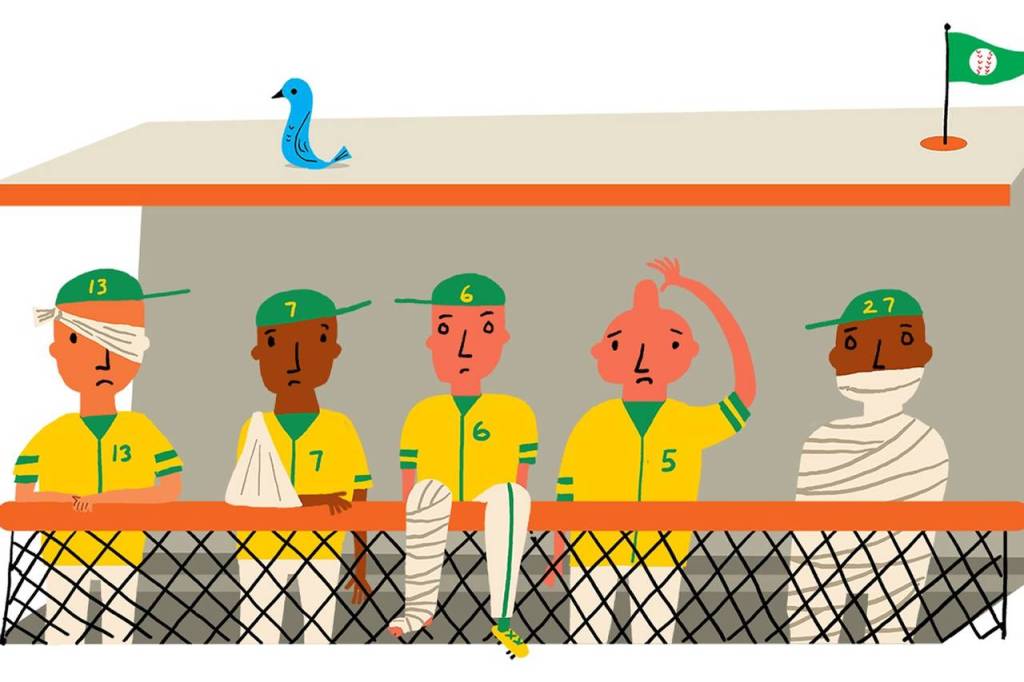
“Is this what puts baseball players on the Injured List?”

“Yeah. This kind of injury puts them out for the season.”

Major League Baseball has two Injured Lists: the 10-day IL and the 60-day IL. Players move off the active roster and onto the IL depending on the prescribed recovery time of the injury. NY Mets pitcher Jacob DeGrom spends a lot of time on the 10-day IL. He says he doesn’t know what he does to cause the tightness, tendonitis, and soreness in his various body parts. Well, I know! He’s throwing, running, reaching, stretching, swinging.

Not me.

All I do is walk the dog and water the geraniums. 

This is the summer we all break out of our pandemic packaging, swing our arms around the human race and make big, unmasked plans. As soon as we notice our freedom shoes under the bed, we meet the day like it’s Christmas morning. After spending fifteen sheltered months behind closed doors humped over Zoom squares, curled around books and squinting at TV subtitles we’re ready for the party.

I’m supposed to be riding my bicycle to newly reopened lakeside hot dog stands and hip new coffee shops. Instead, the IL calls for friends to share their leftovers and homemade cookies at my table.

I’m eager to get out and do what I did 18 months ago. I ignored the caution to start slow and go slow in reinvigorating muscles that weakened during the shutdown. Kaiser Health News published a lengthy article about “older Americans struggling with physical, emotional and cognitive challenges following a year of being cooped up inside.” Nina DePaola, Northwell Health in New York, warned that getting back in shape may take time. “Pace yourself. Listen to your body. Don’t do anything that causes discomfort or pain. Introduce yourself to new environments in a thoughtful and measured fashion,” she said.

Thoughtful and measured pacing eluded me as the city gardens came into full bloom. I walked farther and faster. I did nothing to injure myself. Neighbors who see me now with a walker offer a simple hello. If anyone asks I say I slid into third.

Now each painful step is involuntarily thoughtful and measured. I shelter in place dreaming of freedom.