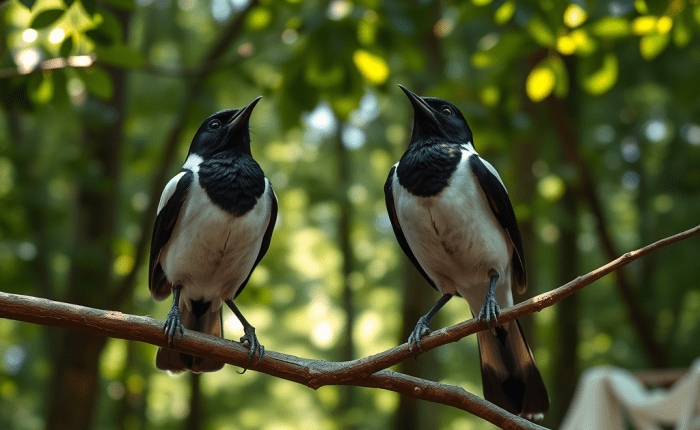
The Merlin app in my iPhone reported two singing Magpies above the deck built into the trees surrounding the wedding. Standing at the rail with my 19-year old grandson, we looked to the sounds — to one side of the dense forest, then to the other.
“We should be able to see them,” I said. “They’re the size of a crow, with white bellies and flashy black wings.”
The Merlin Bird-ID developed by the Cornell Lab of Ornithology, identifies birds by their song. It works like this: I open the app, Merlin tells me the name of the bird it hears, and I look for that bird. I’m satisfied, thrilled actually, with knowing who they are even if I don’t spot them.
We were in Salt Lake City for Kirby and Nate Green’s wedding. My granddaughter. I had walked around my hotel neighborhood earlier looking for birds. Many North American birds, like the Magpie, never come over to my side of the Mississippi River in Chicago. They stay out West. On my morning walk, I spotted only the ubiquitous house sparrow.
Magpies! Known as the world’s most intelligent animal, they are in the equally-smart crow family. Magpies have even been observed mimicking human speech. Trying to spot the Magpies on the on the deck, I thought of a time I visited Los Olivos, California.
In the garden of a gift shop, I noticed a gregarious Magpie couple roosting on a shed.
“Look them in the eye!”
The proprietor instructed me to interact with the birds because of my exaggerated curiosity. My friend, Cappi Quigley, tried unsuccessfully to lure me away to the California artists’ original wares displayed around the garden.
“They are wild pets,” the owner explained. “They’ll follow you, protect you. Lock onto their eyes and you will not be forgotten.”
We drove out of Los Olivos five miles up Figueroa Mountain Road to Michael Jackson’s Neverland Ranch for a look-see. MJ had been dead for about two years then. We managed to snap each other’s photos in front of Neverland’s iron gates, just as the guard shooed us away.
Two Magpies yacked and magged at us the whole time from low hanging olive trees. They had followed us up from Los Olivos and all the way back to town, swooping down on the car and yelling, as if they were warning us away from Michael Jackson’s ranch.
Folklorists report that Native Americans believe the sight of a single Magpie brings bad luck. But a pair of Magpies, as heard in the trees above the wedding, brings joy. I heard the Magpies again as Kirby and Nate exchanged their vows. There is a world where we might believe that those two Magpies have found their way from the trees above the wedding to Kirby and Nate’s backyard. And that the Magpies will roost on the shed, bringing joy to Kirby and Nate’s lives together as long as they live.
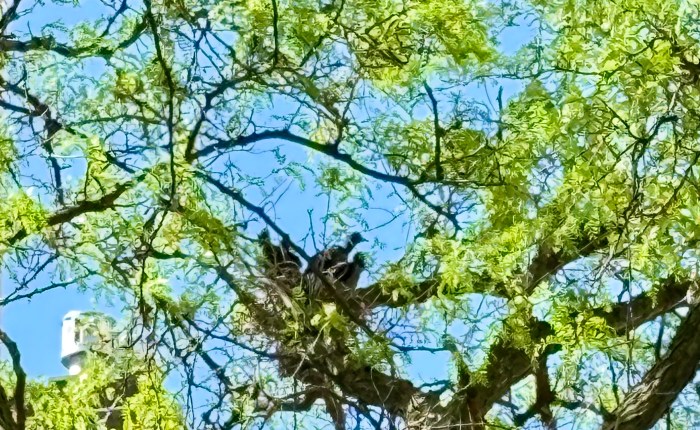
Two nests of crow chicks fledged on my city street this past week. I wonder if the high-rise humans down the block noticed the chicks’ noisy beginning of life in the urban wild. Everyday for two weeks, I looked up from under the trees while walking Elsa. I saw the chicks poking their hungry beaks out of the nests, then stepping out to bounce from leafy limb to limb to rooftop to balcony, squawking away. The parent crows flew farther and farther, screaming at their offspring as encouragement to get those wings flapping and join them in pursuing edible horizons. And then, quiet. They’re gone. They’ll be back, of course. But for now, the daily racket of new young crows has flown the coop.
How comforting to observe the steadfast natural order of things. These days, the built world I’ve known my whole life is breaking down so fast that I half expect the natural world to follow;Lake Michigan to dry up and all the birds to drop from the sky. That bad? Sometimes. Experts say old-age limits short-term memory, exaggerates long-term. My long-term emotional memories are thus resistant to age-related decline. I’m in my 80th year, having just celebrated the 79th. The fear I felt watching the original Mad Max (1979), Poseidon Adventure (1972) and Blade Runner (1982) bubbles up without reference to those movies. It simply presents itself as the world we know is over.
On the other hand, I’m convinced The Wizard of Oz gave me a love for birds, if not a curiosity about an unearthly world. Somewhere over the rainbow, bluebirds fly. Birds fly over the rainbow; why, then, oh why can’t I?
Yeah, why can’t I?
Every time a crow chick leaves the nest, some transcendental part of me follows. My earliest dreams were flying visions. I willed myself off the ground and flew around the neighborhood spying on people. God help me, if I had a drone. I’d probably be peeking in the windows of high-rise residences.
There’s no question movies have influenced my core. They’re not saving me from worry, nor diverting the fear of living in a militarized police state. That long-term memory perverts itself into real and present danger. Can the now-pardoned Jan 6 insurrectionists show up as a Mad-Max-type private army? Would there be a search and rescue operation if my transatlantic ship capsized like the Poseidon? And worse, will there be an antidote for experimental robots gone bad as in Blade Runner?
Fortunately, the clouds of knowing break open every morning to a normal reality. Recent shoulder surgery grounds me in pain. Friends gather for coffee. My granddaughter is marrying a super guy. Regulars show up at church. The same 12 Steps of Alcoholics Anonymous are read at every meeting. The “No Kings’ protest is actually a movement. The rabbits are back in the park. Elsa goes for walks.
The gardeners in the small neighborhood park I call my own, butchered the beauty out of the spring flowers and attendant bird migration. In their zeal to prune away the dead and diseased tree branches, they yanked out all non-native “invasive” species. This disrupted the seasonal pattern of our expectations. As I wandered through the other day, a neighbor with her spaniel in tow stopped me.
“What happened to our flowers?” She yelled across the boxwood. “The gardeners mulched it all into last years’ compost.” I said. I don’t know her, but here we were joined by a sudden mutual experience. “They went too far! Can’t you do something about it?”
Me? I must have spoken with authority about the Chicago Park District’s program to remove invasive species and introduce native plants. As usual, I imparted knowledge based on next to nothing. Last summer as my allergies exploded, I read an article in the Chicago Tribune about the Park District planting more allergen-producing native plants, like goldenrod. A passing employee of the Chicago Park District once educated me on the park’s introduction of native plants, especially those glorious hibiscus. And a neighbor who is a volunteer gardener at the Lincoln Park Zoo spends her summer eliminating “invasives”. That’s the extent of my knowledge on the subject.
“You can go to the Park District Board meetings and ask about it,” was my know-it-all answer.
But Nature has once again reigned supreme in my city neighborhood. On my street, there is no human control over the crow’s nest and its four chicks that are flapping around in the branches. I watch them strengthen their young wings to fly out from their birthplace and fend for themselves. Wildlife never needs permission to be. But it does need protection.
The New York Times reported this week on one of Chicago’s best nature stories. The Lakeside Center at McCormick Place applied a treatment on its glass building to deter migrating birds from banging into it. Last year up to 1,000 birds died in one night at McCormick Place. This year, the deaths, due to the widow treatment, were down by 95%. Chicago’s unpopular mayor should take credit. For some of us this fact alone is enough to vote for his reelection.
Unfortunately there’s no treatment we can apply to protect ourselves from bumping up against the current man-made enemy that is called the United States of America. What can protect us from dirty air and water unleashed by industrial, vehicle and power plant toxins?
I envision a doomsday scenario, a post-apocalyptic environment like “the Last of Us.” Will my city’s native species die off and be replaced by invasive, toxic-loving kudzu? The White Christian Nationalists setting ecological policy have abandoned the Bible as their guide. Genesis 2:15, in all versions, clearly states we must tend to God’s creation.
NIV: The Lord God took the man and put him in the Garden of Eden to work it and take care of it.
KJV: And the LORD God took the man, and put him into the garden of Eden to dress it and to keep it.
NLT: The LORD God placed the man in the Garden of Eden to tend and watch over it.
CSB: The LORD God took the man and placed him in the garden of Eden to work it and watch over it.
Rabbits are born and live out their stories in the same patch their entire lives. The lineage of the fat rabbit I see in the spring may have begun sixty-seven generations back, when the park was first established. After a month or so of observing her in April, she allows me the honor of seeing her two small cottontails, the next generation. They’re never in sight for long before they scurry away to the low brush.
My dog Elsa has old eyes. They may catch the bunnies on the run. Yet, her little legs tire as soon as the furries stop moving. Neither can her thinning olfactory glands sniff out their burrows. I’m pretty sure the rabbits are on to her as they don’t go far. All to say, the wildlife in the little city park seems safe.
Except it isn’t.
On a chilly November morning, I approached the far side of the park with Elsa. I wondered if the rabbits had burrowed in for the winter. I glanced over to the street side of the park to see gardeners unloading a backhoe from their truck. They wasted no time starting that thing up and ramming through the waist-high boxwood hedge to the middle of the garden, ripping out vegetation where the rabbits live.
“Hey! Stop!”
With Elsa at my heels, I barged through the boxwood on my side of the park, flailing my arms. I was about to jump in front of the moving machinery. The driver stopped. His companion came to me.
“What about the bunnies?” I shouted.
“No English!” he shrugged.
“The rabbits! The rabbits! They live there!”
He laughed at me and signaled to the backhoe driver to keep going. They were having a ball.
That was it. I had no choice in the matter. The feral gardeners yanked all the underbrush, faded lilies and droopy irises. They removed the clumpy hostas that cover wild animals and the prairie asters that catch goldfinches and warblers. The backhoe dug holes for six newly planted baby trees.
December is here now. Arborists removed honey locusts and hackberries that no one realized were distressed. The winter trellis of bare branches is spare. Above and below the wide open space leaves no comfort. No place to hide. The left-behind soft brown and grey prairie grass, goldenrod and hydrangea are fallow and forlorn.
But all will be lovely in the spring. And the ancestral rabbits will return.
Whenever one of my dogs died I experienced profound grief that turned to sadness, for a time. A season of sadness. These days, sadness lasts longer. It’s not because my dog died but because so much is out of my control, like the displaced rabbits. I pray not for the sadness to leave me, but to manage to live with it. I have a sense many seasons of sadness are afoot. All may not be lovely this spring.
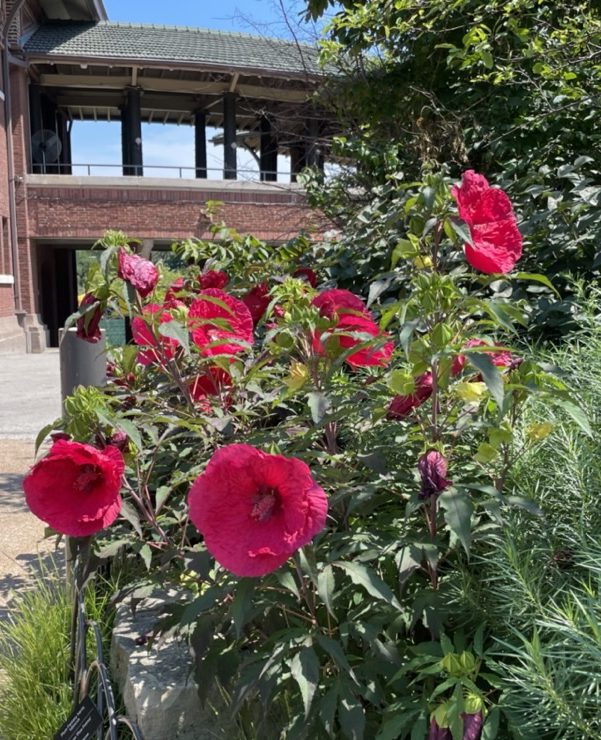
Rounding the corner by Cafe Brauer, the 115-year old red brick refectory on Lincoln Park Zoo’s South Pond, I stopped dead in my tracks at the sight of blooming Chinese-red hibiscus. Hundreds of blossoms the size and shape of CDs preened in the bright sun. They were onion-skin thin. I could practically see through them. I inched along the path flower by flower scanning each one for an answer. What. Were. They. Doing. There?
I’d rounded that corner hundreds of times in my life and had never seen those flowers. A woman in a dark green shirt marked with the telltale Lincoln Park Zoo logos wandered by.
“Do you know anything about these flowers?” I shouted.
“Yes, they’re Lord Baltimore hardy hibiscus.”
“Were they here last year?”
“Nope. We cultivated them.”
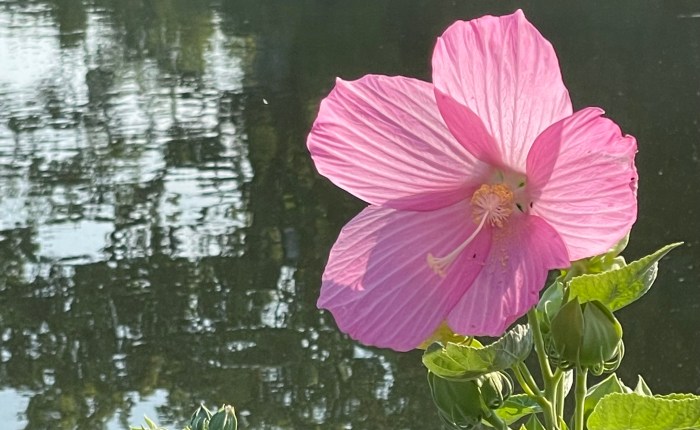
She introduced herself as the head horticulturist at the Zoo and gave me a hibiscus primer. There are four species of hibiscus native to Illinois around the Zoo and the South Pond.
“Everyone thinks they’re tropical. We have a unique collection — the only accredited perennial herbaceous native hibiscus collection in the country.”
On the way home, I spotted a couple I’ve known for years taking their afternoon walk. They informed me they’re thinking of buying a summer house in Michigan.
“What? How could you leave here in the summer? Did you know we have four native hibiscus around the South Pond and the Zoo?”
At the time, I thought this fresh information established the best reason to summer in Chicago. I doubled down on what I’d just learned. Without taking a breath I told them the hibiscus feed bees, hummingbirds and butterflies. Each flower on a hibiscus stalk lives only for a day or two, like a daylily. But, the plants keep opening new blooms from July to September. Garden Clubs from all over the Midwest send busloads of flower lovers to gaze at our hibiscus.
“You must walk by the pond and see them!”
That was the summer of 2019. I see them walking from time to time now, a little slower, a little quieter. A few weeks ago, I’d been in the zoo luxuriating in what I’ve come to think of now, five years later, as my hibiscus. I ran into my friends on the way home and fed them new information.
“Did you see the news?”
“What news?”
There’s so much real news or breaking news these days they looked anxious.
“My friend Karen who volunteers at the zoo told me it’s in the paper today. Lincoln Park Zoo has just been named a National Botanic Garden!”
“Oh.”
“Yep. It’s a big deal. There are only two zoos in the country that are botanic gardens.”
“Oh yeah? What’s the other one?”
“Dunno. Maybe San Diego.”
I had no idea what I was talking about. The media and Time Out have touted San Diego plenty. So, I used this acclaim to put the best spin on our zoo.
“And the international Botanic Garden show will be in Chicago in summer 2027. First time its been in the U.S, in 27 years.” I said.
“Wow, that’s great. Is that like the Chelsea Garden Show?”
“Yes! Only better.”
“Well, we’ll see you around. We need to keep walking.”
“Ok. Great to see you. Glad you didn’t buy that summer house in New Buffalo.”
“Oh, we did buy it. Stayed for a few weekends before the pandemic hit. Tried it that summer for a few weeks. Mistake. Too lonely. You’re right. Theres’s nothing like Chicago in the summer.”
There’s a special providence in the fall of a sparrow.

If it be now, ’tis not to come.

If it be not to come, it will be now.

If it be not now, yet it will come – the readiness is all.

— Hamlet
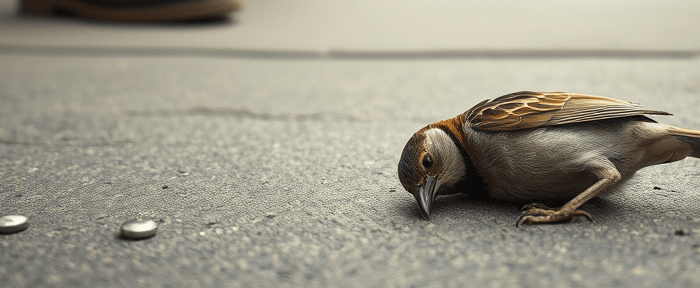
A sparrow fell from the sky and plopped down next to me on a sidewalk corner beside the church as neighbors, shoppers, and tourists bustled to their places.
“Damn! That’s disgusting!” Said a snap-back-hatted young man sidestepping around the splat. Looking the revenant himself as if returning from a dead weekend that probably started out fun on Friday night, he looked up. Was he searching for someone behind the clouds to blame?
“Look at it. So gross!” Looking down now, seemingly blaming the sparrow for its dead ugly existence.
Perhaps because I was headed to church, the sparrow’s lasting legacy in the bible came to mind. Scriptures tell us to look at how God cares for the lowly sparrow as a metaphor for how that same God cares even more for humans. But here I was, staring at a dead bird. Did that God in the bible throw the bird down beside me so I’d know who’s in charge around here? Is it an omen of a bad year ahead? A symbol of immortality? A sign to repent?
There’s a peregrine falcon nest directly east on Lake Michigan in the intake crib of Chicago’s water system. Those tricky raptors attack other birds in mid-air and sometimes miss their prey as they swoop down to catch them. On my dog walks, I’m constantly on the lookout for bird carcasses (sometimes impaled in the bushes) because Elsa will sneak a forbidden lick if I’m not vigilant. I assumed the unfortunate sparrow was one of these victims.
If God set this complicated natural aerodynamic food chain in motion, so be it. I’ll accept that God. However, no God is going to snap me to attention about the upcoming election or remind me of some regrettable remark I’ve made by throwing foreboding dead birds at me. The same force may have set all the emotions of fear and regret in my DNA, but a god that powerful better not have my same human characteristics. I’m conscious of an impersonal force, something outside of myself, an unexplained presence. I believe there’s a higher power, that I call God. Holding that power out as a relatable, reasoned person that acts as a mean-spirited human, to get my attention is not my idea of a god. At least not today, or, not at this moment.
The ubiquitous house sparrow is not native to the United States, I’ve been told by birders. They chirp most of the US awake in the morning and nest outside our homes’ nooks and crannies. At Chicago’s Navy Pier, if you try to eat McDonald’s fries outside, you’ll be sharing them with sparrows. If you look at your phone outside the Pancake House to catch up on text messages, sparrows will swoop in and pluck at the remnants of your Dutch Baby. This diminutive invasive species is so plentiful that I give it short shrift, ignore it, as if it’s not important.
Recently NPR/WBEZ reporter Monica Eng called me about a question I submitted to WBEZ’s Curious City. She asked if I’d like to meet her at the Illinois water testing lab at UIC. Here’s what happened.
Regan Burke used to love taking her dog, Usher, down to Oak Street Beach for morning walks — until about a decade ago, when she says a lifeguard came up to her and told her to get her dog out of the water because E. coli levels were too high.
Ever since, Regan’s been worried about water safety at Chicago beaches.
Still, for a while, she felt confident the city was responsibly warning people and closing beaches when fecal bacteria (measured through E.coli) got too high.
“In the early 2000s, they really reported that every day, and you’d hear it on WBEZ,” she recalls. “It was on the regular Chicago news. But I don’t hear it at all now.”
So Regan wrote in to Curious City with a few questions:
Is that water safe for dogs? Why don’t they close the beaches for E. coli anymore? Are Chicago beaches safe [from bacteria]?
The answer to that last question depends on a lot of things, like which beach you visit, what day you visit, and how old and healthy you are. But it’s an important question because, on most summer days, at least one Chicago beach has elevated fecal bacteria levels. In fact, one city beach recently saw a level more than 300 times the federal notification level — and remained open. Also, the public appears to be confused about how to interpret the city’s new swim advisory system. And so, in an effort to clear up any such confusion, we offer this handy primer on fecal bacteria on Chicago beaches.
Regan Burke used to love taking her dog, Usher, down to Oak Street Beach for morning walks — until a lifeguard came up to her and told her to get her dog out of the water because of high E. coli levels. (Courtesy Regan Burke)
How do I find out how dirty a beach is?
Each morning at dawn, University of Illinois at Chicago researchers collect two water samples from at least 20 Chicago beaches. The samples are delivered to a UIC lab where they are tested for enterococci, a fecal indicator bacteria. The park district then takes the two readings for each beach and calculates a geometric mean (which is not the method recommended by the EPA; more on that later).
The city communicates its recommendations to beachgoers in three ways: on the park district’s website, through the city’s data portal, and through a flag system at the beach. Here’s how you can find it online:
Keep in mind that the Chicago Park District only posts the average (geometric mean). If you’re good with spreadsheets and you’d like to find the highest sample at your favorite beach on a given day, go to the city’s data portal after 1 p.m., export the data into Excel, and then sort to find the correct day and beach. Look under the “DNA sample” columns to find that day’s readings.
You can also check the flags posted at each beach:
How can I stay safe?
Check the levels for your beach before you go. If fecal bacteria levels are anywhere near 1000 CCE, UIC public health scientists Sam Dorevitch and Abhilasha Shrestha say to consider avoiding contact with the water, particularly if you are:
Elderly
Very young
Immune-compromised
Pregnant
Or have an open wound
If you go to the beach before the website is updated, keep in mind that hard rains the previous day often result in high fecal levels the next morning.
If you swim on a day when levels exceed 1000 CCE, be careful not to swallow water or dunk your head.
Always wash your hands after swimming, especially before eating.
What can I do to make beaches safer?
Clean up your:
Food
Garbage
Diapers
Pet poop
Don’t feed the birds.
Wait. What? The city doesn’t follow EPA suggestions on when to warn people?
That’s right. The EPA suggests advising the public to take precautions when any single sample is above 1,000 CCE. The Chicago Park District, however, determines whether to notify the public based on the geometric mean of its two samples (which will always be lower than the highest single sample). In its 2012 guidance, the EPA suggests using the geometric mean “to assess the longer-term health of the waterbody”; not to determine whether to issue a daily warning. None of this EPA guidance is legally enforceable; it’s just a suggestion based on extensive research.
Officials from the park district defended their use of the geometric mean in a statement, saying: “Densities of [fecal indicator bacteria] are highly variable in ambient waters therefore a measure based off of a distribution, such as [geometric mean]…, are more robust than single estimates.”
Chicago Beach Poop By the Numbers, 2018 Edition
We crunched enterococci data from last summer, totaling 101 days. Below are some highlights, which take into account the differing standards used by the city and suggested by the EPA. Here are some highlights:
And what about the dogs and E. coli?
Chicago veterinarian Dr. Vaishaili Joshi says that dogs are exposed to E. coli all the time and usually don’t get sick. But, like humans, “immunocompromised pets, juveniles and seniors may be at higher risk of infection secondary to heavy exposure.”
More about our questioner
Regan Burke is a Chicago writer who worked in local and national politics — for Gary Hart, Bill Clinton and Adlai Stevenson — for most of her professional life. She details that part of her life in the upcoming book, I Want To Be In That Number, which she says is all about “politics and nervous breakdowns.”
As Regan grew up in Chicago and around the Midwest, she says her mom would often tease her for being a “nature lover.”
“I always thought of myself as a city person, but I do love nature,” she says. “That’s one of the reasons I’m more interested and cognizant of what’s outside my window than what’s inside my apartment.”
When she heard the final answers to her questions about the nature on the lake, she had a couple of reactions.
“Well, I’m very impressed at the level of testing that they do on the Chicago beaches,” she says. “But, at the same time, we don’t get the results until 1:30 in the afternoon.”
Still, Regan was pleased to hear that dogs are not very susceptible to E. coli., despite what the lifeguard seemed to imply.
But when she heard that the city will never puts up a red flag or close a beach, even when fecal levels skyrocket, she was not pleased.
“That, to me, is appalling,” Regan says. “The idea that at 1000 CCE there is a health risk — I can buy that. But when it’s 300,000 and they don’t close the beaches? I mean, how sick are people getting? And people go to the beach with their dogs, their children and their grandchildren. They must close the beaches when that happens. It’s just appalling.”
The 9 minute audio story has more information. Listen here.
Once upon a time a long time ago I got tumbled round and round and somehow knew to go limp, relax my breath, close my eyes and not wriggle toward the sky I couldn’t see. I let myself go, with, the, flow; let the tide churn my body turned-fish-turned-seashell-turned-driftwood-turned-mermaid. Sanded, winded, exhilarated and afraid I ended up splayed out on the beach—waiting for someone to acknowledge my courage in facing the swollen ocean alone and coming out alive. But they were all in their beach chairs smoking cigarettes, drinking beer, telling jokes, gossiping, hissing—the parents, the aunts, the uncles, the friends, the neighbors.
That was the summer my father taught me to swim and I made friends with the ocean.
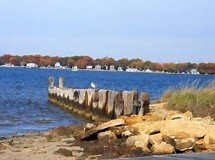
Twenty-two years later, second-husband Ed moved me and my child Joe into flat-roofed, low-slung stucco in the tidal flatlands of Ocean Gate, New Jersey, where freshwater Toms River flowed into saltwater Barnegat Bay and made the brackish brine off our sandy backyard abundant with sealife, birdlife and shorelife. Ed, a no-good sometime-recovering alcoholic raised in the working-class Ironbound neighborhood of Newark, had spent gobs of time at the shore and had one good characteristic—he loved nature. The first summer on the bay, he taught Joe and me to fish, crab, birdwatch and seine.
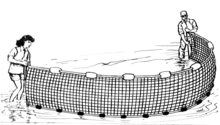
In knee-deep water, Joe’s five-year old body, barely holding up a pair of trunks, stood on one side of the seining net. He gripped its wooden pole with both hands. Holding the other pole, I stretched the net six feet to the side of Joe. On the count of “One, two, three!” we dug our poles into the bottom and slowly pulled them through the sand, dragging the slackened mesh to the shore and heaving it waterlogged onto the beach to see what lived beneath and around our sea-shored feet. We scrambled to our catch before low-flying seabirds descended to snatch up bottom-feeding young flounder; then we examined the rest of the bounty, which always contained a variation of tangled fishing line, faded lures, pieces of styrofoam, oyster shells, mussel shells, small rocks and pebbles, and once in a while a prized jellyfish, baby turtle or blue crab.
One time an osprey flew overhead scouting out what may have been his next meal. He held something flapping herkyjerky in his talons that dropped smack on the beach in front of our seining net. Screeching like seagulls we threw up our arms, jumped up and down, pushed and pulled each other screaming for Ed. Ed grabbed a stick and an old ice chest and lifted the six-foot rat snake into captivity. That snake lived in a glass tank in the kitchen for a few months eating live frogs and mice before we released it back into the seagrass.
Once upon a time a long time ago I learned to be the mother of a boy, face fear and love nature. And she loved me back.
When friends from out of town ask to visit, they know they’ll be sleeping on a pull-out couch. No one seems to mind. But in the summertime, when I inform them I have no air conditioning and no screens, few believe me. The original in-the-wall air conditioner in my 1959 condo conked out in 2006. Replacing it would require ripping up and rewiring the wall and I’ve never had the inclination to do so. Neither can I bring myself to replace the broken dishwasher or stove.
Hot spells can be oppressive, even claustrophobic. When heat envelops me, I sweat, swell up, get dizzy. At times I feel like I’m going to faint. The failure of my body to adjust disrupts my circadian rhythm and agitates my sleep cycle. To cool off, I sleep with my windows open for the nighttime breeze from Lake Michigan which means on weekends I hear 2:00 am passersby mixing it up from the bars down the street and cars and motorcycles gunning it on my corner. North Lake Shore Drive makes an “S” curve at Oak Street Beach right outside my building and the occasional emergency siren wakes me as it hones in on late night crashes.
Summer sleep can be exasperating. I rise with the sun at dawn because my blinds are open all the time to catch the changing light and moving clouds. Oh, there are some — I’ve run out of wall space, so I hang paintings and dangle sculptures from drapery rods in front of partially closed blinds.
When I was about 10 years old, I occasionally slept outside in the summer on a porch with no screens. Mosquitoes didn’t bother me there. But when I slept inside, the bloodsuckers buzzed my ears until they found a juicy spot to prick my skin. I figured this was because mosquitoes come inside through the screens and can’t get out. I vowed to get rid of all the screens as soon as I had control over my own surroundings. And so I did. Some visitors are afraid of the mosquito-borne West Nile Virus so they spray gobs of poisonous DEET all over themselves. I’m as afraid of West Nile as I am of getting hit by a bus. Bugs fly in. Bugs fly out. Mosquitoes, moths, flies, bees, wasps — they come in, take a look around and go out.
An occasional sparrow or pigeon may fly in too, but they find their way out once Ozzy the dog wakes up and gets wind of them. City life with all the windows open, nature buzzing around, birds chirping, cars honking, buses burping, lake breezes, the sound of rain on the trees – all of it fills me with joie de vivre. I wouldn’t live any other way.
So, if you’re nostalgic for life before air conditioning, come to my place. You’ll be cooled and calmed by slow-whirring fans and iced lemonade.
I threw down the Sunday Real Estate section, flew out the door and sped toward the city to catch the last minutes of the 1-3 pm Open House in a Lake Shore Drive condominium. View of Lake Michigan, one-bedroom, 900 square feet, 24-hour doorman, close to everything, dogs allowed, balcony.
Balcony? During the hour drive to downtown Chicago from temporary quarters in my son’s suburban home, I fantasized sitting on the as-yet-unseen balcony overlooking the Lake, tending my garden.
“I’ll take it,” I said to the agent as I moved across the living room of the third-floor apartment and saw old-growth trees fully dressed in their summer clothes. Outside the wall-to-wall windows a flickering in the trees revealed a red-headed house finch flitting from limb to limb. And then, there was the balcony.
Before light bulbs, blinds or a shower curtain, I bought clay pots and flowering plants for my new home. Young lime-green sweet potato vines and purple morning glories would grow up hugging each other, curling around the railings, stretching toward the sun, competing for space on the top rail, then spilling over the top, and finally hanging down in a graceful cascade of tangled color.
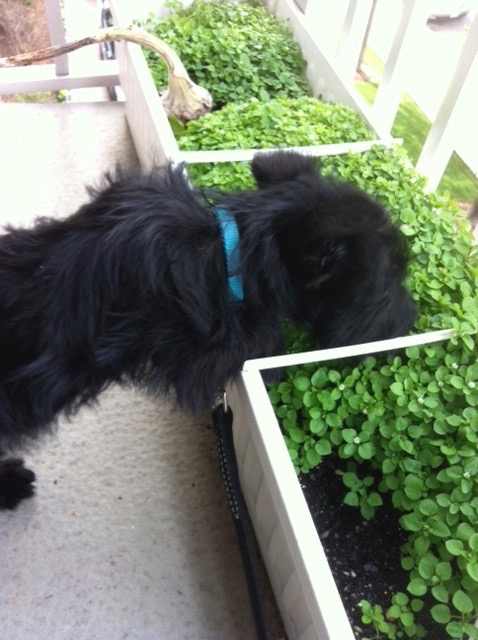
I laid the pots of soil on the balcony overnight to let the dirt cure before planting, leaving the door open – inviting the overnight breeze to bring on a soft sleep. In the morning I strolled into the living room to find dirt tracked all over the floor. My terrier, Usher—legs splayed out on the balcony floor, muddy nose, dirty paws—held his head high with half-closed eyes basking in the light wind. What do you suppose dogs think? Was he grateful I gave him the opportunity to dig up our new backyard?
Off to Home Depot I went for another bag of soil and over-the-railing brackets to hold the pots up and away from those ancient canine instincts. I planted and watered. Perfect.
My north-facing home juts out just enough on a curve of Lake Shore Drive to have a tree-filled lake view. In fact only the trees stand between my balcony and the North Pole – no buildings, no mountain ranges, not much to break the full force of prevailing winds barreling down the Great Lakes, slamming into my building and battering the sweet potato vines and morning glories. They didn’t last the week.
For three years I tried all manner of perennials and annuals praying for wind resistance. The gardeners at Gethsemane Garden Center finally told me I was in a losing battle. Abandoning the outdoor garden, I still delighted in my tree-filled panoramic view full of sparrows, chickadees and one squirrel that sat on a parallel branch, squeaking and shaking his tail, tormenting the dog.
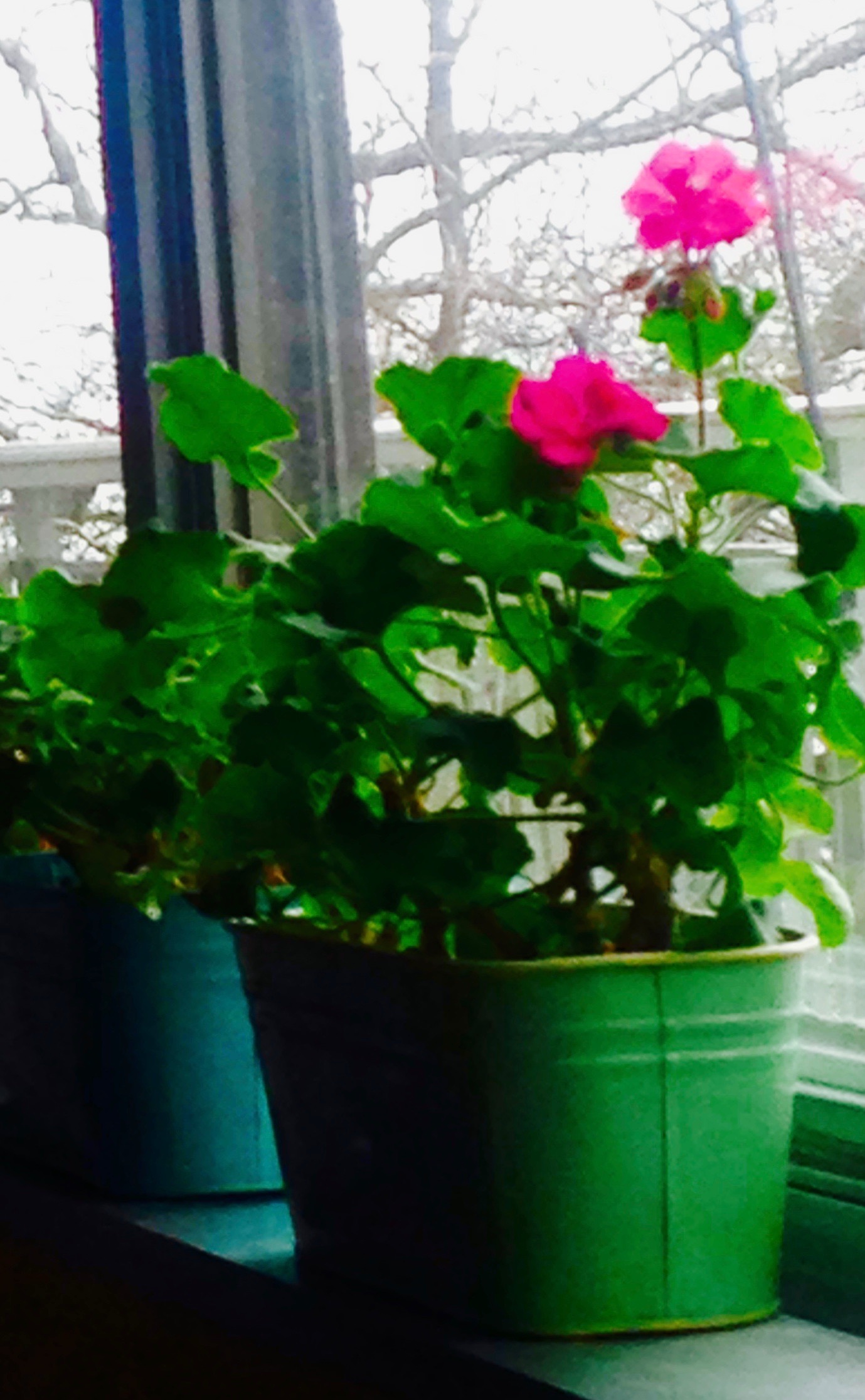
Eventually the emerald ash borer brought down most of the old trees, allowing more
light to fall on the indoor geraniums that are spread across the window sills and bloom all year. Conquering nature in a high-rise requires unwavering love of God’s creatures and a solid commitment to the game.
 joy to Kirby and Nate’s lives together as long as they live.






 slackened mesh to the shore and heaving it waterlogged onto the beach to see what lived beneath and around our sea-shored feet. We scrambled to our catch before low-flying seabirds descended to snatch up bottom-feeding young flounder; then we examined the rest of the bounty, which always contained a variation of tangled fishing line, faded lures, pieces of styrofoam, oyster shells, mussel shells, small rocks and pebbles, and once in a while a prized jellyfish, baby turtle or blue crab.
 the wall and I’ve never had the inclination to do so. Neither can I bring myself to replace the broken dishwasher or stove.
 Some visitors are afraid of the mosquito-borne West Nile Virus so they spray gobs of poisonous DEET all over themselves. I’m as afraid of West Nile as I am of getting hit by a bus. Bugs fly in. Bugs fly out. Mosquitoes, moths, flies, bees, wasps — they come in, take a look around and go out.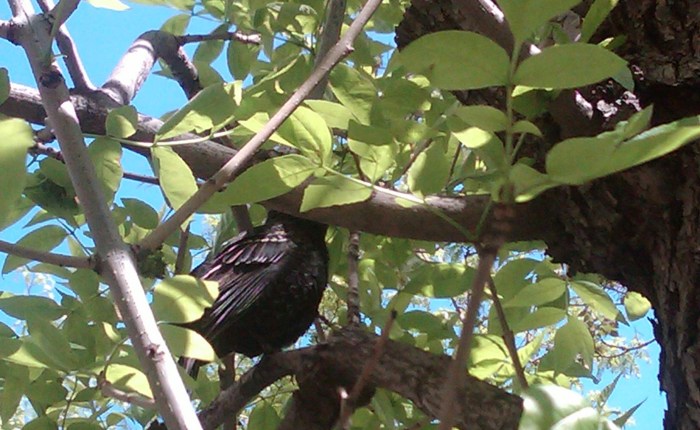
 gave him the opportunity to dig up our new backyard?
 sparrows, chickadees and one squirrel that sat on a parallel branch, squeaking and shaking his tail, tormenting the dog.
 Regan Burke