Love and Hate

Love and Hate

A member of my writing group recited the following essay the other day. I asked permission to post it here because I was moved by how two different Chicagoans address the current influx of migrants.

Conversation on the Bus

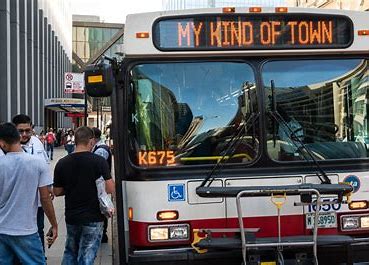
Last week I rode the bus and noticed a migrant family near me.  The mom was pregnant, her youngest son was fussing, and her other son, maybe three years old,  was playing with the window. The father was looking out the window, and the daughter, about ten years old, was sitting next to me. I don’t usually start a conversation on the bus, but she was asking her parents about a bus and their destination. So I said, “Hi, I’m Annette, do you speak English?”  
“A little,” she said. 

“Where are you going? Could I be of help?”

She looked down and said, “I’m not sure.”  

We were quiet, and then I said, “I’m going to my church to a class. Do you go to school?”

She shook her head and said, “We’re new to Chicago.” 

“Oh, welcome. Where are you from?”

“We are from Venezuela.”  

“I hear your country is beautiful. Nice and warm.” 

“Yes, but I miss my grandmother.” 

“Of course,” I said.  “Your English is quite good.”

“Thank you,” she said. “My dad helps me.” I smiled at him. He smiled back. 

Looking at him, I added, “My church supplies clothing and food to immigrants. It opens at nine on Tuesdays and Wednesdays. I’m going there now. “

 As we neared my stop I said, “I wish you the very best. I’m getting off at this stop.”

I bundled up and walked along thinking these were gentle people who needed help and hadn’t done anything wrong.  I wish everyone had a better understanding of their plight. 

People’s problems need a “face” because the mindset changes once you become engaged in conversation with them. I believe most people would want to help, but the housing issue is so severe. I don’t know how to begin to solve the not-in-my-neighborhood problem.

I went to morning prayers and mentioned this encounter to the group and one of them said. “We need to help our homeless first; after all, they are Americans.”

I bit my tongue and simply asked the group to pray for the migrant situation.

Afterward, I talked with my friend Carol. She said, “It’s a complex problem. We desperately need more workers and they’re hard workers.”

“This is a classic social work problem,” I said. “The people on the lowest rung of Maslov’s triangle are fighting for limited resources, and the “scarcity” principle is at work.

The United States has great abundance.  Congress has done nothing about immigration for twenty-five years. The situation in South America, with no democracy and lawlessness, makes this a five times bigger problem than it was. People want to escape.  I certainly would leave my country if my life and my family’s lives were in danger.

A. Baco 1/18/2024

 

Cold Wars

Cold Wars

The 2019 Polar Vortex slid down from the North Pole, threatening to lock Chicago into subzero stillness. I prepared for the warring cold by teeing up the entire 18-hour series of The Marvelous Mrs. Mazel. Then I threw stale bread crumbs onto my balcony to nourish the house sparrows, finches, and chickadees before they huddled together in eaves and cracked soffits to wait it out. I shuttered in and Dapped all the little crevices around the balcony door that were spritzing air into my not-so-insulated living room. That was the extent of my preparation for the coldest two days ever recorded in Chicago.

Day one brought minus 23 degrees. I woke to a thick film of silver ice covering all the windows. The ice curtain obscured the humanity moving around behind the windows across the street and any fool pedestrian walking in the feels-like-minus 40.

My binge-watching was interrupted mid-morning by a thrashing whomp, whomp whomp on the concealed balcony. I inched toward a clearing in the frosty glass.

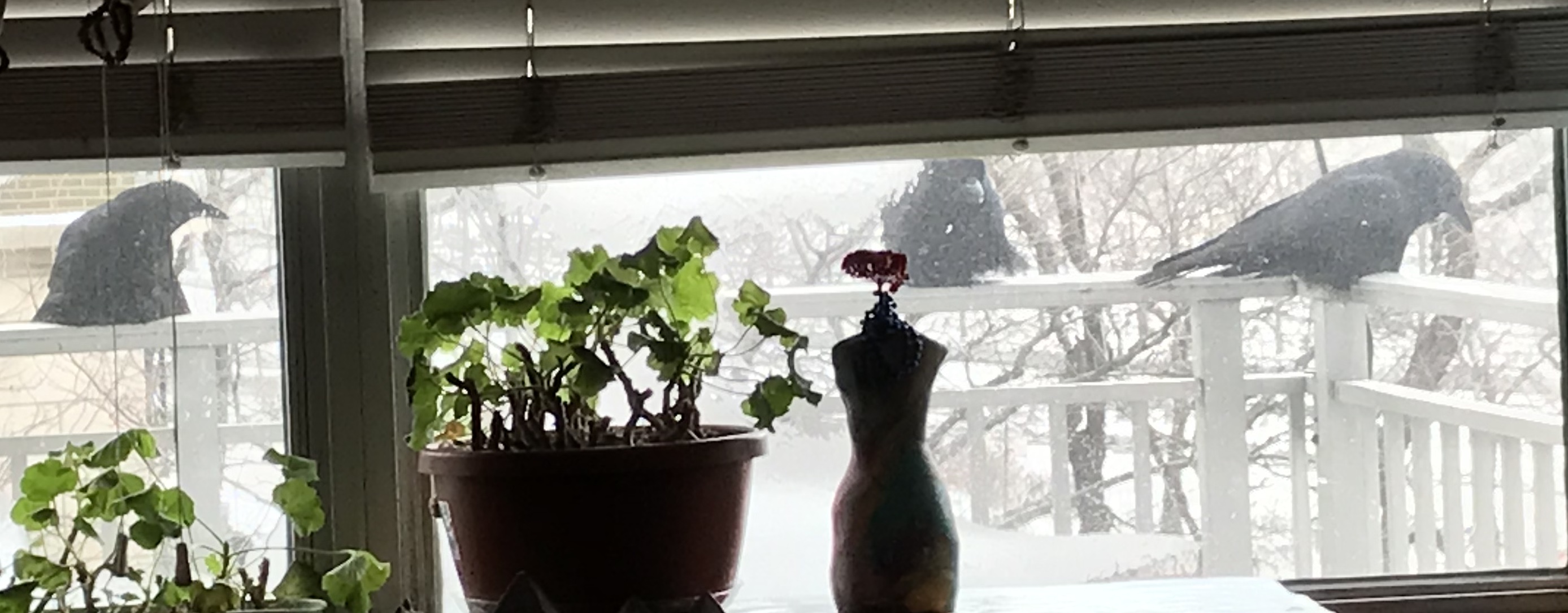
A murder of crows had come to forage.

The much-studied American Black Crow might be the most intelligent animal other than primates. They hide their food and come back for it. If a crow looks you in the eye, she will remember you, follow you down the street, and caw at you for attention like a wild pet. 

On day two, the temperature was 21 degrees below. The ice wall on my windows melted enough for a small lookout. I abandoned Mrs. Mazel and placed a chair well away from the clearing to observe the crows without startling them. They first landed in late morning. A mighty set of black wings fluttered a plumped-up body onto the balcony railing, and the rest followed—a family of five dipping to the balcony floor for leftovers. They flew off and came back. Again. And again. And again. I remained still throughout, trying to lock eyes with the birds. In the afternoon, the weather broke and allowed the dog and me to walk outside—under the watchful eyes of noisy new friends.

The first cold days of 2023 were predicted for the weekend after Thanksgiving. Though nowhere near the 2019 plunge, 30-degree temperatures heightened awareness of asylum-seeking families living on cardboard slabs outside police stations. I sought diversion through another favorite TV series, Julia.

The TV automatically tuned in CNN, though, where there was live coverage of the hostages being released from Gaza. A mysterious and curious need for every scrap of information gripped me. Who are they? What are their stories? Where are they going? I saw six women over the age of 70. One 85-year-old was helped onto a bus. I winced, feeling my own arthritic pain. Four children appeared—ages 2, 4, 5, and 9. I squinted to see if they were clutching teddy bears.

After watching for two tearful days, unrelenting shivers overcame me. And when I took the dog for a walk, that murder of crows cawed to us from the barren trees.