Somatic (Trump) Healing

Somatic (Trump) Healing

The 2020 Spring confluence of the Covid Shut Down and the Murder of George Floyd both sparked nationwide protests. As an old hippie, I uncharacteristically refrained from the George Floyd, anti-racist marches due to the possibility of covid-contaminated wandering spew. I confined myself to protesting by laptop day and night. On my newly-learned Zoom app, I heard Resma Menakem, psychotherapist and somatic practitioner, offer a description of white supremacy as told in his book, My Mother’s Hands. 

Menakem writes that racism is a form of PTSD that resides in white European DNA. He suggests using body-centered awareness and movements to reduce the trauma and tension stored in the nervous system. With Zoom, I began leading a weekly online meditation group using simple breathing instructions. After I read My Mother’s Hands, I subconsciously expanded the instructions to include somatic thoughts and body-centered words.  

In September 2026, my Zoom book group concluded a prolonged study of Resma Menakem’s book. As the weekly discussions progressed, I slowly became aware that his work has influenced the guided meditation I use to center us before our group discussions. I consider this gradual insight the most important dimension of our book group work. We may not “get it” right away, but the authors’ influence seeps in through contemplation.

On September 27, 2026, David Brooks talked to Ayad Akhtar on his podcast “The Permanent Questions.” Brooks labeled the session “What Is the Meaning of Mystical Experience?” And centered the discussion around Akhtar’s latest book, The Radiance: A Novel. 

Akhtar, my favorite new atheist, revealed that he has a practice that has no words, like a somatic practice of walking in the woods or staring at a sleeping cat. He clearly expects to have transcendent experiences in this practice and used the telling of it to let us know there is a certain spiritual life beyond, or more precisely, without, religion. 

I don’t know about you, but deep transcendent experiences, are flittering away these days. The sight of a monarch butterfly is a momentary, rather than a mystical, thrill because we’re told they are disappearing because of us. Happiness, peace, tranquility are fleeting surface emotions. It’s as if Trumpism has physically removed them from my psyche, excised them from my soul. The longing for them has not, however, evaporated. Ayad Akhtar expresses this as the ultimate human emotion — the longing for it.

“Firing Line” host Margaret Hoover asked foreign affairs scholar and measured journalist Anne Applebaum, “If architecture expresses political values, what should the next president of the United States do with the ballroom?”

Applebaum, a Washington DC native, reacted with visible somatic emotion, “Knock it down.”

She’s longing for it. The bodily return to normalcy. Me too. Ayad Akhtar’s novel has the promise of ushering in spiritual relief, regulated breathing, reduced back pain and a quieter stomach—without religion or God. 

Walking my dog Elsa does that too.

____________________________________

Guided Meditation as influenced by “My Mother’s Hands.”

Whatever you experience during meditation is right for you. Don’t try to make anything happen, just observe.

Begin by sitting in a comfortable position. Notice how your breath flows in and out. Don’t change your breathing in any way, simply notice how your body breathes. When your thoughts wander, bring your attention back to your breathing.

I close my eyes softly bringing awareness to my breathing.   

I allow my mind to rest in my heart as I come into my body. 

Sitting still. Relaxed.  Alert.  

I hold my back straight, not stiff.  

My torso rests with ease and comfort centered in my pelvis.  

My feet are held up by the floor, my body held down by gravity. 

I sense the temperature of the room.  

I notice sound. 

I notice thoughts of sound.

I imagine stiffness melting away from my neck, shoulders, eyes, forehead, cheeks.

I watch tension leave my face as my jaw drops slightly.   

I breathe in. I breathe out.  

I have no where to go, nothing to do; need nothing to change. This moment. 

And this Moment. And this moment.  

I allow complex thoughts to enter my mind and leave my mind. Feelings, plans, fantasies, memories, conclusions, judgements come in and go out. Come in and go out.

The worries of the world do not own me. I do not own the worries of the world.

I bring my focus to my breath as distractions come into my mind.  

May I be at peace. May my friends & family be at peace. May my enemies be at peace. May all sentient beings be at peace.

I breathe in. I breathe out. 
Broadview: Silent Resistance

Broadview: Silent Resistance

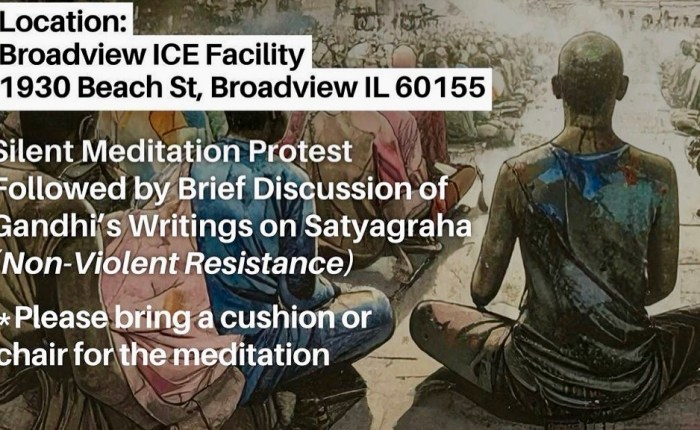
The announcement of a “Peace is our Protest” silent meditation hit my incoming a few weeks ago. I asked my Zoom meditation group to join me at The Broadview ICE Detention Center outside Chicago.

“I thought you were joking!” Rita said afterwards. 

And why wouldn’t she think it was a joke? Since the start of the Trump Administration’s Operation Midway Blitz in late 2025, Broadview has been newsworthy. Masked men in military costumes with automatic weapons shoot protesters in the head with pepper balls that explode into disabling chemicals. Demonstrators have been wrestled to the ground, zip-tied and arrested. Who in our group of graying meditators with varying degrees of mobility and vitality would be going someplace like that?

Well, Abigail and I did go. It was an easy drive. We arrived early. There were a few people already settled on their meditation mats, facing west. We set our lawn chairs down behind them. All was quiet. Two noisy protesters yelled out from time to time but experienced meditators treat ambient noise as neutral thoughts, not sound. We followed their piety and remained unstirred. Silent. Eyes closed. Forty-five minutes passed. A gong sounded. We stretched. 

“Look behind us,” Abigail whispered.

Over my shoulder I caught sight of about two hundred people. Sitting. Quietly. These valorous contemplatives came in behind us and squatted so softly we had no idea they were even there.

“I tried silent protesting and it never works!” A noisy bystander on a bike screamed at us. 

No one responded. No one felt compelled to yell back, argue, persuade. We remained silent. 

An unnamed man read a passage from Gandhi on non-violent resistance. We then folded our chairs and walked softheartedly to the car. As I passed by an Illinois State Trooper, he locked eyes with mine and said, “Thank you for coming.”

Broadview, an immigration processing center constructed in the 1970s, is a spit from the interstate highway leading to downtown Chicago. For thirteen years, a vigil at Broadview has been organized by the Interfaith Community for Detained Immigrants. Every Friday morning, Sisters of Mercy Pat Murphy and JoAnn Persch have led peacekeepers in prayer for detainees, some of whom are in transit to other facilities or are awaiting deportation.

“We are brothers and sisters, and it doesn’t make any difference the color of our skin or our religion or the country we come from,” Sister Murphy says, “we believe in one human being to another, a theology of presence.”

At the silent meditation protest we neither asked for nor received answers. No conclusions. No changes. No one needed to be there. We came to be present. A living theology of presence. I call this God. Others call it something else — the universe, spiritual essence, nature, mindfulness, other God names.

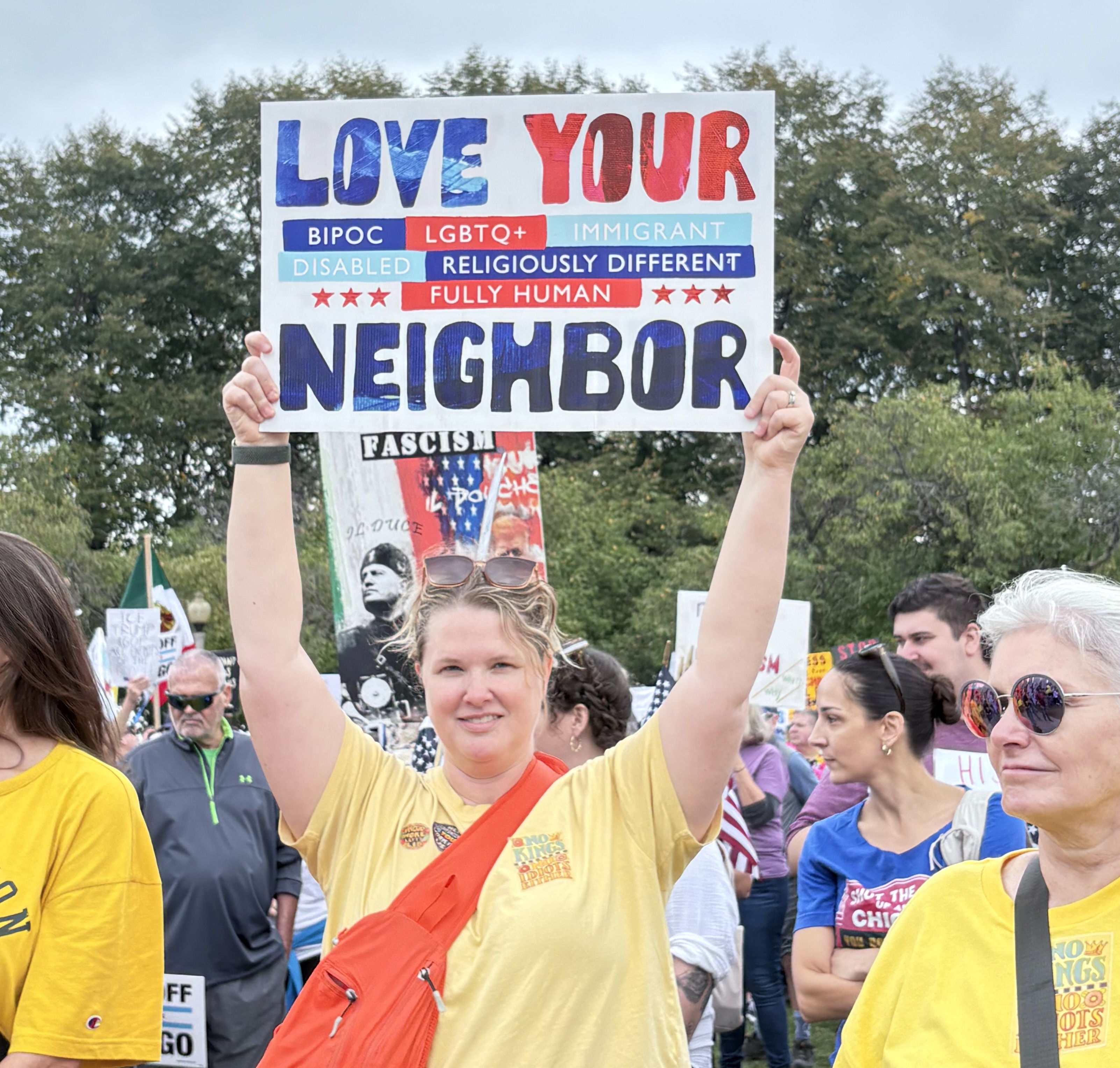
A week later the whole world watched millions peacefully protest at No Kings’ rallies. In Chicago, I walked all around the Butler Field rally in Grant Park and saw very few hateful slogans on signs. I’ve never seen such a noble protest. We marched up Michigan Avenue converging with streams of others walking from the south and west carrying woke messages.

Love not hate.

Faith Over Fear. 

Love Your Neighbor.

The Woodstock Nation. Long may it last.

___________________________________________________

Satyāgraha, from Sanskrit: “holding firmly to truth”, is a particular form of nonviolent resistance or civil resistance. The term was coined and developed by Mahatma Gandhi (1869–1948). Gandhi proposed a series of rules to follow in a resistance campaign:

  1. Harbor no anger.
  2. Suffer the anger of the opponent.
  3. Never retaliate to assaults or punishment, but do not submit, out of fear of punishment or assault, to an order given in anger.
  4. Voluntarily submit to arrest or confiscation of your own property.
  5. If you are a trustee of property, defend that property (non-violently) from confiscation with your life.
  6. Do not curse or swear.
  7. Do not insult the opponent.
  8. Neither salute nor insult the flag of your opponent or your opponent’s leaders.
  9. If anyone attempts to insult or assault your opponent, defend your opponent (non-violently) with your life.
  10. As a prisoner, behave courteously and obey prison regulations (except any that are contrary to self-respect).
  11. As a prisoner, do not ask for special favorable treatment.
  12. As a prisoner, do not fast in an attempt to gain conveniences whose deprivation does not involve any injury to your self-respect.
  13. Joyfully obey the orders of the leaders of the civil disobedience action.