Forsaken Christmas

Forsaken Christmas

The first movie I saw on Christmas Day was To Kill A Mockingbird in 1962. Since I suffered from an endless holiday hangover, little of the story stuck in my saturated brain. As a high school freshman, when I was still afraid to fail, I’d read and reported on To Kill A Mockingbird. Until Mockingbird, I hadn’t seen a movie created from a book I’d read. Fortunately, the film is still so popular it’s come and gone enough times on TV for me to watch it again. And again.

A Christmas Day movie-going tradition began, sometimes with friends, sometimes alone. At first December 25th movie releases offered an escape from uncomfortable family time. Before I got sober in 1976, mandatory holiday gatherings handed out one big gift-wrapped box of shame. Movie people count on family escapees, I suppose. Some of the best movies have been released on Christmas Day: The Sting, Catch Me If You Can, Broadcast News, Sherlock Holmes, and Tombstone. 

Every Sunday when my son was a toddler, he’d nap as his father studied, and I’d go to the movies. When he was old enough, we went to the movies together, especially on Christmas Day after the divorces, when it was just the two of us. When he was seventeen, he convinced me to see Talking Heads’ 1984 concert film, “Stop Making Sense.”  

“I don’t like punk rock,” I said.

“It’s not punk. It’s different. You’ll like it,” he convinced me.

He had his own band at the time and knew his music, so I trusted him. He was right. I blasted the “Stop Making Sense” cassette on my car radio until the tape wore thin.

When movie buddy Marca Bristo was alive and in town, we couldn’t wait to get to the first showing of the Christmas Day releases before she returned home to her family dinner. We’d usually discuss the movie over after-theater coffee, but on Christmas Day, coffee shops closed, so we’d sit in the quiet theater afterward, mulling the pros and cons. Marca died in September 2019. The Christmas releases that year included Little Women, 1917, and It’s a Beautiful Day in the Neighborhood. I chose Just Mercy, which tells the true story of defense attorney Bryan Stevenson and his client, a black man falsely accused of murder. A powerful advocate for people with disabilities, Marca would have chosen the same. 

Movie theaters closed for a while at the beginning of the Covid pandemic in 2020. I’m so wary of catching Covid and all manner of infectious diseases that I’ve not been in a movie theater since Christmas 2019. It’s tempting to see the re-make of The Color Purple, which will open this year on December 25. But every time I’m in a coffee shop or at a public event and someone sneezes or blows their nose, low-level panic attacks. Reclining in a multi-plex next to strangers for two or three hours’ worth of entertainment is out of the question. 

I’ll wait for Netflix. 

The Sound of Metal

It’s been twenty-four years since Christopher Reeve, aka Superman, fell off his horse competing at an equestrian event and broke his neck. Why was a good Democrat like him jumping around in such a patrician sport? I love to watch fancy horses and riders ballet through their Olympic paces on TV but come on! Superman?

After an understandably gloomy recovery, wheelchair-bound Superman rose to become an effective advocate for disability rights and a staunch promoter of research for spinal cord injuries. When he appeared at the Rehabilitation Institute of Chicago (RIC) in 2004, I asked my friend, Marca Bristo, herself a world-famous disability rights advocate, if she was going to see him.

Marca broke her neck when she was a twenty-year-old nursing student, spent a year recovering in what was the first year of RIC’s existence, and learned how to live and love in a heavy metal wheelchair. We were avid moviegoers, but she hesitated in honoring Christopher Reeve. Not because he was no longer a movie star, of course, but because she didn’t fully support his work in regenerative research. To Marca life was all about acceptance. Reeve plunged headlong (pardon the pun) into seeking a cure for spinal cord injuries.

He lobbied for embryonic stem cell therapy to heal the spine, took synthetic drugs to heal the spine, exercised to heal the spine. He founded one of the leading spinal cord research centers in the world. Knowing his injury would lead to an early death, he was on the inside track running toward the regenerative finish line.

I understand the frenzy to find a cure. I thought I was going to die before I found a solution for my chronic pain. The search alone turned pain to suffering. And I understand the reluctance in facing an incurable malady. For ten years my outsides announced I’m an alcoholic out loud in AA meetings, while my insides waged war against the world.

I didn’t drink but I didn’t want to be a sober alcoholic, didn’t want to say I was an alcoholic and sure as hell didn’t want to know other sober alcoholics. I looked for relief in self-help books, exercise, talk-therapy, anti-depressants, sex, food and spiritual retreats. I’ve always known there was no cure for alcoholism, but subterranean stubbornness kept me on the prowl for anything other than acceptance of that truth. I banged my head against a steel drum until the sound of metal made me so sick I finally cried uncle. 

Like walk, eat and love,“accept” needs to be put it in motion. Everyday I actively accept what I can’t change. If I let acceptance lie fallow, uneasiness simmers below the surface. Eventually defiance boils over and I find myself throwing tantrums in Walgreen’s because the clerk is too slow or obsessing over a bag of potato chips. 

I accept this. 

It is what it is.

This is what Marca Bristo wished for Christopher Reeve. 

Bodies of Grace Notes

I wish I’d digested the dictionary definition of “somatic” before attending a community poetry writing workshop at Access Living. The non-profit organization advocates for an inclusive Chicago that enables people with disabilities “to live fully–engaged and self–directed lives”. Part of their mission is to generate programs that give voice to creatives with disabilities. I met my writing teacher, Beth Finke and her guide dog Whitney, at the door of the poetry workshop one evening in early June. 

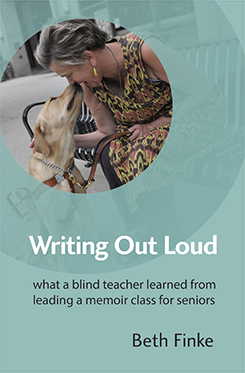
When we entered the room, someone shouted, “Hi Beth!” and it became obvious the greeter attended one of Beth’s writing classes. I can’t go anywhere these days where I don’t run into a current or former student of Beth Finke’s. We sat on either side of a BethFinke-WritingOutLoud-525x8-CoverDesign-245x373young woman artfully made up with dark eyebrows, eyelashes and exquisite dark purple lipstick. Stephanie, her name tag read, had a white cane leaning on her chair.
Stephanie turned to me, asked in a low voice, “Is she the author of Writing Out Loud”?

“Yes, she is. Have you read it?” 

“I’m listening to it now.” 

Our blue-jeaned leader identified himself as Matt, a poet and artist with an intellectual disability, schizophrenia. Invisible disabilities are covered under the Americans with Disabilities Act and spoken of freely at Access Living. They include conditions like chronic pain, chronic fatigue, intellectual and psychiatric disabilities and chronic dizziness. I belong.

Matt tried to describe somatic poetry, using the work of poet CAConrad. He said writing somatic poetry is a bodily experience. All his words following that beginning were Greek to me. They bunched up together, slipped and slid all over each other like a fast-forwarded recording. I mulled my exit strategy. 

CAConrad invented soma(tic) poetics. It involves writing “rituals” like this:         (SOMA)TIC POETRY EXERCISE (abbreviated)                                                                         Wash a penny, rinse it, slip it under your tongue and walk out the door…get your pen and paper and write about POVERTY…”

1A CAConrad photo by Jason Dodge
Poet CAConrad

Conrad describes himself as “the son of white trash asphyxiation whose childhood included selling cut flowers along the highway for his mother and helping her shoplift.” I can, more or less, relate to this life, but not to his writing.

Matt instructed us to write a “ritual” or a somatic poetry exercise, like CAConrad’s. I choked out a few deep breaths and copied the style of the CAConrad ritual. We  ended by reading a few of our rituals aloud. One woman, who sat in front of the signer, described what she was hearing. Stephanie, the dark-haired beauty with the white cane, wrote about throwing her glasses out the window then frantically digging through the dirt to find them. I wrote about the best way to die.

Soma(tic) Ritual. Here & Now.  Find a small bible on your shelf. Look up passages on the best way to die. Read one out loud in the elevator as you descend to the lobby. Announce to the doorman that you are a preacher now. Consecrate him and circle out. Recite passage after passage walking down the street to the birds and the bees. Ask the guy sitting on his steps to read a passage to his big black dog. Go to the park and tell the mother with her stroller you are practicing the best way to die. Read a passage to her baby. Assume the position of one who is reducing the weight of the here and now. Make your voice move words into the trees so they know the best way to die too.

Later, when I couldn’t sleep, I clicked on “somatic”: relating to the body, especially as distinct from the mind. Ahh. We came together with distinct bodies using our distinct voices—diverse souls creating our own flash community. A perfect grace note to Access Living’s mission.


The Americans with Disabilities Act (ADA) was signed into law on July 26, 1990. Special thanks to Marca Bristo, founder, president, and CEO of Access Living who worked tirelessly to draft and win passage of the ADA.