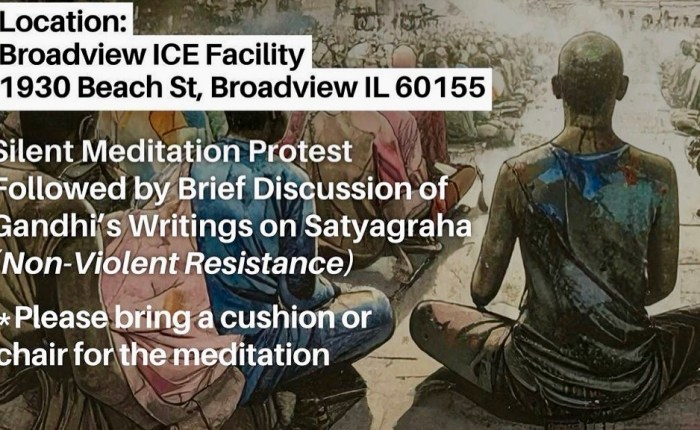
The announcement of a “Peace is our Protest” silent meditation hit my incoming a few weeks ago. I asked my Zoom meditation group to join me at The Broadview ICE Detention Center outside Chicago.
“I thought you were joking!” Rita said afterwards.
And why wouldn’t she think it was a joke? Since the start of the Trump Administration’s Operation Midway Blitz in late 2025, Broadview has been newsworthy. Masked men in military costumes with automatic weapons shoot protesters in the head with pepper balls that explode into disabling chemicals. Demonstrators have been wrestled to the ground, zip-tied and arrested. Who in our group of graying meditators with varying degrees of mobility and vitality would be going someplace like that?
Well, Abigail and I did go. It was an easy drive. We arrived early. There were a few people already settled on their meditation mats, facing west. We set our lawn chairs down behind them. All was quiet. Two noisy protesters yelled out from time to time but experienced meditators treat ambient noise as neutral thoughts, not sound. We followed their piety and remained unstirred. Silent. Eyes closed. Forty-five minutes passed. A gong sounded. We stretched.
“Look behind us,” Abigail whispered.
Over my shoulder I caught sight of about two hundred people. Sitting. Quietly. These valorous contemplatives came in behind us and squatted so softly we had no idea they were even there.
“I tried silent protesting and it never works!” A noisy bystander on a bike screamed at us.
No one responded. No one felt compelled to yell back, argue, persuade. We remained silent.
An unnamed man read a passage from Gandhi on non-violent resistance. We then folded our chairs and walked softheartedly to the car. As I passed by an Illinois State Trooper, he locked eyes with mine and said, “Thank you for coming.”
Broadview, an immigration processing center constructed in the 1970s, is a spit from the interstate highway leading to downtown Chicago. For thirteen years, a vigil at Broadview has been organized by the Interfaith Community for Detained Immigrants. Every Friday morning, Sisters of Mercy Pat Murphy and JoAnn Persch have led peacekeepers in prayer for detainees, some of whom are in transit to other facilities or are awaiting deportation.
“We are brothers and sisters, and it doesn’t make any difference the color of our skin or our religion or the country we come from,” Sister Murphy says, “we believe in one human being to another, a theology of presence.”
At the silent meditation protest we neither asked for nor received answers. No conclusions. No changes. No one needed to be there. We came to be present. A living theology of presence. I call this God. Others call it something else — the universe, spiritual essence, nature, mindfulness, other God names.
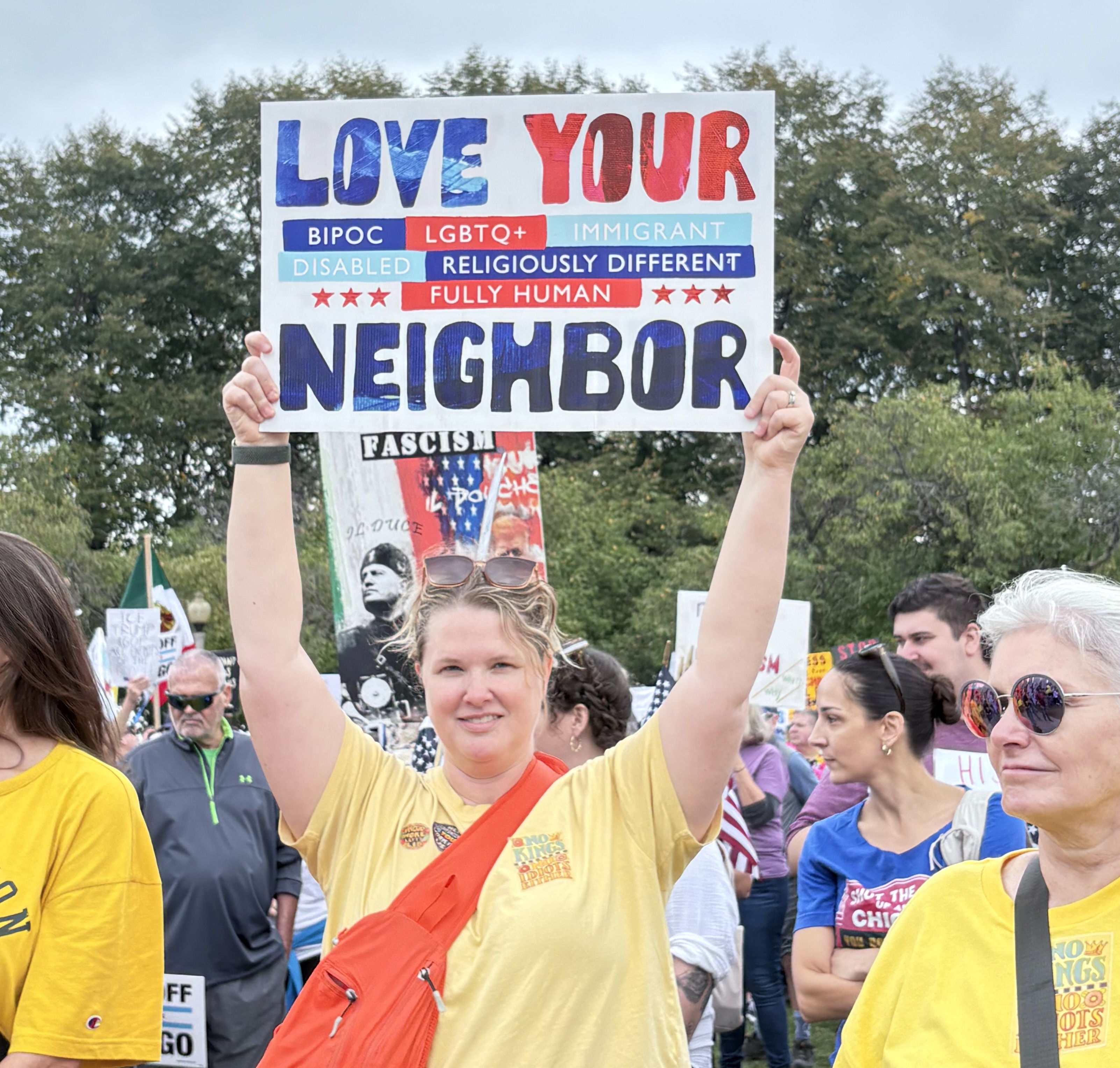 A week later the whole world watched millions peacefully protest at No Kings’ rallies. In Chicago, I walked all around the Butler Field rally in Grant Park and saw very few hateful slogans on signs. I’ve never seen such a noble protest. We marched up Michigan Avenue converging with streams of others walking from the south and west carrying woke messages.
Love not hate.
Faith Over Fear.
Love Your Neighbor.
The Woodstock Nation. Long may it last.
___________________________________________________
Satyāgraha, from Sanskrit: “holding firmly to truth”, is a particular form of nonviolent resistance or civil resistance. The term was coined and developed by Mahatma Gandhi (1869–1948). Gandhi proposed a series of rules to follow in a resistance campaign:
- Harbor no anger.
- Suffer the anger of the opponent.
- Never retaliate to assaults or punishment, but do not submit, out of fear of punishment or assault, to an order given in anger.
- Voluntarily submit to arrest or confiscation of your own property.
- If you are a trustee of property, defend that property (non-violently) from confiscation with your life.
- Do not curse or swear.
- Do not insult the opponent.
- Neither salute nor insult the flag of your opponent or your opponent’s leaders.
- If anyone attempts to insult or assault your opponent, defend your opponent (non-violently) with your life.
- As a prisoner, behave courteously and obey prison regulations (except any that are contrary to self-respect).
- As a prisoner, do not ask for special favorable treatment.
- As a prisoner, do not fast in an attempt to gain conveniences whose deprivation does not involve any injury to your self-respect.
- Joyfully obey the orders of the leaders of the civil disobedience action.


 Regan Burke