Freedom – Keep Walking

FeaturedFreedom – Keep Walking

Julie Hamos announced her upcoming “genealogy” trip to Hungary as she was driving me home recently. She travels to unusual places (like Iran) but this seemed more weighty than a curiosity tour.

Indeed I have known Julie as a Hungarian refugee but she’s been so much a part of the political fabric in Illinois for so long, I forgot she has a pre-American history that never comes up in conversation.

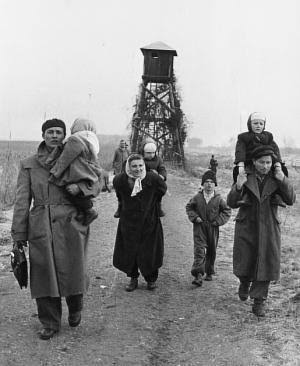
“My parents, and I walked five miles in the middle of the night from Hungary to the Austrian border. My three-year old brother, Jim, was carried. It was rainy and muddy. I was seven.”

“Oh, Julie, I never heard this story.”

In 1956, Holocaust survivors Agnes and Gary Hamos left their ancestral home in Budapest to escape the Soviet communist government. Hungarians were not allowed to leave the country. There were no exit visas. They snuck across the border into an Austrian refugee enclave in the dead of night with their children, Julie and Jim.

After the Hungarian Revolution of 1956, 200,000 Jews fled the country. About 9,000 went to Israel while others settled in the United States, Canada, Australia, Western Europe, and Latin America. The Hamoses made their way to Cleveland.

“Jim and I and another refugee friend are taking a trip to Hungary to retrace the five miles our families walked when we fled.” Julie said.

With Julie’s permission, I’m adding a few text messages that Julie sent to friends while on her genealogy tour. I’ve never known someone with a story like this and reading over Julie’s words still brings me to tears.

Americans are faced with a new commitment to safeguard the unique freedoms the Hamos family and millions of others have risked their lives for.

Freedom is, has always been, worth every step.

Friday. This has been an incredible visit to Budapest – no happy tourist attractions on this trip. Today we went to the large Jewish cemetery where we found, unearthed, cleaned, and pieced together the grave of our friend John’s great-grandmother (his other relatives at that cemetery were buried under rubble.. but we engaged in a treasure hunt to find them.) When we leave here tomorrow and go to the countryside, we’re going to find my ancestors and do the same thing.  

Then we went to the Holocaust Memorial Center which I never knew existed. It was established by the government in 1999 and of course became controversial because originally it whitewashed Hungary’s role in the Holocaust. That’s changed and it’s a true history lesson with real depth about growing antisemitism and then mass extermination. So moving — with lots of lessons for today.  

Tonight we had dinner with our only living relative in Hungary who invited her husband, son and his girlfriend to meet us. Their other son and daughter left Hungary under Orban, but tonight we also talked about their excitement and hope for Magyar – and what the election had been like. Fascinating. 

Tomorrow we go to the border to re-live the Hungarian revolution!

Saturday. Today we went to the border close to where we escaped. We don’t know from our parents that exact route we followed, through muddy cornfields, to  Austria. 

We do know a smuggler was paid by Grandma and he met our train and then took us to his house to rest before nightfall. Today we visited Moszonmagyarovar which was the end of the train line and his home town. We also went to the train station where we got off that train  70 years ago.  

The bridge at Andau (a James Michener novel) was the bridge used by many of the 70,000 Hungarians who escaped there. We did not do a long walk  to re-create our escape (since those long—ago fields are unknown, and likely private).  As our own symbolic experience, we walked across the bridge at Andau from Hungary to Austria. The bridge has been rebuilt and has graphic depictions of families pointed toward Austria. It’s the site of a memorial to the Hungarians who dared to make the escape. 

Halfway across the bridge, at the border of Hungary, I surprised Jim. One of our family lores has been about little 3-year- old Jimmy’s white teddy bear.  He was allowed to bring it (he was carried on the long walk) but we kept seeing searchlights and hearing gunshots through the night, so our parents threw it away – in the mud!- so we wouldn’t be discovered (along with Mom’s raincoat which was too shiny, they thought). 

Halfway across the bridge, I surprised Jim with a small white teddy bear and a note that said “This time I made it all the way across the Hungarian border!” We both bawled – it’s a great video. Funny thing, he had talked about looking for a white teddy bear nonstop these last 24 hours, so it really was a big surprise.
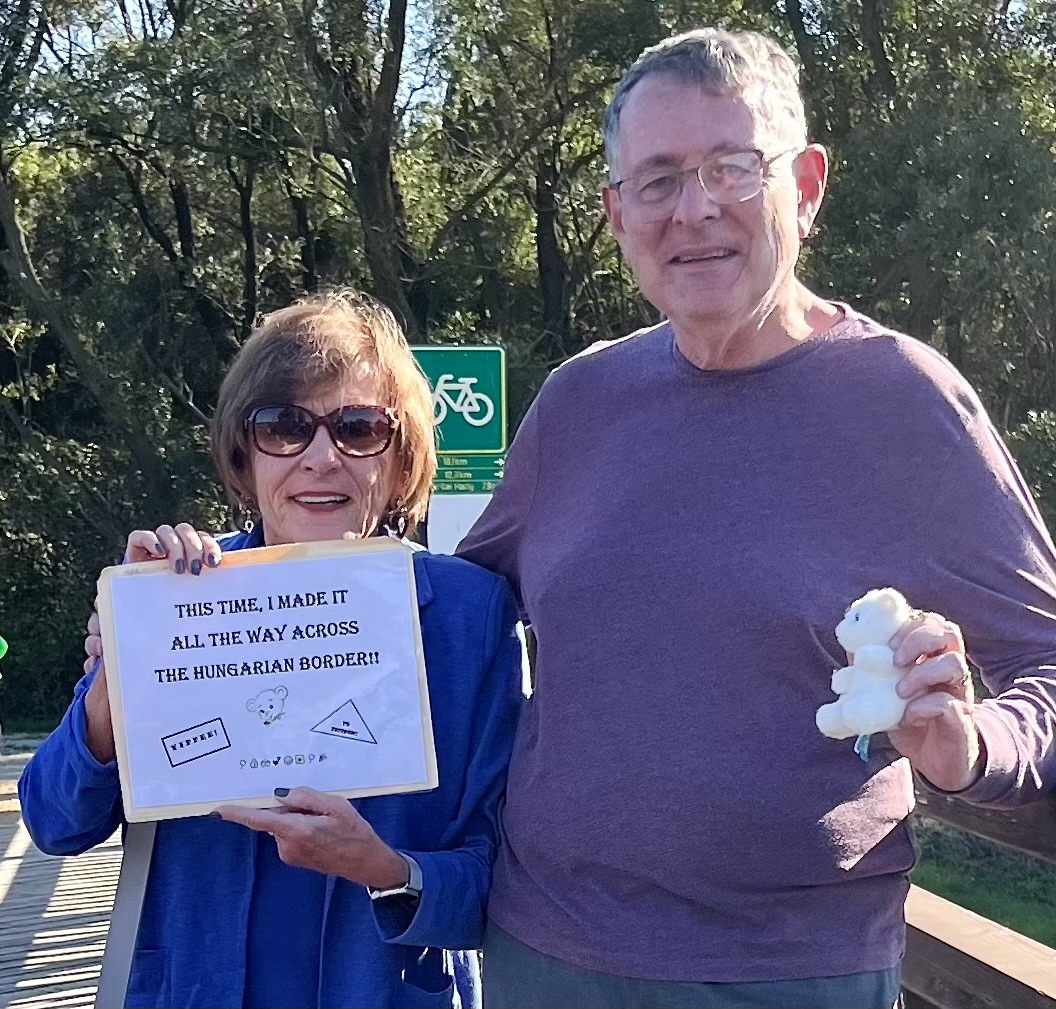
Staying at a “resort” with a spa and gourmet food at Andau. Great irony.

Tuesday. Hi all. The last two days in the countryside of Hungary have been meaningful and so, so emotional. 

Yesterday we went to Paszto, Dad’s small home town. There the Holocaust exterminated almost everybody – except my dad and his brother who were in forced labor camps. Two grandparents died there and their names are on a memorial to Holocaust victims (the type found in every village in Hungary, it seems). We searched and found the graves of a great-grandmother, a great-grandfather, a great-great-grandmother and two great-great-grandfathers.  Unbelievable! This was searching through and cleaning many ancient graves, and then placing our pebbles down on each grave in their honor. 

Jim and I had an entourage of 9 people – our 2 traveling friends, 3 historians he had met online, the 2 remaining cousins we had met the other day in Budapest who took off a day to join us because they/we didn’t want to let go, and 2 friends from 77 years ago when I lived in Paszto. We got to really meet everyone over a group lunch.

I was born in a Budapest hospital, but Mom, Dad and Grandma were living in Paszto because Budapest was not habitable after the war. So I lived there to age 3.  These two friends were my age as small children and we’ve connected over the years. It was fantastic to catch up with them. (BTW: my Hungarian is getting better by the day… ) At my request, we went to the house where we had lived and the lady who lives there now insisted on inviting me in to give me a tour. 

So yesterday was quite a day. Lots of memories, and a real recognition that I wouldn’t be here without all of these life experiences and  ancestors…

Today we drove to another part of Hungary with another historian (and distant cousin of our friend John). We went to two other cemeteries searching for Mom’s family. We found the graves of 2 great- grandfathers, while searching for more. 

We also stopped at two train stations where Jews had been rounded up to be put in cattle cars to be transported to Auschwitz. We’ve seen the scenes in movies – so very sad. They have plaques in their honor, that’s it. I cried. 

Tomorrow Jim and I go on to Romania – then part of the Austro-Hungarian Empire. Jim arranged tours with two different genealogists. My Grandma who lived with us all her life – a love of my life! – was born there. We’ll be looking for her large family. 

It’s an amazing trip, everything we had planned (Jim mostly).  It inspires lots and lots of thoughts and feelings about the tragedy of the Holocaust, the meaning of life, and about family. Whew

Love to all.

Friday. We’re in a beautiful little town called Oradea in Romania. Yesterday was bittersweet. Our guide for the walking tour took us to the Jewish sites and we learned about the impact of the Holocaust here. 

There were about 30,000 Jews here in the 1930s-1940s. During the WWII period, antisemitic laws were passed, but the Jewish community was successful and pretty assimilated here.  And then….in May 1944, a decree came down that every Jew had to walk away from their homes and possessions, and move into a cramped ghetto. Everyone!! They then interrogated some people and beat them to have them divulge where they hid their wealth. By the end of May and early June, they boarded everyone in cattle cars to ship them off to Auschwitz. In one month! Their Romanian/ Hungarian neighbors and friends stood on the sidelines and jeered. Only about 2,500 victims survived.That broke my heart yesterday… even as we enjoyed much of this lovely town. 

Today was our last day. Jim had hired a guide to take us to 3 small villages where our Grandma’s family from at least 1850 had lived.  One village had the Jewish cemetery and we searched mightily for our family’s graves (Jim will continue this cause we are convinced a few are there, and we now see the numbering system; he is determined to track down the cemetery register with the Jewish community.) 

A sweet experience was going to Grandma’s tiny village, then called Papfalva and now Popesti, which has fewer than 2,000 residents.  Hers was the Schwartz family with 12 children. Our guide wondered whether a senior would remember any descendent of this family who remained there, even for a while. We drove around until we saw an old guy in a wheelchair. His wife came out and offered to take us to the nursing home where the two oldest residents lived.  This is hysterical, right?  Sure enough, the nursing home agreed to bring them out. The man is 93 years old, his wife a little younger. 

They searched their memories for a Jewish family named Schwartz, but no luck. It was adorable.They took a photo with us. For Jim and me, there was something spiritually very exciting to walk in the footsteps of our Grandma in this tiny village. She lived with us all our lives and was very important to us. So, we’ve experienced both heartbreak and joy in Romania. 

Tomorrow we will  drive toward Budapest for our flight home on Sunday. We will spend the afternoon in a town near Budapest that is a UNESCO-listed artist village.  

Talk to you at home.  Love 

Julie Hamos has had a long career as policy advocate, public interest attorney, state legislator and state agency director. She was a young lawyer on the Subcommittee on Oversight of the U.S. House Ways and Means Committee in 1975, served as Illinois State Representative from 1998 for over 11 years, was a fellow at the Harvard Kennedy School of Government, appointed Director of the Illinois Department of Healthcare and Family Services. Julie has a J.D. degree from George Washington University. She continues to serve the public on boards and commissions too numerous to list.


Jews

Jews

Jesus, my lifelong friend, accompanied me through chicken pox, mumps, and measles when quarantine isolated me from my sisters, parents, and friends. No, I didn’t have Mother Theresa-like visions. He was more of an imaginary friend for my waxing brain, like an animated Pooh Bear.  Clergy at St. Mary’s school in Terre Haute, Indiana, taught that Jesus was born in Bethlehem and died in Jerusalem. Due to those back-to-back pre-vaccine childhood illnesses, I heard these Jesus facts my second time around in the first grade. The teaching doubled down in my malleable brain, which had grown to ninety-five percent of its total capacity, normal for a six-year-old.

There was never any question that Jesus was born of Jewish parents. Israel, presented as a holy place, not a political state, was sacred ground because that’s where Jesus lived. There was always the implication that we, as Catholics, were in Jesus’s family, that somehow we had Jewish roots. If Jews believed in Jesus, they got to go to heaven, like us Catholics. But no other religion. Such was my Roman Catholic schooling.

Our single black-and-white family television transmitted few programs into our living room in the 1950s. Roy Rogers and I Love Lucy were allowed, but my parents insisted we watch the nightly news. My sisters and I didn’t dare whine for fear of verbal reprisals like, “Shut up and listen—maybe you’ll learn something.” 

They’d let us watch “This is Your Life,” a forerunner to PBS’ “Finding Your Roots’. In 1953, This is Your Life broadcasted the story of 32-year-old Hanna Bloch-Kohner, a Holocaust survivor. I wasn’t much interested in the not-so-famous Hanna, but I did wonder about the Holocaust.

When I was ten years old, as my brain power peaked, local TV stations advertised the opening of Old Orchard Shopping Center in Skokie, Illinois. We lived in Wilmette, on the border of Skokie.

“Where’s Skokie?” I asked my mother.

“That’s where all the Jews live.” She answered.

All my thoughts screeched to a halt. I’d never seen a Jew. I assumed that whatever Jews were leftover from the time of Jesus surely had died in that mysterious “Holocaust,” a word adults uttered in a hush. Of course, I couldn’t ask my mother what Jews were doing in Skokie. She expected me to know what she knew, no matter the subject. She would have ridiculed me with a sarcastic, “You’re kidding me. Don’t you watch the news?”

From that moment on, I looked for Jews in supermarkets, at the beach, in the record store, and even at school. It’s possible I looked for men who resembled Jesus. In high school, I met a Jewish brother and sister. I stared them into my spiritual family. I wondered how they got to New Jersey from Bethlehem or Jerusalem or Israel, those holy places whose ancient remnants had settled in my bones, with Jesus. 

My brain, now waning, has reformed itself through evidence, facts, and logic into knowing and loving the Jewish story. There may be evidence, and there may be facts, but there’s no logic to knowing Jesus. 

That’s still a belief. 

Atonement: Bird on the Wire

Atonement: Bird on the Wire

In the late 1970’s I worked at a run-down residential hotel that had been sold and was about to be renovated. The legions of accountants, lawyers, contractors and financial schemers confounded even the notable. I managed to keep them all straight, pass information one to another and generally play the know-it-all role I like.

The lead accountant, Mel, asked if I had any friends who could be temporary helpers on some new events his firm was staffing—the Taste of Chicago, ChicagoFest and Art Chicago Expo.

“Sure,” I said, “How much will they get paid?”

“Free entry, all the food they can eat, a T-shirt and a poster.”

Having just accumulated a whole batch of new friends in Alcoholics Anonymous, I knew plenty of unemployed sober oddballs hungry for food and fun as ticket-takers and money-changers. Next thing I knew, Mel told me I had to meet “the guy” in charge.

“Come to Temple Beth Israel on Yom Kippur.” Mel said.

“What? What’s that?” I said, “Am I allowed? What do I wear?”

“Everyone’s allowed. Day of Atonement. It’s the best time to do business.”

I tried to sneak into a seat in the back and look around for Mel. After lengthy  prayers and singing, there was an intermission. Mel appeared at my side, grabbed me by the elbow and said, “Let’s go.”

All the congregants rose up, walked around, talked and laughed and “did business”. Mel introduced me to “the guy” who headed up one of Chicago’s Big Eight downtown accounting firms.

“How many people you got?” The guy asked me.

“Twenty or so,” I lied.

“Good.” Bring ‘em to Navy Pier on Saturday and get ‘em signed up. We’ll take it from there.”

In the years since, I’ve practiced atonement often — not just once a year, but almost everyday. At a recent book group studying The Jewish Annotated New Testament, I inched into a discussion of Ken Burns’ documentary, The US and the Holocaust.

“Someone told me the trouble with Jews is that they didn’t assimilate.” I said.

“The. trouble. with. Jews?”  One of the Jewish participants admonished.

“Do you hear what you’re saying?”

“I’m so sorry,” I said. I then attempted to overcompensate the sin of victim-blaming by blabbering about assimilation, of which I know nothing.

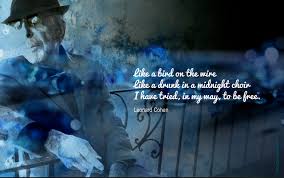
I once asked a musician friend to sing Leonard Cohen’s Bird on the Wire at my funeral.

“No.” He replied.

“Aw, c’mon. Just say yes. I won’t know. I’ll be dead.”

“Better to atone when you’re alive.” He said.

I bowed to my ignorance and he agreed to sing just these words.

Like a bird on the wire

Like a drunk in a midnight choir

I have tried in my way to be free

Like a worm on a hook

Like a knight from some old-fashioned book

I have saved all my ribbons for thee

If I, if I have been unkind

I hope that you can just let it go by

If I, if I have been untrue

I hope you know it was never to you

God bless Leonard Cohen 1934–2016.

Listen to Bird on the Wire here.

How Will I Know When You Die?

How Will I Know When You Die?

No. No. No.

A friend asked me if I’ve given my son a list of people to call when I die. And right then I felt the future running away with me so fast I could hardly catch my breath.

“No.”

“Why not?”

I told her he’d never do it. “He’d get mad if I even approached the subject.”

“How do you know?”

How do I know? He hardly talks to me as it is, much less about an uncomfortable subject.

“It’s a hard job—to call around to strangers and tell them their friend has died. Think of the responses—the oh-no’s! and the demand for details. No. He wouldn’t do it.”

“Well, how will I find out?” pleaded my friend.

There’s that future again, coaxing me to live in it, whispering that it’s my responsibility to inform my friends when I die.

I’m drawn to a passage in Pascal’s Pensees: “We never keep to the present…we anticipate the future as if we found it too slow in coming and were trying to hurry it up,” He writes about our failure to live in the present, “we think how we are going to arrange things over which we have no control…” So, no. I’m not going to try to control what happens to me after I die, other than keeping my end-of-days papers in order. I’m happier owning this moment and this moment and this moment. I’ll let time future govern itself.

On the Sunday after All Saints Day, November 1, my church recites the names of those members who’ve died the past year. This year there were more people on the list I knew. I mean, I knew them. Not just their names. I knew them. After the service, as I sat alone in my pew listening to the organ postlude, I popped open my iPhone. I read an account about two women who guarded the dead body of one of the synagogue victims in Pittsburgh so that, in keeping with Jewish custom, the person would never be alone. I had descended into the grace of solitude, a still point, wondering if Jews believe the soul lives beyond the body when I heard someone call my name.

“Hi Regan,” came the voice of my pastor, Shannon Kershner. I looked up to see we were the only two people left in the church after the All Saints Service. She had just delivered a sermon on John, 11:35: Jesus wept. It’s the shortest verse in the Bible. Pastor Shannon reminded us Jesus cried over the death of his friend, Lazarus, joining in the collective grief of his community.

“Are you ok?” she asked.

“No,” I answered. “The dead.”

“Yes.”

She knew.


Heaven or Hell on Suicide Hill

Heaven or Hell on Suicide Hill

Willmette, Illinois 1950sth-4

The only non-Catholics I knew as a child were our babysitters. I always felt sorry for them knowing they were headed straight to hell when they died. In 1956 we rented a four bedroom tudor built into the cliff on Lake Michigan in Wilmette, Illinois, having moved from a month-long stay in a downtown Chicago hotel where we landed after our eviction from Clayton, Missouri. To the east, the view of the lake was obscured by an over-propagated evergreen garden leading a quarter mile down to a rusty wire gate that opened to the beach. My mother hired seventeen-year old twins to watch my sisters and me on the beach so she’d not have to dress for the day and be our lifeguard. And those twins came with boyfriends—who had boats. The teenagers taught me to waterski and by the end of the summer I had my feet sloshing around in the rubber boots of a slalom, skiing far out into the lake, so unmoored at the edge of the world that I often forgot to let go of the tow rope when we we came back to shore for the drop-off. None of them were Catholic and I silently mourned for their souls, asking God why He’d be sending them to hell when they obviously didn’t deserve it. After all, they had shown me where heaven is.

Sitting at the foot of my parents bed one day, I saw a television commercial for the opening of Old Orchard Shopping Center in the next town over.

“Where’s Skokie?” I asked my mother.

“That’s where all the Jews live,” she answered.

At 10 years old, I didn’t know there were Jews alive in the world. I wanted to ask my mother how Jews were living near us and not in Jerusalem where they lived at the time of Jesus. She detested answering my questions and would have accused me of stupidity, a criticism I already couldn’t stand, so I sat back and wondered if Skokie was, in fact, hell.

When winter arrived in Wilmette I could hardly contain myself. The only thing separating me from the sledding hill next door was a mammoth pile of snow huddled around evergreen growth and a chain link fence next to our house. All the girls and all the boys, all ages and all sizes came to slide down Suicide Hill. Firemen hosed it at least once a day turning soft snow into cold hard ice. Traditional sleds, too dangerous for the slippery terrain were cast off—piled up in a Flexible Flyer junkyard off to the side at the top of the mountain. Flat cardboard slabs were the most valuable commodity. I shredded straight down on the cardboard, sitting down at first, then up on my feet. Eventually we, the first snowboarders, traded our cardboard for our boots and slid downhill on our feet.

Girls and boys had equal status on Suicide Hill. There were no rules, no lifeguards, no snowguards no unofficial guards. We all raced down the slope expecting no prize, bumping each other off into snowpiles like soccer balls, soaring like heavenly rockets.  Winter stuck in our noses, but our fevered bodies rollicked in unfastened coats flapping in the wind. Medics and parents came to bandage limbs and scrapes. Ambulances carted broken bones off to Evanston Hospital. Exhaust smoke obscured our vision of cars double parked on Michigan Street where parents yelled Let’s Go!

And when the stars came out we went to No Man’s Land for hot chocolate where I eyed my non-competing competitors. We belonged together, heaven or hell.

The Big Lie: Catholic Hell

The Big Lie: Catholic Hell

In every one of the thirteen grade schools I attended in the 1950’s, Catholic nuns taught me about Heaven and Hell, including the nugget that Heaven was only for Catholics, but there was no guarantee I’d go there. From the age of six I knew if I, as a Catholic, died with a “mortal” sin on my soul, I’d go to Hell, or perhaps Purgatory, the halfway house to Heaven.

This teaching dwelled in the official Catholic textbook for American children used from 1885 to the late 1960s, the Baltimore Catechism. Theth-2 Catholic Church denied that physical Heaven, Hell and Purgatory are part of Church doctrine, long before the Pope declared in 1999 that heaven and hell were “primarily eternal states of consciousness more than geographical places of later reward and punishment”. But that turnaround came after these medieval lies were grafted onto sapling children like me.

The only non-Catholics I knew as a child were our babysitters. I always felt sorry for them because they were headed straight to Hell when they died. In 1957 when I saw a TV ad for Old Orchard Shopping Center, I asked my mother, “where’s Skokie?” “That’s where all the Jews live,” she answered. At 11 years old, I didn’t know there were Jews alive in the world. I thought they were all burning in Hell.

I’ve come to believe that my own personal heaven and hell do exist. I visit hell whenever I relive the last time I got sober forty years ago, or when I regret insensitive words I spoke five minutes ago. And heaven appears when my 10-year-old grandson texts me photos of his lizard.

At the suggestion of my fellow seeker Terry, I crammed into the O’Hare Hilton with 1,000 other souls one weekend in 2012 for a retreat, “Transforming the World through Meditation” with Franciscan Richard Rohr and Benedictine Laurence Freeman, two men I’d never heard of. I had started meditating a few months prior in a Buddhist group and asked Terry if she knew any Christian meditation groups.

In addressing heaven and hell, Rohr said the ego prefers winners and losers. He offhandedly mused that if Jesus descended into hell, as it says in Church doctrine, than there is no more hell because, ”Hell cannot exist in the light of God.” I lost my breath, sprung out of my seat and staggered to the door for air.  A volunteer brought me a chair and water. “Raised Catholic?” I nodded yes. “Yeah, this happens a lot.”

If my subterranean soul had known all my life that I wouldn’t go to Hell for attempting suicide or stealing pens from the office, if I had known all non-Catholics were not doomed to go to Hell; I would have been a better friend to Jesus. I didn’t know my nature was adolescent, fertilized with dead ideas about Hell, sprouting false judgements on myself and everyone I knew.

Uncovering the lie is heaven indeed.