Anita Bryant’s Legacy: Gay Rights Activism

Anita Bryant’s Legacy: Gay Rights Activism

As I was about to cross the threshold toward the elevator with Elsa tethered to my thick gloves, I reached back for the handle to close the door behind me. At that moment, WBBM news radio announced Anita Bryant had died. Out in the park, Elsa tiptoed on the crunchy December earth — a slower walk leading to a longer think. Memories arose about Anita Bryant and her anti-homosexual campaign in the 1970s.  

Anita Bryant, a Miss American pop singer who sold Tropicana Orange Juice on TV was so well-known in US culture that her startling attack on homosexuality betrayed her seemingly good-natured Christian persona.

Elders in the fundamentalist Christian cult where I spent a few years in the 1970s never addressed homosexuality. They also ignored any other moralistic culture clash that evolved because of Bryant’s media campaign. I doubt any of us in that community even knew a homosexual. Oh, there were instances of men going off on drug-addled toots and ending up in gay bath houses. They’d come crawling back to church asking forgiveness from an uncomfortable congregation that had no knowledge of gay life. I was never sure what we were meant to forgive since no sin was committed against us.

Bryant, sparked by a Dade County, Florida decision to protect sexual orientation as a civil right, created the Save Our Children coalition to build anti-gay public support. She succeeded. In June 1977, the Miami area voted against homosexuality as a civil right, an act that lasted twenty years. 

Fresh from the Florida victory,  Anita Bryant brought her teethy bigotry to Chicago to perform a white-bread repertoire including her signature “Paper Roses” at the Medinah Temple. She was met by 5,000 gay rights protesters.

Christian churches throughout the country were called upon to take a stand, including mine. Homosexuality was justified as sin through church elders’ literal interpretation of a few bible passages. It became a disqualifying dictum for church membership. I knew nothing about homosexuality. Shunning people, however, didn’t fit with what brought me to Jesus, namely the parable of the Good Samaritan, or love one another, especially the least among us. I’ve needed that Jesus all my life. Extending unconditional love is a hard practice. In fact, it’s really impossible. I’ve always known it’s required of me nonetheless. 

Anita Bryant’s anti-gay campaign invigorated gay activism in the civil rights movement. We had a new cause. We boycotted orange juice. We attended Chicago’s Gay Pride parade that year. We mocked Tropicana’s tagline by wearing t-shirts that said, “A day without human rights is like a day without sunshine.” Gay rights, women’s rights, equal rights, all blended into one big active advocacy movement. 

I moved on to La Salle Street Church, which made no small point of accepting all people. Founded by rejects from the Moody Bible Church down the street, these Christians were definitely descendants of the real Jesus. They left Moody because the church elders required blue-jeaned converts to sit in the balcony and wouldn’t allow them to receive the Eucharist. In the 1970s, no one wore blue jeans except anti-establishment long-haired hippies, known these days as Progressives. 

The noise generated by the blue-jeaned Christians galvanized the nascent Christian fundamentalists, known these days as White Christian Nationalists. 

I’m not sure what happened to separate the civil rights groups. Gay rights, abortion rights, voting rights and anti-violence organizations eventually established their own fundraising machines side-by-side with their own causes.  Everyone started marching to a different drummer. We came together to protest the Iraq war and for the pink-hatted Women’s March after the 2016 election. But not all my friends showed at the NATO protest in 2012.

As a straight white old lady, I’ve recently tried with scant success to advocate against ageism. I no longer wear blue jeans. Dress codes are almost extinct. This is evident by Elon Musk’s t-shirt, MAGA hat, and long, black, steampunk coat at an Oval Office press conference. 

Anti-ageism is the most difficult cause to rail against. It’s an implicit or subconscious bias, practiced by those who are discriminated against and by those who do the discriminating. Dismissing Elon Musks’ functionaries as teenagers and constantly stating their ages is a display of age-bias. The same applies when stating Joe Biden’s or Donald Trump’s age. Or mine.

“You don’t act like a 78-year old,” remarked a friend last week.

“Yes I do. This is what 78 acts like.” I shot back.

It’s not that age isn’t a good descriptor to place people in their lived experiences. But age as a descriptor is most often used to put people in their place. The unchecked functionaries have stolen my Social Security records inside the US Treasury Department. They are no better or worse than me because of age. They are wrong no matter how old or young they are.

As happened with Anita Bryant, is it too dreamy to imagine a galvanizing backlash? Is a movement forming to neutralize the extreme bigotry falling out of the dirty mouths of Washington DC?

____________________________

Click to see Anita Bryant sing, “Paper Roses” https://youtu.be/0UoRKstI8Q4?si=3ar2deoIWIu6YwVN

___________________________

Black Hole Jesus

Black Hole Jesus

First Holy Communion is a right-of-passage ceremony in the Roman Catholic Church where a seven-year-old is initiated into eating the body of Jesus Christ. I learned the elements of the Catholic service, the Mass, with my classmates in the second grade. The priest transforms the bread into Jesus’ body and the wine into Jesus’ blood. The wine, the blood of Jesus, is reserved for the priest. We the people eat paper-thin white tasteless wafers, the body of Jesus. Catholic children all learn that after we make First Communion, it’s expected we’ll eat the body of Christ every week for the rest of our lives.

“Let it dissolve in your mouth,” the nuns instructed, “It’s a sin to chew the body of Christ. And don’t touch it!”

The pomp and ceremony of my First Holy Communion overshadowed any eww!-ness related to eating Jesus’ flesh. Prim little girls wore white crinolined lace dresses, white shoes and socks, white cotton gloves and angelic white veils. Like brides. Squirmy spit-polished boys wore ill-fitting white suits and ties. Children sang a Gregorian chant, Tantum Ergo, in Latin. The ceremony shined as if the light of heaven broke through the ceiling and blessed us with all good things forevermore.

In the early grades, if anyone questioned how Jesus’ body and blood changed from bread and wine, there was only one answer.

“It’s a mystery,” they said. 

I fell hook line and sinker into this ethereal mystical world of Jesus-eating. He was inside me, outside me, all around me, all the time. Jesus, my imaginary friend, was under the bed with me when my parents’ raging drunkenness woke me in the night. And when long-fingered nightmares reached their talons in through the screens, Jesus saved me.

At Jesus’ Last Supper (and his First Communion) before he was tortured and murdered, he broke bread, sipped wine and said, “The is my body. This is my blood. Do this in remembrance of me.” Surely Jesus and his father knew what a theological shit storm this would cause for all time. There is no earthly world where anyone could possibly digest all that’s been interpreted by those simple words. 

In the upper grades, Catholic clergy gave fuller answers for Holy Communion, the Eucharist, they called it. Explanations always ended with, “It surpasses understanding.” When I joined a non-Catholic Christian church in my twenties, I learned that Protestant Communion is a public display of piety, not a mystery at all, a non-binding sacramental tradition.

Jesus, like the simple chassis of a computer, hides his infinitely more complex workings from the young in faith. It’s good he came as a baby. People love babies. I would have settled for a dog since I love dogs. This human Jesus soothed me as a child. In the second half of life I’m soothed by and troubled by the man or the myth at the same time. Jesus, a synonym for love, is comforting. His hidden complexities are troubling. Questions arise, starting, but never ending with, “Are you real?”

In Christopher Nolan’s movie Interstellar, a concrete love story moves in and out of a celestial black hole. A black hole forms when a star collapses in on itself, eventually creating a singular point of irresistible gravity. All matter, light, space and time are sucked into it and all instances of time become the present moment. 

These days, at my Presbyterian church, I sit motionless at traditional Communion, the Eucharist. When I hear the minister say Jesus’ words ‘do this in remembrance of me’, if I’m aware, I contemplate the past as present, as if in a black hole. The story of the Last Supper reminds me to honor the original Twelve, and others, who were in the room where it happened. They come through a black hole to my pew, in the hope that I see that the whole of the story is swallowed up and Jesus is the present moment. 

The veneer of the Communion tradition, like the computer chassis, hides the paradox of a simple complexity. Non-traditional Jesus, that black hole of pure love, that present moment, issues the most complex inhuman commandment, ‘love your enemies.’

The Big Freak Out

The Big Freak Out

Metaphors have frittered away from me. To be fair, they hadn’t much choice. In conveying messages to contemporaries over the past few years, whether speaking, emailing, texting or DM’ing, I’ve developed a necessary plain spokenness, lest the meaning be misconstrued, misunderstood or confusing. Fallout from this mind-bending prosaic language is living at a level of plain thinking, another aspect of old age (I’m 78) that I wish I’d been warned about.

While watching Joe Biden perform at the now-famous CNN debate in June, I came unstrung in the grip of knowing that Biden’s plain-thinking, plain-speaking style was killing any chance of beating Trump in the November election. 

“Oh. my. god. He’s like my neighbor Ray,” I thought. Ray, who used to converse like a college professor and remember your name like you were his student, but now he talks only sports and weather. Ray, who cannot grasp metaphors unless they’re baseball sayings he’s used all his life, like “on the ball” or “step up to the plate” when he motions for you to exit the elevator before him.

On an unsually quiet afternoon, that is to say, no sirens, no gas-powered lawn mowers, no garbage trucks beep, beep, beeping as they backed out of the alley, I was studying David Montero’s new book, The Stolen Wealth of Slavery: A Case for Reparations. My book group decided to read two chapters at a time in order to absorb a history none of us had ever known. The premise that the intellect is stimulated through awe and wonder has proven true in this group, with this book. Montero’s research thoroughly tracks how the free labor of Black people in the South became the basis of the entire US economy and her dominance over world markets. His writing is loaded with similes and metaphors.

“The energies of three million enslaved people were organized into an industry, industrial enterprises were increasingly fertilized by slavery, and the output of the system was shipped across the world.”

(All of a sudden, a swift “click-clum” in the room interrupted my reading. I turned and saw a ragged chunk of dried-up old paint on the floor, fallen from the ceiling. Surely there’s a metaphor here. Chip off the old block? Chip on your shoulder? Paint the town red? Naw. Nothing. I got nothing.)

In the chapter, “The Union Must Perish,” Montero included a white abolitionist’s account of his travels to the slave market of Virginia. Published in the New York Daily Tribune in 1850, part of it reads:

“…this was the most heart-sickening sight I ever saw. I involuntarily exclaimed, “Is it possible that this is permited in my own native country—the country I have loved so well, and whose institutions I have exultingly pointed to as an example for the world. If this is Christianity, don’t call me a Christian.”

The emotons expressed are precisely what I feel now that the Trump-appointed United States Supreme Court ruled that the President is unbound from the rule of law and can freely engage in criminal activity. Our Christian Nationalist Supreme Court looks forward to the next president closing the borders to anyone but White Christian Europeans, slashing gay rights, civil rights, and women’s rights, and requiring biblical education in public schools. Echoing the 1850 abolitionist, if this is Christianity, don’t call me a Christian.

There ain’t no metaphor for that.

The Ten Virgins

The Ten Virgins

As a veteran churchgoer, I’ve logged about 3,650 hours in the Sunday pew.  My childhood church clocked in at one hour a week for Catholic Mass. When I came to my senses at eighteen, I abandoned churchgoing. After a long period of barstool arguments on the God-is-dead theme, I started up churchgoing again at the Metaphysical Center, where I received a “reading” from a medium. The two-hour-long talk between the spiritualist and his dead interlocutor revealed that I had been Harriet Beecher Stowe in a former life.

I like that. Harriet Beecher Stowe, one of the world’s most famous abolitionists, wrote Uncle Tom’s Cabin after receiving a vision during a church service. Church is indeed a good place for visions. Clare of Assisi, Joan of Arc, and Theresa of Avila are famous Christian visionaries. And, of course, there’s the fearless Miss Harriet Tubman herself, who led enslaved people through the Underground Railroad at night, led by her visions. 

After I learned as much as my addled brain could absorb in metaphysical spiritualism, I sobered up and joined a Christian fundamentalist cult. It was so extreme that the elders admonished me for making friends at Little League games with parents who were not our kind of Christian. To extricate myself from that legalistic life, I spent a year drinking jugs of vodka in my basement. Turning again to Alcoholics Anonymous, I sobered up through the holy love of AA veterans. 

Since 1979, I’ve been attending a Presbyterian church in downtown Chicago. Yet, I never call myself a Presbyterian. Why? I’m not too sure. Perhaps the residual PTSD from the Christian cult or, Catholicism or, spiritualism protects me from assigning myself religious labels. More likely, I’m not altogether sure I believe what they believe. 

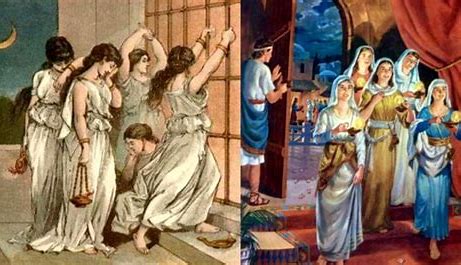
Last Sunday, churchgoers throughout the land heard the parable of the ten virgins, or bridesmaids as they say in today’s lingo. The seven-day wedding feast in ancient times couldn’t begin until the bridegroom arrived. In the story, five wise bridesmaids had working oil lamps when the groom arrived late at night, and they all entered the gate to the feast. The other five foolish bridesmaids were out buying lamp oil and got locked out of the party. In previous preachings, I’d heard Jesus’ explanation of his parable is that we must always be ready, have our lamps lit, awaiting his coming (or was it his second coming?). No wonder I’ve been a nervous wreck my whole life, constantly failing to be ready for Jesus. I really hate parables. 

The church’s new pastor spun the story as a lesson in patience. Be patient because we never know when God will present a reason to throw a party. I had to listen again to him on YouTube because I swear I heard that ominous “Jesus is coming” sermon. This is one of the blessings and curses of old age. My brain holds years-old information, which is a blessing. But that information is a curse when it doesn’t make room for new ideas.

Like with those wily parables.

Lessons Learned: God

Lessons Learned: God

First Grade—Third Grade

God is a white man with a white beard and white flowing hair, sometimes holding white stone tablets, later to be revealed as the Ten Commandments. Then He has a son, Jesus, and simultaneously is Jesus. Jesus’ mother, Mary, and God aren’t married. Then God becomes a ghost, the Holy Ghost. Then He’s all three. Three persons in one God.

All people who were ever born are sinners who can never redeem themselves. But God gives Jesus to Catholics for salvation from their sins. Only Catholics have access to Jesus. They go to heaven when they die, thanks to Jesus dying on the cross for their sins. Everyone else goes to hell.

Lesson: Everyone is bad and God only likes Catholics.

Fourth Grade—Sixth Grade

God created Adam and Eve in His likeness and placed them in Paradise, a tropical garden with no predators or stinging bugs, and all the animals, flowers, and fruit in the world. God forbade them to eat apples from the Tree of Knowledge, but they wanted to be like God, to have His knowledge, so they ate the apples. He got mad and threw them out of Paradise. They had to fend for themselves—grow their food, make their clothes, and pay attention to God.

Adam and Eve had two sons, Cain and Abel. God seemed to like Abel better. Cain got jealous and killed Abel. God punished Cain by throwing him out of his hometown into the desert.

Lesson: Avoid God.

Seventh Grade—Eighth Grade

Jews and Romans alike feared Jesus for riling up the citizenry against their oppressive power structures. The Roman king of Jerusalem sentenced Jesus to a brutal crucifixion. Even though He was a Jew, the Jews didn’t come to his defense.

When Jesus’ followers went to the tomb to see His dead body, Jesus was gone. God resurrected Jesus, body, and soul to live forever. This is what happens to Catholics. They live forever. In Paradise.

“Tiger, Tiger, Burning bright, 
In the forests of the night,
What immortal hand or eye
Could frame thy fearful symmetry.”

Lesson: I want to be a nun.

Ninth Grade

Using my leaky Esterbrook fountain pen,  I write “How can God make evil” in the margin of my English literature textbook next to William Blake’s first stanza of “The Tiger”.  

Lesson: God is confusing.

Teenage—Twenties 

I look for the heavenly in alcohol, drugs, and men. I see God. Then I don’t. 

Lesson: There is no God.

Thirties—Sixties

There is a Higher Power. Maybe God. Maybe Jesus. Maybe the Holy Spirit. Maybe Buddha. Not a Catholic. Not even a Christian.

Lesson: Keep looking.

Seventh Decade

Casting off the lifelong mantle of sinner; I’m finally hip to the knowledge no one is born bad. God does not create evil and Jesus didn’t die to save me—God doesn’t need atonement from me or Jesus. There’s no heaven. No hell. Resurrection may be so. At the end, perhaps time and space will simply let go of me and I’ll wander an endless field of puppies, aka, Paradise.

Lesson: I’m OK. 

Me and Jeremiah

Me and Jeremiah

Anti-abortion evangelical Christians use the scriptural, “The Call of Jeremiah” to defend their idea of fetal viability at conception. It goes something like this:

“Before I formed you in the womb I knew you…”

Frankly, those words take my breath away. I believe in a higher power most days and simple words like those give life to the marrow of my dry old bones. I can feel their power shimmy up and down my spine. My life has meaning if for just one moment of each day I know that spirit, that entity, whom I sometimes call God, has known my name since the beginning of time. 

Nothing in those words equates to the government denying women (and men) the right to choose when they wish to become parents. 

Christian mystic Richard Rohr teaches “The marvelous anthology of books and letters called the Bible is all for the sake of astonishment—not “proof” or certainty!” He says we don’t read for information but for transformation.

I’m not meant to get explanations from scriptures on how to support my point of view. I’m meant to be astonished. On more days than not, I accept the mystery and power of that astonishment without explanation, without questions, without answers. On some days, like when my body needs medical attention, I dig for certainty and absolutes, even demand them. I throw the spirit of mystery out the window and root around in the soil of black-and-white thinking.

Every week this summer I wake up feeling like Supreme Courts-federal and state—are bludgeoning me with a baseball bat. Their traditionalist interpretation of the Constitution coincides with literal  interpretations of the Bible. Prayer in the schools. Public funding of religious education. Dismantling the administrative state of consumer & climate change protections. The license to freely carry any weapons anywhere. Denying reproductive freedom. These and other contrivances are biblically-based ideas embraced by 41% of Americans who believe Jesus will descend on Earth in the flesh by 2050. Yeah. Really.

Christian zealots in every age have found signs that we are in the end-times as described in the Book of Revelation. In my twenties I belonged to a cult that looked for modern signs of the Apocalypse. We were convinced the arrival of branch banking and credit cards signaled the end was near. Globalism was then, as now, a sign. If we had today’s Supreme Court, they’d take up consideration of banning those. The World Council of Churches constituted a fulfillment of the end-times prophecy of a one-world religion. Ecumenism was shunned since it relegated Christianity an equal to other religions. I escaped that cult with a staggering amount of information that took years to dump. 

Now comes word  about how excited the 41% religious warriors are about the war in Ukraine—another fulfillment of the prophecy of the second coming of Christ. 

I know. I know. Who would believe such wacky stuff?

But is it such a leap from my belief that my existence was known eons before I was born? 

Seeing Jesus

In 1949 the Soviet Union started the Cold War by detonating its first atomic bomb, blockading Berlin, and pushing its way into Poland and Eastern Europe. The voices I heard swirling above my head at cocktail hour in our Washington home implied the Russians were coming for us. Everyone acted like this was the worst thing that could ever happen. 

Air raid drills were concocted by the federal government through the National Civil Defense Administration to protect people from incoming A-bombs. Common folk-wisdom said only cockroaches would survive a nuclear attack. Nevertheless teachers were required to conduct impromptu air raid drills. They shouted, Drop!—a signal for us to jump out of our seats, crawl under our desks, fall over our knees and cover our heads. The nuns added the instruction to recite Hail Marys aloud while on the floor. 

Holy Mary, Mother of God, pray for us sinners, now and at the hour of our death. Amen.

At seven, I didn’t understand the difference between a drill and the real event. I went to my death every time I huddled under that desk. I feared the A-Bomb was the worst thing that could ever happen. But, I was not. afraid. to die. 

This is it, I’d pray. This is the day I’m going to see Jesus.

I believed Mother Mary would grab me in her arms like she did baby Jesus and take me to heaven. Why did we practice to avoid such ecstasy? 

By the time third grade rolled around, I got used to not dying under the desk. Images of children who lived after their exposure to the atomic bombs in Hiroshima and Nagasaki appeared on our small black and white television. I saw that there were worse things than death. 

Our Catholic school teachers taught that Communists who ruled Mother Russia prohibited the celebration of  the Mass. The clergy declared this was the worst thing that could ever happen. We prayed for Catholic Russia.

At home, my two sisters and I made our own breakfasts and school lunches because my mother’s alcohol intake rendered her unconscious in the mornings. We often gathered around her bed trying to figure out if she was alive. Holy Mary, Mother of God. One of us would place a finger under her nostrils to feel her breath until, with one exhale, she’d confirm that the worst that could’ve happen, hadn’t—and we’d be off to knock on neighbors’ doors scrounging rides to school. 

Those early almost-worst-that-could-happen memories have inoculated me against the mau-mauing of present-day alarmists, naysayers and fear-mongers who sermonize about the death of our democracy. Yeah-but’ers and tsk-tsk’ers want us to heed their cynical creed that our country is hopelessly overrun with insurrectionists, sexual predators, corrupt politicians and gun-toting scofflaws.

And what if these are apocalyptic times? So what? So were the 1950’s. I’ve been here before. 

Mother Mary may be out of commission these days, but I still dream of seeing Jesus.

Shutdown Week 8: What Would Agnes do?

What would Agnes do (WWAD) during the coronavirus pandemic? Agnes had an uneasy way of placing wedge occurrences in her life, like being married, onto the long arc of outputhistory. Her pastimes, smoking and drinking, fit nicely into an imaginative destiny all her own. She believed she was meant to smoke, meant to drink, that they were a sign of the times and not to be missed because of some pollyannaish medical or social admonition about motherhood. Nothing would have stood in the way of her scotch, beer and Marlboros. She was destined to have them.

Along side the subliminal moral compass WWJD (What Would Jesus Do), I act and react from a Pavlovian response to my mother’s teaching, character and personality. WWJD helped replace a lot of the bad stuff with certain social mores, like not stealing and staying sober. Stealing and drinking came so naturally to Agnes that by the time it occurred to me my mother might be setting a bad WWAD example, she’d already shut the door on self-reckoning. And I had to suffer through reckoning of my own.

She would have loved being in the midst of a pandemic, entering the shutdown as if it were a fun house full of reasons to drink jumping out at every turn. If I had said we must social distance ourselves, she would have said, “Don’t be ridiculous. You don’t know what you’re talking about.” No earthly situation of hers held destiny captive. She would have known the virus and all that went with it were temporary disruptions to help justify consuming more alcohol, smoking more cigarettes.

It’s not that Agnes was a rule-breaker. It’s that the rules didn’t apply to her in the first place. She would not have adhered to mask wearing, six-foot distancing and certainly not staying in her lane at the grocery store. She would have swallowed up the news, argued over every tidbit, insisting she was right and driven everyone in the house to their corners.

Medical appointments cancelled? School conferences shut down? What a relief! Except for clothes shopping, motherly obligations drove her nuts. Curling up on the couch with her beer, cigarettes, a mystery novel or the New Yorker were her destiny. She raged against anyone who tried interrupting her routine or attempted to rearrange her destined spot in the universe. Being told to stay home would have been the only rule she’d have upheld and savored.

WWAD hasn’t left me completely. Cozying up to the couch reading mysteries and the New Yorker is fine with me for as long as it takes. I love her for that hard-wired legacy.

But thank God I’ve ditched the booze and the cigarettes.

Believe in the Devil

Believe in the Devil

In my twenties I accepted Jesus Christ as my personal savior in order to belong to the bible fellowship I had been attending with my friends. I “became” (as if that were possible) a born-again Christian just before Jimmy Carter, also a born-again Christian, announced his candidacy for President. 

I volunteered every spare moment for Carter’s campaign, a Democrat who proclaimed himself a sinner, saved by Jesus, just like me. After he was elected, some men and women in my small community bible fellowship preached that Carter was a tool of the devil, because he promoted sex education and family planning in public schools (today’s purity tests are abortion and gay rights). I had naively become part of a Christian sub-culture that wanted no government interference in family matters. These Christians yoked Carter’s actions to his character and denounced the whole man as the anti-christ. That’s what evangelical Christians did then.

What Evangelical Christians do now is the exact opposite. Those who support Donald Trump have an ends-justify-the-means theology. As long as abortion is outlawed and gay rights are quashed, the means to get there (coercing Ukraine to dig up dirt on his potential political opponent) are not only ok, but justified, even applauded. Donald Trump’s interior life is not considered important or relevant, nor is the outward display of his character. They worship the end product.

In his book, Prayers of the Cosmos, Neil Douglas-Klotz notes that Aramaic, the language of Jesus “…does not draw sharp lines between means and ends, or between inner quality and outer action.”  There are no words in this ancient language for an ends-justify-the means psychology: a person with unrepentant character defects is so unlikely to perform noble deeds that it cannot even be talked about. Logic follows that a person who provides immoral leadership is likely to be of ignoble character.

A guy named Josemaria Escriva de Balaguer established an ultra-conservative, ultra-secret Catholic lay organization in 1928, Opus Dei. Followers learn to abandon their principles, that the ends always justify the means. They believe Trump was chosen by God to protect the unborn fetus and restore Judeo-Christian moral order. Trump’s Attorney General, Bill Barr is Opus Dei (as are other Trump appointees). Doesn’t this explain a lot?

I left that Christian cult years ago. However, I understand, even admire, their members’ rejection of Jimmy Carter because they considered his views on sex education immoral. I disagreed with their opinions but I too measured his character by words and deeds and came to a different conclusion. Perhaps this ancient Aramaic Jesus language trickles into a collective consciousness enabling some to see inner qualities and outer actions as one big squishy blob and accept or reject that whole person.Untitled 2.png

I keep asking myself what’s wrong with those Evangelical Christian (and conservative Catholic) Trump supporters. Don’t they care that his morally corrupt outsides match his morally incontinent insides? Their religious fervor veils their eyes to the hypocrisy Jesus condemned. They justify the deeds of their beloved lawbreaking reprobate. Have their souls separated from their minds? Or as Rev. William Barber has said, “After this year (with Trump) if you don’t believe in the devil there’s somethin wrong with your fuckin mind.” 

Family In Three Parts: Skateboarding, Abortion and Jesus

Family In Three Parts: Skateboarding, Abortion and Jesus

 Part 1 Skateboarding

In high school a new boy arrived at the Jersey Shore from California with a skateboard. Someone made them for all of us using old roller skates and plywood. We skateboarded Skateboarding in New York City, 1960s (19)downhill in forbidden cemeteries until dark. It was the 1960s. Skateboards were outlawed, not because they were dangerous but because they were unknown, not a part of the mainstream and somehow subversive. We hid them in car trunks and behind
old tires in the garage. None of us had standard-issue parents so we formed our own family. Our family stuck together, laughed a lot and listened to each other. The police chased us out of the graveyards, creating a deeper bond of secrecy and protection. We vowed to call each other, not our parents, if we ended up in the police station. Later on, one did, with a bale of marijuana. He didn’t call. He went to jail. Another drank too many beers, drove himself  into a telephone pole and died.

Part 2  Abortion

I thought I should have an abortion. The boy I loved said I had to decide on my own. If I kept the baby we’d marry. If not, he’d never be able to see me again. How could a 20-year-old college student know that? He had more confidence than I, seemed less emotional, but had the same love for beer and the beach and rock & roll. She wasn’t hard to find, this illegal woman in Newark, NJ. When you reached a certain age in the ‘60s, everybody knew someone who knew someone. I drove alone.The three-story house had a small front porch. I climbed the wooden stairs, knocked on the rattling screen door. She answered and asked my name. Nothing came into my mind. Nothing came out of my mouth. She suggested I come back when I’m ready, but “don’t wait too long.” I drove to the boy and we started a family.

Part 3  Jesus

The poet pastor wandered around church saying hello to people with his Shrek voice, usually on his way to and from the courtyard. Sneaking cigarettes. I saw him frequently at the bar in a neighborhood restaurant. Sneaking scotch. As a former drinker and smoker myself, I had th-2a familial attachment to him. When a spiritual crisis befell me, I found him outside, lurking among the Gothic arches of the colonnade. I told him I have  something serious to discuss.  

“Sure, how ‘bout this afternoon?”

Tears got in the way of explaining myself any further until later, in his office. 

“I don’t believe in the Resurrection anymore,” I confessed.  

“Huh? Most people don’t even think about this stuff, Rrregan,” he confessed.  

“Do I have to believe in the bodily resurrection of Jesus to be a Christian?” I asked.  

“Well, it’s the main tenet of our faith,” I thought he exclaimed, but he probably just said.  

“What should I do?” I asked.

“Wait it out!” He definitely exclaimed.

“You will always be in the church family no matter what you believe. Just. Wait. It. Out.”