Chicagoans: People of the Water

FeaturedChicagoans: People of the Water

Chicago is a water town. Lake Michigan and the sky above are our watermarks, the invisible identifier embedded in the soul of anyone who lives here for more than a year, or so. We are built around the lakeshore, the river banks, the canals, the bridges. Oh those bridges! For the next two to three years, three downtown bridges over the Chicago River are closed for repair. I know the river. I know those bridges. Whenever I’m a passenger in a car headed toward the Chicago River, I, a non-driver, turn into a navigational virtuoso.

“Turn left on La Salle Street! Now! Go to Jackson and make a right. Yes, Jackson.”

I’m insufferable. And always right.

Once you’ve lived anywhere in Chicago with even the thinnest view of the lake or the river, you can never go back, never not have water in your sights. Magical is an inadequate adjective. It’s cellular. What must it have been like for those who settled this land we call Chicago? Did a wild black and blue sky moving over Lake Michigan shout danger to our native ancestors? On windy days, did the lake and river together kick up such a fuss that the confluence was unnavigable? Were their beliefs tied to a cellular connection between the water, the land, the ancestors? Dare we imagine that those first peoples inseminated future generations, yes us, with a cellular connection to the water? 

My favorite visitors are those whose excitement about the Chicago Harbor Lock exceeds mine. The Lock is at the confluence of the Chicago River and Lake Michigan. It is part of multiple locks and dams that allow water from Lake Michigan to flow inland, toward the mighty Mississippi. Chicago devised reversing the flow of the river in the 1900s to send our sewage downstream, away from our beloved lake. Lucky for us. Unlucky for St. Louis. 

Boats and cargo ships moving from the river to the lake first enter the lock and tie up. Like a water elevator, the water raises or lowers to meet the level of the lake. I’ve been on tourist boats waiting in line on either side for tankers and cargo boats to get through the Lock. Thousands of Chicagoans live in high-rises with floor to ceiling windows where they can pull up their work desk and chair and watch the Lock all day long as they work from home. What a great city. This water town.

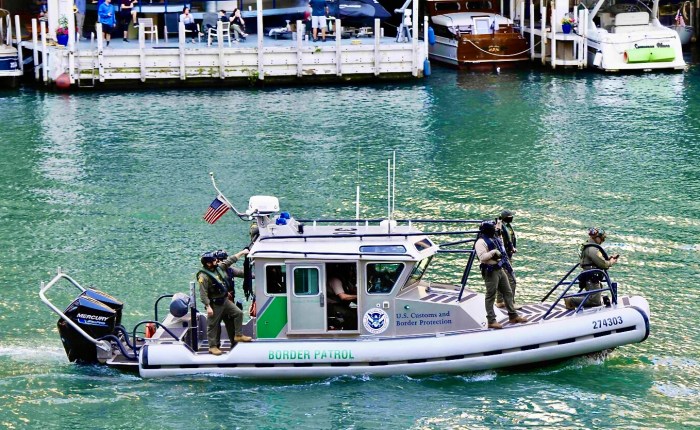
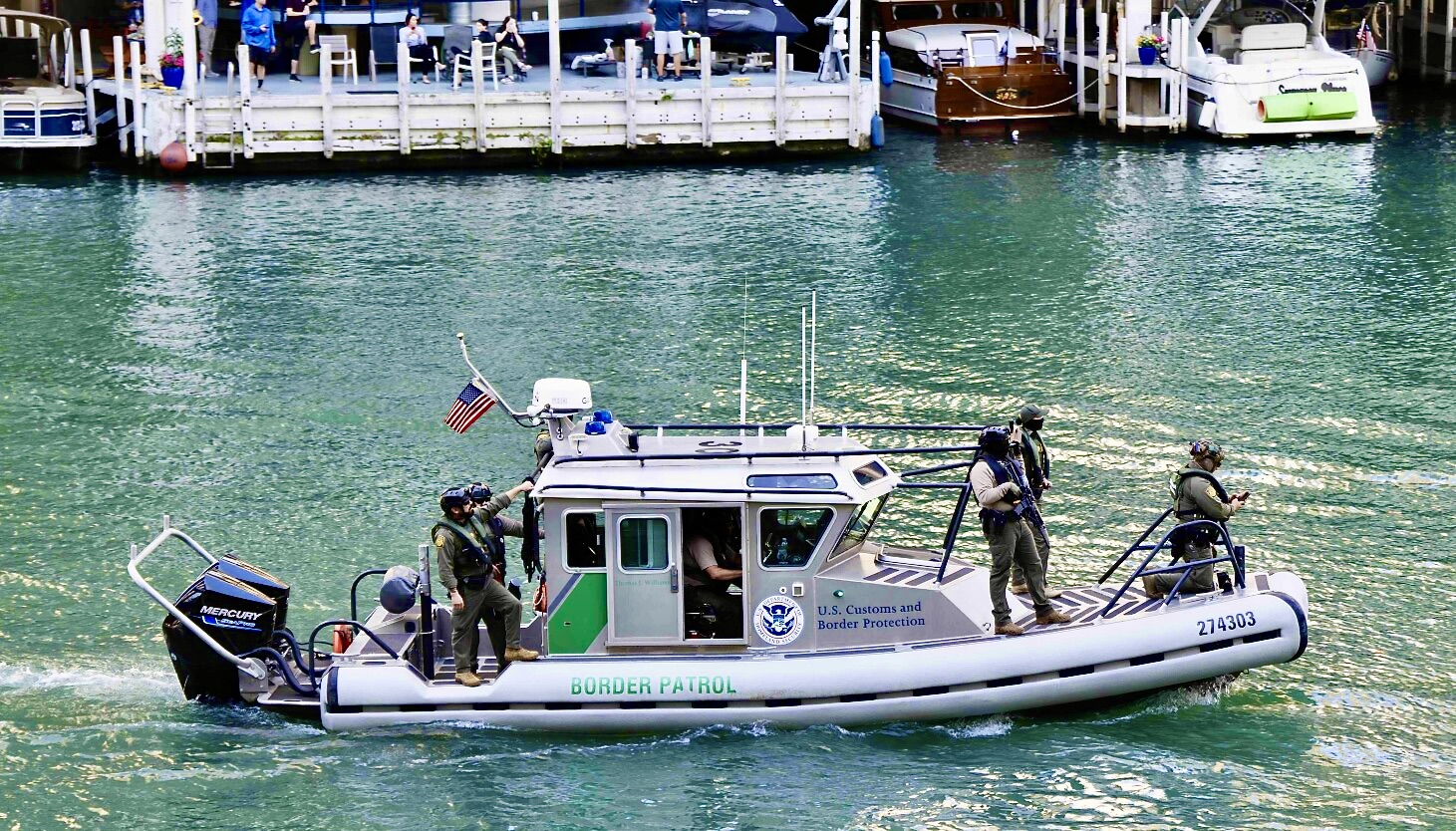
In mid-September, Customs and Border Patrol (CBP) agents were dispatched to Chicago as part of the Trump Administration’s ICE operation to arrest illegal immigrants with criminal records. They announced themselves by cruising up and down our cherished Chicago River, in and out of tour boats and kayaks. Some were masked. All were uniformed. All were armed with semi-automatic long guns. How did such an invasion get through the Lock?

Since that absurd melodramatic entrance into our city, the CBP has cruised into neighborhoods in military vehicles, springing into action to terrorize Chicagoans, citizens and non-citizens. 
Chicago responded with multiple layers of volunteer rapid response teams covering every scenario of civic and private life. New and old activists carry whistles to alert neighbors of CPD/ICE presence on our streets. Neighborhood school patrols walk children to school.

The Customs and Border Patrol floated into Chicago with 250 agents. There’s reason to believe that number is reduced to 100 for the winter. One of their most horrific tools, tear gas, doesn’t work in cold weather. They’ve gone off to warmer climes for training — to figure out how to deal with the likes of Chicagoans. Reportedly they will be back a thousand fold in the spring.

Oh these blue-minded Chicagoans.

These people of the water.

Will be ready.
______________

“Yet once you’ve come to be part of this particular patch, you’ll never love another. Like loving a woman with a broken nose, you may well find lovelier lovelies. But never a lovely so real.”― Nelson Algren

Driven to Risks

Driven to Risks

In 1950s Wilmette, Illinois, children followed rules. Not many ten year olds would steal onto the public works property and play around on the Water Plant roof. The first taboo my sister and I broke was to gather stones and toss them from the roof into the sand below. Next, we dared each other to jump off the 1930s one-story building. The sand provided a warm soft landing and extracted plenty of triumphant giggles from two adventurous little girls.

The Wilmette Water Plant, built into a low cliff on the shores of Lake Michigan, is walled off by an eight-foot cast iron spiked fence. The street level roof sits back far enough from the shore road to avert curiosity. A 1956 building expansion required a construction entrance in the fence leaving the Water Works temporarily defenseless.

We waited until the workers left for the day and again and again sneaked onto the roof to throw ourselves off. Eventually my sister slacked off and I jumped alone. Each leap to the unknown helped transcend the uncertainty of our volatile home life. For years afterwards I dreamed I was flying. Indeed, when I took a lot of psychedelic drugs in my 20s, I relived those jumps. 

In winter, down the street from the Water Works on the same cliff system, the fire department hosed down a steep hill for sledding. Devil-may-care pre-snowboarders sailed down the icy slope standing on cardboard slabs. Eventually I tossed the cardboard and flew downhill toward Lake Michigan standing only on my brown rubber boots. Ambulances, always at the ready, carted off sledders everyday to Evanston Hospital. Never me.

I see no reason to examine why I’m driven to dangerous adventures. Risky jumps and high-flying sledding sparked a fire in me that can’t be extinguished. Perhaps those early escapades instilled self-confidence, or more likely, false invincibility. 

For a few years I spent all my expendable income on scuba diving in the Bahamas. After a short course in diving, and a few failed attempts, I jumped to the unknown once again and flippered around with the fish. I never once thought of the risks. And there are plenty. 

Scuba Diving in the Bahamas

One morning before I left the islands, I suited up and waited for the divemaster to outfit the boat. I casually mentioned to a fellow diver I was leaving that afternoon.

“Are you flying?” asked the divemaster.

Yes I was. 

“Hang up your wetsuit and get out of here! Don’t you know you’ll get the bends if you dive and fly the same day? Your insides could explode in the plane!”

On social media last week, many posts begrudged the efforts to rescue five wealthy souls lost in the Titan submarine. My risky adventures are over now, and were never so grand. But I join adventurers everywhere who cherish the U.S. Coast Guard’s salvation message:

“We don’t put a price on human life. Every person who is missing deserves to be found. That’s the mission, regardless of who you are.”

Heaven or Hell on Suicide Hill

Heaven or Hell on Suicide Hill

Willmette, Illinois 1950sth-4

The only non-Catholics I knew as a child were our babysitters. I always felt sorry for them knowing they were headed straight to hell when they died. In 1956 we rented a four bedroom tudor built into the cliff on Lake Michigan in Wilmette, Illinois, having moved from a month-long stay in a downtown Chicago hotel where we landed after our eviction from Clayton, Missouri. To the east, the view of the lake was obscured by an over-propagated evergreen garden leading a quarter mile down to a rusty wire gate that opened to the beach. My mother hired seventeen-year old twins to watch my sisters and me on the beach so she’d not have to dress for the day and be our lifeguard. And those twins came with boyfriends—who had boats. The teenagers taught me to waterski and by the end of the summer I had my feet sloshing around in the rubber boots of a slalom, skiing far out into the lake, so unmoored at the edge of the world that I often forgot to let go of the tow rope when we we came back to shore for the drop-off. None of them were Catholic and I silently mourned for their souls, asking God why He’d be sending them to hell when they obviously didn’t deserve it. After all, they had shown me where heaven is.

Sitting at the foot of my parents bed one day, I saw a television commercial for the opening of Old Orchard Shopping Center in the next town over.

“Where’s Skokie?” I asked my mother.

“That’s where all the Jews live,” she answered.

At 10 years old, I didn’t know there were Jews alive in the world. I wanted to ask my mother how Jews were living near us and not in Jerusalem where they lived at the time of Jesus. She detested answering my questions and would have accused me of stupidity, a criticism I already couldn’t stand, so I sat back and wondered if Skokie was, in fact, hell.

When winter arrived in Wilmette I could hardly contain myself. The only thing separating me from the sledding hill next door was a mammoth pile of snow huddled around evergreen growth and a chain link fence next to our house. All the girls and all the boys, all ages and all sizes came to slide down Suicide Hill. Firemen hosed it at least once a day turning soft snow into cold hard ice. Traditional sleds, too dangerous for the slippery terrain were cast off—piled up in a Flexible Flyer junkyard off to the side at the top of the mountain. Flat cardboard slabs were the most valuable commodity. I shredded straight down on the cardboard, sitting down at first, then up on my feet. Eventually we, the first snowboarders, traded our cardboard for our boots and slid downhill on our feet.

Girls and boys had equal status on Suicide Hill. There were no rules, no lifeguards, no snowguards no unofficial guards. We all raced down the slope expecting no prize, bumping each other off into snowpiles like soccer balls, soaring like heavenly rockets.  Winter stuck in our noses, but our fevered bodies rollicked in unfastened coats flapping in the wind. Medics and parents came to bandage limbs and scrapes. Ambulances carted broken bones off to Evanston Hospital. Exhaust smoke obscured our vision of cars double parked on Michigan Street where parents yelled Let’s Go!

And when the stars came out we went to No Man’s Land for hot chocolate where I eyed my non-competing competitors. We belonged together, heaven or hell.

First Impressions of Bill Clinton

In August 1991, twelve Democratic leaders and influencers, were seated in leather armchairs at a walnut oval table in a small dining room at one of downtown Chicago’s private clubs. I was the only woman. When Governor Bill Clinton entered the room, his th-2tall navy-suited body seemed to shift the atmosphere, moving the dust molecules away from him and clearing the air as he moved. He gave a hardy salutation and proceeded to introduce himself to each person while he circumnavigated the room, one-by-one. I was halfway around the table, and when he reached me I stood and looked up to his bemused rosy face, full of laugh lines. He had a big red nose, like Santa Claus. As I tried to introduce myself, he interrupted me by saying he knew who I was— the Executive Director of the state Democratic Party. He asked if I knew my name was the same as one of King Lear’s daughters. “Yes,” I said, “My name came from her.” He leaned over and whispered let’s keep that between us since she wasn’t such a great character. And just like that we had a best-buddies pact.
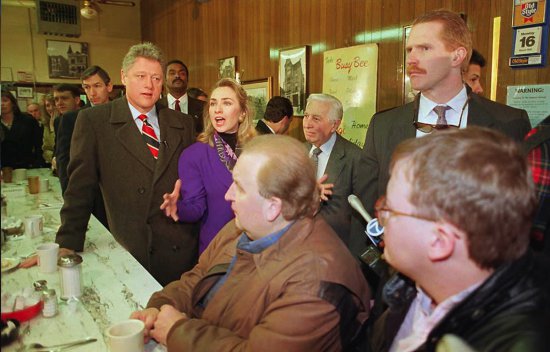
He finished working the room, told us why he was thinking of running for president, and asked us to support him. He never sat down.

A few weeks later, Bill and Hillary entered a crowded 2nd-floor meeting room in a Chicago hotel with about 50 curious political activists who gathered to meet them for the first time. He neither ushered her in ahead of him as a well-mannered (albeit chauvinistic) gentleman nor did he make her walk behind him as an ill-mannered boor. Democratic presidential candidate Bill Clinton (L)
Side-by-side they came to us. We all jumped to our feet and cheered before he even said hello, before he shook one hand. It was two months before he announced his candidacy for President. His nascent message stressing personal responsibility for welfare recipients echoed what I’d learned in Alcoholics Anonymous — to acknowledge that I am responsible for the choices I make in my own life. Later in his presidency I despised his welfare reform policy but for now this seemingly spiritual insight vaulted my commitment to a new height. This was my guy.

The first week in October, one of Clinton’s many Chicago friends asked me to join him in driving Bill Clinton to Midway Airport. We’d been at a 100-person meet-and-greet where Clinton learned I was moving to Little Rock to work on his campaign. He looked back at me in the car and asked what my boss said when I told him I was quitting my job. My boss hoped I’d change my mind, so I told Clinton he wasn’t happy.  Clinton picked up the car phone, called my boss, thanked him for letting me have this opportunity of a lifetime and said he was happy to have me on board. He ended the call by inviting my boss to bring his family down to the Governor’s mansion for a weekend. In the back seat I imagined throwing my arms around his neck and kissing the top of his ever-loving head.

I was in Little Rock by the end of the week.