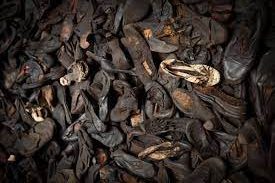
Jews

Jews

Jesus, my lifelong friend, accompanied me through chicken pox, mumps, and measles when quarantine isolated me from my sisters, parents, and friends. No, I didn’t have Mother Theresa-like visions. He was more of an imaginary friend for my waxing brain, like an animated Pooh Bear.  Clergy at St. Mary’s school in Terre Haute, Indiana, taught that Jesus was born in Bethlehem and died in Jerusalem. Due to those back-to-back pre-vaccine childhood illnesses, I heard these Jesus facts my second time around in the first grade. The teaching doubled down in my malleable brain, which had grown to ninety-five percent of its total capacity, normal for a six-year-old.

There was never any question that Jesus was born of Jewish parents. Israel, presented as a holy place, not a political state, was sacred ground because that’s where Jesus lived. There was always the implication that we, as Catholics, were in Jesus’s family, that somehow we had Jewish roots. If Jews believed in Jesus, they got to go to heaven, like us Catholics. But no other religion. Such was my Roman Catholic schooling.

Our single black-and-white family television transmitted few programs into our living room in the 1950s. Roy Rogers and I Love Lucy were allowed, but my parents insisted we watch the nightly news. My sisters and I didn’t dare whine for fear of verbal reprisals like, “Shut up and listen—maybe you’ll learn something.” 

They’d let us watch “This is Your Life,” a forerunner to PBS’ “Finding Your Roots’. In 1953, This is Your Life broadcasted the story of 32-year-old Hanna Bloch-Kohner, a Holocaust survivor. I wasn’t much interested in the not-so-famous Hanna, but I did wonder about the Holocaust.

When I was ten years old, as my brain power peaked, local TV stations advertised the opening of Old Orchard Shopping Center in Skokie, Illinois. We lived in Wilmette, on the border of Skokie.

“Where’s Skokie?” I asked my mother.

“That’s where all the Jews live.” She answered.

All my thoughts screeched to a halt. I’d never seen a Jew. I assumed that whatever Jews were leftover from the time of Jesus surely had died in that mysterious “Holocaust,” a word adults uttered in a hush. Of course, I couldn’t ask my mother what Jews were doing in Skokie. She expected me to know what she knew, no matter the subject. She would have ridiculed me with a sarcastic, “You’re kidding me. Don’t you watch the news?”

From that moment on, I looked for Jews in supermarkets, at the beach, in the record store, and even at school. It’s possible I looked for men who resembled Jesus. In high school, I met a Jewish brother and sister. I stared them into my spiritual family. I wondered how they got to New Jersey from Bethlehem or Jerusalem or Israel, those holy places whose ancient remnants had settled in my bones, with Jesus. 

My brain, now waning, has reformed itself through evidence, facts, and logic into knowing and loving the Jewish story. There may be evidence, and there may be facts, but there’s no logic to knowing Jesus. 

That’s still a belief. 
The Shoes

The Shoes

No one told us about the shoes.

Truth be told, we didn’t know much about the U.S. Holocaust Memorial Museum. My colleagues and I at the Department of Education were too busy. Busy with our new jobs. Busy in the heady Washington scene. After all, we were political appointees of newly-elected President Bill Clinton. 

The Secretary of Education, Richard Riley, revealed in a private moment that he thought his Deputy Secretary, Madeline Kunin, should have had his job. As a feminist, an immigrant, and a Jew she successfully ran for governor of rough-hewed Vermont three times. Like many survivors of the Holocaust, Kunin’s political courage developed in her core at an early age. She voluntarily lobbied for better education, health care and reproductive rights as a young stay-at-home mother. 

Like a hen with her clutch, she rounded up the staff at Education and arranged for a special tour for us of the Holocaust Museum before its grand opening in 1993. At first I thought she’d lead the group of Assistant Secretary level who’s-who’s. After all, Madeleine Kunin’s name is among those carved into the granite exterior of the Museum. But no, Deputy Secretary Kunin accompanied us staffers on the bus.

As a group, we were from all parts of the country. Some knew people from education circles. Some knew each other from the Clinton campaign. Our clucking enthusiasm escalated as we gathered in the Hall of Witness.The Museum staff beamed. We, their initial visitors, crowed about our staggering first-look. The architecture appeared contradictory: industrial and elegant, light and shadow, wide and narrow. Initially the exhibits were background to our huddled getting-to-know-you conversations rather than observations of incomprehensible evil. We skimmed family narratives, peered into replicas of boxcars and camp barracks, listened to eyewitness recordings.

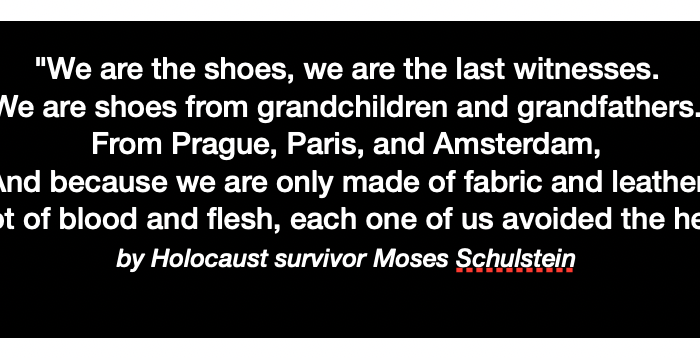
At some point the way narrows, and Museum visitors have no choice but to crowd into a shadowy passageway. It’s meant to replicate the cramped trains and camps. Then all at once our eyes adjusted to a large dark room illuminated by several downlights drawing attention to the floor.  Shoes. A field of shoes. Men’s leather wingtips, women’s pumps, children’s oxfords are all piled up in an erratic display of magnificent personal remembrances. My stomach cramped. And then I saw them. Baby shoes. Tiny Mary Jane’s like I used to wear.

It wasn’t imagination that told me what happened to that child. The proof was all around me: the photos, the documentation, the accounts of survivors. The shoes told the story. The Jews wore their best apparel in the forced-leaving, believing they were being transported to a better place to live, not a place of torture, starvation and extermination. 

Shoes confiscated from prisoners at Majdanek, Poland Concentration Camp (photo: US Holocaust Memorial Museum). 60,000 Jews were exterminated at Majdanek between October 1, 1941 and July 22, 1944

I hung onto the railing and wept.

Sixteen years later two of my grandchildren, ages ten and twelve, and I traveled to Barack Obama’s Inauguration from our hometown Chicago. At a visit to the Holocaust Museum they followed the life of a brother and sister in a special children’s exhibit. When we got to the shoes, they whispered.

“Are those hers?”

“Are those his?” 

People Say They Did the Best They Could

What My Parents Believed

No One Ever Said We Were Democrats. Neither of my parents campaigned nor wore political buttons nor wrote thoughtful letters to politicians. They were Catholics, went to Catholic schools, Catholic colleges, married in the Catholic church. They took on the mantle of Irish Catholicism as if it were a physical birthmark, a once-a-Catholic-always-a-Catholic mental tattoo unaccompanied by belief in God or Jesus. They took advantage of the culture of the sacraments— Holy Communion, Marriage, Baptism—to display how beautiful we all were in our expensive clothes, polished shoes, fashionable hair styles.

They argued. About money mostly. And other women, other men. They agreed on important things. Pope Pius XII was a backwater imbecile for invoking papal infallibility in 1950 when he proclaimed all Catholics must believe Mary didn’t suffer physical death and was assumed into heaven. This new doctrine, along with the Pope’s insisting the Church of Rome stay neutral during the Holocaust, put a stake in their religiousity.

They hated right-wing bullies like Senator Joseph McCarthy and J. Edgar Hoover. McCarthy was a reckless demagogue who ruined lives with public witch hunts and unsubstantiated accusations against communist sympathizers. FBI Director Hoover amassed power by steering favorable press and policy his way using his secret files to blackmail Congress and Presidents alike. Throughout their lives my parents derided the Red Cross for raising money for war-time troops then charging soldiers and sailors for their so-called giveaways like toothpaste, coffee and donuts. My mother eagerly showed how smart she was in these matters. After all, my parents attended college in the nation’s capitol in the years leading up to World War II. She gossiped about under-informed conversationalists, “What do you expect, they don’t even read the New York Times.”

During the war, they lived in housing provided by the Navy in Key West. With no children to mind, they spent evenings in the Officer’s Club chattering about the day’s news, forming opinions and cooling off with rum smuggled in from Cuba. The men were Navy pilots and Naval intelligence officers. Some worked in the newly-formed CIA. Anyone who didn’t drink was not to be trusted. They never went to a restaurant, nor any gathering, party, picnic, or church function unless they knew alcohol would be served.

Any friend or relative who stopped drinking was derided as a reformed drinker, as if that were a dirty word. My father eventually stopped drinking and went to Alcoholics Anonymous, but he still steered clear of social events and restaurants where there was no alcohol. With all their strong opinions about religion and politics, the foundational belief of my parents was that life without alcohol was as unsophisticated and tasteless as a Greek diner.

My father, divorced from my mother, helped me get sober in 1979. When I told my family I was in AA, my older sister, glass of wine in hand, said, “Well. Just because you’re an alcoholic, doesn’t mean everyone is.”