Is Scott Galloway out of Touch?

FeaturedIs Scott Galloway out of Touch?

For the first time in my life, I attended a Sunday service at a Unitarian Universalist Church, to see Chicago’s mayor, Brandon Johnson, in dialog with the pastor. I was curious to hear what this progressive Black mayor had to say to a progressive Northside (White) church.

The pastor began the service with an announcement.

“The Unitarian Universalist Church was established by and for people who do not believe in hell.”

“Whaat?” I was so startled I hardly heard the rest of the preamble. I don’t believe in hell. No one I know believes in hell. But I’ve never heard nor would I ever expect to hear such good news from any church pulpit. 

But wait, there’s more good news! The “UU’s” reject original sin, believe in a God who loves and redeems all human beings, and trains congregants in social justice work. These are my beliefs too.

The bias I’ve had against the Unitarian Universalist Church stems from old thinking that Unitarianism is a heretical religion because they don’t display a cross. Where did I get that crap? Since I’ve been attending a Presbyterian Church for over 45 years, it must have slipped into my head when I was half asleep some Sunday morning. 

Speaking of old ideas, on Friday, December 5, podcaster Scott Galloway responded to a young man who asked:

“How do I get more involved in politics?”

Galloway said “… because young people don’t vote, old people keep voting themselves more money, right? $40 billion child tax credit gets ripped out of the infrastructure bill, but the $120 billion cost of living adjustment for Social Security flies right through.

…our old people have figured out a way to vote themselves more money, and the fact that people under the age of 18 don’t vote, the budget reflects values, and our values are that we don’t really love our children.”*

This is a typical Scott Galloway motivator: money. He will happily reveal how much he’s worth and how he manipulated the modern system to get there. But his statement pitting the young against the old using the antiquated idea that we old citizens are sapping federal dollars from the young shows a decided lack of sophistication and reality. 

First of all, we want young people to succeed. We were young Pete Buttigieg’s biggest voting bloc, long before he announced his Gray New Deal in Iowa 2020. We vote for SNAP and child tax credits. We volunteer at food kitchens, tutor at public schools, babysit our grandchildren and are worried about ours, yours and future generations.

Secondly, we pay. We will pay the government $202.90 a month in 2026 for Medicare Part B, which covers doctor’s visits. That’s a 9.7 percent increase from 2025. We count on the Social Security Cost of Living Adjustment (COLA) to offset that Medicare increase. But in 2026, the Social Security COLA is only a 2.8 percent increase, posing a hardship for Social Security recipients who live check to check in this era of (non) affordability.

Third, don’t we all know that the way young people get involved in politics is to volunteer? What? Is that just a Chicago thing?

After 40 years, curiosity brought me, 79 years old, to an unexpected new idea about the Unitarian Universalist Church. 

Let’s hope Scott Galloway, 61years old, becomes curious enough to come to a new idea about how the real world works.

______________

You can find Scott Galloway’s email address here:

*The Prof G Pod with Scott Galloway: How to Get Involved in Politics, How Scott Galloway Writes, and How He Follows the News, Dec 5, 2025https://podcasts.apple.com/us/podcast/how-to-get-involved-in-politics-how-scott-galloway/id1498802610?i=1000739823645&r=196.38 This material may be protected by copyright.


Lessons Learned: God

Lessons Learned: God

First Grade—Third Grade

God is a white man with a white beard and white flowing hair, sometimes holding white stone tablets, later to be revealed as the Ten Commandments. Then He has a son, Jesus, and simultaneously is Jesus. Jesus’ mother, Mary, and God aren’t married. Then God becomes a ghost, the Holy Ghost. Then He’s all three. Three persons in one God.

All people who were ever born are sinners who can never redeem themselves. But God gives Jesus to Catholics for salvation from their sins. Only Catholics have access to Jesus. They go to heaven when they die, thanks to Jesus dying on the cross for their sins. Everyone else goes to hell.

Lesson: Everyone is bad and God only likes Catholics.

Fourth Grade—Sixth Grade

God created Adam and Eve in His likeness and placed them in Paradise, a tropical garden with no predators or stinging bugs, and all the animals, flowers, and fruit in the world. God forbade them to eat apples from the Tree of Knowledge, but they wanted to be like God, to have His knowledge, so they ate the apples. He got mad and threw them out of Paradise. They had to fend for themselves—grow their food, make their clothes, and pay attention to God.

Adam and Eve had two sons, Cain and Abel. God seemed to like Abel better. Cain got jealous and killed Abel. God punished Cain by throwing him out of his hometown into the desert.

Lesson: Avoid God.

Seventh Grade—Eighth Grade

Jews and Romans alike feared Jesus for riling up the citizenry against their oppressive power structures. The Roman king of Jerusalem sentenced Jesus to a brutal crucifixion. Even though He was a Jew, the Jews didn’t come to his defense.

When Jesus’ followers went to the tomb to see His dead body, Jesus was gone. God resurrected Jesus, body, and soul to live forever. This is what happens to Catholics. They live forever. In Paradise.

“Tiger, Tiger, Burning bright, 
In the forests of the night,
What immortal hand or eye
Could frame thy fearful symmetry.”

Lesson: I want to be a nun.

Ninth Grade

Using my leaky Esterbrook fountain pen,  I write “How can God make evil” in the margin of my English literature textbook next to William Blake’s first stanza of “The Tiger”.  

Lesson: God is confusing.

Teenage—Twenties 

I look for the heavenly in alcohol, drugs, and men. I see God. Then I don’t. 

Lesson: There is no God.

Thirties—Sixties

There is a Higher Power. Maybe God. Maybe Jesus. Maybe the Holy Spirit. Maybe Buddha. Not a Catholic. Not even a Christian.

Lesson: Keep looking.

Seventh Decade

Casting off the lifelong mantle of sinner; I’m finally hip to the knowledge no one is born bad. God does not create evil and Jesus didn’t die to save me—God doesn’t need atonement from me or Jesus. There’s no heaven. No hell. Resurrection may be so. At the end, perhaps time and space will simply let go of me and I’ll wander an endless field of puppies, aka, Paradise.

Lesson: I’m OK. 

Heaven or Hell on Suicide Hill

Heaven or Hell on Suicide Hill

Willmette, Illinois 1950sth-4

The only non-Catholics I knew as a child were our babysitters. I always felt sorry for them knowing they were headed straight to hell when they died. In 1956 we rented a four bedroom tudor built into the cliff on Lake Michigan in Wilmette, Illinois, having moved from a month-long stay in a downtown Chicago hotel where we landed after our eviction from Clayton, Missouri. To the east, the view of the lake was obscured by an over-propagated evergreen garden leading a quarter mile down to a rusty wire gate that opened to the beach. My mother hired seventeen-year old twins to watch my sisters and me on the beach so she’d not have to dress for the day and be our lifeguard. And those twins came with boyfriends—who had boats. The teenagers taught me to waterski and by the end of the summer I had my feet sloshing around in the rubber boots of a slalom, skiing far out into the lake, so unmoored at the edge of the world that I often forgot to let go of the tow rope when we we came back to shore for the drop-off. None of them were Catholic and I silently mourned for their souls, asking God why He’d be sending them to hell when they obviously didn’t deserve it. After all, they had shown me where heaven is.

Sitting at the foot of my parents bed one day, I saw a television commercial for the opening of Old Orchard Shopping Center in the next town over.

“Where’s Skokie?” I asked my mother.

“That’s where all the Jews live,” she answered.

At 10 years old, I didn’t know there were Jews alive in the world. I wanted to ask my mother how Jews were living near us and not in Jerusalem where they lived at the time of Jesus. She detested answering my questions and would have accused me of stupidity, a criticism I already couldn’t stand, so I sat back and wondered if Skokie was, in fact, hell.

When winter arrived in Wilmette I could hardly contain myself. The only thing separating me from the sledding hill next door was a mammoth pile of snow huddled around evergreen growth and a chain link fence next to our house. All the girls and all the boys, all ages and all sizes came to slide down Suicide Hill. Firemen hosed it at least once a day turning soft snow into cold hard ice. Traditional sleds, too dangerous for the slippery terrain were cast off—piled up in a Flexible Flyer junkyard off to the side at the top of the mountain. Flat cardboard slabs were the most valuable commodity. I shredded straight down on the cardboard, sitting down at first, then up on my feet. Eventually we, the first snowboarders, traded our cardboard for our boots and slid downhill on our feet.

Girls and boys had equal status on Suicide Hill. There were no rules, no lifeguards, no snowguards no unofficial guards. We all raced down the slope expecting no prize, bumping each other off into snowpiles like soccer balls, soaring like heavenly rockets.  Winter stuck in our noses, but our fevered bodies rollicked in unfastened coats flapping in the wind. Medics and parents came to bandage limbs and scrapes. Ambulances carted broken bones off to Evanston Hospital. Exhaust smoke obscured our vision of cars double parked on Michigan Street where parents yelled Let’s Go!

And when the stars came out we went to No Man’s Land for hot chocolate where I eyed my non-competing competitors. We belonged together, heaven or hell.

The Big Lie: Catholic Hell

The Big Lie: Catholic Hell

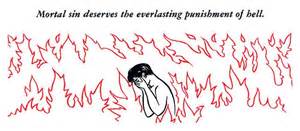
In every one of the thirteen grade schools I attended in the 1950’s, Catholic nuns taught me about Heaven and Hell, including the nugget that Heaven was only for Catholics, but there was no guarantee I’d go there. From the age of six I knew if I, as a Catholic, died with a “mortal” sin on my soul, I’d go to Hell, or perhaps Purgatory, the halfway house to Heaven.

This teaching dwelled in the official Catholic textbook for American children used from 1885 to the late 1960s, the Baltimore Catechism. Theth-2 Catholic Church denied that physical Heaven, Hell and Purgatory are part of Church doctrine, long before the Pope declared in 1999 that heaven and hell were “primarily eternal states of consciousness more than geographical places of later reward and punishment”. But that turnaround came after these medieval lies were grafted onto sapling children like me.

The only non-Catholics I knew as a child were our babysitters. I always felt sorry for them because they were headed straight to Hell when they died. In 1957 when I saw a TV ad for Old Orchard Shopping Center, I asked my mother, “where’s Skokie?” “That’s where all the Jews live,” she answered. At 11 years old, I didn’t know there were Jews alive in the world. I thought they were all burning in Hell.

I’ve come to believe that my own personal heaven and hell do exist. I visit hell whenever I relive the last time I got sober forty years ago, or when I regret insensitive words I spoke five minutes ago. And heaven appears when my 10-year-old grandson texts me photos of his lizard.

At the suggestion of my fellow seeker Terry, I crammed into the O’Hare Hilton with 1,000 other souls one weekend in 2012 for a retreat, “Transforming the World through Meditation” with Franciscan Richard Rohr and Benedictine Laurence Freeman, two men I’d never heard of. I had started meditating a few months prior in a Buddhist group and asked Terry if she knew any Christian meditation groups.

In addressing heaven and hell, Rohr said the ego prefers winners and losers. He offhandedly mused that if Jesus descended into hell, as it says in Church doctrine, than there is no more hell because, ”Hell cannot exist in the light of God.” I lost my breath, sprung out of my seat and staggered to the door for air.  A volunteer brought me a chair and water. “Raised Catholic?” I nodded yes. “Yeah, this happens a lot.”

If my subterranean soul had known all my life that I wouldn’t go to Hell for attempting suicide or stealing pens from the office, if I had known all non-Catholics were not doomed to go to Hell; I would have been a better friend to Jesus. I didn’t know my nature was adolescent, fertilized with dead ideas about Hell, sprouting false judgements on myself and everyone I knew.

Uncovering the lie is heaven indeed.