Anita Bryant’s Legacy: Gay Rights Activism

Anita Bryant’s Legacy: Gay Rights Activism

As I was about to cross the threshold toward the elevator with Elsa tethered to my thick gloves, I reached back for the handle to close the door behind me. At that moment, WBBM news radio announced Anita Bryant had died. Out in the park, Elsa tiptoed on the crunchy December earth — a slower walk leading to a longer think. Memories arose about Anita Bryant and her anti-homosexual campaign in the 1970s.  

Anita Bryant, a Miss American pop singer who sold Tropicana Orange Juice on TV was so well-known in US culture that her startling attack on homosexuality betrayed her seemingly good-natured Christian persona.

Elders in the fundamentalist Christian cult where I spent a few years in the 1970s never addressed homosexuality. They also ignored any other moralistic culture clash that evolved because of Bryant’s media campaign. I doubt any of us in that community even knew a homosexual. Oh, there were instances of men going off on drug-addled toots and ending up in gay bath houses. They’d come crawling back to church asking forgiveness from an uncomfortable congregation that had no knowledge of gay life. I was never sure what we were meant to forgive since no sin was committed against us.

Bryant, sparked by a Dade County, Florida decision to protect sexual orientation as a civil right, created the Save Our Children coalition to build anti-gay public support. She succeeded. In June 1977, the Miami area voted against homosexuality as a civil right, an act that lasted twenty years. 

Fresh from the Florida victory,  Anita Bryant brought her teethy bigotry to Chicago to perform a white-bread repertoire including her signature “Paper Roses” at the Medinah Temple. She was met by 5,000 gay rights protesters.

Christian churches throughout the country were called upon to take a stand, including mine. Homosexuality was justified as sin through church elders’ literal interpretation of a few bible passages. It became a disqualifying dictum for church membership. I knew nothing about homosexuality. Shunning people, however, didn’t fit with what brought me to Jesus, namely the parable of the Good Samaritan, or love one another, especially the least among us. I’ve needed that Jesus all my life. Extending unconditional love is a hard practice. In fact, it’s really impossible. I’ve always known it’s required of me nonetheless. 

Anita Bryant’s anti-gay campaign invigorated gay activism in the civil rights movement. We had a new cause. We boycotted orange juice. We attended Chicago’s Gay Pride parade that year. We mocked Tropicana’s tagline by wearing t-shirts that said, “A day without human rights is like a day without sunshine.” Gay rights, women’s rights, equal rights, all blended into one big active advocacy movement. 

I moved on to La Salle Street Church, which made no small point of accepting all people. Founded by rejects from the Moody Bible Church down the street, these Christians were definitely descendants of the real Jesus. They left Moody because the church elders required blue-jeaned converts to sit in the balcony and wouldn’t allow them to receive the Eucharist. In the 1970s, no one wore blue jeans except anti-establishment long-haired hippies, known these days as Progressives. 

The noise generated by the blue-jeaned Christians galvanized the nascent Christian fundamentalists, known these days as White Christian Nationalists. 

I’m not sure what happened to separate the civil rights groups. Gay rights, abortion rights, voting rights and anti-violence organizations eventually established their own fundraising machines side-by-side with their own causes.  Everyone started marching to a different drummer. We came together to protest the Iraq war and for the pink-hatted Women’s March after the 2016 election. But not all my friends showed at the NATO protest in 2012.

As a straight white old lady, I’ve recently tried with scant success to advocate against ageism. I no longer wear blue jeans. Dress codes are almost extinct. This is evident by Elon Musk’s t-shirt, MAGA hat, and long, black, steampunk coat at an Oval Office press conference. 

Anti-ageism is the most difficult cause to rail against. It’s an implicit or subconscious bias, practiced by those who are discriminated against and by those who do the discriminating. Dismissing Elon Musks’ functionaries as teenagers and constantly stating their ages is a display of age-bias. The same applies when stating Joe Biden’s or Donald Trump’s age. Or mine.

“You don’t act like a 78-year old,” remarked a friend last week.

“Yes I do. This is what 78 acts like.” I shot back.

It’s not that age isn’t a good descriptor to place people in their lived experiences. But age as a descriptor is most often used to put people in their place. The unchecked functionaries have stolen my Social Security records inside the US Treasury Department. They are no better or worse than me because of age. They are wrong no matter how old or young they are.

As happened with Anita Bryant, is it too dreamy to imagine a galvanizing backlash? Is a movement forming to neutralize the extreme bigotry falling out of the dirty mouths of Washington DC?

____________________________

Click to see Anita Bryant sing, “Paper Roses” https://youtu.be/0UoRKstI8Q4?si=3ar2deoIWIu6YwVN

___________________________

‘There’s a special providence in the fall of a sparrow’

‘There’s a special providence in the fall of a sparrow’
There’s a special providence in the fall of a sparrow.

If it be now, ’tis not to come.

If it be not to come, it will be now.

If it be not now, yet it will come – the readiness is all.

— Hamlet

A sparrow fell from the sky and plopped down next to me on a sidewalk corner beside the church as neighbors, shoppers, and tourists bustled to their places.

“Damn! That’s disgusting!” Said a snap-back-hatted young man sidestepping around the splat. Looking the revenant himself as if returning from a dead weekend that probably started out fun on Friday night, he looked up. Was he searching for someone behind the clouds to blame?

“Look at it. So gross!” Looking down now, seemingly blaming the sparrow for its dead ugly existence.

Perhaps because I was headed to church, the sparrow’s lasting legacy in the bible came to mind. Scriptures tell us to look at how God cares for the lowly sparrow as a metaphor for how that same God cares even more for humans. But here I was, staring at a dead bird. Did that God in the bible throw the bird down beside me so I’d know who’s in charge around here? Is it an omen of a bad year ahead? A symbol of immortality? A sign to repent?

There’s a peregrine falcon nest directly east on Lake Michigan in the intake crib of Chicago’s water system. Those tricky raptors attack other birds in mid-air and sometimes miss their prey as they swoop down to catch them. On my dog walks, I’m constantly on the lookout for bird carcasses (sometimes impaled in the bushes) because Elsa will sneak a forbidden lick if I’m not vigilant.  I assumed the unfortunate sparrow was one of these victims.

If God set this complicated natural aerodynamic food chain in motion, so be it. I’ll accept that God. However, no God is going to snap me to attention about the upcoming election or remind me of some regrettable remark I’ve made by throwing foreboding dead birds at me. The same force may have set all the emotions of fear and regret in my DNA, but a god that powerful better not have my same human characteristics. I’m conscious of an impersonal force, something outside of myself, an unexplained presence. I believe there’s a higher power, that I call God. Holding that power out as a relatable, reasoned person that acts as a mean-spirited human, to get my attention is not my idea of a god. At least not today, or, not at this moment.

The ubiquitous house sparrow is not native to the United States, I’ve been told by birders. They chirp most of the US awake in the morning and nest outside our homes’ nooks and crannies. At Chicago’s Navy Pier, if you try to eat McDonald’s fries outside, you’ll be sharing them with sparrows. If you look at your phone outside the Pancake House to catch up on text messages, sparrows will swoop in and pluck at the remnants of your Dutch Baby. This diminutive invasive species is so plentiful that I give it short shrift, ignore it, as if it’s not important.

Until one drops from the sky on my way to church.

____________________________


The Peace of Non Closure

The Peace of Non Closure

A new concept popped up at the outset of a recent anti-racist training session. Among the familiar “courageous-conversation” ground rules, the leader added, “We commit to non-closure. (pause) Right?”

Whoa, really? My fellow attendees all yes’d the speaker as if they knew this already. I thought I must have ignored an inboxed message, or, in my long season of retirement, missed another new corporate buzz word. Non-closure.

On the brink of Juneteenth, the half-day session promised to address the backlash to Diversity, Equity and Inclusion programs and policies. That morning all of nature said yes! to Chicago. I wanted to say yes! too, and take a long walk in the park with my dog. Instead, I reluctantly ambled over to the dingy conference room in a church basement near my home. Anti-racism churned inside me and I had no organized outlet. I was curious to see if there was anything new.  Answers.

But here I was, swallowing a commitment to non-closure. No answers, no conclusions, no plans, no fantasies of what might be. Of the numerous anti-racism trainings I’ve attended since the murder of George Floyd this may be the first time I recognized that it’s safe to be in that liminal space of unknowing, of ambiguity. There would be no meaning-making, no sense-making, no closure.

Facilitators from Crossroads, an antiracism training organization, gathered us together, not to tell us what they know, but to find out what we know. They see, feel, but even more, they sense, not just a political backlash in anti-racism work but, an active softening in community and personal commitment. 

The air is leaking out of the tires.

This week Donald Trump and I had birthdays. We’re the same age. Several friends asked me how I planned to celebrate.

“I don’t really celebrate my birthday.”

“Why not?” Asked my favorite poet.

I had no answer. 

He asked about my writing.

“I’ve been thinking lately I may not write anymore.”

“Why?” He asked.

Another why question. And no good answer. Is that a failing? No answer? Does it mean I’m not sufficiently self-reflective?

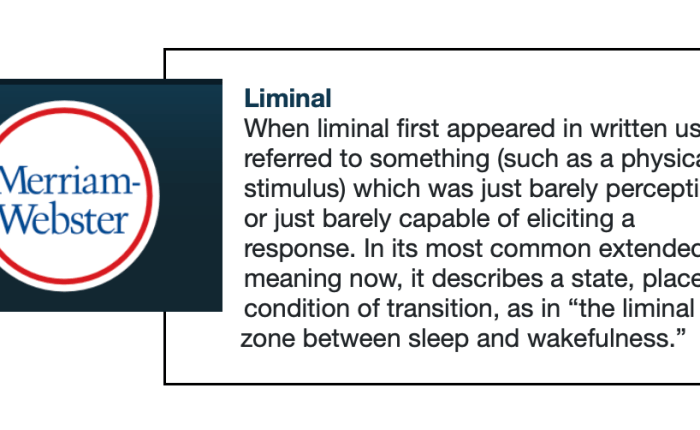
Liminal, from the Latin, “threshold” puts time and space betwixt and between. On liminal days, birthdays dangle off the edge of time. The past no longer haunts me, the future no longer calls me. I neither wait nor wonder. Indeed, birthdays are liminal days.

Anthropologists say that memory disorder, pandemic uncertainty, authoritarianism, virtual reality, border disputes, old-age anxiety, environmental issues, and gender trouble put society in a self-protective liminal state. Whew! Thank you God. This beloved gift  allows me to live on the threshold where social norms, like answering the question “why” or reading every damn email are temporarily suspended. 

In the ninth grade, when I was consumed with past and future popularity by any means, I was inconveniently tormented with one living and one dead poet: T.S. Eliot and Alfred Lord Tennyson. A lot has been written about the spiritual liminality, the non-closure of their work. It’s only now (or is it?) that I see why these vexing lines captured me:

Tennyson’s Ulysses:
Yet all experience is an arch wherethro' 
Gleams that untravell'd world whose margin fades 
For ever and forever when I move.
TS Eliot’s Four Quartets:
Time past and time future
What might have been and what has been
Point to one end, which is always present
.

Lessons Learned: God

Lessons Learned: God

First Grade—Third Grade

God is a white man with a white beard and white flowing hair, sometimes holding white stone tablets, later to be revealed as the Ten Commandments. Then He has a son, Jesus, and simultaneously is Jesus. Jesus’ mother, Mary, and God aren’t married. Then God becomes a ghost, the Holy Ghost. Then He’s all three. Three persons in one God.

All people who were ever born are sinners who can never redeem themselves. But God gives Jesus to Catholics for salvation from their sins. Only Catholics have access to Jesus. They go to heaven when they die, thanks to Jesus dying on the cross for their sins. Everyone else goes to hell.

Lesson: Everyone is bad and God only likes Catholics.

Fourth Grade—Sixth Grade

God created Adam and Eve in His likeness and placed them in Paradise, a tropical garden with no predators or stinging bugs, and all the animals, flowers, and fruit in the world. God forbade them to eat apples from the Tree of Knowledge, but they wanted to be like God, to have His knowledge, so they ate the apples. He got mad and threw them out of Paradise. They had to fend for themselves—grow their food, make their clothes, and pay attention to God.

Adam and Eve had two sons, Cain and Abel. God seemed to like Abel better. Cain got jealous and killed Abel. God punished Cain by throwing him out of his hometown into the desert.

Lesson: Avoid God.

Seventh Grade—Eighth Grade

Jews and Romans alike feared Jesus for riling up the citizenry against their oppressive power structures. The Roman king of Jerusalem sentenced Jesus to a brutal crucifixion. Even though He was a Jew, the Jews didn’t come to his defense.

When Jesus’ followers went to the tomb to see His dead body, Jesus was gone. God resurrected Jesus, body, and soul to live forever. This is what happens to Catholics. They live forever. In Paradise.

“Tiger, Tiger, Burning bright, 
In the forests of the night,
What immortal hand or eye
Could frame thy fearful symmetry.”

Lesson: I want to be a nun.

Ninth Grade

Using my leaky Esterbrook fountain pen,  I write “How can God make evil” in the margin of my English literature textbook next to William Blake’s first stanza of “The Tiger”.  

Lesson: God is confusing.

Teenage—Twenties 

I look for the heavenly in alcohol, drugs, and men. I see God. Then I don’t. 

Lesson: There is no God.

Thirties—Sixties

There is a Higher Power. Maybe God. Maybe Jesus. Maybe the Holy Spirit. Maybe Buddha. Not a Catholic. Not even a Christian.

Lesson: Keep looking.

Seventh Decade

Casting off the lifelong mantle of sinner; I’m finally hip to the knowledge no one is born bad. God does not create evil and Jesus didn’t die to save me—God doesn’t need atonement from me or Jesus. There’s no heaven. No hell. Resurrection may be so. At the end, perhaps time and space will simply let go of me and I’ll wander an endless field of puppies, aka, Paradise.

Lesson: I’m OK. 

Seeing Jesus

In 1949 the Soviet Union started the Cold War by detonating its first atomic bomb, blockading Berlin, and pushing its way into Poland and Eastern Europe. The voices I heard swirling above my head at cocktail hour in our Washington home implied the Russians were coming for us. Everyone acted like this was the worst thing that could ever happen. 

Air raid drills were concocted by the federal government through the National Civil Defense Administration to protect people from incoming A-bombs. Common folk-wisdom said only cockroaches would survive a nuclear attack. Nevertheless teachers were required to conduct impromptu air raid drills. They shouted, Drop!—a signal for us to jump out of our seats, crawl under our desks, fall over our knees and cover our heads. The nuns added the instruction to recite Hail Marys aloud while on the floor. 

Holy Mary, Mother of God, pray for us sinners, now and at the hour of our death. Amen.

At seven, I didn’t understand the difference between a drill and the real event. I went to my death every time I huddled under that desk. I feared the A-Bomb was the worst thing that could ever happen. But, I was not. afraid. to die. 

This is it, I’d pray. This is the day I’m going to see Jesus.

I believed Mother Mary would grab me in her arms like she did baby Jesus and take me to heaven. Why did we practice to avoid such ecstasy? 

By the time third grade rolled around, I got used to not dying under the desk. Images of children who lived after their exposure to the atomic bombs in Hiroshima and Nagasaki appeared on our small black and white television. I saw that there were worse things than death. 

Our Catholic school teachers taught that Communists who ruled Mother Russia prohibited the celebration of  the Mass. The clergy declared this was the worst thing that could ever happen. We prayed for Catholic Russia.

At home, my two sisters and I made our own breakfasts and school lunches because my mother’s alcohol intake rendered her unconscious in the mornings. We often gathered around her bed trying to figure out if she was alive. Holy Mary, Mother of God. One of us would place a finger under her nostrils to feel her breath until, with one exhale, she’d confirm that the worst that could’ve happen, hadn’t—and we’d be off to knock on neighbors’ doors scrounging rides to school. 

Those early almost-worst-that-could-happen memories have inoculated me against the mau-mauing of present-day alarmists, naysayers and fear-mongers who sermonize about the death of our democracy. Yeah-but’ers and tsk-tsk’ers want us to heed their cynical creed that our country is hopelessly overrun with insurrectionists, sexual predators, corrupt politicians and gun-toting scofflaws.

And what if these are apocalyptic times? So what? So were the 1950’s. I’ve been here before. 

Mother Mary may be out of commission these days, but I still dream of seeing Jesus.

Shut Down Week 3. Tagging

Shut Down Week 3. Tagging

One of the boarded up stores I walk Henry past everyday is Hermes, a Parisian couture import. You can buy a Hermes over-the-shoulder mini bag just big enough for your cell phone, keys and plastic poop bags (if you’re walking Henry) for $1,875.00. On the very first board-up day, a tagger spray-painted one of Hermes’ dark grey boards with a

IMG_1675
Shut Down Hermes Chicago

tasteful lavender scribble. The contrasting colors were delightful really, very French. And the next day, the street art was gone, painted over in Hermes signature dark grey.

Like the Buddhist arhat, Irish banshee and today’s death doula, the mythical greek Hermes is a psychopomp, or soul guide. Powered by his winged sandals and helmet, he guides the soul into death, to the other side. Crows are also psychopomps often depicted waiting in murders outside the home of the dying to herald the soul’s journey or perched inside the chamber as in Edgar Allen Poe’s “The Raven”.

Crows are sparse these days on downtown Chicago streets. There’s no discarded food to forage in the alleys behind the restaurants. Oh, sure, the restaurants are providing take-out, but all that trash goes home to another neighborhood’s compost. The heralding crow has taken her business elsewhere. No one is bothering to die a natural death here. We are all in a state of shutdown limbo. Indeed I never hear the usually frequent ambulance sirens headed to the hospital a quarter of a mile away. The covid-infected dying are taking cabs to the Emergency Room, hoping they won’t be turned away or sent to the field hospital at the McCormick Place convention center.

Hermes is known as Mercury in Roman mythology, from a Latin derivative meaning merchandise. I love the window displays but I have no reason to step across the Hermes threshold and finger the merchandise. These days I think of its namesake as a hallmark to protect the life of commerce in the city. I hope Hermes/Mercury doesn’t let the city die.

I have to grab hope wherever I can. It was Hermes’ sister Pandora who opened the box that unleashed plagues, diseases, and illnesses on the world. Our current Pandora, President Trump, has unleashed the coronavirus on us in opening wide his box of ignorance, inaction and mismanagement. The myth says Pandora closed that box before the healing spirit Hope escaped. President Trump spews false hope to us everyday with lies, inaccuracies and ego-driven platitudes. 

Hope seeps out on its own power though, just like the spray-painting tagger letting us know the street is still alive.

Speaking of God…

Speaking of God…

I’m not sure what day or year or even decade I stopped being ruled by men. Feminist pop psychology (and real shrinks) used to tell me I “allowed” men to rule my life. Of course I was roped into that, having been raised in the patriarchal Catholic Church where women are still not allowed to be priests. God was always a man and because of that men were always in charge. Recovery from those old ideas was precipitated not by strong women helping me see the light, but by some very important men acting badly.

My Amazon Dot is tuned into the impeachment vote of President Trump. He’s the worst example of male dominance I’ve ever known, but he’s an extreme case. I’ve experienced Christian cultist men telling me God wanted me to submit to a physically abusive husband; a married lover who insisted I wait by the phone on Christmas for his call; a father who dragged me into fraudulent schemes; and, bosses (Gary Hart and Bill Clinton) who got caught with women-not-their-wives. To paraphrase Nancy Pelosi, “I don’t hate them. I pray for them.”

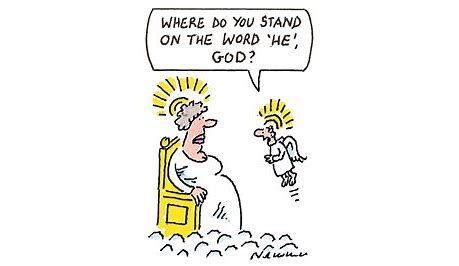
It’s true. I’ve been taught by the Twelve Steps of Alcoholics Anonymous to pray for people I don’t like (or, more likely, who don’t like me). The words I use in prayer for God’s gender are still masculine though. To be modern, I could rant publicly against male-centric words like “Lord,” or mind my manners and quietly substitute the more gender-neutral (or is it gender-inclusive?) “God.” I want to do that because these days I think of God as non-binary, neither male nor female.

I pause to see She-He-It in the yellow leaves of the honey locust fluttering down in front of me when I walk Henry-the-Dog. I hear They-Them when the crows caw. I even smell Her/Him/Them in the spring (what are those fragrant shrubs called?). These delicate manifestations of God are indeed gender-neutral.

But my senses play tug-of-war. The Bible rarely shows these versions of God. Just as I see the streets of Edinburgh when reading Ian Rankin mysteriesOIP.oB0fL0JIYA1IHyc9P5Ik4AHaEK, I see God as a man when reading the Bible. I visualize men—Jehovah, David, the king on his throne, the Father, the Lord. God the man made a covenant with David the man. David’s seed, not his eggs will rule as kings, not queens, from generation to generation. 


The subtler Biblical images of God as a mother caring for her children undergird my faith that God will always be, always live and always love. That female-male God who loves me deeper than I can visualize, who enfolds me at the still point, who sees me as perfect and lets me be. That is the God whose help I seek, whose direction I want, whose words I hear. I sing to that God.

In another world, I will know God as intersex, non-binary, genderqueer, agender, gender fluid, androgynous, bigender, multigender or demigender. In this world, I await David’s seed to change the God-man language to align with my gender neutral spirit.

The Gift: World’s Greatest Christmas Song

The Gift: World’s Greatest Christmas Song

Christina Rossetti’s “In the Bleak Midwinter” 

“In the Bleak Midwinter”, a poem by the English poet Christina Rossetti, was published under the title “A Christmas Carol” in the January 1872 issue of Scribner’s Monthly. The poem was set to music by composer Gustav Holst in 1906.

What can I give? 

Christina Rosetti gave us a personal tender poem pouring out her love for the transcendent God and later, in a rush, Gustav Holst vocalized her words with a snowy melody that perfectly acquaints us with her quiet passion. How pleased God must be with the gifts of these two artists whose 19th century lives were crippled by illness, financial despair, loneliness and depression. 

Their living legacy of lyrics and music are sprinkled delicately on the page waiting for me to sing them out from some curious reflexive viscera. As the organ introduces the tune, I nervously set my heart to sing with a childlike exuberance, “Me too! Me! Me! I want to give too.”  But what can I give? I have a terrible voice. Off-key. Tone-deaf. Dissonant. Breathless. Creaking. Croaking. Grating. I will make a mess of this magnificent carol. People will judge me. Shoot me dirty looks. Wish I’d shut it. Hope I choke. Hfullsizeoutput_48e5ate me!

He calls me to stillness. I respond in silence, close my eyes and allow Peace to rule my heart. In one second my transformed heart awakens and shakes off the grumbling in my head. I sing as loud as I can with my whole engaged core. I give God imperfect singing of this perfect song. I set my voice on an imaginary course of graceful, harmonious, angelic melody. This, I believe, is what He hears.

Oh my God, I love that my discordant heart can be stilled by Your Peace. I love that a perfect gift for You is my imperfect singing.

________________________________________

Dan Fogelberg sings In The Bleak Mid Winter HERE

Deut. T-Deut. T-Deut. Deut. Deuteronomy

Deut. T-Deut. T-Deut. Deut. Deuteronomy

Reflection on Deuteronomy?

Every couple of years my church asks me to write something for their Daily Devotions. When the request appeared in my inbox this year, it included the assignment list for the Advent writers. I sent a note to Pastor Rocky, “You get Mark and I get Deuteronomy?”

I’m not sure I have a favorite book in the Old Testament, but I am sure I have a least favorite—Deuteronomy. It has always seemed to me that this book is reserved for scholars; we lay people aren’t supposed to know its secrets.

Deuteronomy 18:15-18: The Lord your God will raise up a prophet like me from your community, from our fellow Israelites. He’s the one you must listen to. That’s exactly what you requested from the Lord your God at Horeb, on the day of the assembly, when you said, “I can’t listen to the Lord my God’s voice any more or look at this great fire any longer. I don’t want to die!” The Lord said to me: What they’ve said is right. I’ll raise up a prophet for them from among their fellow Israelites—one just like you. I’ll put my words in his mouth, and he will tell them everything I command him.

Reflection. There’s no secret in this passage. Moses tells us we are getting what we asked for, someone we can talk to, who knows what it is to love and suffer and be happy and sad. He’ll be human, a Jew and a Prophet, like Moses. And when He comes, we can trust His words because He’ll be speaking for God.

Watch out if you see a prophet coming your way. They’re not foretellers of the future. They are truthtellers of the present, who expose hidden gracelessness. Jesus is God’s Truthteller. He digs into my dry bones and pulls out the person He wants me to be. I want to be that person too. Sometimes. I often hide from the truth—fearing ridicule and silent scorn because my greatest obsession is to be normal and to fit in.

God’s Truthteller came in the form of a sassy teenager recently: “you think you’re so privileged.” she said when my wrinkled old mouth asked for her seat on the bus. God’s Truthteller told me to love her, to be a Christian, to trust Him with her words.

Prayer. Thank you God, for sending me your Truthteller, a baby I can cherish, a man I can believe, and a friend I can trust. Expose the flimflam thoughts I tell myself and give me courage to have a life of truth and grace.

advent-devotions-banner-for-website

See more Daily Devotions from Fourth Presbyterian Church Chicago here.

Christmas Stress Test 2017

I floated out of Northwestern Medicine’s Echo Lab, Stress Bay 3, onto the evening sidewalk four days before Christmas. All Chicago was scampering out of work, race-walking to the bus, flocking into Gino’s East and hurrying over to Michigan Avenue for holiday bargains.

Months earlier I’d run out of breath one block into my morning walk. My mind decided since I’d been overweight my entire adult life at seventy-one years old I probably had a deadly heart problem. The doctor ordered a stress test. Before I made the appointment I tried to heal myself with a no-salt, no-sugar, no-carb diet. The condition persisted. Then I thought God might heal me—if only I could remember to ask Him once in a while. In 110x70_what_causes_heart_palpitations_slideshowStress Bay 3, injections shot my heart rate sky high, my breathing stretched to its outer limits, then it all parachuted back down. The whole test took ten minutes. I figured if I didn’t have a heart attack after that, God had absolved me of my lifelong mashed potatoes intake.

Flying high down Superior Street toward the twinkling Magnificent Mile, I came upon a two-foot long sprig of red eucalyptus looking up from the sidewalk.

“Hmm, this would be good to put in the vase I just bought for Bill.” I scooped up the sprig and poked it down through the tissue paper in my Crate and Barrel shopping bag. Rounding the corner at Nieman Marcus I spotted more red eucalyptus sticking out of the cement urns in front of the store.

“Oh, good, I’ll just lift another bunch.”IMG_0504 (1)

And there it was. Ancestral habits. Within a block I’d turned from a scavenger to a thief.

Ripping down the street toward the Water Tower it occurred to me there may be some more items for Bill’s vase outside the stores on Rush Street. I found perfect branches of red plastic berries in the four planters on Quigley Seminary’s sidewalk. I took one from each pot. Lovely.

As I came up to Oak and Rush, I stopped myself from stealing birch branches from Barney’s pots because Oak Street Bank across the street recorded activity outside. I’ve binged on enough English crime shows on Netflix to know I didn’t want to get caught on the bank’s video.

And so within five blocks of finding out my heart is not going to kill me anytime soon, I became an all-out criminal.

The next day at coffee, I spilled the beans to a normal friend. He diminished the crime saying they throw all those decorations away after Christmas anyway—trying to let me off the hook or perhaps saving himself from admitting his friend is a thief. I shared my thievery at a 12-step meeting. We all laughed as we often do whenever someone is vulnerable enough about their character flaws to tell on themselves—no letting me off the hook in that room, where God allows for admitted imperfections.