Mow the Grass War Tactic

FeaturedMow the Grass War Tactic

God and Nature teamed up to give Chicago a few 70 degree days in March. On one of those days, Elsa hopped into the back of a Flash Cab, happy to be going anywhere in a car, even to the vet for a shot. She gave the vet a kiss, because Elsa loves attention, even if it stings. Afterwards, sunshine accompanied us on a mile walk to the park. Elsa chased a few squirrels then jumped on the bench next to me, laid down, eyes open to the sky, blinking away sleep.

I’d been softly observing the small periwinkle clumps popping out of the fallow ground here and there. Hyacinths. They were rebelliously making themselves known far away from the boundary where the rest of their family sprouted. Did you know the hyacinth root is poisonous? Yep, if Elsa digs up Hyacinths with her snout or teeth, it would precipitate an emergency vet visit. 

These Hyacinth bulblets multiply slowly over years. When you see them out there on their own, you can bet the root system is strong and ancient. It’s impossible to get rid of. They always come back in the least expected place. When the grass grows an inch or two Chicago Park District employees arrive with monstrous noisy machines that gleefully mow everything down, including errant Hyacinth cells.

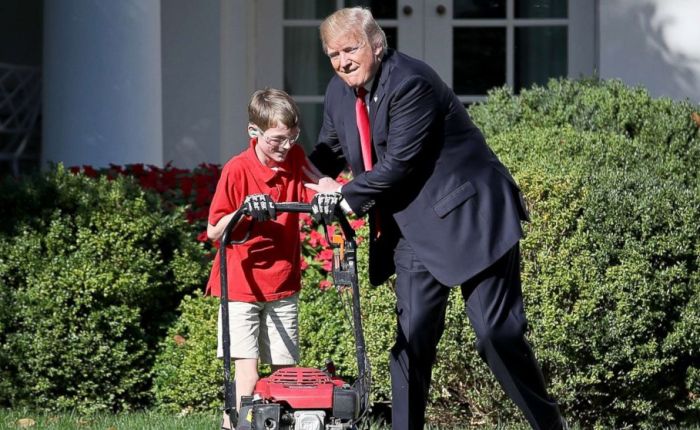
“Mowing the grass” is an Israeli war term coined in their conflict with Hamas in Gaza. These days we hear about the mow-the-grass theory with Trump’s war in Iran. It’s a violent approach meant to weaken Iran’s, or Hamas’, capabilities through intense surface bombing. Mow-the-grass implies that our beef with Iran is intractable. We can only manage it, akin to the Park District gardeners regularly chopping the heads off the relentless hyacinths. The roots are never destroyed. Iranians have unending seedbeds of henchman whose aim is to destroy Israel and terrorize the United States, just as those poisonous doggie land mines remain beneath the surface. Mowing the grass provides temporary relief. There is never, nor will there ever be, lasting freedom from danger. 

Meanwhile, the Iran war has distracted us from Israel’s mowing the grass in the West Bank. “Settler Mind” has become a buzz word describing Israeli soldiers (IDF) who kill and maim Palestinians on their own property. The Israeli Settlers have been given free reign to burn out their Palestinian neighbors. 

The US Ambassador to Israel, Mike Huckabee, avowed Christian Zionist, has stated on Israeli radio (before the explosive Tucker Carlson interview) that “biblical lands” belong to Israel. He insists on calling the West Bank “Judea and Samaria”, biblical names. Have you wondered lately why the US policy on Israel has shifted away from Trump’s Comprehensive Plan to End the Gaza Conflict? The US is sitting on the park bench softly observing Israel mow the Palestinian grass.

If the White House doesn’t remove Ambassador Huckabee soon, the Arab countries will deem the United States a non-player in any constructive role in peace in the Middle East. Their only regard for the US will be in whatever corrosive deals the individual Gulf states are cooking up with the Trump dynasty. Is that the real strategy?

At the moment, even those corrupt deals look bleak. For who can trust a small-fingered discrepant mean old would-be king?

Cold Wars

Cold Wars

The 2019 Polar Vortex slid down from the North Pole, threatening to lock Chicago into subzero stillness. I prepared for the warring cold by teeing up the entire 18-hour series of The Marvelous Mrs. Mazel. Then I threw stale bread crumbs onto my balcony to nourish the house sparrows, finches, and chickadees before they huddled together in eaves and cracked soffits to wait it out. I shuttered in and Dapped all the little crevices around the balcony door that were spritzing air into my not-so-insulated living room. That was the extent of my preparation for the coldest two days ever recorded in Chicago.

Day one brought minus 23 degrees. I woke to a thick film of silver ice covering all the windows. The ice curtain obscured the humanity moving around behind the windows across the street and any fool pedestrian walking in the feels-like-minus 40.

My binge-watching was interrupted mid-morning by a thrashing whomp, whomp whomp on the concealed balcony. I inched toward a clearing in the frosty glass.

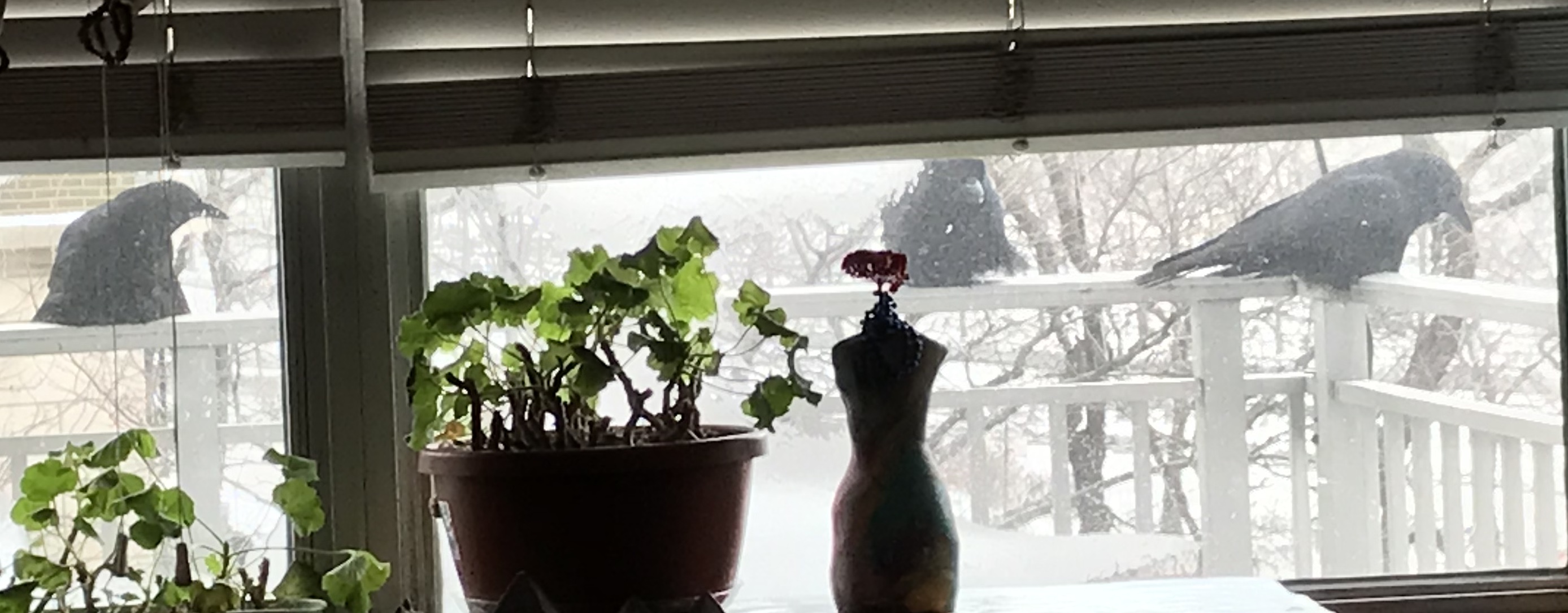
A murder of crows had come to forage.

The much-studied American Black Crow might be the most intelligent animal other than primates. They hide their food and come back for it. If a crow looks you in the eye, she will remember you, follow you down the street, and caw at you for attention like a wild pet. 

On day two, the temperature was 21 degrees below. The ice wall on my windows melted enough for a small lookout. I abandoned Mrs. Mazel and placed a chair well away from the clearing to observe the crows without startling them. They first landed in late morning. A mighty set of black wings fluttered a plumped-up body onto the balcony railing, and the rest followed—a family of five dipping to the balcony floor for leftovers. They flew off and came back. Again. And again. And again. I remained still throughout, trying to lock eyes with the birds. In the afternoon, the weather broke and allowed the dog and me to walk outside—under the watchful eyes of noisy new friends.

The first cold days of 2023 were predicted for the weekend after Thanksgiving. Though nowhere near the 2019 plunge, 30-degree temperatures heightened awareness of asylum-seeking families living on cardboard slabs outside police stations. I sought diversion through another favorite TV series, Julia.

The TV automatically tuned in CNN, though, where there was live coverage of the hostages being released from Gaza. A mysterious and curious need for every scrap of information gripped me. Who are they? What are their stories? Where are they going? I saw six women over the age of 70. One 85-year-old was helped onto a bus. I winced, feeling my own arthritic pain. Four children appeared—ages 2, 4, 5, and 9. I squinted to see if they were clutching teddy bears.

After watching for two tearful days, unrelenting shivers overcame me. And when I took the dog for a walk, that murder of crows cawed to us from the barren trees.

Joys and Sorrows of a Colonoscopy

Joys and Sorrows of a Colonoscopy

The morning after my last colonoscopy, I stood in line at Starbucks to satisfy a sudden obsession for a flat white, not my usual coffee drink. A familiar tune came through the surround sound subwoofers. My toes began tapping involuntarily until the song’s words remembered my voice from long, long ago and softly fell freely from my lips.

Thunder only happens when it’s raining

Players only love you when they’re playing.

Dreams. Stevie Nicks. I imagined myself wiggling my hips and flailing my arms—an unwise move for a not-so-sure-footed roly-poly 77-year-old.

Feldenkrais teacher Deborah Darr says, “Imagine you’re doing the movements you can’t physically do.” She taught me that imagination can so deeply engage the mind that the body feels like it’s moving when it’s not. So, on my way home from Starbucks, I imagined myself line-dancing down the street humming Dreams.

By the time I got home, I was physically exhausted. I clicked into a meeting of Alcoholics Anonymous on Zoom. I’ve been attending AA meetings for over 50 years and often ho-hum to myself, “I’ve heard this story already…nothing new,” even if I’ve never seen the speaker before in my life. On this day, I zeroed in on the story so wholly that I felt every cheap drink, every disgusting hangover, every regrettable hook-up, and every sickening word of his drunken story. When he talked about getting sober, my stomach balled up, remembering the agony of those early days of sobriety with uncontrollable sweaty shakes and tears. The love he felt from fellow sober alcoholics and for his family sticking with him filled me, too. Love and gratitude seeped into my every pore. 

The growing ball in my stomach erupted at the emotional and physical powerlessness, and I ran to the bathroom and puked. 

(AP Photo/Dor Kedmi)ASSOCIATED PRESS

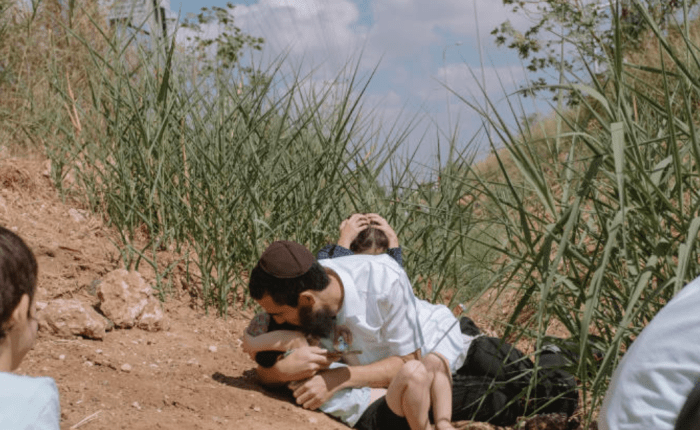
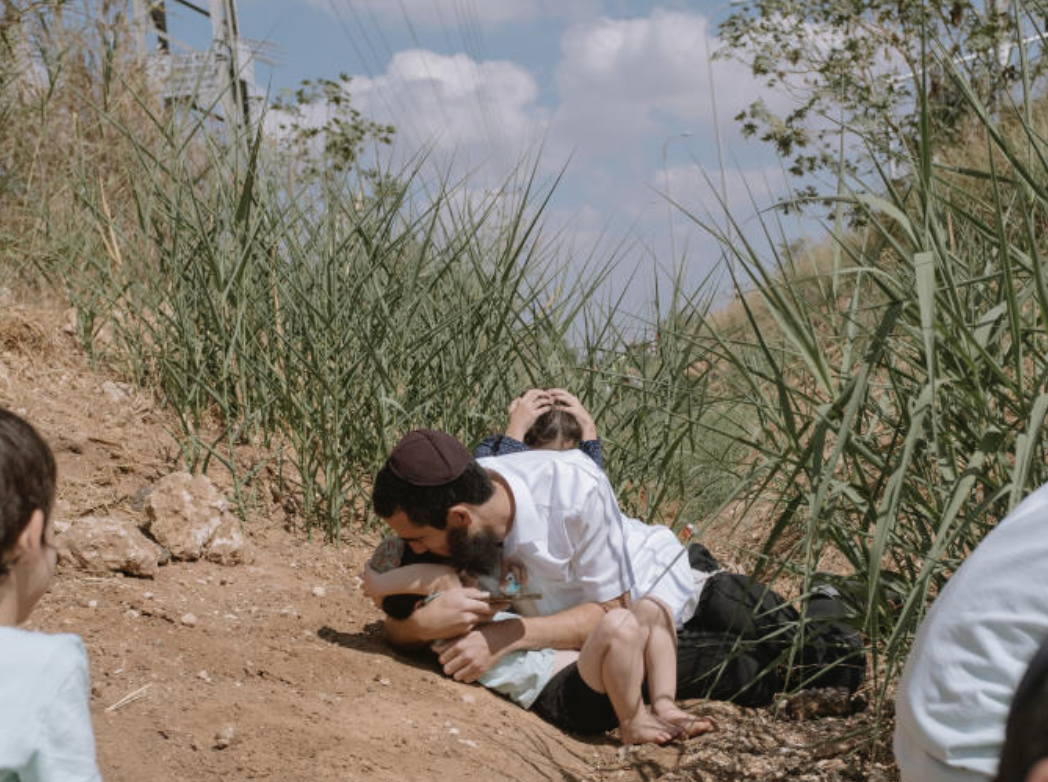
Seeking distraction, I turned on the TV. Hamas terrorists had tunneled under the Gaza-Israel border a few days before and riddled Jewish babies with bullets. News outlets had taken a few days to get the images to us. I wept watching the photos and videos, hearing children crying out for their mothers, watching helpless fathers, and reporters describing families on the move. Displaced. Terrified. Confused. Grieving.

I reached in my purse for the forgotten mound of papers handed to me as I left  the “colonoscopy suite.” Was I supposed to read them sooner? I don’t know. But I saw why I was so giddy, twirly, and happy in the morning and so emotionally flattened later. Fentanyl. The doctor shot fentanyl in my arm before snipping a bit of chitterling from my innards. Fentanyl is so powerful that I forgot biopsy results were coming my way.

The doctor sent me a note within a few days. “All clear,” he wrote.

Just one veinful of fentanyl laid down a new neuro path in my brain, allowing the deepest of joys and sorrows. Since then, if I’m tuned in, boundless joy arises from the hope of alcoholic stories—and bottomless sorrow from images of bloodied children being carried to unsafe safety.

Click: Stevie Nicks sings Dreams